


Glands Gone Wrong
There are few phrases that cause a faster full-body clench than:
“Hey… I found a lump down there.”
Before the doom-spiral begins, let’s talk about two of the more common culprits that can show up around the vaginal opening: Skene's (paraurethral) and Bartholin (greater vestibular) gland cysts. They occupy the same neighborhood, but they are very different tenants with their own quirks, habits, and solutions.
A Quick Tour of the Neighborhood: Anatomy 101
Just outside the vaginal opening is a surprisingly bustling district of ducts and glands, sort of the Beverly Hills of mucosal real estate (those are words you can't unread).
Right beside the urethral opening (usually around the 10 or 2 o’clock position) sit the Skene’s glands, sometimes called the “female prostate.” These tiny glands produce lubrication near the urethra and empty through microscopic ducts. When one of these ducts gets blocked, fluid backs up, and voilà: a paraurethral cyst (pictured below) enters the chat.
Head slightly further south and you’ll bump into the Bartholin glands, located at roughly 5 and 7 o’clock along the inner lips of the vaginal opening. These glands are mucus-secreting factories designed to provide lubrication during sexual arousal. When their duct becomes obstructed, fluid accumulates and forms a Bartholin gland cyst.
Same general zip code, very different personalities.
When Good Glands Go Rogue: How These Cysts Develop
A paraurethral cyst typically starts with a blocked Skene’s gland duct. That obstruction might follow inflammation, irritation, childbirth-related trauma, or infection. Sometimes these cysts aren’t from Skene’s glands at all, but from leftovers of embryonic development—remnants of the Gartner’s duct from the Wolffian duct system (because the human body loves keeping unnecessary souvenirs).
Most paraurethral cysts are small and painless—but if they grow, they can press on the urethra. This may lead to fun party tricks like urine dribbling after you think you’re done peeing, or discomfort during intercourse or tampon use. Infection is less common, but if it happens, the cyst can get tender and swollen.
A Bartholin gland cyst, on the other hand, tends to be a bit more dramatic. These glands sit deeper and produce thicker mucus, and when that fluid gets trapped, the cyst can grow from “hmm, that feels like a pea” to “why does it feel like I’m sitting on a golf ball?” faster than anyone would like. Most are painless at first, but friction from walking, sitting, or existing can turn awareness into annoyance.
If bacteria join the party—frequently E. coli, Staph, Strep, or sexually transmitted microbes like chlamydia or gonorrhea that cyst can upgrade into a Bartholin abscess (pictured above). This is the kind of pain that makes people waddle into urgent care ready to sign whatever papers lead to immediate drainage.
Worth noting: after age 40, a new Bartholin mass earns more clinical side-eye because (rarely) malignancy is possible. It should be evaluated rather than ignored.
Living With It or Evicting It: Treatment Approaches
Paraurethral cysts tend to be less chaotic and often don’t need much intervention. If the cyst is tiny and not causing trouble, the recommended treatment may be… nothing. Bodies do weird things, and sometimes the best approach is to shrug and monitor.
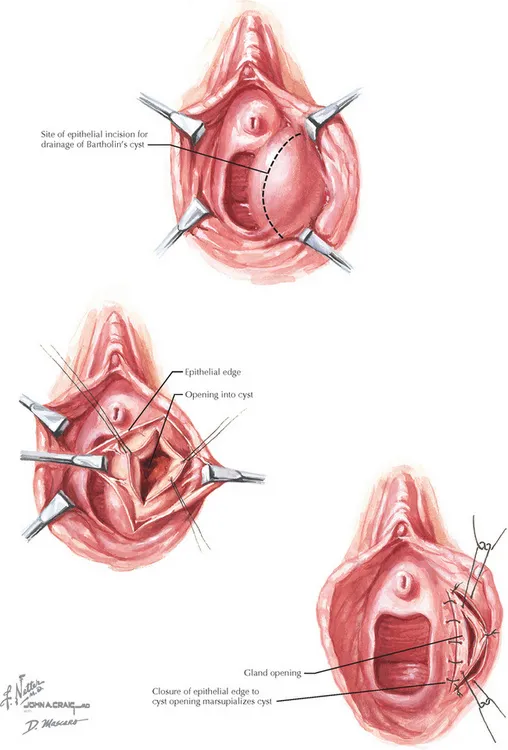
If infection is suspected, antibiotics may be prescribed. For cysts that cause persistent symptoms or distort the urethral opening, surgical options include needle aspiration (pictured abouve), which is quick but recurrence-friendly. Marsupialization (pictured below) creates a small permanent opening so the gland can drain freely. For the most extreme cases complete excision of the gland may be employed.
Bartholin gland cysts are where treatment gets more hands-on. The first-line home remedy you’ll hear over and over: sitz baths. Warm water can encourage spontaneous drainage and relieve discomfort. Essentially, a spa day for your vulva. These baths help dissolve and loosen the blockage, which can allow the cyst to drain naturally.
If an abscess forms, medical intervention becomes the main event. Incision and drainage bring rapid relief, but simply draining the cyst tends to invite future recurrences. To prevent that revolving door, clinicians often place a small balloon catheter which is left in place for 2–4 weeks to keep the duct open as it heals. Chronic or recurrent cases may be managed with marsupialization. Turn that blocked dead-end duct into an open floor plan! If all else fails, surgical removal of the gland.
If you read this far, thank you so much for being part of the Secret Classroom. I truly appreciate everyone who is here!
Comments (10)
I had a baby and then after I noticed a ball like bump down there and I had 6 week postpartum check with my doctor so I told him about it and he was like “oh that’s just a clogged duct. It’ll go away in a couple weeks.” It didn’t go away. 3 years later I was messing with it and got it to pop. So much gunk came out of it
I'm here from Facebook. Thank you so much for all your amazing informative posts about the human body. I have glands that swell up and turn into cysts, now I know what to watch for and when to go to the doc. I usually can squeeze them out myself, is that bad to do?
The problem with squeezing cysts out leaves the lining of the cyst intact in the body, and will likely fill up again. You really need to see a doctor so the whole cyst can be taken out. 🙂
I love all of your knowledgable content. You are appreciated 👍
I had a Bartholin cyst during pregnancy. It was the wrist pain of my life. Ballon didn’t help, only made it worse. It was finally drained and immediately relief. Worst pain than child birth (I was given the good meds so those probably helped).
Can I just say I love you and this space?! Seriously though, I have never seen anyone talk about Bartholin gland cysts in this kind of forum (outside of a medical website). I began struggling with chronic Bartholin gland issues my mid-teens. At first it was as you described ("hmm, that doesn't seem right.") Later it would become exactly what you described ("my god there's a golf ball in the opening of my vagina"). I have had issues with bladder/kidney/UT infections since was I was 3-ish years old. When these cysts would appear it would exacerbate the urinary issues I already struggled with because of urine backing up into my bladder. These issues (urinary/cysts) seemed to coincided and peak around menstruation. Every month there would be 3-5 days where I would have to miss school and do what is best described as "the wife is on the burlap" (see Family Guy S03E12). This remained the status quo for about 5 years (except for a short remission when I became pregnant at 17) until at 21 I sought out care from my OBGYN. Due to multiple female health issues he decided to perform a DNC, marsupialization of the Bartholin gland, colposcopy, and hysteroscopy. He also was in practice with a urologist who he brought in to consult and together they performed a cystoscopy. They found I had deep infiltrating endometriosis that had spread to my bladder and bowels, removing everything they could. They also found my urethra was anatomically 7x smaller than average, I had large amounts of scar tissue along my urinary tract (which the urologist removed as best he could) and I was ultimately diagnosed with interstitial cystitis (made worse by urine backing up into my bladder for a prolonged period of time). Eventually my OBGYN would go in and surgically remove the Bartholin gland as sexual intercourse and tampon use had become impossible. I would go on to have a radical hysterectomy with bilateral salpingo-oophorectom at 27. Doing so radically improved my IC symptoms and I rarely have issues these days. However, other problems have developed. I also cannot take any form of hormone replacement because my IC comes back with a vengeance. I anticipate issues arising from this as I age. All of that to say, I have never been able to share with anyone, outside of very close family (my mother, husband, and one aunt), this long road of chronic pain that left me with severe depression and suicidal thoughts and greatly impacted my marriage, my ability to mother my children, my life goals, and my overall quality of life. So thank you for talking about this issues and creating a space where I could put my experience out into the world.
Oh bless you for that awfully difficult rollercoaster ride you’ve had, health-wise! I am glad you got some help even though it obviously has not been a cure-all effect by any stretch of the imagination. I just hope you manage to keep going because despite not knowing anything about you, you are obviously a caring person. I hope your health is stable and allows your mental health to be better than it has been and thank you for sharing your story 🥰
Well that made for great reading first thing this morning
Been there... I will say, local anesthetic in that area might be my new pain tolerance level. Holy fuck that was awful. I've read many women choose to be cut open without numbing because it's less terrible.
Very educational but also totally new nightmare fuel, thanks 😅