



Was the Chainsaw Invented for Childbirth?
The Internet’s Favorite Misunderstood Origin Story
If you’ve spent any time online, you’ve probably seen the claim that “the chainsaw was invented for childbirth.” It’s usually paired with a grim photo and a caption like, “Medicine was wild back then.”
It’s true that childbirth has produced some of the most extreme and desperate procedures in medical history, but is is not because doctors were sadists. It was because they were terrified of losing their patients.
Sadly, I have regurgitated this "fact" in the past. Something I'm not proud of. On the upside, I did eventually question the idea. I dug up the real story. And now I have recruited you to help me correct the timeline.
Childbirth Was (and Still Is) Dangerous
Before modern medicine, childbirth was a gamble. Even with the best midwives and doctors, a baby’s position, size, or the shape of the mother’s pelvis could turn a normal delivery into a life-or-death crisis in minutes.
Conditions like shoulder dystocia (when the baby’s shoulders get stuck behind the pubic bone) could cause the baby to become trapped in the birth canal (pictured below). This emergency situation is precarious for both parties. Without quick intervention, the baby can suffocate or be crushed against the pelvis by the powerful uterine contractions. On the maternal side, all of this can lead to death via hemorrhage (blood loss) or from infection weeks later.
In the 18th and 19th centuries, doctors had limited tools and even fewer options. There were no antibiotics, no blood transfusions, no reliable anesthesia, and C-sections were almost always fatal. So when faced with a hopelessly obstructed labor, they reached for anything that might save one or both lives.
Even if it meant dismantling part of the pelvis.
That’s the grim truth: it wasn't cruelty, it was desperation.
And from that desperation came the invention of one of the most infamous tools in medical lore.
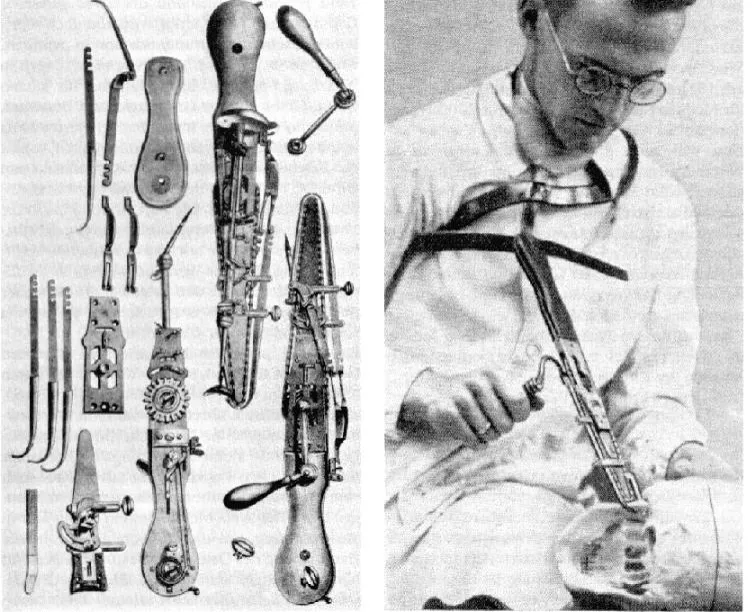
The Birth of the Osteotome (pictured above)
The tool at the center of this myth wasn’t born in a maternity ward. It was born in an operating theater, in a time when surgery was equal parts innovation and improvisation.
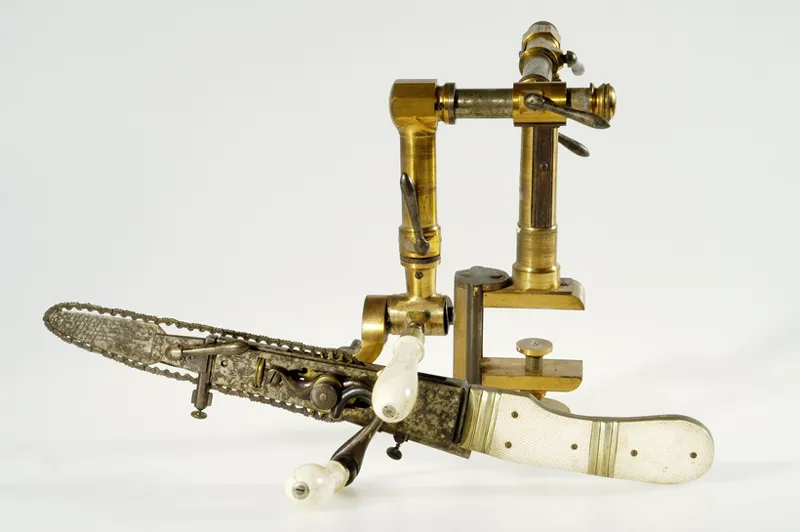
In 1830, German orthopedist Bernhard Heine developed the osteotome (Greek for “bone cutter”), a hand-cranked chain saw designed for orthopedic surgery. Picture a handheld eggbeater with a toothed chain running around its frame. It featured, a precise, clockwork mechanism meant to slice through bone cleanly, not splinter it like a surgical saw (pictured below).
Heine’s invention was revolutionary. It allowed surgeons to perform cleaner, faster, and more controlled bone cuts. This was a major step forward in an era when every extra minute of surgery meant more pain, blood loss, shock, and infection risk.
It’s fair to say this device made patients’ survival more likely and surgeons’ lives easier.
Why It Was a Step Forward
To appreciate Heine’s contribution, you have to understand what came before.
Surgeons used:
Straight saws that splintered bone and shredded tissue
Chisels and mallets that required brute force (and a strong stomach)
Wire saws, which were slow and prone to snapping
The hand-cranked chain mechanism changed the game. It was:
Faster — continuous motion meant less back-and-forth labor
More controlled — smoother cuts and fewer jagged edges
Compact — freeing one hand for stabilization instead of needing an assistant
In the pre-electric era, this was literally a cutting-edge technology!
From Bone to Baby: How the Myth Was Born
So how did this orthopedic marvel get entangled with childbirth?
The culprit is the symphysiotomy (pictured below), a desperate procedure used in obstructed labor before C-sections were survivable. In it, surgeons would cut through the cartilage (and sometimes bone) of the pubic symphysis to widen the pelvis and make room for the baby to pass.
On rare occasions, tools like the osteotome were adapted for this procedure. That single overlap, bone-cutting device meets pelvic bone, birthed a rumor that would outlive its truth.
The truth is that the osteotome was invented for orthopedic surgery, not childbirth. It simply got roped into one of the most traumatic emergencies imaginable because no one had anything better.
It’s the 19th-century equivalent of using a kitchen knife as a surgical scalpel because that’s all you had.
The Evolution into the Modern Chainsaw
Once the chain-and-tooth mechanism proved its worth in medicine, engineers outside the operating room took notice. By the late 19th century, inventors adapted the idea for cutting wood — a problem that required the same principles, just on a much larger scale.
Timeline:
1830s: Heine’s surgical osteotome
1890s: Industrial adaptations for lumber
1920s–1930s: Fully motorized chainsaws designed for forestry work
So yes, the chainsaw’s great-great-grandfather worked in surgery. But he was an orthopedic specialist, not an obstetrician.
Science Sidebar: The Hand-Crank Advantage
The hand-cranked osteotome deserves its due as a mechanical milestone.
In an era before electric motors, its gearing system allowed continuous motion with minimal slippage — a massive leap in precision surgery.
Benefits of the design:
Surgeons could operate solo, no assistant needed
Cuts were smoother and more predictable
The design foreshadowed both surgical drills and industrial saws
It wasn’t cruel. It was clever. Our modern eyes offer a privileged viewpoint that lacks context.
Now that you know the whole story, I hope you will feel emboldened to challenge this misinformation when you see it out in the wild. In fact, I'm counting on you to do that. If you need a little assistance you can tag me and I will answer your call. Like Batman, but for anatomy misinformation.
Comments (5)
Just asking cause I can't find it anywhere. Do you have any information on children born with disorders of sexual development such as true hermaphrodistism or any of the 5 conditions that go with it? Thanks love your info. Takes me back to nursing.
How did the bone cuts heal? Were they repaired by the surgeons, or just left to repair themselves? I only ask because I would have needed this 'treatment' myself 😱
So if Heins osteotome was invented in the 1830’s (is there a more precise date/year?) for orthopedic surgeries, when was its first use for the symphysiotomy?
I love going to museums and learning about 1800 medical devices and medications. I wonder what people will be laughing about our technology in 200 years?
They'll be able to teleport babies out by then!! 😃