
Vasa Previa (🚨Anatomical Images Ahead🚨)
Lifeline Gone Wrong
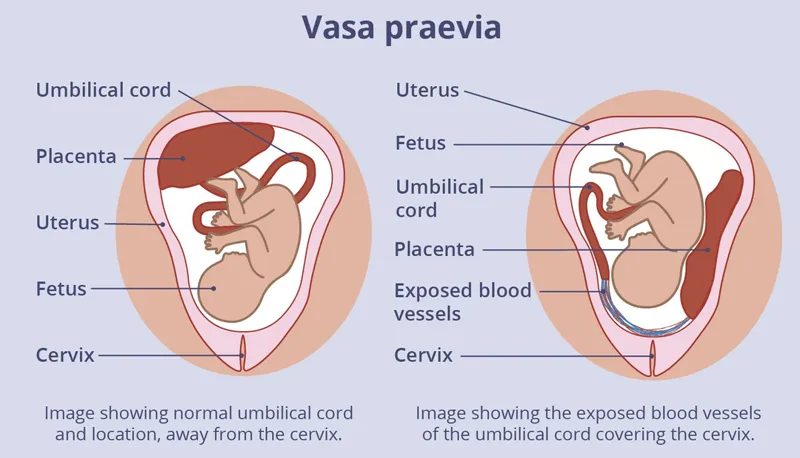
Normally the umbilical cord is a smooth connection that runs from the baby's belly to the placenta. But here, instead of running safely into the middle of the placenta, some of the cords blood vessels are stretched out, exposed, and running across the opening of the cervix like a tripwire. This deadly malfunction is called vasa previa.
The problem? Those vessels are unprotected by the cord’s tough, jelly-like insulation (it's actually called Wharton’s jelly, not good on sandwiches). They're basically naked blood vessels, and they sit right right over the doorway out of the uterus (cervix).
Pictured: Vasa Previa Vessel on display after a C-Section
What Causes It?
Vasa previa usually happens because of unusual placements of the placenta or cord:
Velamentous cord insertion – The umbilical cord attaches to the fetal membranes rather than the placenta directly, so vessels have to stretch across unprotected before reaching the placenta.
Succenturiate or bilobed placenta – The placenta grows in separate “islands” connected by vulnerable vessels that can cross the cervix.
Low-lying placenta / placenta previa in early pregnancy – As the uterus grows, the placenta may “move” upward, but in some cases, the connecting vessels remain over the cervix.
Multiple pregnancies (twins, triplets) – More placental complexity = higher odds of funky cord insertions.
Why It’s Dangerous
Those vessels belong to the baby, not the mother . This means they're carrying the baby’s blood supply. If they tear (usually when the membranes rupture during labor), the baby can lose life-sustaining blood in minutes. We’re talking catastrophic blood loss
Modern Outcomes
Thanks to routine prenatal ultrasounds, vasa previa is often caught before labor.
If diagnosed early: Delivery is usually planned by C-section around 34–36 weeks, before labor begins.
Survival rates: Over 95% if caught before delivery.
If undetected: The prognosis drops sharply. Rupture can lead to fetal death in a matter of minutes.
Before Modern Medicine
Before ultrasounds, vasa previa was almost always a tragedy. It wasn’t even something midwives or doctors could predict; there were no warning signs until labor began and the membranes broke.
Here’s how it likely played out:
Labor would progress normally… until suddenly there would be immense vaginal bleeding which would rapidly progress to fetal distress and/or demise.
The mother might survive, because the bleeding is isolated to the placenta, but hemorrhaging is never a good thing.
Historical medical texts describe it as “the sudden death of the infant in labor,” and it was often blamed on “placental rupture” or “cord accidents” without knowing the true cause.
Until the 20th century, vasa previa was essentially a death sentence for the baby in almost every case. The only rare exceptions were if labor was so fast the baby was delivered before major vessel rupture, or if the cord insertion anomaly didn’t fully cross the cervix.
Evolution Sidebar: Who Designed This Thing?
From an engineering standpoint, vasa previa is like running a power cable across the middle of a busy hallway and hoping no one trips over it. Evolution usually does a great job of keeping baby’s blood vessels tucked away inside the umbilical cord, shielded by a thick jelly coating and anchored safely into the placenta. But sometimes… the blueprint gets funky.
Why?
The placenta isn’t designed, it’s grown on the fly. It forms where the fertilized egg decides to implant, and if that spot’s awkward, the placenta improvises.
Sometimes the cord attaches at the edge instead of the middle (velamentous insertion), and those vessels have to stretch like exposed extension cords to reach the main placenta.
Add in a second “bonus” placenta lobe or some twin drama, and you’ve basically set up an anatomical booby trap.
From a survival perspective, vasa previa doesn’t make a lot of sense, which is why it’s rare (roughly 1 in 2,500 pregnancies). But when it happens, it’s a harsh reminder that evolution isn’t about perfection. It’s about “good enough to usually work.” Unfortunately, "usually" doesn’t help the unlucky few in this instance.
Comments (7)
My third has undiagnosed vasa previa, I had spontaneous labor start around 41 weeks with membranes rupturing during a non-stress test. Ended up with a cesarean after a lengthy labor that was called due to it being a VBA2C, uneven effacing, and a couple weird tracings. Upon delivery they discovered a uterine window (which was what was causing the uneven effacement) as well as velamentous insertion and vasa previa. My OB said she didn’t sleep for two days because of all that should have gone wrong that didn’t. My kid just turned 14 ❤️
Currently 28 weeks prego and waiting to find out if my placenta previa has moved out of the way or not (next scan is at 33 weeks). Add in additional risks with anemia and gestational diabetes that i was just diagnosed with and it's been a "fun" pregnancy 🙄 I've been appreciating your videos on pregnancy lately.
I had velamentous insertion and a bi-lobed placenta with my son. It wasn't caught on my ultrasounds or prenatal care visits. I had a home birth with a certified nurse midwife, and she showed me my placenta and where my son's cord entered. It attached between the two lobes and the attachment looked just like the stretched out membrane in the picture above. Fortunately, my placenta was in the correct location and not near the cervix. My midwife asked me if she could keep my placenta for educational training purposes since she oversees new CNM interns , and I consented. She had never seen that in real life before. I could tell by her body language and the look in her eyes that she was both fascinated and relieved--like she dodged a bullet. She tried to play it off like it wasn't as big of a deal as it was, but I could tell she was holding back. Not gonna lie, that was pretty freaky, and I think my dad and grandmother were watching over me.
Thank you for the information! I am a labor nurse who also moonlights as a nursing school clinical instructor. Your videos explain everything so well!! Thank you!
If you got here early, you got to watch me rework that first paragraph in real time. You were not jumping timelines. The text and images really were changing. Video coming to the socials in a bit.
I am endlessly amazed at the glitches medical professionals successfully work around, and how many seemingly impossible conditions are highly survivable. (And on the flip side, how many seemingly small things can end a person. We are so fragile, and so resilient.).
My daughter had had a normal pregnancy. She then went for a routine ultrasound at 20 weeks and there was no fetal heartbeat. As difficult as it was, I accept that sometimes things go wrong and we don’t know why. I am happy that there are increasing numbers of pregnancy complications for which we currently have treatments that result in happier outcomes.