


So Many Floors
Kyle here, just a quick update on structural model progress.
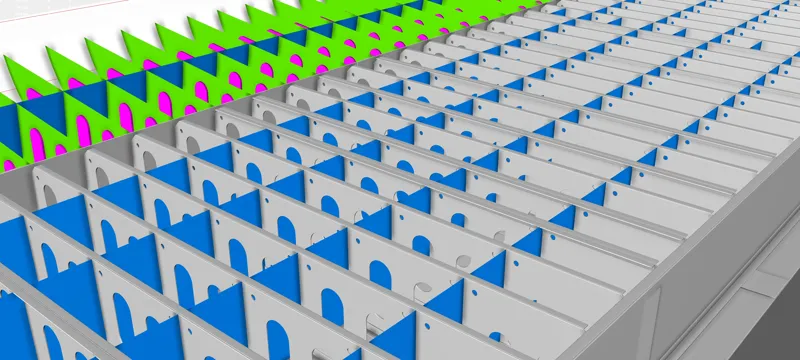
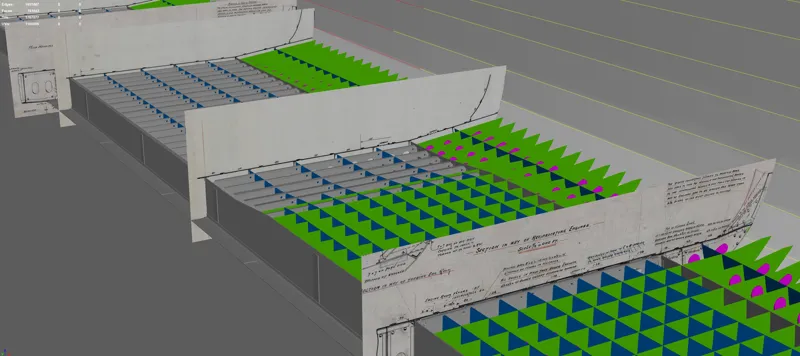
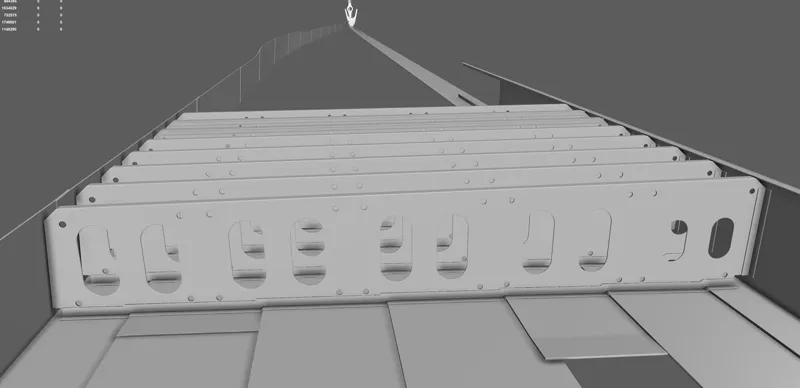
I more or less finished blocking out the lightening holes and some other aspects of the double bottom, so it was time to start working on the actual models for the tank floors. For those still out of the loop, the "floors" are the vertical frames/plates running side-to-side out from the center vertical keel, like ribs making up the bottom. The lightening and limber holes in them remove some weight while allowing water to flow inside the ballast tanks.
While they're pretty much uniform through part of the middle of the ship, the tank floors start getting unique the further fore and aft you go, due to the curvature of the hull mainly, as well as the changing patterns of intercostals (those are blue in these images). This means every floor is unique and needs various tweaks in their meshes as they're placed. It's going to be a rather long process yet, so we'll see how that goes. For the moment I'm only working on the floors for the inner tanks, with the dividing plates between the inner and wing tanks now done.
Once the tank floors are in place, I can start placing intercostals and other parts. Then comes the next challenge: Making more of the plating around the turn of the bilge (the curved corners along the bottom-sides of the ship where the hull goes from horizontal to vertical, along which the bilge keels are placed), and then making the wing tank brackets. It will not be fun.
Updates will probably be a little slower as I work through this area as there really won't be much to show aside from floors, floors, more floors, even more floors, wing tanks floors, more wing tank floors, and more floors. And intercostals. Many intercostals. Once the bottom of the ship is out of the way, things will get exciting.
Comments (10)
Definitely not “fun”, but certainly well worth the effort. Awesome work!
Wow! What a maze this is… Just bowing to the work you have done Kyle
So were those holes for people to walk through?
No, they are 16-18 inches wide.
Great work Kyle!, exciting to see the final result!
What about modeling scripts? Maya has Mel and Python to help automate modeling if the differences are of a uniform nature. I.E. there's a mathematical equation whereby the computer do much of the work for you. (if it's predictable.)
I wonder how they sealed the plate joints together to avoid leakage? Or were the rivited joints so tight that they were watertight? Also it seems like the areas used for ballast and fresh water storage would quickly rust out. Probably didn't have very effective rust proofing paint back then.
Very interesting. Can't wait to see the frames and decks go up!
Just finished raising my pledge and voilà here's one another amazing update. This project is as fascinating as the original ship. Please make double bottom explorable in the Alpha. Keep up the good work guys...
Wow! Keep up the great work!!