
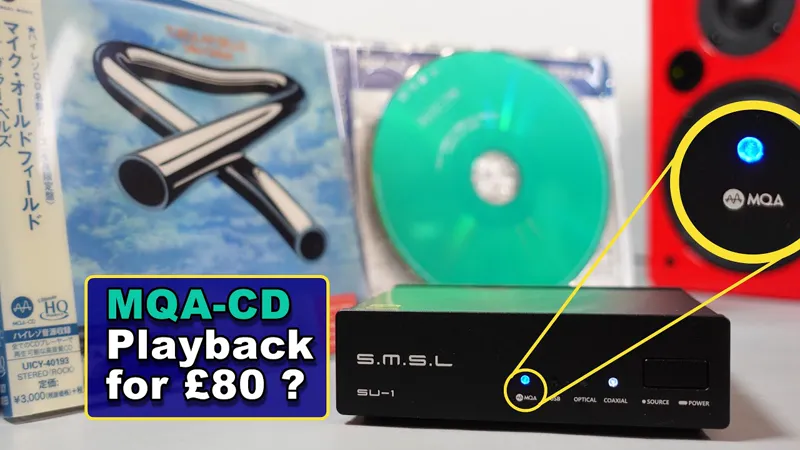
MQA-CD - Affordable playback, but it's too late.
After spotting a £80 MQA-CD decoder I thought I’d have to give this Hi-res audio format one more spin. I managed to locate some of the discs I’d bought to make a relatively popular, yet unsatisfactory video about this format in 2018 and tried it out again.
The original video proved to be rather frustrating as it generated enough confused venom-filled audiophile diatribes to fill a good size septic tank. I suspect though by this point nobody, not even them, will care a jot about MQA as it’s a company and format that appears destined to become another minor footnote in audio history.
MQA-CD releases dried up with impeccable timing - just as affordable decoder hardware appeared on the market.
This video is a bit late as there’s been a winter illness affecting the household since the day the last Patreon video was posted on here. This is why my voice sounds off in the video. But I hope you’re all doing well, take care.
Comments (45)
I also wanted to point out that I have a bit of a conflict of interest with schemes like MQA. This is because I've worked for years developing a proprietary process (Spectrelayer) to improve audio - but my philosophy is quite different from the MQA/"Audiophile" crowd. You see, the claim you will constantly heard made is how the "magic" process allows you to hear the MUSIC RELEASED BY THE STUDIO in unparalleled clarity. Very early on, I realized that the PROBLEMS with the audio were baked into the studio releases. I explain it this way on the main website: "You might think that I would sing the marketing-song of sonic purity & fidelity to the original recording in order to market Spectrelayer. After all – isn’t that what all of those other companies say about their processes? Well, there is a certain logic to that marketing approach. However, Spectrelayer’s claim is that it makes a better sounding audio file than the original release. The “rumor” is true: Spectrelayer alters the sound (so much that the waveform is visibly different when examined in a DAW)! That may seem like the ultimate sonic heresy at the altar of the self-proclaimed “audiophile”. BUT, the gigantic fallacy that almost everyone falls prey to is the presumption that the studio engineers chose all of the optimum settings as they recorded, mixed & mastered the sound in the first place! If you think audio engineers have halos & always choose the best possible mix parameters out of the ocean of permutations – then I can’t out- dogma you -nor will I try. Spectrelayer uses machine hearing to make innumerable continuous adjustments during post-mastering & Spectrelayer’d audio sounds DIFFERENT – BETTER than the version the record label had originally slated for release. And, most listeners agree that Spectrelayer sounds remarkably better than the original source or pre-Spectrelayer’d version. But if you analyze the waveforms Spectrelayer creates, – the so called “purists” may cry “foul”! Vastly different EQ curves! Different dynamics! A relocated noise-floor (sometimes higher depending on the source quality); -And a complete disregard for the -1dB ceiling so many services advocate! But, let me ask: “Where were the purists while the loudness war was destroying the music in the 1st place?”, eh? Perhaps they were too enamored admiring the shine of some engineer’s halos – to notice what their ringing ears were telling them at the end of the mix? The purists will likely tell you that Spectrelayer introduces types of tonal coloration & even distortion (gasp). And (being brutally honest), by showing you charts, graphs & numbers – they’ll be able to technically PROVE IT (but, not with listening comparisons)! And HERE’s the critical distinction: WHY does Spectrelayer sound so much better to most ears – even when certain statistics & technical measurements may accuse the methodology of the process? It’s because Spectrelayer’s benefits far outweigh any detractions – by magnitudes (Yin vs. Yang). I once considered myself a “purist” – ever watching the noise-floor & signal THD levels, IM distortion & never ever let the digital peak level hit the 0dB marker (Oh! The humanity!); -& don’t gasp too loudly, but I think I derided the artifacts of a noise-gate opening on several occasions! But, then I heard what certain machine’s speculate humans prefer to hear based on how the human brain perceives audio, -& those intelligent algorithms nailed it! And, as a sonic purist; – That’s humbling. You see, there are now (2) very different approaches to making great sound. The conventional involves ultra-tight control of every aspect of the recorded signal. It’s very “left-brained” & mathematically solid. It has an elegant beauty that appeals to the perfectionist part of every audio engineer. And that philosophy has made fantastic recordings possible and is absolutely necessary because the better it is executed – the better the next approach works. See, there is an emerging body of tech (which builds upon the former) – intelligent algorithms that work with multiple parameters at once while treating the signal with a “brute-force machine-philosophy” concluding that “the end justifies the means”. These networks don’t understand nor even care about the sanctity of test signals if the style-template & processing schema suggests that such needs to be adjusted to “sound better”! This drives conventional engineers to nail-biting. Trying to follow the logic of a network that can control countless parameters as sonic processing nodes spring into and out of existence dynamically – is like trying to track a scurry of squirrels. “Orthodoxy was violated…”, observes some purist. “Yes, -but did you hear that fantastic output compared with the input?”, replies someone with ears (Because, if it sounds better, – it sounds … better)! Often, some critical comment about “Spectrelayer’s sound” is simply addressed by adjusting the playback EQ slightly – usually as easy as adjusting the bass or treble bands a bit. So, remember this: “The pursuit of the perfect is the enemy of the good.” – General George Patton. And I think the quote from a decorated war general is apt here. Because, despite the casualty of an occasional “purist’s audiophile religion”, – Spectrelayer, has not only won the loudness war – but has allowed some of its casualties to be brought back from the dead using its AI! Furthermore – & more importantly: Spectrelayer makes most recordings sound better – even if they were not casualties of the loudness war! And you don’t need to take my word for it! Hear it for yourself! And like any technology, -Spectrelayer is constantly improving which means that a shortfall today may be addressed tomorrow. If you’re an engineer who has suggestions – PLEASE send a message: Hear for yourself on the Spectrelayer YouTube Demo site: https://youtu.be/mLhbOygKkOM
I was actually enthusiastic when I 1st heard about MQA. And then I heard MQA. At this point in time, it's pretty obvious that MQA was a new term for "The Emperor's New Clothes". It's been DEBUNKED & quite brilliantly I might add: https://youtu.be/pRjsu9-Vznc
Yes, I'm a bit late. But thanks Mat for doing this! My DAC is from the middle ages (so is my CD player) and it really doesn't do MQA. I WAS curious though! But the Tidal subscription with hi-res is almost double the price, so no thanks. Now I don't have to try any more! I was a bit sceptical about it in the first place. Lossy hi-res? Hmm.. I DO want to try to get a nice SACD player some day though. Oh, the better masters also tend to be made for vinyl, so vinyl isn't necessarily better than digital, but the master is. Nice tip though. Never really thought about it that way...
Out of all the audio formats there have ever been, assuming they all were equally successful, which would have been/was your favourite?
There are too many variables to make a decision - but *if* Elcaset had been as successful as regular cassette, it would be near or at the top of the list. It would probably just be for the home though - imagine an Elcaset Walkman. Then again I also like DBX LP and of course MD for portability.
Really glad you went back and took another look at MQA. The reasons for my interest are basically the same, and it's good to have a record of what it was at the close of the format's life. Agree with the others - I can't hear the difference between CD, SACD, FLAC... never tried MQA but I doubt it'd be any different. To be honest everything above 192 kbps MP3 has always sounded great to me, V0 was my go to back in the day of being at all involved in what quality the digital music I 'acquired' was. My Dad claims to but he's incredibly deaf so I've always just filed his claims under 'audiophile nonsense'. Texture of 'normal quality' stuff is the thing, for me. Enjoying the difference in sound between a well made cassette, a metal recording, a vinyl record, an aged vinyl record, a minidisc etc... that's the real joy I find.
When my ears were younger I was at the hifi store and listening to an SACD player. Even back then I couldn't tell the difference between SACD and CD. I'm sure there are people with better ears who can pickup the difference and of course there are good reasons for hi-res in the studio, but CD has always been good enough for most people. All the fuss over hi-res and master-quality is a load of codswallop if you ask me. Neil Young certainly can't hear the difference at his age anyway!
Thinking about these tricks to squeeze "high quality" audio onto normal CDs instead of just sticking compressed files into data tracks, I wondered how many CD players there are that can play burned CDRs with media files. That's almost an unofficial media format in its own right. Not that the market would be there to support commercial releases, but maybe something for self-publishing artists.
Good plug for Parlogram - highly enjoyable channel!
I always get very skeptical if they put something on an existing format that is supposed to be still completely compatible but should have "extra information" in it to create "better quality"... Yes, you can put extra information in a compatible signal — the best example would be the colour information in a black and white analog TV signal — but get a "better quality"? Colour TV puts some (weakly) visible artefacts in the B/W signal, Dolby Stereo "hides" extra channels in the stereo signal, but at a quality cost. As for Hi-Res per se: of course, that's just psychological, the human ear can't hear the difference! But those formats still have their purpose: for editing, it is much better to have the extra resolution, slowing down yields the extra high end, amplifying quiet sounds goes better if you have more bits per sample available. I think the statement that they put more effort in getting the best quality and the best master might be the main point.
Nice one Mat. How about a sort of compilation of "The History of Hi-Res Audio Systems", you've covered them so you've got most of the work done, just do some VO's to explain then vs now and it would make a good video for the channel. ???
Judging by the level of knowledge of this topic exhibited in some of these comments - it appears that I may by one of the least qualified people here to talk about this. I suppose it also depends where you draw the line on Hi-res - in the home, reel to reel was providing ‘Hi-res’ in the 1950s.
Great video Mat, just a couple of observations. First, for some reason for me at least, the sound of this video is a little bit sibilant and sharp. Didn't detract for me, but someone might notice it. Secondly, your point about the 'latest is the greatest' regarding CD's needs to discuss brick walling in more detail, as often newer mastering/mixing has been done to be prominent for streaming services and not for those that want a higher quality sound. I have found older CD's from the 80's sound better than a new 'Deluxe' or 'Remaster' due to the horrible brick walling. A well recorded, mixed and mastered album sounds pretty fantastic in 16/44.1Khz CD quality and SACD/MQA CD and other so called higher quality are likely a bit snake oil. A badly recorded, mixed and mastered album will sound ever more terrible in higher bit rates.
Hi-res to me indicates that someone believes they made an effort to produce good sound quality - whether they were successful in that endeavour is another thing.
An interesting concept, but I have my doubts I'd hear the difference either. In any case, there's nothing enticing me to this format since none of the music I listen to has been released in MQA, and likely never will be.
A testament also to the absolutely incredible tech that is CDs... They were so good in 1981 that they can still hold their head high in 2024. A mindboggling leap...
Curious how the CD player/recorder only sent the MQA out on one of the decks. I wonder what it could be doing to lose it. Which also triggered the question - was your original review seeing the MQA datastream at all or was it using a deck that didn't pass it through? But I think that is answered by your home HI-Fi stack passing it through fine.
The Superscope player can alter the pitch and tempo of the music from the CD, so it must be applying DSP (Digital Signal Processing) which alters the digital data and thus renders the MQA encoding un-decodable.
Fascinating and superbly presented as always, Mat. I especially liked hearing the intro to the Band's 'Tears of Rage' - hope you don't get a content match on that! I noticed when you were browsing the available MQA CDs, there was one from Chesky Records. I have a couple of their recordings (on vinyl) and they are the best recorded records I have ever heard. I am no audiophile, but they really stand out to my ears. The vinyl copies are nearly impossible to find now, but you can get them on streaming, so if you look for their 'binaural' recordings which are made with microphones fitted inside a model human head, they are really worth a listen. Melissa Menago 'Little Crimes' and Amber Rubarth 'Sessions from the 17th Ward' are the ones I have and particularly recommend. The Chesky web page is worth a browse. Have a great weekend ahead, Mat.
After seeing the whole debacle with MQA, Tidal and GoldenSound video, I pretty much see the "improvements" of MQA on the same light as Sony saying SHM-CDs made the bits pressed into it sound better.
For anyone still on the camp of "more bits, more samples, more better", this article from Xiph.org founder Monty Montgomery (who created Vorbis and Opus and Xiph also is responsible for FLAC, so he knows what he's taking about) pretty much sets the record straight: https://people.xiph.org/~xiphmont/demo/neil-young.html There's also this excellent video on common misconceptions of digital recordings: https://youtu.be/cIQ9IXSUzuM?si=1tipWJX6cTNHlJR0
Tin hat time for MQA and ready yourself for the audiophile comment section. The MQA company was finally (thankfully?) wound up November 2023 so this really is the last gasp. You make good points about the recording being as important as the format/ codec. Hope you’re feeling better; there’s a lot of it about.
Yeah a couple years ago I had stumbled on the GoldenSound video that it seems you watched according to a screenshot in the video and went looking for your video to find it gone. Did end up scrolling through some of the community posts to see a small mention that it was gone. It's still interesting your perspective on it just being a physical format and ephemeral too. I strongly disagree with the idea that people wouldn't be able to understand the price changing over time because they'd all complain about the Techmoan effect when looking up stuff and as you had described it before - it's the same listings that are always there at the high prices that never move :P But yeah. Interesting follow up to something that I thought was gone forever.
Mat, when you said this could be the last new physical format my imagination sort of took flight. Could there not be a new advancements in mastering, etching, pressing etc? My thought is that since vinyl is the result for a mechanical process there are areas for improvement that are unique to the medium. Maybe a new formulation of the vinyl substrate...perhaps in combination with a novel stylus. Advances in material science suggest that such innovations are possible and even likely. Expensive and niche? Possibly, but I suspect that if Neil Young can throw all kind of silly cash at a digital service like Pono, a vinylphile like Jack White might be inclined to sink loads of his dough on a tri-helical mastering technology for analog multichannel playback (three grooves... a "Hydra"-needle with three heads to play all three grooves). Now, that's just me messing around with sci-fi. I have to think that a wealthy tech-head with access to loads of recreational drugs and the ear of Jack White can come up with something even less sensible!
Laser-engraved "HD Vinyl" has been vaporware since 2018. And now if I try to go their web site, my browser blocks it as a security threat! I'd say that's even more of a hopeless future than MQA slowly grinding to a halt.
I guess that a properly decoded MQA audio stream is supposed to sound somehow "better" than a 16 bit PCM recording at 44.1 kHz, considering this is passed off as high resolution audio. Not sure what your PCM recorder is capable off, but was your re-recording done with higher specs than what the Red Book offers? Not that I think it would make much of a difference... Since the external DAC is designed to work with standard CD players, the extra information needs to be modulated onto the actual audio signal (as opposed to utilizing subchannels), thereby degrading the quality. The decoder must then both compensate the information loss and supplement those ominous extra "high resolution" bits. I'm sceptical, not to say this sounds a bit like a scam. One approach of a fair comparison could be to digitally extract the MQA-encoded audio stream from the CD (using an optical drive with decent DAE) and then use a software MQA decoder to produce a high-resolution PCM file, provided such a decoder is publicly available. If those "improvements" actually map well to PCM. The sigma-delta encoding of SACDs for example does not, as there will always be subtle conversion losses when played back on PCM hardware (pretty much every sound chip). I'm just theorizing... not sure if such efforts would be justified.
The Red Book CD audio bitrate is 1411.2 kbps. Consider that AC3 (Dolby Digital) typically uses 192 kbps for stereo content. Of course, AC3 is lossy, but it encodes the *entire* audio signal in 192 kbps, whereas MQA only needs to encode the (hopefully much less complex) error signal in whatever bits it carves out. Let's assume that MQA shaves 192 kbps off of Red Book's 1411.2 kbps. This effectively reduces the "CD compatible" signal from 16-bit down to ~13.82-bit, or in other words it reduces the signal-to-noise ratio from ~96.3 dB down to ~83.2 dB. That's still an excellent SNR that is well in excess of anything a typical home listener will ever exercise. (Even if you are listening to your music at a peak loudness of 83 dB, would you really care at that point if you have hiss at 0 dB? Your listening room's noise floor will almost certainly be higher than 0 dB.) So, then, the question is whether MQA can fully "repair" those ~2.18 bits per sample that it chewed off of the CD audio *plus* add some extra resolution that could not have been encoded in 16 bits. I suspect that in most cases it could since even the most naïve algorithm should be able to at least encode nearly 2.18 bits' worth of signal in 2.18 bits, and presumably MQA isn't completely naïve. Any extra resolution that MQA can achieve beyond the original 16 bits is simply a bonus and is strictly better than a vanilla CD. That said, will anyone be able to tell a difference in listening to 18-bit audio versus 16-bit audio? Nope. We're talking about a SNR that is the difference between something so loud that it causes permanent hearing damage and something that is so quiet that it is barely perceptible to a human in an anechoic chamber. In other words, 96 dB of SNR is already plenty, and MQA is just a gimmick.
Would it be possible to see the spectrograms of the recording's you made? I think the most discernible differences would be in the visualization of the sampling frequency
I’ll have to see if that’s an option in Audacity.
I can't hear the difference either, but I still download the FLAC if available, over the well-encoded MP3, just because I've paid for the damn thing! Also, my last two MP3 players can play them, whereas the iPod couldn't.
At the very least, you know your FLACs are future-proof. If ever the day comes when MP3 support has all but disappeared in playback software/gadgets, you'll always be able to transcode your FLACs to the latest format du jour without any loss.
Hm, flac is when you rip from a regular CD though
FLAC is a free lossless audio codec that can encode (nearly) any sample rate and bit depth. It's not just for ripping CDs.
It's a shame nobody makes an MQA digital-to-digital decoder box. It would take in the 16-bit 44.1-kHz PCM from the CD player and output 24-bit 384-kHz PCM over HDMI. Then you could capture that high-res output digitally and do the waveform subtraction trick to see what the difference really is. (I am certain the difference would be more than 40 dB quieter than the actual audio content across the entire audible audio spectrum. In other words, high-res audio is entirely pointless for playback, purely a marketing gimmick. It really only makes a difference in the editing studio, and even then, it's really only the bit depth that matters at all; any sampling rate faster than ~40 kHz is just a waste of data unless you're making content to be enjoyed by cats and dogs.)
I believe that's forbidden by the MQA license agreement. Probably because it would reveal that it is in fact a lossy codec, as revealed by YouTuber GoldenSound a couple of years ago. In fact, it was that reveal that was probably the final straw in the downfall of the MQA company.
'Techmoan After Dark' again, eh? An intriguing concept. 😊 I remember when you expunged the previous video because it came up as deleted on my created playlist*; and I felt unfairly deprived. 😉 I don't even remember the content of it, and that's saying something. Hi-Res audio has passed over my head completely unnoticed. It seems akin to applying DBX or Dolby encoding, but I know it's more complicated than that. • Agreed with your sentiment about acknowledging the MQA physical format existence. • Nice thumbnail design with MQA emphasis framed within the speaker. • This reminds me of Papa Moan: https://youtu.be/U6hl04gubJA • On a completely unrelated topic - during today's charity/thrift shop browsing I found a random cassette tape 'Fast Start ... A Quick Review of Your New 1996 DODGE CARAVAN' 😂 I enjoy odd things like this - I was getting ready to play it when your video notification came through. https://ibb.co/GPGQ0BG I'm certain I like you. Take care of you. 🤍 Advise Bees Knees to stop bringing the contagions home to you. 😅 *playlist - http://tinyurl.com/bd5eyddr
I like those old car demo tapes (and 8-tracks) - they seemed to be especially abundant in the US and just recently I bought one because it might just be one of the best quality cassettes ever released.
It happens that I spent too much money on a DAC for my PC because it had specific features I "need" (want) and it purports to support MQA. The issue I have is that all sound from the PC goes through it - so it gets an already mixed bitstream and I am not convinced that it can do anything but that. OK, so I use Linux so gave up the option for a lot of this stuff anyhow but unless this thing has more than one DAC onboard an mixes sounds form the PC I don't see how it could do MQA even on a Windows PC with tidal without disabling all other PC sound and, even then, I'm not convinced. Sorry, long ramble, and I agree with the conclusions in the video.
Indeed, if you're sending more than one concurrent audio stream to ALSA/dmix or PulseAudio or PipeWire, then the MQA-encoded bits will be mixed with the other audio streams, and any MQA decoder will not recognize the resulting mix as an MQA bitstream. That said, if the other audio streams are just momentary (such as a notification sound), then the MQA decoding should recover after the other sound has finished. All of this assumes that you're not doing any software volume adjustment of the MQA stream, of course. Even if you're multiplying each sample by 0.999 because your software volume control isn't perfectly set at unity, you'll be corrupting the MQA bits. Side note: I have been using Linux as my daily driver since 2005 and have never used a sound server. I use ALSA/dmix as my default sound device, but I configure my music playback programs to output to the exclusive hardware sound device, so while I'm listening to music, anything else that tries to open the sound device will get EBUSY and fail to disturb my music. This also means that my music gets sent over TOSlink to my stereo receiver/amplifier at the native 44.1-kHz rather than being (lossily) upsampled to 48-kHz by dmix. (Yes, I know I can reconfigure dmix to use 44.1-kHz, but then all 48-kHz content gets downsampled, which I don't want either, especially seeing as that's the predominant sample rate on the web.)
This is very interesting and all the more pleasing for confirming my prejudices: loudness wars aside, bog-standard CDs are great. I'm slightly older than you and probably wouldn't hear any variations in 'resolution', even if they exist. For the most part, I'm perfectly happy with old Amazon 320kbps MP3 purchases. That little DAC looks like a nice, if niche, gadget though. I wonder if I'd notice the difference if I added one of those to my Wiim Pro. The packaging of the Nina Simone CDs looked nice too.
It’s well known at this point that MQA-encoded audio has reduced quality compared to any other lossless format, so it’s disappointing that every time an MQA-enabled DAC is sold, the MQA company gets money. However, ignoring MQA support, the SU-1 is an *unusually* good quality DAC, especially for the price. You can see the measurements at AudioScienceReview. It will give you truly audiophile quality output from any standard digital source. As well as audio from a PC or Mac, you could use it to improve the quality of audio from any CD player, for example. The phenomenon of unlabelled MQA-CDs reminds of the older HDCD format. I ripped all my CDs years ago, and only later discovered that it is possible to identify HDCD rips (as long as you ripped them losslessly) using free software. So I scanned all my albums and discovered more than one that were actually HDCDs! I went back to look at the boxes and some of them mentioned it in very tiny text, but some of them didn't say anything at all. Crazy stuff.
If it's any consolation, MQA clearly didn't get much money out of it and any licensing fees are now going to someone else.
Is the original video still up? I can’t seem to find it
No it was deleted, I go into the reasons why in this video.
Ooooooh! I see CD players have made an insane comeback and saw this had an uptick of interest