






[Update] Economy (v1.124.0)
Economy, Trade, Markets, and Navigable Rivers
This is the biggest update in a while: your maps now have an economy simulated. Burgs produce and manufacture goods, regional markets set prices and move surpluses around, trade flows are animated across the map, states collect taxes into a treasury, and rivers finally carry boats inland.
Everything is generated automatically: create a new map or open an existing one, and the economy is there.
Heads-up for existing maps: loading an older .map upgrades it in place – goods, markets, deals and tax rates are generated on load.
Concept
Until now a burg was mostly a point on the map with a population number. The new version tries to give every burg an economic life:
• Rural cells grow and extract raw resources based on their biome and any special (bonus) resource sitting on the cell.
• Burgs turn those raw materials into manufactured goods through recipes, constrained by how many workers (population) they have.
• Every flow of goods or money passes through a regional Market, which holds stock, sets prices from supply and demand, and ships surpluses to markets that need them.
• States tax the trade happening inside their borders and bank the proceeds in a treasury.
Everything is done in a single generation cycle. So it is not a computationally expensive realistic ticking simulation, but it produces a plausible web of who makes what, who buys it, and who gets rich.
Goods
Goods are configurable resources and products that flow through the economy: wood, grain, iron, tools, wine, and so on. Each good is one of three kinds:
• Raw: extracted from the land (has a distribution rule that decides where it appears, e.g. fish near coasts, ore in mountains).
• Manufactured: built from other goods via recipes (e.g. tools from iron + wood).
• Hybrid: both extracted and manufactured.
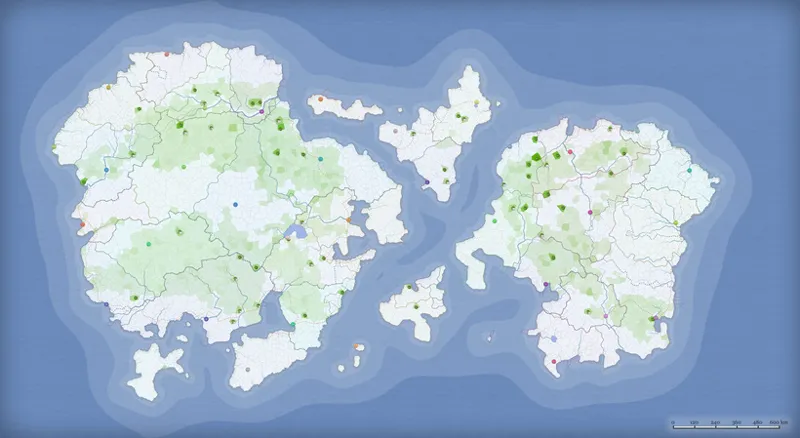
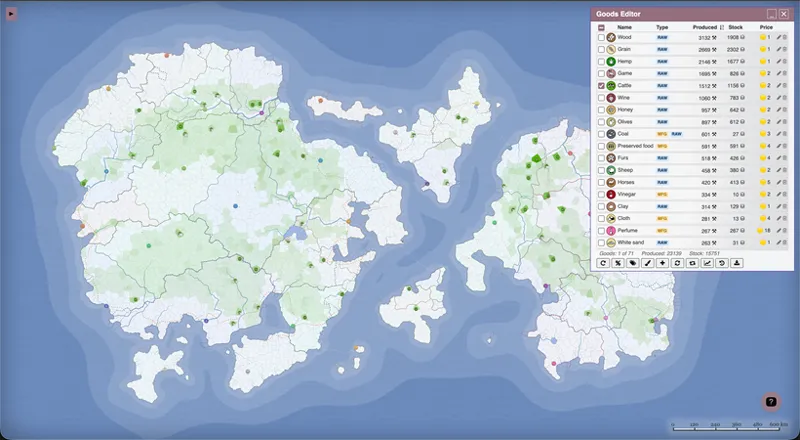
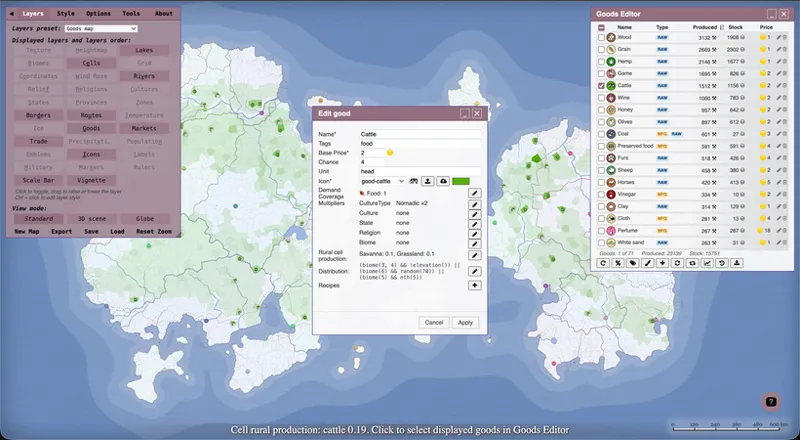
Turn on the Goods layer to see three things at once: resource icons marking which bonus good each cell carries, a production shading showing how much each cell contributes, and a burg plate showing how many goods it produces. Select a good in the Goods Editor to see its data.
Editing goods
Open the Goods Editor (Tools → Goods, or Shift + G) to browse the whole set of goods, select the ones to display on the map, filter by tag, and tweak. Clicking a pencil icon opens the good editor where you can set its value, icon, color, demand contribution, and multipliers.
Multipliers let you boost or suppress a good's production along five dimensions: culture type, culture, state, religion, and biome. A value of 1 (or absent) means no effect, 0 means the good isn't produced at all, and anything in between scales it.
They stack multiplicatively, so you can say "wine ×2 in this culture but ×0 in that state" and have total output of base × 2 × 0 = 0 in the second case.
For raw goods, a visual Distribution Editor lets you build the placement rule (biome, elevation, temperature, shoreline, rivers) without writing the expression by hand.
Production chains
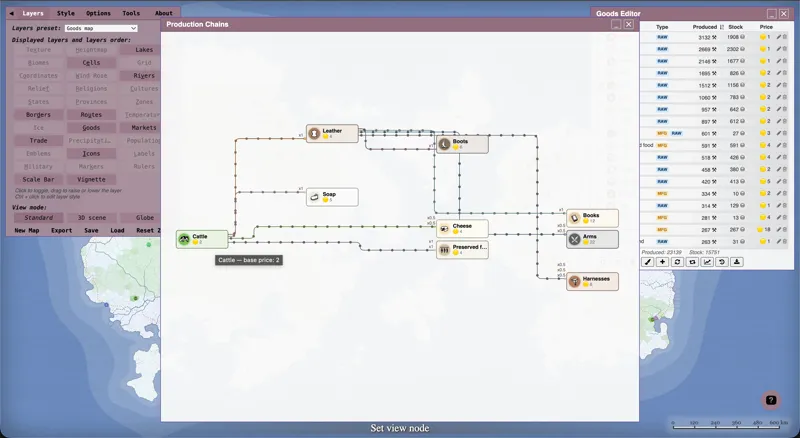
The Production Chains viewer draws the recipe graph – what feeds into what, so you can trace a finished good all the way back to its raw inputs.
Markets and Production
A Market is a regional economic hub anchored at an important burg (capitals and ports are favored). Each market claims a territory of nearby cells via a cost-aware flood fill algorithm, and all the trade in those cells flows through it. Burgs buy from and sell to their market, and markets ship goods to each other.
Within a market, the production cycle runs only once:
Rural cells seed the market with their raw production output, forming the initial stock of raw goods with local prices adjusted for demand and supply.
Burgs manufacture goods, selecting the most profitable recipes they can make with the materials available in stock or bought from the local market. Both sell and buy orders affect the market's stock and prices.
Global trade moves surpluses between markets, driven by price differences and demand.
Burgs fill demand, buying food, utilities, construction, military and luxury goods from the market to cover their population's needs.
• Markets Overview (Tools → Markets) lists every market, lets you reassign market territory, add or remove markets, and compare a good's price across all markets. Clicking a single market opens its Market Overview (per-good stock and price) and Market Deals (the transactions it took part in).
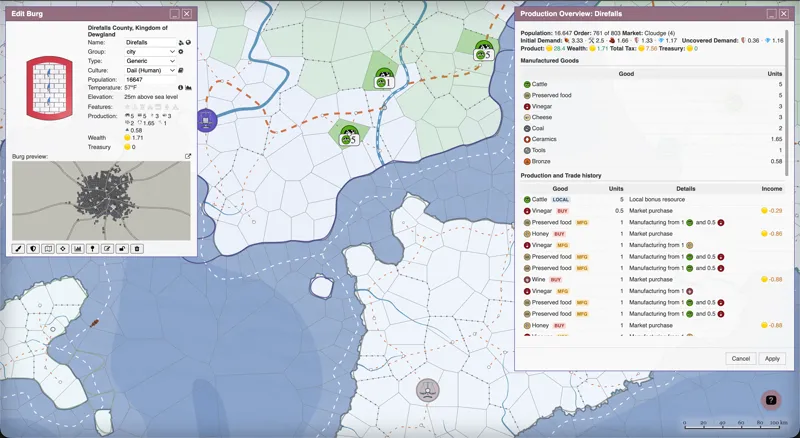
• A burg's Production Overview breaks down what it made, bought, and sold.
• Cell details (Shift + E) show the raw production of any single cell.
Trade Animation
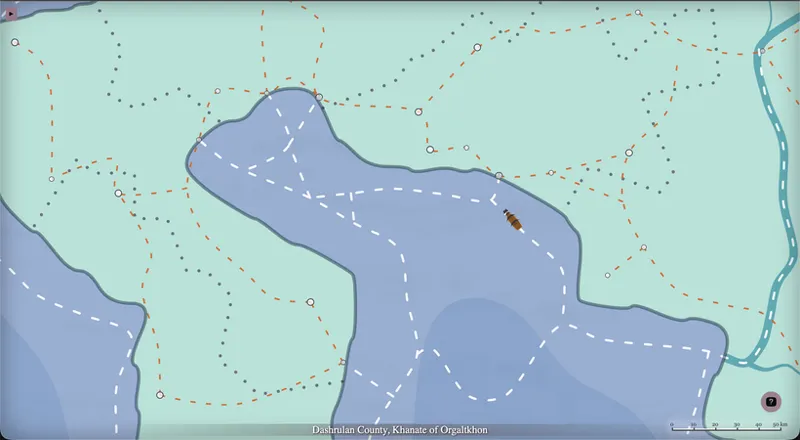
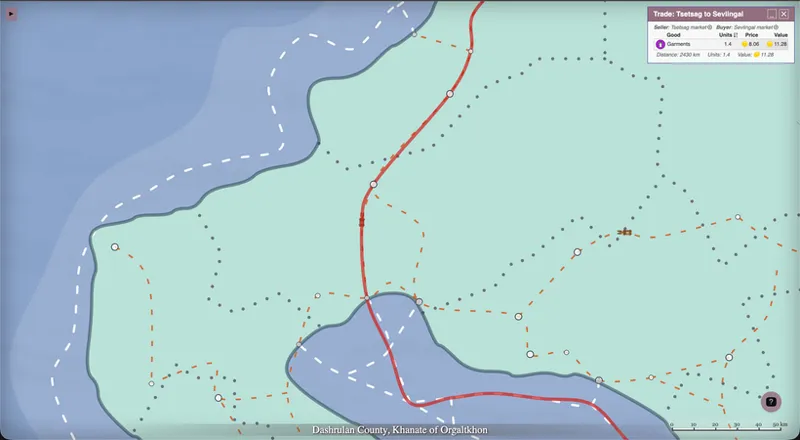
The whole economy generates a log of deals, capturing every buy and sell between burgs and markets. The Trade layer turns that log into living movement on the map: wagons roll along roads and ships sail the sea lanes and rivers, each one a real transaction.
It's purely a visualization and it never changes your map data. The idea is to make the trade network legible at a glance: you can see which corridors are busy and where goods are flowing.
Click any moving marker to open Trade Details: the goods carried on that route, their quantities, prices and total value.
Tune the animation from the Trade Animation Editor (Tools → Trade, or the backtick key ` shortcut): choose which trades to show, how many move at once, and the animation speed and size.
Navigable Rivers
Historically, great rivers carried more cargo than coastal shipping ever did. Now they do on your maps too.
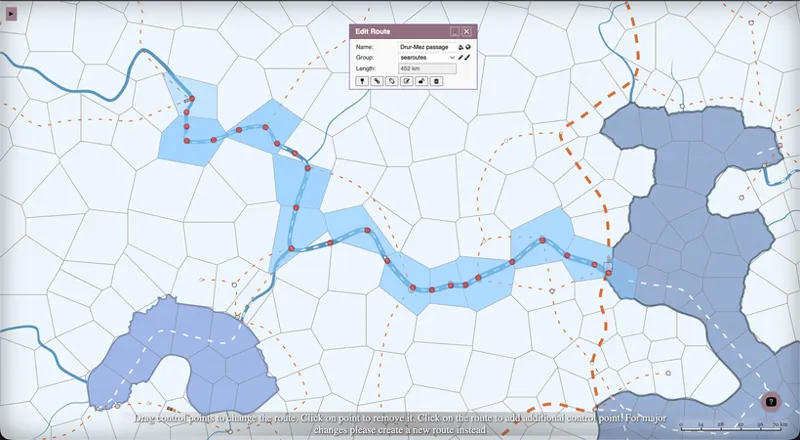
Sea routes can follow navigable rivers inland, so a city deep in a river basin is connected to the coast, and to other river cities, by water, not just by land trails and roads.
A few nice consequences:
• River cities above a flux threshold are marked as ports and join the sea-route network of whatever water body their river ultimately drains into.
• A chain of rivers and open lakes that reaches the ocean folds those cities into the ocean's shipping network; a basin that ends in a closed lake (think Caspian) forms its own self-contained network.
• The route lines now meander with the river to reflect its natural course.
There's nothing to configure: regenerate routes (or a whole map) and inland rivers light up.
State Taxes and Treasury
States now earn money and bank it in a treasury. Two taxes feed it:
Sales Tax
Charged on sellers in every market transaction.
On local sales it's taken out of the burg's revenue; on long-distance trade it's added to the buyer's landed cost, so heavily-taxing states become less competitive exporters and reduce their burgs' wealth.
Poll Tax
A flat levy per head of population, collected once per cycle.
Tax rates are derived from a state's form of government and jittered a little per state: a Theocracy taxes sales harder than a Republic, Anarchies tax nothing, and Neutrals never tax or bank anything.
Open the States Editor (Shift + S) to see the new Treasury column. Clicking a value opens a dialog where you can adjust the sales and poll-tax rates or override the balance.
Rate changes take effect the next time production is regenerated.
How to Try It
Generate a new map, or load an existing one so it's upgraded automatically.
In Layers, switch to the Goods Map or Trade Animation view-mode preset, or toggle the Goods, Markets, and Trade layers individually.
Explore from the Tools menu: Goods (Shift + G), Markets, and Trade editors, plus Regenerate → Goods / Markets / Production to re-roll any part of the economy.
Click around: markets, burgs, and moving trade markers all open detailed overviews.
As always, feedback is very welcome – especially on whether the generated trade networks and prices feel believable on your maps.
Comments (10)
MAJOR UPDATE v1145.0 REWORKED SATELLITE 2D MAP? BY: Azgaar
I just came back to Azgaar after having a daydream about it finally having resources and an economy on it, only to find out it wasn't just a dream. Wicked, WICKED stuff! I am so psyched to try it out! Although, perhaps my map is just too old, but for some reason a lot of the produce is being made offshore in the ocean 1 cell off of the landmass 😅
This is a great major update. With gold and economy and animations, we might even hit the point where we can buy troops and play out our own scenarios however we like like Age of history 2 or Europa Universalis 4.
I've joined your Patreon because of this economy update, keep it up! Would love to see you continue development on this and updates for other cultures (East & South East Asian).
This is really cool! I never expected such a big update to this program, but you delivered nonetheless! Some notes: 1. Maybe it's just my world, but it seems like the default production parameters need some tuning. Some things that ought to be very common, like stone or salt, for example, are hardly being produced at all. 2. The units are unclear to me, are they meant to be multiples of thousands? They don't seem representative. I have a city of several tens of thousands of people and the stock is only roughly 10 or less units of about 6-8 goods. I know the market has more going on, but even looking at that the numbers aren't intuitive. Same goes for Wealth and Treasury. 3. It would be very cool if Goods, at least raw ones, came before (at least) culture in the generation loop. It makes sense that cultures develop/seek out/are influenced by the resources available to them. Maybe this would interrupt your elegant and streamlined implementation. I have a JSON file if you'd like to confirm.
Ok i have played around a bit and you wanted feedback onn the pricing and trade networks. it looks like the goods generation is large enough to provide for (roughly) the entire population, but consumption is only linked to urban population, this widely impacts the price and trade flow.
Great update, although the pool tax seems to default a bit high in medieval times, 3 years of taxing the English between 1 and 4 daily ages a year did lead to the 1381 peasant's revolt. Pool tax was an extreme measure to fund exceptional expenses.
I am utterly blown away. Absolutely incredible update. 👏
Unreal! What an amazing addition to already fantastic maps!!
this is great, thanks. Especially like the river ports and sea routes change, that's been a headache.