
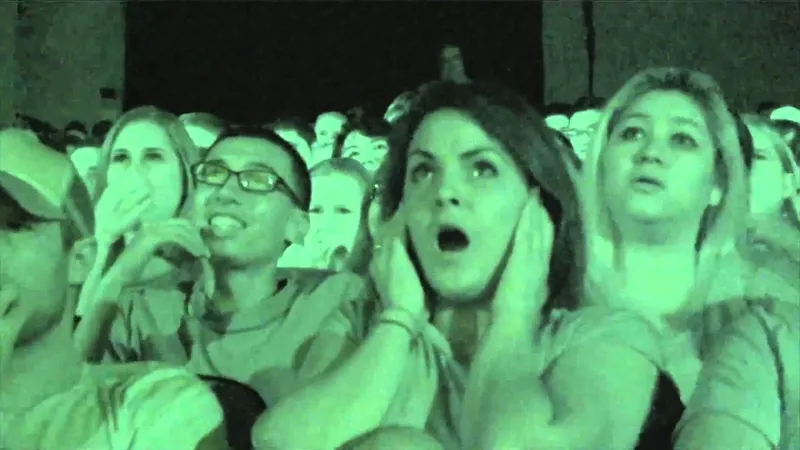
The Art of Fear and The Power of the Frame: Audiences and Assumptions
“Horror – as an interest, passion, or profession – has fandoms and sub-fandoms; it has cliques; it has little fiefdoms. If horror is your business, you might have an audience, or followers, and hopefully customers (those three are not the same thing, by the way). It’s tempting, natural and even good business to try to pretend these hundreds of little enclaves are all part of one tribe. But when you expect all these different sects to be in lockstep like one big, idyllic Mickey Mouse Club, you’ve made a terrible mistake – and you might actually be looking for a cult, not a community. (I’m gonna pause here and plug issue #15 of FANGORIA, in which Richard Newby delves into how horror explores the dangers of buying into “community” better than I ever could. It’s a great read.)
I don’t make this assertion lightly. This job has given me a front-row seat to just how much horror fandom is NOT some monolithic “community.” Our FANGORIA Pride Shirt, which we’ve been doing for four years, does a great job of raising money for charity and galvanizing like-minded fans. It also results in angry emails and canceled subscriptions every year. (So not only are these particular fans not aligned with us, they’re not even paying attention. Some community!)
Examples exist in other fandoms, and again, I’ve seen it firsthand. When I stood up last October for a woman being harassed online by other Bond fans, some of those fans tried calling my house and my cell phone, looked up my home address, and created a social media profile pretending to be my dead dad. Does that sound like a community, or just a pack of assholes?
I do not claim any fellowship with these people; an overlap in our DVD collection does not magically create a kinship between us. But I also don’t blame the good people in my fandoms for their existence. When someone in your imagined “community” makes a shitty joke (as happened this week) and a thousand people like it while a thousand people call for an apology and atonement, is the “community” at fault? Or is that just life? People suck all over; call it out, but you can’t take the proximity so personally. Even in our beloved horror stories, the community is not responsible for the transgressor. Freddy Krueger isn’t Springwood’s fault; no one blames all of Haddonfield for The Shape. There’s a “Let’s Go Brandon” sign hanging on a house around the corner from mine. Does that person speak for my community? My town overwhelmingly voted blue; enjoy shitting up your lawn, buddy.”
The above is excerpted from an editorial by Phil Nobile, Editor and Chief for Fangoria magazine, in the April 8, 2022 edition of the magazine’s newsletter The Terror Teletype. The editorial was titled, A Crowd Is Not A Community.
One of the things Phil is getting across is that there are many different audiences within horror, and within any fandom. An audience is anyone who sees or hears something presented to them, basically. They are one group, in that sense. Being that they share the distinction of being an audience to say a film, a concert, a television show, only tells us that they have seen and/or heard a specific thing. It doesn’t tell us how they engage with that thing, why they do or what they think about it.
Back in 2006 or so, there was a good bit of buzz being generated by a film being made by a French filmmaker. He was remaking one of his own films, for an English speaking audience. This is somewhat unusual, by itself. It helped that he is a pretty widely respected and renowned director, having had a few internationally successful and well received films. His reputation was that of a thoughtful, provocative, skilled filmmaker. Added to this was that Tim Roth and Naomi Watts were part of the cast. Both were more or less at the height of their fame and status. Watts had come to acclaim in Mulholland Dr., David Lynch’s masterpiece. Lynch’s work, though not necessarily squarely in the horror genre, never avoided speaking its language, and the cross over between the audience for horror and for his work is substantial. Watts had then gone on to star in the American remake of the Japanese film, The Ring, which was a certified box office smash, and a cultural moment of its own. So, the inclusion of Watts, along with the French film being remade a well respected director, made the announcement of production and its progress a source of interest to the press covering horror and some of the mainstream film press.
Horror fans and those film aficionados whose interests extend outside the shores of the US know I’m talking about Funny Games. I’d seen Caché and Time of the Wolf, both made by the same director, Michael Haneke, and both of which I think are excellent films. I hadn’t seen the French version of Funny Games and since it was announced the American version was going to more or less be a shot for shot remake, I didn’t see any point in hurrying to catch it. Combine these factors with the interest the horror press was taking in it, their descriptions of the original, the inclusion of Watts and Roth, and the excitement with which I was anticipating Funny Games makes sense.
With the possible exception of Uwe Boll’s Alone in the Dark, I’m not sure I ever left a movie theater as frustrated and angry as I was after seeing Funny Games. Alone in the Dark seemed to have been made by people who had no interest in making a film. It was clear their only interest was getting something into theaters that could be advertised as a film, so suckers like me would buy a ticket. I may have seen worse films, considering the amount of straight to video or micro budget films I’ve seen, but I don’t think I’ve ever seen anything being marketed as a feature film so blatantly lacking in any interest in the experience it was giving audiences. I can appreciate experimental film. I can appreciate sophomoric films, made by people with more passion than experience or understanding in how to craft the experience of a narrative film. Alone in the Dark wasn’t an incomprehensible mess due to any of that though. It was clear it was an incomprehensible mess because the people making it didn’t care about what they were making. They only cared about producing enough images and scenes to resemble being consecutive in sequence, and marketed it as a narrative film. They deemed everything else not very important.
The critical response to Funny Games didn’t reflect mine. To my surprise, even a good deal of the horror press and horror audiences responded well to it. I was completely baffled. To be honest, I’ve even gone back to rewatch it a few times, wondering if it were possible I missed something or if maybe, as I know is possible from experience, that particular day or some other pressing thing in my life had resulted in my response to the film. Repeated viewings of Funny Games only further solidified my feelings about it though. Even now, I find it baffling when I come across people who are enthusiastic fans of horror that express fondness and respect for it.
Part of the problem was, I couldn’t say it was a badly made film. Haneke is a talented, skilled, passionate and often thoughtful filmmaker. Even after having seen Funny Games, I’ve seen The White Ribbon and The Piano Teacher, which I think are both good films. The entire cast of Funny Games is doing some of the best work of their careers in it, which is saying a lot, because Naomi Watts and Tim Roth are excellent actors, with impressive careers. The cinematography is visually and stylistically interesting. In every way it can be measured on a technical level, it’s a well made film.
For those unfamiliar, Funny Games is a scathing scream of rage, an invective of a film, about the appetite for violence in media, most particularly horror films. If you’re familiar with any of my other work, you’ll know I have an appetite for films meant to be raging invectives. It’s one of the reasons I enjoyed The Bride! so much, in contrast to the majority of public and critical opinion. Rage is a messy, unruly emotion, and I don’t expect its artistic expression to always be neat and tidy. In fact, we need messy expressions of it, because that contributes to the overall honesty and truth of the source of that rage, in the larger picture. Those messy, shaggy, unkempt films raging about different subjects shouldn't be the only examples of cinematic expressions of rage at societal problems, but they are necessary too.
You might even be thinking, “Well, you’re a horror fan, I’m not surprised you’d be so turned off by a film critiquing the genre.” That’s not true either. I’m rounding the corner on fifty. I’ve been a horror fan since I was a child. I’m used to the critiques and criticisms of the genre, well founded or ignorant. A good deal of my introduction to formal film criticism and academic writing about film came from feminist critique of the genre, which is often uncomplimentary. I can recognize a well founded criticism, and engage with it, in part because I respect the effort and thought it takes to develop them. Feminist criticism of horror has taught me more than I can express, and I'm grateful for it, even when I don't agree with it. Part of the problem, as someone who does want to be challenged in my way of thinking about these things, is just how rarely new ideas are presented. As they say, "Putting a new coat a paint on a trash can doesn't mean it's not full of trash," and that's how a whole lot of our cultural discussions tend to go. Someone trundles out an old, already creaky if not debunked idea, throws a coat of paint on it and says it's new.
My response to Funny Games didn’t even come from the fact that it was unfounded and poorly considered. It’s that it was making a whole set of assumptions about the audience. It was also that I might not be able to blame Haneke for making the film, as thoughtless as it is. I can’t completely fault him for his assumptions about the audience, because in the larger cultural context, the belief in the existence, size and dominance of the audience he thought he was speaking to was clearly supported by a number of people and institutions considered legitimate. I’ve been seeing and hearing these same arguments about media generally, and horror specifically, since I was a child.
It was that recognition, the self re-enforcing nature of that cycle that was the foundation of my response to Funny Games, the degree it was celebrated, because that cycle does something very specific. The assumption at the heart of Funny Games is that the audience for the horror is basically lazy and takes a sadistic form of pleasure from watching violence visited on innocent people, and as a result this creates some kind of complicity with the violence that happens in real life. This assumes the worst of the audience, while simultaneously giving the person making the argument the ability to feel morally superior. It’s a set of assumptions made from the standpoint of the discomfort depictions of violence as graphic as horror often exemplifies invokes, concluding their discomfort is itself inherently moral, and there has to be something immoral in people who don’t experience it. It’s an entire set of assumptions about a very large number of people, that never goes far enough to ask, “Can all of these people be so intensely immoral?,” and because the sense of superiority prevents that question, there's never consideration of what else could explain the desire to engage with the violence horror can depict.
It is true that social norms around media have changed in allowing a greater tolerance for graphic violence. However, if media were as directly contributive to our norms about violence as the people who make these arguments suggest, we wouldn’t be seeing the drop in violent crimes we have steadily seen. If media is contributing to changes in social norms or even just the upholding of those social norms in the way this argument suggests, the degree to which violent crime has fallen (a thing we don’t really have a solid explanation for) says the contribution would be in the opposite direction from what they are arguing. If media is so significant a contributor, it's hard to make the follow up argument that it isn't somehow contributing to the drop in violent crime.
The personal need of the individuals making the argument to believe in their moral superiority is over riding the ability to ask what else might be happening in the space between the intentions of the creators and the way the audiences experience and engage with the specific work. It’s part of our cultural heritage, the way we’re taught to think, to individualize everything we see as a wrong or a failure.
In a society where our “divides” are so often a topic of conversation, the divide between the people who have experienced traumatic violence and the people who haven’t is possibly one of the most influential. The plain truth of it is that if someone has never had experience with violence that has impacted them in a way so significant, taking years to understand just how profoundly that impact was, they can’t actually understand the depth, strangeness and complexity of it. I make the distinction of having to evaluate and investigate it, because the truth is, there are many people walking around who have never had to do that. In many ways, the world we live in helps insure that doesn’t happen, because it has use for the way the violence they’ve experienced has shaped them. One of the least investigated aspects of this is how violence is intricately woven into how boys are socialized into masculinity. I can’t say Haneke is a person who’s never experienced violence which deeply shaped his understanding of himself and his world, but I can say his perspective is too simplistic to have ever had to investigate and interrogate it, because once a person has to do that, it’s impossible to accept the simple perspective he has.
One of the things revealed in research about audiences for “dark” media, is that many people who have experienced severe trauma engage with it in the journey it seems Haneke hasn’t ever had to take. It’s not just the research either. Part of the revelation of the digital revolution, has been how common this is. Blogs, informal criticism, social media are all replete with people expressing one way or another that horror and other forms of dark and/or violent media have been part of their journey through excavating their traumatic experiences.
And in this, comes the question about what art really is. I know, I know… You’re probably sitting there, rolling your eyes, thinking “Christ, not this…” because if you’re at all like me, and have interest in things at all related to this question, you’ve endured a whole lot of sermonizing, half formed ideas repeated ad nauseam and so on. I’m going to try to be brief about this though.
One of the dominant perspectives about art, maybe especially in the kind of world Haneke comes from, considering his background, education and so on, is that “real art” is one of the “highest” forms of communication human beings create. The idea is that “real art” serves the highest ideals of the society, and then there’s this other stuff, which speaks to our basest, lowest aspects of ourselves. It’s a noble sentiment, and I absolutely do love art that speaks to the best of what human beings are or can be.
The problem is, it doesn’t take into account how deeply power shapes what we define as our “highest” ideals. One of the things I think a majority of people with power, especially in our institutions, are failing to understand or don’t really find discomforting enough, is the way power is being used to create the conditions to define what people are capable of considering as possible ideals. Their faith in the ideals they’ve been taught throughout their lifetimes, is in and of itself, preventing them from seeing the way this is happening. They recognize singular, individual actions of people in power right now as wrong, but the larger picture of what those actions leads to is beyond their conception, because it's obscured by faith in those ideals, as if they are somehow magic, and will through this faith repel the attempt to undermine them, erase them from cultural heritage, along with the ability of tomorrow’s public to even consider them as options. This reveals the fault in this conception of what art is. We tell ugly stories about ugly people acting for ugly reasons, in some part because we need to understand them and be able to recognize them. We also tell them so we understand how to survive those people.
We were making things, creating what we now understand to be art, before we created civilizations. It’s not en vogue to acknowledge these days, because of the way art is commodified and treated simply as a consumer product (a thing which benefits the social order as it currently exists), but art is a foundation of human civilization, because its an inevitable product of human evolution. It sits at the center of all the things that make the human mind capable of what has made us the dominant species on the planet. It is communal. It is a method of communication. It can both support our communal beliefs, attitudes and ideas, and it can challenge them. It’s part of the way human beings create, analyze and reveal what becomes collective wisdom. It’s another way we interrogate, celebrate, investigate, and develop our understanding of what it is to be human, and in relation, whether our civilizations and societies are working in supporting the ability for human beings to exist in health, with some level of contentment and fulfillment. It’s part of how we keep adding to that collected wisdom that enables human beings to better adapt civilizations to what human beings are, and part of the effort civilizations engage in to adapt human beings to what they are.
Ideals change. Not just artistically, but morally, intellectually and so on. The storytelling arts are going to reflect back to us what we are, and we’re going to do what we do, ask questions about that reflection, whether we think any individual piece or genre of storytelling is good or not. One of the most important aspects of how we go about those discussions is the scope of variation in how, and what questions, we ask. “Art” is so ingrained in what being human is, such a foundational part of our civilizations, people will die for it, and many have throughout our history. I'm not only talking about people who knowingly or willingly martyred themselves to it, I'm also talking about people who never thought much further than making something they wanted to, only to discover it was going to cost them their lives after. Art and storytelling are the result of human beings evolving into social animals with the ability to engage in deductive reasoning, to create collected knowledge that results from the complexity and specificity, and language to communicate these to each other.
It is always in power’s interest to decide how broad the acceptable scope of subjects can be in art, because of the questions resulting from it. We’ve seen, throughout history, power will engage in every form of violence and atrocity to achieve that goal. It's important we make art about violence, if for not other reason than the questions related to that. Violence isn't only method power uses to achieve that goal either. Maybe even more destructive is its ability to shape how readily we accept its answers about what is allowable, what is tolerable, and come to believe this is for our own good, innate in us, and serves us, whether or not that is demonstrably true.
All art is in some way participating in that process of revelation and investigation of what we are, and whether or not our societies and civilizations serve human beings. One has to assume they understand whether the society and civilization is good for human beings, and every society and civilization has believed it is, art is part of the the system of self regulation in the human species. How do we live in these conditions? What are the best conditions for us to live in? Can we be what these conditions require? In this, it’s impossible to even say whether or not a particular piece of art is “good” for the society it’s being introduced to or “bad” for the society it’s being introduced to. It’s good that it’s introduced, and that the society has it to wrestle with.
There is no “real art” and “not real art.” There is just art. Even if we take the commercial influence over the process and what the public is presented with, that is still just human beings adapting to the social environment they live in, as they go about creating art. The commercial influence, in this capitalist landscape, certainly favors power to a large degree. I don’t think arguments to the contrary have much merit, if we even just shrink it down to volume of output. Yes, some indie filmmaker can make some provocative, intelligent film challenging power in a profound way and there’s a chance that film can touch the zeitgeist or some nerve and become a touchstone, but the truth is that is extremely rare when we take into account the number of films made, and which ones have the kind of advertising and press support that pushes a film to that cultural status.
Art isn't about reflecting our "highest" ideals. It's about investigating our ideals, what they are, what they aren't, are we living up to them, are we telling ourselves the truth about what they are or whether we living up to them and so on. My reaction to Funny Games is a suspicion of someone so sure they know the answers to these questions, who seems convinced he's the product of some set of ideals and values separate from the people he's talking to.
I also can’t say it’s not possible some portion of the audience does fit the characterization Haneke and many others using this same argument paint of the general movie audience. It is possible. We’re only weeks away from the revelation of a website devoted to men sharing tips on how to avoid detection in drugging and raping their wives and partners. Over 20,000 videos were shared on it. I also think the volume of the outrage in response to that revelation, tells us more about the attitudes toward the idea of engaging with media based on this sadistic desire are a minority.
This isn’t just true of Haneke, or the kind of stodgy, mainstream liberal who wrings their hands about the effects of violent media on the public.
One of my introductions to formal and academic film criticism was feminist cultural criticism. At the time, there was a generally accepted perspective in both academic and mainstream feminism that the horror genre, with some specific exceptions, was reproducing, favoring, privileging and more or less upholding misogynist, patriarchal ideals. Again, I can’t argue there isn’t truth in a number of the ways feminist critique has described the way women and violence against them have often been portrayed within many horror films.
It’s a perspective that held that horror was a genre for an audience of men, who wanted to see these beliefs and attitudes about women reproduced on screen, satisfying their sense of belonging in a world that holds those attitudes and beliefs, as well as their superiority over women. Most of this came from the analysis of the slasher, which started coming to dominance in the seventies, but came to fully dominate the landscape of horror in the eighties, continuing into the nineties. Not that there haven’t always been other sub genres, with strong entries of their own, but that the number of slasher films being made, the degree they dominated the box office for horror, and the focus given them by the horror centered audience made slashers dominant.
Over the years though, it’s become clear, this is an incomplete picture. There is undeniably truth to the kinds of ideas and attitudes being revealed in the feminist critique of horror at that time, but it also wasn’t the full picture really, because what goes into the film itself and its making, is not always the same as what the audience is responding to in it. What the creator intends isn't always how the audience experiences it, and even if we go past direct intent to the way a creator is reproducing unconscious ideas they have about the world they live in, it doesn’t always mean those are the ideas that are motivating the audience in their engagement with that work.
One of the reasons this perspective now seems incomplete, that it does reveal a truth or a part of the truth, but not The Truth, is that we’ve come to understand women make up half of the audience for horror. So, if women make up half of that audience, how are they engaging with it? If it’s a genre meant for a male audience, recreating, supporting and helping hold in place all the ways misogyny and patriarchy are destructive and harmful to them, why are women half the audience? Again, in part because of the digital revolution and the ability for anyone to make public the different ways they relate to or interact with the genre, the picture is pretty clear that there is a whole audience who self identify as feminist, and find horror providing them with a whole lot they find useful and fulfilling. If you’re so inclined, there are many blogs, podcasts and the like which can walk you through the full spectrum of how they’re engaging with and identifying with horror, its stories and characters. If you engage with discussions about horror across social media, it’s impossible to miss just how vibrant, alive, intelligent and engaging the conversations feminists who love horror can be.
Another part of the degree to which that older, then dominant perspective in feminism toward horror is incomplete is the fact there’s a substantial male audience that has no trouble identifying with the female protagonists in horror. The assumption men, even if they are or were the intended audience during a film’s creation, are identifying with the perpetrators of violence, and not the victims and survivors, doesn’t square. There is a counter critique, which likely has some truth in it, suggesting The Final Girl is a kind of avatar for male fantasies, but that also, in a way, assumes the gender binary always overcomes the degree the human brain is built for identifying with other human beings. We have a whole system of mirror neurons, for that exact purpose. As feminism has successfully proven, there are gendered aspects to how people are subjected to violence in real life. That also doesn’t mean the way they process experiences with violence can be contained by attempt to use the gender binary to constrict their humanity to its parameters.
In 2024, I wrote a piece reconsidering John Carpenter’s Halloween, in the context of the cultural conditions it was released into, the experience the assumed teenage audience would have walked into theaters to watch it would have had and been having. I didn’t realize it at the time, but what I was really doing was just not putting the worst possible assumptions about that audience at the center of what might explain the success and cultural relevance the film achieved. I was asking, "Given what we know about what was happening in the rest of the culture, in their lifetimes, what might they have been reacting to?" In part, this came from the degree I’ve been the audience for horror, including slashers, and certainly, Halloween.
I never engaged with slasher films, maybe Halloween especially, from the standpoint of feeling some sense of vindication or a reification of myself or my values in the killing spree of the perpetrator. In Halloween, what I always saw was, overall, tragic. A bunch of kids who’d done nothing to deserve that fate, were summarily killed off by someone whose motives and drives were inaccessible. As a fictional creation, I loved Michael Meyers, because he was the engine of revelation for the fear of violence, how often random it is, how present it is, and seeing it presented in that specific way, knowing how impactful the film was, said to me that fear was common. I loved Laurie, Annie, Linda and Bob, because they represented different ways of trying to be a kid, and how randomly and without cause violence can intervene in that period of life.
Additionally, the degree to which the film presents Laurie repeatedly saying, “Something’s not right” and being dismissed was something that I deeply identified with. I was an undiagnosed autistic kid, who’d experienced traumatic violence, trying to navigate a world that made very little sense, and watching people accept a whole lot of stuff they would turn around and say was unacceptable. Walking around, feeling very uncomfortable, watching everyone else going about life as if things were just fine or unchangeable, was my daily experience. When I tried to communicate that, responses like, “That’s just how things are” or “Toughen up, that’s life,” felt very similar to seeing a guy in a mask who keeps disappearing when someone else is looking. It felt kind of like living in a world full of red flags, where everyone else was color blind, had no idea what red was, but kept saying red flags were bad.
Even as Halloween is often referred to as the originator the slasher's dominance, that’s not quite true. Very few of the films that followed seemed interested in trying to imitate it. The film that really sparked the explosion of slasher film productions was Friday the 13th, and it was the blueprint the majority of films after followed. Halloween may have been the first major financial success using the basic structure of a slasher film, but in the horror film industry, firsts are rarely the films that inspire the trends. It’s the second film proving a structure or formula successful that tends to create the most imitators. The other more notable example of this being The Blair Witch Project as a run away success, introducing many audiences to first person point of view narrative film and “found footage,” but it wasn’t until Paranormal Activity demonstrated that success could be repeated that the landscape of horror started being flooded with low budget, first person POV films, using the “found footage” aspect as a narrative device.
The eminent feminist cultural critics weren’t alone in their very low opinion of the slasher sub genre either.
Siskel and Ebert may be two of the most well known film critics of all time. At The Movies, their weekly television show that covered films being released to theaters, was a staple for at least one generation of nascent cinephiles and movie enthusiasts. Among those of us who are also of the version of horror fan that involves obsession with the general critical and societal perspective in different periods, their distaste for horror films of the 1980s is well known. It’s a source of consternation and comedy, equally.
Siskel, following the release of Friday the 13th, went so far as to publicize the contact information for Betsy Palmer, in an effort to encourage his viewers and readers (he was also a well known, well regarded print critic) to lodge their disgust with such an esteemed actor lending their talent (and by extension cultural status) to what he deemed a morally and artistically reprehensible film. Siskel doxxed Betsy Palmer, long before the term existed in today's parlance, as an act of righteous indignation.
The degree to which the slasher dominated the genre, both in terms of sheer number of slasher films produced and box office returns, helped extend that sentiment to the genre more broadly. As I am wont to remind anyone I can, these were also the years of the Satanic Panic, and horror as a genre was more or less under scrutiny from every variety of culture critic who considered themselves responsible to safeguard public morality.
Religious fundamentalists blamed every form of media imaginable for the combination of decline in their perceived morality and participation in religious services, which they of course used as part of the explanation to how there might be Satanic cults in every nook and cranny of the nation. Horror was no exception. Horror films weren't just about demons, devils and witches. How could you be so naive? They were actually cursed. Portals allowing demons, devils and witches to gain purchase on the poor naive souls who watched. With the advent of VHS, you were inviting them into your home, your mind, and your soul, every time you sat down and watched one of those cursed films, produced by Satan worshipping child killers in Hollywood. Those slasher films are telling your children to massacre you in your bed!
You need not be too afraid if you've been watching them though, because of course, our the good Reverend can rebuke the Devil and his minions if you call the number at the bottom of the screen. For the very reasonable required donation of $19.95, he will use the gift God has given him to rebuke your demons and place prayers of protection on you. We only require donations so we might continue this ministry God has called on us to do, carrying his love and protection to you. And, you know, for an additional $9.95, we can provide you with a prayer book that can help keep you protected. These are prayers given our great Reverend annointed. You know the Devil has it in for him because he is doing this Good Work, and if these prayers work to keep him safe from the Hells agents, they'll work for you, which is why we are providing them to you at such a low cost.
Now, as I’ve said, I do think what feminists have unraveled in terms of the beliefs and the symbolism in the creation of many horror films has real merit. On the other hand, I think the Siskel and Ebert had the same problem Michael Haneke did in how they view art. Art isn’t something to be worshipped. It’s going to inspire awe and wonder, whether or not one worships it, and worshipping it just creates a distance between what we are and what it is that is unrealistic. Worship is a relationship to art that doesn’t serve us very well. The most vocal and prominent evangelicals have never struck me as much more than charlatans and con men. All of these perspectives on horror, and most particularly, have in common that they assume the worst of the audience, putting the person or people making the claims in some kind of morally superior position.
One of the things that is inescapable in looking at how a large portion of the horror audience that watches slasher films reacts, is that they find them fun. This is often used as a kind of cudgel. In their episode on Friday the 13th, Siskel and Ebert specifically cite the fact that a number of the teenage members of the audience laughed during some of the most gruesome kill sequences as proof of some kind of moral vacuousness in the audience.
But, what if we take feminists as having correctly diagnosed social pressures and norms, but don’t assume the worst of the audience? What if, the slasher film is a kind of undiluted expression of the most base attitudes and sentiments in a conservative, patriarchal culture? If we don’t assume the worst of the audience, what might be fun or funny about that?
Is it not possible that in a culture that was telling kids to “Just Say No” as it was drinking and snorting itself into oblivion, espousing attitudes about sex so absurd it was wiling to condemn hundreds of thousands of people to death or life altering illness instead of providing basic sex education, while cheering that living under constant threat of nuclear annihilation was "victory," and presenting people caterwauling about demons and Satanic cults on a daily basis, that teenagers were experiencing the slasher film as the furthest logical extent of those conservative, patriarchal values and laughter was the response to the sheer absurdity of it?
The slashers of that era were putting on screen the promises the world of adults were making to kids at the time. Sex, drugs and inappropriate behavior equaled if not death in the literal sense, then death in the social and economic realms. Slashers were making those ideas literal, taking them to their furthest logical conclusions basically. None of the cultural critics, at least at the time, considered that some or even a large portion of the audience for slasher films might essentially be engaging with and receiving them as what we recognize as camp.
Maybe today, more than ever, there’s a recognition that satire can be mistaken for sincerity. It’s the Fight Club argument, basically. If a piece of media isn’t clear enough, isn’t telegraphing too loudly that it’s intent is to highlight the absurdity of its subject, it can produce a sense of identification with those subjects. Hence, there’s a portion of the male movie going audience that didn’t seem to get the memo that the film was actually making fun of Tyler Durden and the unnamed narrator, not suggesting they should be role models. There’s a laundry list of criticism about Fight Club and the way some portion of the audience finds it inspiring or aspirational, instead of seeing it as a piece of satire pointedly skewering aspects of masculinity and modern life. This is often expressed with an antipathy toward the film itself, and the idea that there are just too many films about men, when this is a film highlighting some of feminisms validity.
Personally, I lean toward asking how we expand the audience that can understand that works like Fight Club are satire, and see the fact that about sixty percent of the nation doesn’t read beyond a sixth grade level as the answer. I’m very much in favor of more work being made that skewers the worst aspects of masculinity, and believe the lack of ability to see that Fight Club is satire isn’t a product of individual failure, but a cultural outcome, produced by the thing the film is satirizing. The film becomes, in essence, something like a flare or marker. The men who believe it’s aspirational, are exactly the men who most identify with what it’s satirizing, and if you have them in your life, you should probably keep an eye on them and consider what proximity you’re willing to accept.
It rarely comes into these conversations that this same principle can work in reverse too, which is what we refer to as camp. Something can be so exemplary of what it stands for, so dedicated to being that thing, it ends up becoming revelatory in the ways that thing is absurd and ridiculous. It’s part of what can make bad movies entertaining. Plan 9 from Outer Space was not conceived as a comedy, but it’s definitely funny, and for some entertaining, specifically because of how seriously it takes itself, even though it’s universally recognized as being absolutely terrible as a work of narrative film.
Is it not possible, that in the face of the cultural conditions at the time, teenagers were watching characters meant to represent them transgress and experiencing that as fun, while also seeing the most dire, logical conclusions of those messages that called it transgression absurd, and in turn fun too? This is a perspective which would require all of those cultural critics to consider the possibility that maybe they were the ones being laughed at, and like those films which take themselves so seriously as to be camp, it’s not in their nature. Teenagers would never... right?
There are also ways that this tendency to assume the worst of the audience also reinforce some of the things the people railing against as some of our most dangerous cultural norms and standards.
I recently came across someone suggesting that if men are engaging in the relatively new phenomenon of celebrating female villains and/or referring to different horror films as “Good for Her Horror,” it’s a fetishization of mental illness in women, because people love to see women acting against standards and norms on screen, but they don’t want to deal with real women who are experiencing mental illness.
“Good for Her” horror, if you’re not familiar, is a somewhat nebulous concept. Like so much culture and discussion of culture over the last two decades, it began as a reference in social media, and there’s disagreement about what the hard lines of the concept are. In the broadest terms, it recognizes female characters who assert their agency and autonomy in response to a situation where some aspect of gender is effecting their well being in a negative way.
The idea that men are fetishizing depictions of women who break norms and taboos, in the ways mental illness is represented in horror films, is itself based in an assumption the gender binary is real, and dictates behavior and psychology to a degree feminism itself has demonstrated isn’t true. It’s an idea that requires a belief men can’t identify with what women feel or experience, which is itself a claim made by those who most fervently assert the gender binary is real. There is truth to the fact that there are aspects of the social experience of the gender that leave us, men and women, unable to understand what the cumulative affects of our socialization into gender are. I can read for decades, engage with the women’s art, listen to women talk about these things, and still not fully understand the cumulative experience of the various aspects of patriarchy and misogyny in the way I would if I were experiencing life in this society as a women. It is unquestionably true the various institutions and powers which are charged with diagnosing and treating mental illness have clearly been and still are, deeply sexist.
At the same time, the idea men can’t identify how women may feel in response, ignores that those institutions often fail in their diagnosis and treatment of men. That assumption it treats men better is based in the definition of "better" that's failing both men and women. It is a belief that privilege produces better outcomes, and I’d suggest, in part because of the evidence feminism has unearthed and in looking at what’s happening in our culture and world now, and the privileges feminism has unveiled in terms of mental illness and its treatment, the outcomes aren’t much better for men. The privilege is part of what produces those outcomes, for men and women. Feminism, generally, has diagnosed one set of those failures, and it's effect on the people the gender binary categorizes as women, and even as it's done so accurately and thoroughly, that doesn't necessarily mean it understands the ways that is failing the people the gender binary calls men.
I’m not going to say there can’t be some degree of truth to it. There probably is some portion of the audience who is engaging with these varieties of storytelling as fetishization. That’s a very different thing than assuming a majority, whether of the audience as a whole or even just the male/men audience. The outcomes would suggest, patriarchy, as the system enforcing that gender binary isn't interested in the well being of men or women, so much as it's own reinforcement and reproduction, because of its relationship to power and wealth.
I am personally familiar with the ways a diagnosis of a mental illness or behaviors that deviate from the norm are unappreciated, and fetishized. I was undiagnosed as autistic for over forty years, and treated for a variety of other diagnoses which were essentially wrong. I am intimately familiar with the feelings of alienation, rage, self hatred, and so on, how inextricable so much of that can be from the expectations of the performance of gender. There are patterns of behavior autism result in, for me, that are rewarded or punished in the ways we would otherwise recognize as fetishization, if our social structures weren't built to prevent it. I am very aware that this experience is different for women who are autistic, particularly, and at the same time, those differences haven't produce outcomes any more positive for me. I may not have the exact experiences, but their results? These feelings, patterns of thought, reactions to this which are most often portrayed in women in "Good for Her Horror," the sense of alienation, from the world and one’s self? I know them intimately. I understand them when I see them, and I identify with them, as well as the sense of satisfaction in seeing a character react to that reality in a way that is counter to social norms in a way that is consciously chosen.
I can watch a character like Nancy Downs in The Craft, and identify with what she's feeling, and why she makes the choices she does. I can also identify with the fact that the cumulative nature of the feelings and sense of alienation created by the way she treated in the film, can produce extreme behavior, because there is no "polite" or "acceptable" behavior that's going address what she's experienced, while also holding onto the idea this can have negative consequences on people who aren't responsible for that. Even if it's not identification, it's what Alexandra Heller-Nicholas would call, "allegiance." Nancy Downs is tragic character, and does reflect the very real consequences of the effects of social systems that don't recognize human beings as human beings.
I'm certainly a human being. Am I not a man if I do react this way to these characters?
When I see the many of the ways “Good for Her” horror is often categorized or referred to, I experience what I would call identification, and even at times when I might not experience that depth of identification, what I see is the logical result of the way human beings are treated by systems more interested in their own propagation than they are the well being of the human beings they’re charged with aiding, supporting, whatever it is you describe those systems as being charged with as a reason to exist. I also see recognition. Someone in the making of that film, the creation of that story, understood some aspect of this.
More than one thing can be true at the same time though. One of the central focuses of socializing men into the most traditional patriarchal gender norms, is to create a boundary between the people it categorizes as men, and the expression of the people it categorizes as women. Whether that expression is it through art or social media and so on. What I see in the claims that men can’t identify with or understand women’s feelings, the expression of their experiences and the like, is the work of the gender binary. It’s something that was told to me in the socialization into masculinity. It’s part of that complex of the most harmful forms/parts of patriarchal masculinity. It suggests if you are a boy and can identify with, show too much care or empathy for the feelings and experiences of women, you are lacking in or will be denied masculinity. This is too often successful, and it’s true there is a very vocal portion of the men who have been socialized into and ascribe to, this deeply harmful variety of masculinity.
Engaging with feminism and feminist writers, artists, thinkers, was central to giving language to my suspicions about it. The experiences weren't exactly the same, but I did understand and identify with the sense of alienation from the socially understood and approved performances of gender, especially as a young man, because like young women, they are the target of it's most virulent and focused efforts to socialize and police.
It’s also true that when both the proponents of these patriarchal attitudes and ideas are saying, “You’re not a man if you’re engaging with storytelling about women, because real men can't identify with how women feel and think,” and there’s a pervasive message among opponents to those patriarchal ideas saying, “Men only engage with storytelling about women to fetishize them,” it creates a feedback loop. The people who are claiming to represent opposing viewpoints are sending a remarkably similar message to the casual observers. They’re casual observers, specifically because they’re not spending so much time thinking about gender as a concept, and it should be taken into consideration that the casual nature of their observance, makes these two things the same.
As true as it is violent crime has dropped, the United States is still the most violent of wealthy nations, which according to common wisdom and belief, should prevent violence. Considering how much more saturated our culture is in media now than it was even just twenty years ago when, Funny Games was released, or before that, when Siskel and Ebert were on television, and violent crime has dropped precipitously, but violence is still a significant part of American life, what's actually happening? It's certainly possible and likely, violent media plays some part in our relationship to violence. We can't ask the right questions about what that relationship is, if we don't accurately assess the reality, because we were busy making ourselves feel good individually, by simply believing there's some moral righteousness in our personal preferences for media. The difference in the media diet, the why and how of that interaction, the nitty gritty as they say, is more likely to lead us in a good direction, than blanket assessments of the morality of a very large group of people, the overwhelming majority of whom don't seem to have some atypical relationship to actually committing violence.
The ire so many women have for the lack of care for the ways American society belittles, demeans and dehumanizes them is earned. Their distrust of the men in that society is justified by the degree it is earned. One of the reasons I do either identify or feel some allegiance to so much feminist media and expression, is because of how true that is. I also recognize that part of what creates that reality is the degree human beings have evolved to adapt to social norms, and that patriarchy has created the social norm that instills the ideas that are responsible for demeaning, belittling and dehumanizing women. A significant part of achieving that is instilling socially rewarded behaviors that create boundaries between men and women that have no basis in reality. The basis of the arguments to support the patriarchal regime of gender, is to say it is "natural," as in inherent to the human beings it calls men and women. The project of feminism has been to deconstruct that in order to accurately assess how to overcome it. It serves none of us, including women, to create social norms where the response to it is providing a different argument suggesting the gender binary is real and can't be overcome, however justified the anger that underlies it might be. When women say, "Sure, not all men, but we can't tell which ones," I understand that, both intellectually and from an experience, that is different, but still similar to women. One of the reasons men are less likely to socialize with each other than women are with women, is that we can't know which men are more likely to bring violence into our lives either. It's also important that we collectively begin to develop a good understanding of why those differences exist, based on the sciences that explain human behavior. I think the evidence of today's reality suggests shame alone isn't getting us further.
I use the examples I have here, because whether the reason for assuming the worst of the audience is morally dubious, as is the case of Micheal Haneke, Siskel and Ebert, the Christian right or it's morally justified in the case of feminist opposition to the patriarchal regime of gender, because if nothing else, it's not the whole picture. The more accurately we can perceive and conceive of what the picture is, the more likely we are to be able to develop effective responses to what are problems reaching a level of seriousness as to contribute to the threat the human species faces.
