
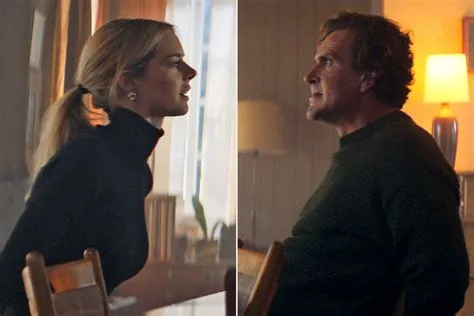
Over Your Dead Body (2026, Jorma Taccone)
Well, they've done it. They've managed to put Samara Weaving at the center of not one, but two films, I just don't like. They, in this case, being the film industry in general, though I can't say Weaving's business team and her taste in scripts are without responsibility, as much as I'd like to.
Over Your Dead Body stars Weaving, as Lisa, and Jason Segel as Dan, a married couple, headed to a weekend at his father's lake house for a getaway, where each has planned to try to kill the other. A combination of life events and lack of maturity has driven their marriage into the ground, and one of those life events being financial ruin, each wants to kill the other, end the marriage and secure the windfall of life insurance as a way to escape the debt the marriage has accumulated.
This is, at least, the movie we begin with. There's a point that it introduces a new set of three characters and becomes another movie. That second movie is far less interesting, because it's much dumber than the first. At that point, there are four excellent, charismatic, compelling actors, whose characters are or become a few steps beyond what is so often referred to as cartoonish. Do you remember in the Looney Tunes when Daffy Duck or Bugs Bunny would pull a giant mallet out of... somewhere... and smash Elmer Fudd over the head? When the film takes its turn, the three characters that are introduced are about as much characters as the mallet was. Timothy Olyphant and Juliette Lewis are completely wasted in their roles, as a result.
That first part of the film, the one it leads you to believe you're going to see, has the capacity to be interesting, and funny. Weaving and Segel are excellent casting choices for that film. Both are charismatic, and capable of playing in that place between comedy and impactful, emotional depth. A film exploring the nature of a relationships dissolution, through an absurdist lens of its husband and wife having reached a depth of disappointment and anger they've decided to kill each other, has room to be a Buñuel-esque exploration of gender, relationships, and the American Dream. Hell, this could even be the setup for a Hitchcock-eseque thriller. These two leads are capable of either, and for a little while, the possibility of something as interesting as either of those two films would be is on the table. Admittedly, these are difficult films to make well. Either would be a high ambition to reach for. I, personally, would rather see a film with a grand ambition miss its mark than the film I watched. The film I watched seems to only have the ambition of being a collection of moments and scenarios designed to wave a cartoon mallet around in front of the camera.
It's in that sense of possibility that I found the film disappointing. When it makes it turn, the film it becomes has no such ambition. It's not interested in exploring much of anything. The feeling I came away from it with was the the writer(s), Tommy Wirkola, Nick Ball, and John Niven, were doing everything possible to avoid exploring anything, and in so doing, turned to a very rote, predictable, easy set of R rated Looney Tunes gags.
I can see Tommy Wirkola's fingerprints on this script. One of this previous films, Violent Night has a similar set of elements. That film mixes a somewhat schmaltzy sentimentalism, broad comedy, some very well choreographed action scenes with charismatic performances to produce something that's satisfying and fun, because it manages to feel a little transgressive in mixing its tugs at your heart strings with such an orgiastic approach to its violence, and it's willingness to put a character who couldn't be more associated with wholesome goodness, Santa Claus, into that mix and make him fit in that universe. With David Harbour as Santa and John Lequizamo as the antagonist, the two leads capable of making that level of absurdity have some emotional depth and grounding, and there's just enough investment in the characters to sprinkle some honest human truth on top of it all.
In it's structure though, Violent Night never gets too far away from why we as an audience should care about anything that's happening on screen and why we're supposed to be rooting for Harbour's Santa and the little girls who is his de facto accomplice. In Over Your Dead Body, we go from Weaving and Segel's character's being the center of the narrative, to another set of characters being the majority of the focus, and there's nothing remotely interesting about those characters. Even what could be interesting about them is avoided, with a mix of not very interesting action beats, and a sense of shock and threat that is too grim in comparison to the rest of the film's tone.
I can appreciate some Looney Tunes style comedic violence in a film. I did enjoy Violent Night. Evil Dead 2 is, in my opinion, a masterpiece of comedy, because it understands the mixture of elements that make that particular variety of comedy entertaining, visually interesting and they mix well with the variety of fantastical absurdity horror often traffics in.
There's a point Over Your Dead Body introduces the threat of sexual violence, and it returns to that sense of threat again at another. Maybe it's me, but there's a weight to the threat of sexual violence that is too much for the kind of cartoon, Three Stooges attitude the film has about all of its violence, and its characters. The way it's introduced and the way it's handled just can't carry that weight.
Straw Dogs is a controversial film. Whatever one might feel about the execution, it understands the weight of the subjects it's dealing with. "What if we made Straw Dogs, but it's a comedy?" sounds like a pitch meeting that would happen, and unfortunately, it's a pitch that not only was put into production, but it somehow attracted a set of talent in front of the camera that is more than capable of handling the weight the subject matter deserves. The feeling is the intent was to follow the desired tone, and the focus on tone results in not seeing how what it starts touching on is antithetical to the tone the filmmakers were set on delivering.
The assumption in the way this film is written and constructed is that the audience for it is only really interested in how. It consistently turns to the how in its evasion of who and why. It sees the who and why as excuses for getting to the how, and maybe I'm just not the audience for that. I lean much further toward excusing some sloppy execution of the how, as an excuse to get to the who and why. The how of a film like this isn't interesting to me, if I'm not invested enough in the who and why, and frankly, the how of this film is pretty uninteresting by itself. It's possible to make a film focused on the how that's interesting and compelling, but its a very different kind of film. Shin Godzilla is a great surprise in that it makes the how of the response to a giant monster stomping around the landscape interesting, compelling and funny, because of its banality.
But that brings me back to the question of exploration and the assumption of who the audience for the film is. Shin Godzilla is an exploration of how, because it's interested in the why of what the how is. Over Your Dead Body isn't interested in exploring much of anything. It assumes the ending it delivers is what the audience wants more than they want an exploration of anything, about any of its characters or the world they exist in.
In the past, I've refrained from writing about films I just don't like very much on this Patreon. My feeling was that there is so much negativity designed to be clickbait where it comes to just about every subject imaginable, that I didn't want to contribute to it's continued contribution to discussion of something where curiosity is so much a part as storytelling. The grift that is the hyperbolic declaration of that negativity in our information environment is the antithesis of curiosity. It ends up creating a sense that the only interesting thing way to think about anything is the question of what possible insult one can justify.
I have to thank Sharai Bohannon for causing me to think about the other side of that coin though in the information environment related to culture, the variety of film focused writer whose goal is to get a quote attached to a film's marketing. It's hyperbolic positivity, in service of trying to expand one's exposure, which is a grift of its own. Probably less damaging than the negativity of its opposite, but no more honest or curious.
And, if I'm going to be honest, that lack of curiosity is why Over Your Dead Body fails for me. What we end up with is a handful of stereotypes, and an assumption about what the audience relationships to those stereotypes are. I'm sure there's an audience who have that relationship to those stereotypes, but it's not me. It stinks of the kind of suspicious, frightened certainty at the heart of what's always repelled me about cultural and political conservatism. It's a film that's a product of feeling the questions it could ask along the way are too terrifying, so it turns to simple, easy assumptions about who it's characters are, why they're doing what they're doing and what about any of it might be interesting to the audience. A film doesn't have to challenge general, socially supported assumptions to be good. It can also support them in the way it comes to reveal what might be positive about them and be interesting. Good storytelling at least feels something in its premise and subjects are worth exploring, and Over Your Dead Body has zero interest in exploration and isn't curious about anything. It's just keeps turning back to the certainty of its assumptions of the stereotypes it's dealing with, and that's patently uninteresting to me as an audience member.