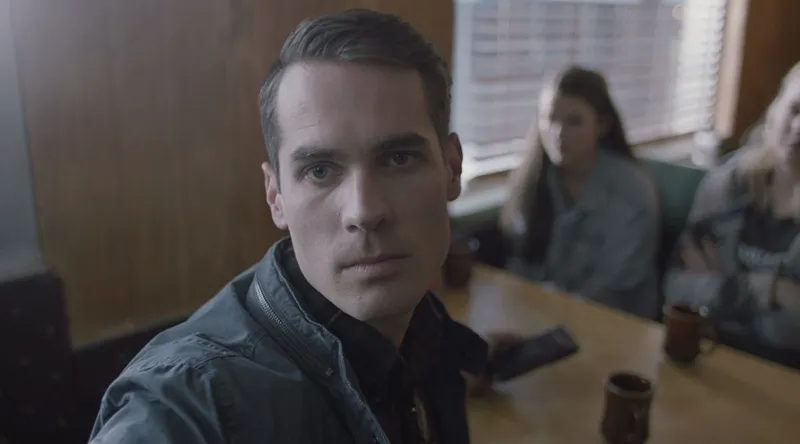
The Wolf of Snow Hollow Part 3: A Man and A Woman
Having gone through John Marshall's sense of his masculinity, its foundations, and the personal issues it's causing him in Part 1 of this series, then the way the film presents the spectrum of masculinity in the town of Snow Hollow in Part 2, it's time to take a look at the way the film presents an alternative to the "traditional" gender roles, and how masculinity prevents John from recognizing this as available to him.
One of the central focuses (and sources of entertainment) in the film is John Marshall being a pathetic failure at almost everything he's trying to do, and how that sense of failure is driving an emotional and psychological decline that is then further hampering his ability to be effective at any of it. His response to that ineffectiveness is trying to "man harder" or as it's more often referred to, "man up." He consistently turns to his sense of masculinity for the answers, as if embodying more completely would be the solution, but it's masculinity that restricts his options so thoroughly, then being the source of the ineffectiveness and the anxiety he's trying to solve. By the end of the film, John has become a killer, and the life he has been envisioning for himself is no longer possible. It's not exactly a tragic ending, because the man he kills is a serial killer of women, and the fact that John has to change his conception of what's possible in his life, along with the consequences of his decisions, are what's responsible for the degree of growth we see in him in the final scene. John is on the journey to being a better human being, and by extension, a better man by the end of the film, which is good. At the same time, murder isn't justice, and getting here required John to become a murderer, on top of the varieties of chaos he's causing in the lives of the people around, most notably for his daughter Jenna.
John can't see alternatives to what masculinity presents as the answer to the conflicts driving him, because there aren't any men in the town of Snow Hollow who are demonstrating an alternative. And in many ways, this is one of the other tragedies of masculinity, because there is someone who is demonstrating an alternative in how to be effective at everything he is failing at, but that person is someone he sees as a woman, and the gender norms of heteronormativity require men not see behavior as being effective or ineffective, first and foremost. It requires behavior be seen through the lens of gender first. Those norms require we don't see any behavior performed by a human being as human behavior first and foremost. We see the person performing the behavior in the context of how we perceive gender, and John isn't a misogynist in the sense that he hates women, but he is sexist in the degree he doesn't recognize them as people he can learn from either. It never occurs to him Deputy Julia Robson is demonstrating all the behaviors it would take to navigate being a successful sheriff, and all around human being really, in the context of the town of Snow Hollow, because she's a woman, and her behavior isn't an option for him to model his own on.
Robson, as a character, is in many ways, a beautiful ode to the practicality of women who decide they're going to follow a path that takes them through spaces dominated by men who ascribe to patriarchal gender norms, whether its the town of Snow Hollow as a whole, or the sheriff's department. Her existence in the sheriff's department is breaking those norms on its own. Because the film isn't centered on Robson, we don't know whether she comes to that practicality from a goal oriented perspective, doing the job as well as possible and relying on the impact of her effectiveness at it or from some more individual value based perspective, that if she's going to be in law enforcement, she's going to be as effective at it as she is capable of being. Either way, the character is clearly focused on the most effective way to navigate every situation she's in. Gender may be part of the consideration, in terms of how people respond to her, but the only consideration for her is how that influences what the most effective way is to approach the situation or people. If Robson were defining herself by the patriarchal gender norms all the male characters are, she wouldn't be working in the sheriff's office at all.
One of the beauties of the The Wolf of Snow Hollow is its deep loyalty to the humanity of its characters. As I've said in the two previous parts of this series, there is no way to argue John Marshall is not an asshole. He's not a monster though either. The motivation of the film is revealing what makes him an asshole, despite being intelligent enough and having the motivation to be capable of better decisions. I have known far more men like John Marshall than I can count, and however embarrassing it may be to admit, I've been among them at times. There is a baseline grounded reality to the character.
At the same time, The Wolf of Snow Hollow demonstrates that asshole and monster are a spectrum of behavior that arise from the ways masculinity creates deeply broken, unwell human beings. It presents a spectrum of masculinity that, at best, produces men who can't care about much of anything other than having fulfilled that sense of masculinity, who live in a comfortable, protected ignorance, like oversized children imbued with the power of law enforcement. At worst, it presents men whose sense of their own inadequacies related to masculinity results in the need to embody the symbol of the predator, in an attempt to fill the space between themselves and the requirements of masculinity with women's blood and flesh.
It isn't a flattering picture of masculinity, by any means, but it does give men the respect to be honest about them as human beings. It avoids the oversimplified canards of personal responsibility, instead treating men like what they are, people responding to the conditions of their environment according to the culture that creates those conditions.
The same is true of Robson. One of the things that has made feminism's push to rethink gender make sense to me, has been the number of women I've known who share the Deputy Robon's intensely practical foundation, in approaching things they choose to do from the perspective of being as effective as possible at them. Where John's intelligence is demonstrated in his intuitive thinking, his ability to stick to the evidence available, not get mislead into the easiest possible answers, the film portrays the kind of intelligence Robson possesses in a different, but very real, grounded way.
Robson is taking that extremely simple foundation, be as effective as possible, but the way she's able to apply it demonstrates a wide ranging, deeply perceptive variety of intelligence too. Both in the film, and in real life, it is unfortunately more the norm for women demonstrating this to not be recognized for it. Robson is only interested in the norms of gender for the ways they influence how she can be effective in the moment she needs to be. She's not interested in or baited by conflicts arising from challenges to her sense of her gender. The way anyone else responds to her only matters in how it helps or hinders her ability to move the murder investigation forward, and how it effects the impact she's able to have in that endeavor. Hers is an intelligence that comes from her understanding that she is one person, among other people (whether they are men or women), who have their own motivations and beliefs, and how well she is able to navigate that in service of her goal.
What we see in Robson is often described as the "soft touch," which in its way delineates it as feminine. Patriarchy delineates all things soft as feminine, because it suggests being malleable. Men are expected to be rigid, unchanging, stoic and stolid. By the nature of expecting women to be submissive and subservient to men, it carries with it connotations of being changed or swayed by circumstance as a feminine trait, therefore one men shouldn't embody.
All of that leads to discounting the depth of intelligence and perceptiveness that it takes to adapt one's perspective or approach to different situations. It takes a nuanced ability to understand and navigate the complications of human social environments, with a realistic and accurate appraisal. This has been one of the things I've experienced and witnessed (especially in male dominated spaces), in so many women who come to be seen as indispensable to things they decide to participate in. There is nothing "soft" about it, and its not something magically available to people who happen to be born with a vagina. It's the use of deductive reasoning, experience and a disciplined perceptivity to navigate overlapping, complicated, sometimes contradictory factors to achieve the desired goal.
It takes curiosity, intelligence and dedication to learning this skill set and perform as well as Robson, and so many women do in real life. That skill set goes undervalued, because to recognize its value would be to highlight how much the norms of masculinity are centered in a willingness and ability to engage in conflict. When we look at the two primary roles we talk about related to masculinity, the protector and the provider (which in so much of the communication and teaching of masculinity is linked to predators and predatory behavior) they are both associated with conflict. To be the protector, a conflict has to exist. To be the provider, because of all of its associations with predation, is to have the skill to insight a conflict and to overcome the thing you are trying to inflict predation on. Conflict, in and of itself, becomes a way of asserting, demonstrating and fulfilling one's sense of masculinity. The question of what engaging in that conflict serves, often never even comes up, because the insecurities masculinity instills leave no room or time for it to come up.
This though, misses an extremely crucial wisdom that Robson, and the many real women like her, understand consciously or intuitively... the very old adage about choosing your battles wisely. It's often presented in the context of whether one can win the battle they're engaging, achieve the desired result of the conflict. There is another kind of wisdom in this question though too. Does this conflict need to be engaged in now? Does engaging it have any effect whatsoever on the outcome of the larger endeavor being undertaken? At a number of points in the film, Robson steps past things that could become conflicts, because they are unrelated to and will only hinder, the larger objective of solving the murders and insuring whoever is committing them cannot continue to do so. We see in John, his sense of masculinity requires him to meet every conflict with aggression, because not doing so threatens his sense of masculinity.
Part of the reason I respond to The Wolf of Snow Hollow so positively, isn't just that I recognize John Marshall in many of the people I've known, and myself, but that I also recognize Robson. The film treats neither of them as "good" or "bad," and its comedy doesn't end up coming across as trying to create excuses for John Marshall, in part because Robson is present as a character. We can assume, because of the reality of what it means for women to navigate environments as male dominated as the Snow Hollow sheriff's department, Robson is doing so because she implicitly and inherently believes what it requires of her is worth the results it produces, at least in the sense of things like public safety and justice. She's willing to violate the kind of patriarchal gender norms the town is clearly infused with, by being in the department in the first place, to achieve that end. What person who is seen as a woman would choose to deal with what Robson is dealing with in the form of her fellow deputies, if they didn't believe it was worthwhile to do so? That sense of being in service to something larger than herself, is also part of what allows her the ability to discard gender norms when they're not useful in that service.
That, in and of itself, is what John is missing, because the insecurities, anxieties and let's call it what it is, neurosis, engendered by masculinity make it impossible to see. They render him incapable of considering that he could possibly be a human being first, and that all the ideas about masculinity that plague him, might not do him any good. He so deeply fears the consequences of failing to fulfill the demands of masculinity, the urgency of those fears over rides the ability to see not just the options Robson demonstrates in her actions, but how he could quiet and eventually be rid of those fears by dethroning masculinity from its primacy in his life.
There's necessity in feminism's expression so often being focused on the behavior of men. There's also an aspect which ends up contributing to the idea that a gender binary exists. I, personally, don't think the solution to this is to attempt to police feminist expression. Instead, the solution is creating a better understanding and a better record, like that which feminism has created for women, in exploring the chasm between masculinity and the human beings we refer to as men. The concept of the gender binary is a significant part of what masculinity relies on in preventing men from learning from women. It asks us to see ourselves first as men, and to turn to it for the answers to anything we face, instead of being able to look around at the available behavioral options and ideas for how we might best serve whatever endeavor we're attempting to engage in. It helps to discourage the ability to engage with the kinds of expression, like the multitude of expressions we call feminism, which can create a sense of identification which overcomes the barriers masculinity benefits from.
John Marshall fails himself, and just about everything he's trying to contribute to, because he's incapable of seeing himself as a human being first, and is constricted in who he can see himself being or what might be possible, because of the masculinity he's been socialized into. Julia Robson ends up being far more effective at the thing John has been trying to make himself into, a good sheriff, because that neurosis about gender doesn't define her. In embracing her humanity as primary, it leaves her the ability to adapt as necessary, to be effective in that role.
The idea that embracing ourselves as human beings before any of the other categories we assign to each other, is how we begin to be able to understand the best possible options in our given context and environment, for how to make the best contribution, authentically be ourselves, and in the end, be the best human beings we can be. Restricting our options to what patriarchal gender norms offer in their very narrow parameters, doesn't do anything but cause us all manner of grief, insecurity, anxiety and neurosis, that not only make us ineffective, but lead to maladaptive responses to the inevitable difficulties and conflicts of the complicated business of living. In all of this, The Wolf of Snow Hollow is an unusually insightful, humane exploration of very human frailties.