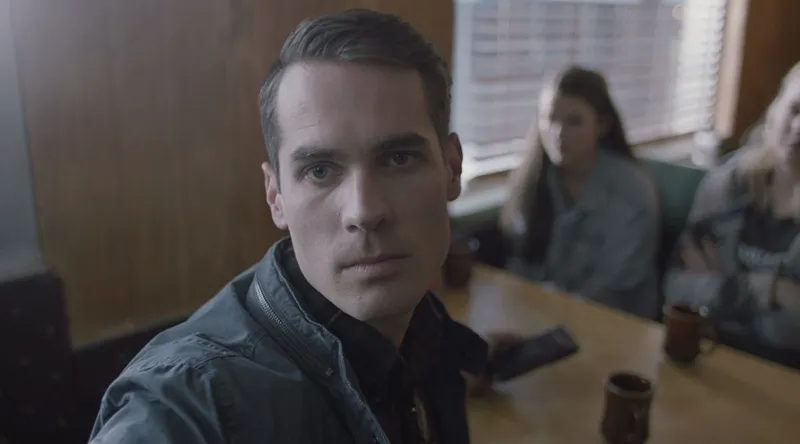
The Wolf of Snow Hollow Part 2 - Predators and Idiots
In Part 1 of this series, I went through the ways The Wolf of Snow Hollow depicts its protagonist, John Marshall, in how his inability to see beyond his conception of masculinity was creating havoc and conflict in every area of his life, including getting in the way of the murder investigation he's trying to conduct.
John Marshall doesn't exist in a vacuum though. As I outlined in that first part, John's conception of masculinity is directly descended from his father. His father is the model John is trying to live up, despite what John sees that model do to his father, and in turn, what his relationship to his father does to him. That conception of masculinity drives his father into his grave. John is also unable to see that he's creating a similar dynamic with his daughter to the one he's had with his father, despite knowing full well how much distress it cause him being the child in it.
There is, in any discussion of things that have heavy or highly intense emotional connections and associations, including those related to gender the film creates around John Marshall, "Why doesn't he just (insert simple, easy, obvious alternative)?" This is something we see in pretty often in relation to the question that is at the heart of this series about the film, "Why are men?" One of the things The Wolf of Snow Hollow does, very subtly, is show us the answer to the question of why John Marshall can't see alternatives, beyond the emotional and familial attachment that is his relationship with his father.
It does so, by putting John in context, and not just through his relationship with his father and the impending responsibility of becoming sheriff. It shows us a spectrum of masculinity the men in Snow Hollow are demonstrating or performing. One of the essential parts of a person learning to see alternative perspectives, is that those alternative perspectives are available to or presented to them. In many ways, this is the foundation of Cognitive Behavioral Therapy, the predominant form of therapy practiced in the United States. How can you look at this problem from another perspective? If you change your perspective, you can often find different possible solutions. It's part of why we talk to people who care about us about our problems and conflicts, they're someone who knows us well enough to know what not to suggest may be a solution, and hopefully, we're developing relationships that we're secure enough in to be able to hear what they may have to say, even if it is outside of what we'd normally consider as a viable solution. We're more willing to hear hard truths from people we know care about us, because part of giving trust is believing there's no ulterior motive and they take no sense of joy or satisfaction in our discomfort or pain.
Alternatives to the kind of traditional masculinity and ideas about gender more broadly, have no representation in the town of Snow Hollow. In one of the earliest scenes in the movie, the couple the movie opens following are having dinner in a local restaurant, and after hearing one of the local men yell a homophobic slur, the male in that couple has a verbal confrontation with the guy who yelled it. It's not a coincidence that he says, "Do you guys have the internet in this town? It's really great, you should check it out. It'll teach your mom's to read." It's a nod to the fact that the kind of discourse around gender and social norms that's been driving a good deal of our sociopolitical conditions more broadly, isn't penetrating the culture of Snow Hollow as a community. The degree of comfort this person has yelling this particular slur out in a public place is a demonstration of that fact.
Jim Cummings and company, do wrap this person in the cinematic language of a stereotypically "country" person. This first interaction with him puts him in line with cinematic language of "redneck/hillbilly," in the connotation of the words disconnected from their historical meanings. The way he dresses, the way he talks, all of it. He's not alone though either. There's also a bit of Napoleon Complex to the character. When we cut to him, we see he's short, thin, and loud. There is someone else with him though, and the way he responds to an outsider challenging his friend on the use of this slur, is far more in keeping with the way "rural" or "country" are portrayed with positive connotations cinematic language. He's polite, and isn't confrontational, a bit more toward what we'd think of as laconic. However he may feel about any of it or whatever he may believe, he at least recognizes this isn't something that needs to be more of a conflict than it already is. I don't think it's a coincidence of the two men, he's the much bigger of the two. It's likely, because of his size, he hasn't spent his time in Snow Hollow having his sense of masculinity challenged for others to feel secure in their own.
So, the film starts with a clash over masculinity. The couple are PJ and Brittany, and Brittany says, "That was extremely, extremely stupid of you." PJ responds, "I know. I'm sorry. It's just that word. It's that one word. I wouldn't have said anything. What if my brother was here? I'm sorry. I shouldn't have..." We get the impression PJ's brother is gay, and personal proximity to someone to whom the slur has a long and terrible history has given him a sensitivity to it. The Wolf of Snow Hollow being released in 2020, in most of the country the "f slur" had fallen out of being generally acceptable in the cultural lexicon already. PJ and Brittany, we learn later, were visiting from Orange County, California. Brittany had for some period of her childhood lived in Snow Hollow though, having attended elementary school in the town. She will be the first victim, and the guy from the bar PJ had initiated this confrontation with is the first red herring of the film. Brittany is also extremely agitated by this confrontation, in a way that might seem over wrought or over blown, but when we take the full events of the film into consideration, her assessment of the risk of masculinity competitions in Snow Hollow is accurate.
For those of us who understand why it should be unacceptable for someone to shout slurs randomly in public places, it's easy to write it all off and simply see PJ as being the better person, and he is, but there's more to it as well. We also learn later in the film, that Snow Hollow is a tourist destination during ski season. Anyone who has ever lived in or near a place that either has a regular influx of tourists or part time residents has experienced the degree of conflict it creates when the economy is is focused on serving people who aren't full time residents who are often of a lower economic status than the tourists or part time residents. The insular nature of Snow Hollow's masculinity is likely, in part at least, a response to this. It creates conflicting imperatives for the sense of masculinity for the men who live there.
One of the most dominant imperatives in the way masculinity is communicated and transmitted is being a protector. There is, in the general sense, the idea we're supposed to protect "our" people from "bad guys." It gets more complicated when you start asking who the "bad guys" are, because they are always "Them," and never "Us." That translates easily in communities that attract tourists. "Them" are the outsiders, the people who aren't part of life on a day to day basis annually. It's one of the ways "The devil you know is better than the devil you don't" becomes a truism. It's easy to call it provincialism or small mindedness, but the economic pressures and conflicts that arise from these conditions are real, and they do create tension within the community of full time residents, which often contribute to the marginalization of the least wealthy and economically stable. Performing masculinity doesn't prevent someone from being subject to this reality. So, the protector comes into conflict with the other dominant imperative transmitted as central to masculinity, the provider.
Even as I agree with the fact that we should all be applying social oppobrium to bigots, we have to acknowledge PJ is acting on the imperative to be a protector. His reasoning comes as a reaction to the degree traditional masculinity has persecuted gay men, and queer people more broadly, specifically because the fact of their existence calls the concept of the gender binary into question. At the same time, when he says, ".... maybe it'll teach your moms to read," he's leaning on class stereotypes and stereotypes of people who live in rural areas that exacerbate all of the anxieties and insecurities masculinity creates. PJ is protecting his "Us," from the perceived "Them."
Later, when we see the local who was yelling the slur talking to officer Robson, he specifically omits the fact that he yelled a slur, itself a sign he understands this isn't widely acceptable, yet no one else in the restaurant said anything about it, again, demonstrating how the norms work in Snow Hollow. And part of what he uses to avoid that uncomfortable truth, is the fact that PJ is an outsider, an out of towner. He knows this is a conflict anyone who lives in the town is aware of, because you can't live in a place that's at all dependent on tourist dollars and not be aware of it. He's using class as an excuse to not confront the aspects of it that come down to masculinity, and the truth is, because of the way we have conversations about masculinity, he may not even be aware that's what he's doing. Class is an aspect, and certainly a material reality that shapes behavior, but it's not the whole story.
The other interesting thing about this being so early in the film may have been intentional or it may have been a coincidence of casting, but when PJ calls out the local who's yelling slurs, that local isn't alone. He is someone who also happens to be of a small stature. He's short. The person he's with, his friend, is not. He's a taller, much more imposing figure, and he's also the one who clearly understands this conflict doesn't need to escalate any further. He's calm, polite, conciliatory, where the loud one is the short guy.
It ends up playing on the idea of the Napoleon Complex. Our loud local comes across as a stereotypical example of it. It's a thing recognized as deeply annoying, by people of all genders, and is often the basis of insults. It's impossible to argue it isn't deeply annoying, and it's effect on the way many of these men treat women is destructive and harmful. At the same time, it can only exist because of the degree we buy into the gender binary. The truth is, within masculinity itself, boys of smaller stature are subjected to a level of bullying and consistent threat of violence that's plainly different from their peers. What we call Napoleon Complex isn't a completely irrational response to the imperatives of masculinity. If larger boys will continuously assert and demonstrate their masculinity by asserting the "superiority" of their masculinity over smaller boys, there is nothing illogical or irrational about developing a defense against that. What we call Napoleon Complex is a maladaptive response to destructive gender norms. There's also nothing wrong with finding fault in a person who doesn't recognize the degree their insecurity is having harmful effects on people around them. If we're going to talk honestly and accurately about gender though, in something like Napoleon Complex, we do have to recognize it is the result of the way patriarchal gender norms are as responsible for it as the individual is. When we focus on it solely as an individual failing, we're collectively practicing the same short sightedness we chastise the individual for.
What we see throughout the film, is by numerical majority at least, is the more passive version of "traditional masculinity." It doesn't have to be active in Snow Hollow, because it's dominant, and seems to have little challenge, so the men who most fervently subscribe to it don't have to take up the mantle to defend and try to reproduce it. It's passively accepted to a degree that conflict would only call into focus that it is so dominant, and that there are alternatives. Knowing this, we can assume the guy with the Napoleon Complex, yelling slurs in the middle of a public place, has been subjected to its enforcement and its socialization, and being of smaller stature means its also likely that socialization means having learned other men are going to use him as the method to assert their own masculinity, to his detriment.
We accept entire complexes of assumptions based on the degree we don't like to admit "Boys being boys" and socialization into masculinity so often involves physical and emotional abuse within patriarchal systems. Men are, in a sense, socialized to be the jailers of patriarchy. We are socialized to enforce the standards and norms it requires on women, and on each other. It's accomplished via different social or personal mechanisms, depending on gender, but overall, if we're talking about adults, different forms of physical and emotional abuse are more likely to have been part of shaping that boy into the man he becomes than not. This is as true of boys as it is of girls, but because there has been little or no interrogation or investigation of masculinity from within it, it's not as recognized, understood and accepted as it is for women because of feminism. It's social engineering, using trauma as the tool of control. Trauma does produce a spectrum of results, but that spectrum is fairly reliable, especially when it has some basis in gender. This, I also think, is part of why there has been a response from people who most ardently identify with patriarchal gender norms that "all this talk about trauma has gone too far." If we all just picked ourselves up and fit ourselves into the socially acceptable models, without interrogating them, we don't ever get to the degree trauma is a tool of social engineering, as much or more than it is the result of individual, personal failings.
It's not a coincidence these patriarchal structures created this kind of permission structure raising and socializing boys into men. There is no more effective, harder to undo and longer lasting socialization, than that of traumatic experiences in our developmental years. Feminism, again, has demonstrated this reality, and given it enough evidence to make it undeniable. Psychology and psychiatry as entire fields, as well as neuroscience, have added further proof as they've advanced. The difference, is essentially, in the people it's trying to "discipline" into being men, the desired outcome is producing people who will serve in the maintenance of those power structures, and women are disciplined into serving those men, so those men have the time to serve those power structures in maintaining and supporting them, including lack the perspective to question their relationship to power, because those insecurities and anxieties are dominant in their sense of self preservation. Power needs soldiers. It needs police. It needs jailers. Traditional masculinity creates the people who are not only willing to fill those roles, but are unable to question them, in order to preserve their sense of identity. It all works in cooperation to prevent us from a confrontation with our relationships to power, which is part of how those systems of power end up preserving themselves.
One of the more sly things the film does is make John, because of this inner conflict, the "best" of the men we do get to spend any time with. As I said in the first part of this series, John is an asshole. There is no defending him. His behavior is destructive, harmful, ridiculous and in some ways, pitiful. He is driven to solve these murders though. He is disturbed by the degree he isn't having fulfilling and satisfying relationships, most especially with the women he should be closest to, his ex-wife and daughter. There is a deep, reflexive selfishness in his drive to solve the murders, in part to be seen as effective as a police officer and in part to fulfill the promise he made to his father before he died. That these are selfish, doesn't change that its a drive absent from the men around him. The other men in the sheriff's department are incapable or unwilling to accept the responsibility the murders create. They are all men without the slightest sign of inner conflict about any of it. Their most significant sense of conflict is with John's repeated attempts to require they develop some sense of responsibility as members of law enforcement. They're all self satisfied, and comfortable with being completely ineffective in that role. John's conflict with the men around him, is in how much they are the barrier to his ability to satisfy the sense of masculinity he's trying to embody.
On one end of that spectrum, we have the men around John in the sheriff's department. Despite their lack of effectiveness in what we see as the single responsibility they have, aiding in solving this series of murders, they are unbothered. In the scene at the beginning of the film, as John sits at a diner with three of them, one of them can't even say the word vagina. He's supposed to be investigating the murder of a person whose physical existence is so alien and discomfiting to him, he can't even use the clinical language to describe the injuries done to her. He's also the first one to start referring to paw prints at the site of the murder, an allusion to the number of people who are going to try to suggest the murders are committed by a werewolf or some other exotic animal or large predator. It's the first time we see John has an analytical capacity beyond theirs. He responds, "No, it's not an animal. You need a knife or specialized claws, and you need thumbs for that, and you don't have a getaway driver if you're a serial killer." It's in this same scene, John figures out the killer was watching the victim from behind the nearest fence. A detail that has meaning later.
It's at that point, one of the other deputies, Chavez, the one who will most consistently bring up the possibility of a werewolf committing the murders says, "My heart goes out to the boyfriend," and not because he's discovered his girlfriends body, a woman we've seen he plans to propose to, but because, "It's the ultimate blue balls story..." He's making a joke about it, from within the hyper masculine perspective that sexual conquest or sexual relationships are the primary and singular reason to interact with women, and to avoid the conversation that the laws of predictability dictate this murder was committed by a man. He does this by objectifying the woman who was murdered. She's reduced to an object of sexual satisfaction, despite the fact that she's been brutally and horrifically murdered. Earlier, at the crime scene, we saw Chavez also being unable to actually express the details of the crime to the sheriff. "That part of the crime scene is missing." Not the body. The crime scene. It's accurate, in a broad way, but it's also evasion. Chavez is confronted with a the brutality of the crime, the reality of what it means for a human being, and he retreats to cover of masculinity to avoid a reality masculinity has helped create, in part because of the sheer horror of it, and because confronting masculinities part in it means questioning self identity too.
It's not a coincidence that later in the scene, Chavez, after a young waitress leaves the table, says, "Why did you let me get married?" an obvious allusion to the idea he finds the waitress desirable, and the need to constrain or disregard this in the role of marriage as the barrier to what he really wants. It all suggests Chavez is uncomfortable with a woman being the center of attention, even if it's a dead woman, unless that attention is that of sexual object. Again, a distance from the basic humanity, the idea that women are human beings, before they're women and not vice versa.
John answers to this saying, "You can't be married and focus on your career," which brings the conversation back around to the investigation, and tells us, directly, what John's priorities are too. His obsession with this investigation, isn't so much about the victim and finding her murderer, it's about his career. His sense of who he is, and what he wants. It's at this part of the conversation we're told the victim, though they seem to be renting an Air BNB or seasonal rental, attended elementary school in Snow Hollow, and John lists of the priorities for the investigation, including that they have ski season to think about, letting us know part of the town's economic well being is based in tourism. Jaws taught us all what bodies piling up mean for tourism. It's another added pressure on John to solve the murders.
The same officer who can't say the word "vagina" is also the one who suggests to John that they let "staties or the feds take over." The proximity to the murder that means having to create the space for the care the investigation requires is too much. John responds, "If you want people to stop talking shit about police? Do better police work." There's a degree to which he is right. There's also a degree to which what John refers to as "people talking shit about police" isn't about how effectively police fulfill the roles we assign them, in this case investigating a crime, and are about our fundamental assumptions about what policing should and could be. John's not going to acknowledge that though, because it's about how people see John, and it's likely not much of this broader national conversation matters in Snow Hollow. The other officer responds, "Somebodies gonna handle it." To which John, increasing in his agitation responds, "Don't say somebody. That somebody is us." He's not wrong. This is the role we've assigned police. It is their job to investigate this murder and do everything possible to identify and apprehend the person who committed it. What we see, is like Chavez just a minute before, this officer is trying to escape confrontation with the responsibility they have, and what it will require. This other officer is also, from his inability to even utter the word vagina, uncomfortable with the sheer humanity involved with this woman's murder. Masculinity precedes humanity for him. It is a threat to the masculinity he is so comfortable in, to have to confront the humanity of both the victim and the assailant, and how much gender plays a part in violent crime.
That officer goes on to say, "This whole things gonna be done in a week. They're going to incriminate somebody through a text, a Facebook message. It's the twenty-first century. Don't start with this shit John. Let the FBI find them," as if the FBI takes over local murder cases, without some overriding circumstances involved. He also calls into question whether it's a serial murder case, and at the same time in his invocation of the FBI, reveals he believes the person responsible is likely a serial murderer. In response, we get first instance of John imagining the cabinet in his house that he's hidden alcohol, and our introduction to the character was while he was in an AA meeting. We don't, at this point understand the significance of the cabinet, but it's a short shot moving in on the cabinet, interspersed with a close up on John's face, indicating where he is mentally going, in response to this interaction.
This scene shows us how the dominant concept of masculinity in John's environment, the community John is ensconced in, is a source of tension related to his own sense of masculinity. His sense of it, in part because he's grown up with a father who's sheriff, and in part because of the ways law enforcement and policing meet two of the commonly cited responsibilities of masculinity, protector and provider, is coming into conflict with the other men in the department. They don't have the sense of responsibility to insure the sheriff's department is executing its contract with the public. It's not, in their view, their responsibility to consider that. They succeeded in securing the uniform, the place among the subculture, they have "drunk drivers to round up" as the one says to John. Their sense of masculinity is met and fulfilled by just being in law enforcement, wearing the uniform and badge and going about the normal routine. I am a cop, and therefore am a man, essentially. Cops are functionaries of power. It doesn't matter how well the execute the roles we assign law enforcement. Those are separate concerns. The badge itself is the recognition they need.
John understands that being aware of public perception is part of being the sheriff, and whether or not he feels secure in his masculinity is then tied to how the public is responding to their effectiveness. It's why the fact that people are "talking shit" about police matters to him. How though, does one go about being a good sheriff, leading a law enforcement agency, when the rest of the men involved have the attitude the men around John do? They're not capable of being capable at their portions of the job, because they literally do not care to be capable, and the only incentive they have to care is to get John to leave them alone about how terrible their police work is.
Their sense of having the badge be enough, comes into direct conflict with John's ability to fulfill his sense of masculinity, because he has to be effective at the job to fulfill his. They treat this as John's personal, individual failing. The behavior John demonstrates in the anxiety and insecurity of that conflict, then just becomes evidence that this is his personal and individual failings, having nothing to do with the fact that they have zero interest in fulfilling the requirements of being law enforcement. The way he deals with their sheer inability to do the job or their care to even try, isn't particularly effective or useful. He responds with aggression. It's emotionally immature, and also, the frustration is understandable.
Within Snow Hollow, masculinity is an almost perfect trap to keep John both trying to fulfill this conception of masculinity, and to be pressured into greater and more destructive emotional and psychological terrain that creates more of what makes his sense of failure even more active.
For any person attempting to take the investigation of a murder with any seriousness, and the majority of the people around them were approaching it with the same attitudes and lack of seriousness the deputies around John are, to describe it as frustrating would be an understatement. We can also assume these are men his father hired from the available candidates. Either his father's assessment of what makes a good deputy is deeply under considered or there is no way to staff his department with people who would be capable and effective. John's in an impossible position, and to say there's some degree to which his father has responsibility means calling into question that same standard and model of masculinity that clearly a central driving motivator in who he believes he is and wants to be. So, John perceives their failures as individual and personal, in the same way they perceive his.
Moving further toward the negative, we have the false suspect, the man who is initially blamed for the killings. He's a loner, a heroin addict, and has killed one woman. Because of the lack of care the rest of the department has, they're satisfied with being able to say he was responsible for the murders, despite all of the evidence to suggest this being circumstantial and assumptive. Even Robson, who has demonstrated as much care as John has, for very different reasons, but she does care about being effective in the job. There is nothing in the film to suggest what might have been his motive for killing the woman he did either. We really know very little about him. We do know one of the reasons given for the certainty he has been responsible for the murders is his wolf tattoo.
At the other end of the spectrum, the other poll representing the opposite of John, we have Paul Carnury, The Wolf of Snow Hollow. He is a serial murderer of women. Carnury has been stalking these women, and we learn through the course of the film, he was previously employed at the elementary school all of them attended. We also know all of the women he murders have men in their lives, in some sense of a coupled relationship. Carnury's wife is gone by the end of the film. He's been married. His wife was clearly in his life at the beginning of the film. During the conversation John has in the diner, the same deputy who says they should let the FBI handle the case, says he got chewed out by the Carnury's wife over their property, where Carnury commits the first murder, being shut down as a crime scene. We get the impression from John's conversation with him, Carnury's wife has left by the end of the film. "She couldn't hack it," Carnury tells John.
Hack what? Considering the rest of their conversation, it's pretty likely she couldn't hack the rigid standards of gender Carnury has. It's possible she's also just not a very decent human being. Giving a deputy an ear full when your rental property is unable to produce revenue because it's the scene of a murder investigation, suggests some level of selfishness, but it's hard to say, considering the source of the claim. "An ear full" may have just been logical questions about protocol.
What we do know about Carnury, is extremely unsettling. There's the plain, abject fact that he's murdering women, and taking parts of their bodies as trophies. If that's not enough, the fact that he knows these women from working in the local elementary school adds a whole other layer. Jenna was one of his intended victims, and she's only seventeen. If we put that together with the fact that he's only chosen women who have men in their lives we'd think of as romantic or sexual partners, it continues deeper into the well of depravity.
The picture these details paint, is one of a covetousness, a sense of entitlement to these women. He's been coveting these women since they were children of elementary school age. All of them have chosen someone who isn't him. At no point do we get any indicator they recognize him or know who he is, as we are shown the fact that he makes himself known to two of them. Those scenes show he takes some degree of pleasure in causing them discomfort before he's attacking them. The scenes we see him in before the finale of the film, suggest he feels emasculated by his wife.
Whether it's purposeful or not, the fact that Carnury chooses to create a separate identity for the commission of these murders, suggests a sense of entitlement to and covetousness of these women and their bodies he can't integrate into his own sense of who he is. He has to become something else to fulfill it. That both of the men in the film who are responsible for killing women identify with the iconography of a wolf, says something poignant and troubling in its incisiveness, especially from the standpoint of 2026.
We are now awash in a political environment in which the mainstream political spectrum has embraced the existence of what it is calling the "manosphere." The new terminology erases how old this perspective is, as is the message of its purveyors. The delivery system for it is somewhat new, because of the technology, as are some of the conditions which have sustained it. Despite the way it's often discussed in news and the public discourse, there's nothing at all new about it's tenets though. Including the way it attempts to adopt the iconography of the wolf, in its constant droning and insistence of the value of men being in whether or not they are able to publicly perform masculinity as an "Alpha."
It is stolen or adopted from the observation of the behavior of wolves. When naturalists and the earliest wildlife experts began observing wolves, they observed that one male was essentially at the head, the leader of a wolf pack. He was dominant over the rest of the members of pack, and enforced its hierarchy through dominance postures and physical aggression. As this has obvious similarities to what patriarchy claims is the natural order of human life, it was adopted as explanation for why men should be treated as naturally suited for power in ways women aren't, including in the home.
One part of the problem is, all of this early observation was done on wolves in captivity. As time has passed and various fields that study animal behavior have had more opportunity to study the behavior of wolves in the wild, this model of rigid social structure doesn't hold up. Wolves in wild packs follow a far more egalitarian social structure. The conclusion that's been reached is that there is something about the stress of captivity that creates this behavior in wolf packs. The dominance posturing and rigid enforcement of hierarchy falls away, and threats of aggression tend to be displayed only when disputes among members of the pack reach a threshold which could threaten its stability. In the wild, the stability of the pack, achieved through this more egalitarian structure, is the primary social imperative, not the enforcement of hierarchy. There are even theories that have come to see young males being ejected from packs as an evolutionary adaptation so those males may develop skills and behaviors that will later serve the packs they may be accepted into, and in turn, help preserve the species, not that they're rejected as the result of status challenges.
This hasn't stopped the purveyors of the claim that "traditional masculinity" is the natural hierarchy of human behavior, and that the "Alpha" is exemplary of it in the animal or natural world. They ignore the more recent discoveries about the behavior of wolves, and maybe most conveniently, the fact that this behavior only happens in captivity.
One has to question the wisdom of deciding the ultimate avatar of human masculinity is a canine predator. If one were so inclined, the chimpanzee is one of our two closest relatives, and they do exhibit more rigid hierarchal social structures. They're not predators though. They're omnivores. What meat they do eat tends to be by opportunity, not the behaviors we associate with predation. Our other closest relative, Bonobos, also don't demonstrate predatory behavior, and tend to live in much more egalitarian social structures. If we're trying to use some scientific basis for explaining our behavior, and presenting viable options, you'd think we'd look to our closest genetic relatives.
I can't help but wonder if there's any wisdom in encouraging this identification with predators. I can't help but ask if this contributes to something cyclical. Men identify with predators, and are to some degree expected to identify with predators, and by extension, the behaviors of predation, and then we expect the "good men" to protect women from the "bad men" who engage in predation against them. If all men are expected to demonstrate predatory behavior, it becomes a competition between who can most effectively do that. Who are what are they providing for or protecting? Can you have a "pack" that doesn't involve other men? This identification with predation and dominance posturing as "natural" and "expected" does nothing but create a constant sense of competition, and women are expected to be both the support structure for it, and objects within it that signify status. As I said in the introduction to this series, I take very seriously the degree violence against women is accepted and part of our social fabric. I also think we fail to recognize the mechanics of patriarchal gender norms when we fail to recognize how much violence men commit against each other in the competition they socialize men into participating in.
People who advocate for the ideas and existence of traditional masculinity as "natural" use the wolf, and other predators, as symbols, because the story they tell about the predator is that it protects and provides for the pack or pride or whatever word we use for the social structure of the species being used as the symbol, and we conflate the "provide" part with predation too. It doesn't quite track though, I don't think. One of the things feminism's greater acceptance into our public consciousness has done, is to create the will to research its claims, and the evidence is pretty damning in the degree predatory behavior of people socialized to believe they are "men" engage in toward people they are socialized to believe are "women," affects both.
There are very few "providers," certainly in the United States, who are out there hunting down what's necessary to provide for themselves or their families. What we're really doing is engaging in elaborate rituals of cooperation, even when we think we're competing. There isn't a set of circumstances by which the deer sits down and negotiates the terms by which they surrender themselves to the wolves, in exchange for an agreed upon exchange of a symbolic representation of their ability to meet the legal requirements of ownership. The deer tries everything within its power to escape, and/or fight, and it does escape or it dies. It doesn't go home and ruminate on the ruination of its self image or reputation because either the environmental conditions or the wolves strategy made it necessary to surrender. It dies. Neither forks over an agreed upon number representing a currency, to relinquish or gain the legal status of ownership. The wolf pack doesn't have a promise of an addition to symbolic representation of its ability to procure the legal status of ownership after a hunt. The wolf and it's pack don't negotiate among themselves or with other wolves. They certainly don't negotiate with the prey for what amount of currency will be rewarded for the effort, time and expertise expended in the hunt. The wolf and its pack succeed in killing the prey or they don't. The wolf certainly doesn't expend any store of currency to procure the legal status of ownership of a Lamborghini so other wolves will see just how good it is at being a predator. A wolf never sits around pondering how market forces are going to effect its hunts over the next eighteen months or wondering whether the Strait of Hormuz being inaccessible to a whole lot of the world is going to screw up supply chains.
The wolf and its pack, eats or it doesn't. End of story. The story of the predator as the avatar of masculinity just erases all of the actual complexity and nuance of human social structures, the complexity of our cooperation, and most especially, the roles power plays in those structures.
I can't help but wonder if the identification with predators and predation veil degree to which predatory behaviors are the results of the anxieties, insecurities and status competition inherent in the way we identify predatory behaviors with power. It serves to both socialize people into those behaviors, and then covers the degree those anxieties, insecurities and neuroses are responses to that socialization. It gives power the ability to claim it's own behavior is "natural" and "human nature," not the the result of the degree power is, essentially, a collection of different privileges allowing it to act outside the norms everyone else is required to adhere to. I can't help but wonder what we'd see if we stopped engaging in that socialization, and what it might reveal about people who still somehow have the need to engage in predation. One thing is clear, it allows power the option to engage in behavior that would otherwise be recognized as predatory, and provide any number of justifications for it, because we're already primed to believe it's "natural," based on predatory behavior being associated with masculinity as natural.
Within the film, a significant part of what is driving John, what is also responsible for the degree his anxieties and insecurities are ruing his life and are behind his self destructive behavior, is the degree of failure he's experiencing at being a predator and protector, simultaneously. It's his job, in our vernacular, to hunt the perpetrator of these murders. He has to be a predator to be a protector.
His most recognizable self destructive behavior? Substance abuse. One of the same definitive behaviors we see in the false suspect. That he's a drug addict is one of few defining characteristics assigned to him, along with the wolf tattoo. This connects him to John. Both men are being driven to self destruction, a maladaptive behavior resulting from an inner conflict without resolution. The wolf tattoo, and the fact that he is also a murderer of at least one woman, connects him to Carnury, the man who is the actual Wolf of Snow Hollow. John's inability to conceive of his own sense of masculinity, one he is socialized into by his environment, one whose social norms support it, says the only solution to both his inner conflict, and his conflict with that environment and community, is to succeed at being a predator. Killing Carnury fulfills the imperatives of being both predator and protector, and all of this, the false suspect we know has killed at least one woman, and Carnury's serial murder of women, all lead to violence and death in the attempt to respond to a masculinity which requires men be inhuman to fulfill it.
What The Wolf of Snow Hollow is demonstrating, in the spectrum of masculinity it presents us with, is that even the men we'd consider the best in this concept of traditional masculinity, are being set up to fail. If we measure the morality of who we are considering the best example and the worst examples, John is at one end, being the man in the film most driven to solve the murders, most in conflict with how he's failing in other parts of his life, and ultimately, the man who delivers something in the realm of justice. The worst is Paul Carnury, a serial murderer of women, who covets their attention and takes their bodies as punishment for not giving it to him. In between them, we have men who just don't care to do anything about the murders being committed in their community, and a man whose been exiled or exiled himself from the community, and dies of his own self destructive behavior, having also murdered at woman at some point prior.
It demonstrates this conception of traditional masculinity, and by extension, patriarchal gender norms, and the gender binary, have no care for either the men or the women who are expected to forced to adhere to them, socialized into them. The mechanisms with result in the consequences for men and women are different, but we all end up paying with our lives, our sanity, our sense of well being, our ability to make and sustain satisfying relationships (romantic or otherwise). It's a film putting masculinity under investigation in ways similar to feminism's investigation of femininity and womanhood, and the conclusion is pretty clearly that the human consequences of both are dire, and catastrophic to the individual and the communities patriarchy claims to be the pillar of protecting and providing for. It presents us with the fact that becoming the best of men means becoming predator whose sense of fulfillment is found in violence and murder, and the best one can do if they don't want to become a predator and murderer, is to be an idiot.