
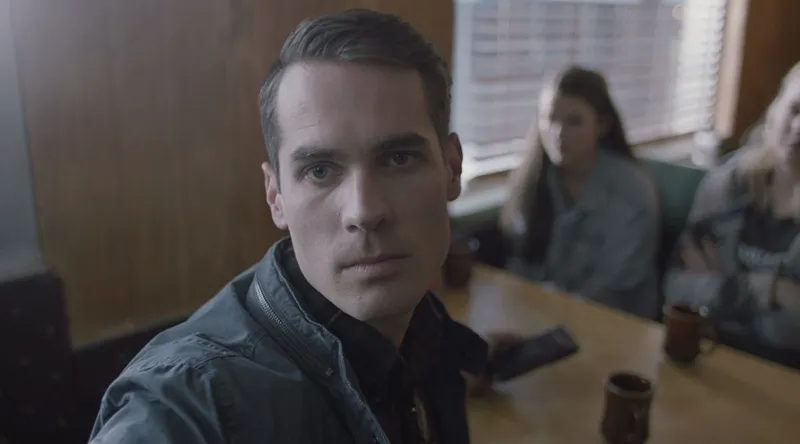
The Wolf of Snow Hollow, Part 1 - The Man John Marshall Is and Can't Be
From the first time I saw it, the thing that impressed me most about The Wolf of Snow Hollow was the combination of incisiveness, honesty and accuracy with which it's protagonist John Marshall is portrayed. It is accurate and little too plain to say, The Wolf of Snow Hollow treats John Marshall as a human being experiencing a masculinity problem. Every conflict he has, in every aspect of life the film gives us privy to, is created or made more acute by John's conception of his masculinity, and his relationship to it. What we're watching is a spiral of anxieties and insecurities creating ineffective responses, which create more anxiety and insecurity, all of them arising from that conception of masculinity. The Wolf of Snow Hollow is centrally about a man at odds with the world around him, because of his definition of masculinity, and it portrays a spectrum of masculinity as harmful to both the individual and those who have to exist alongside them, to different degrees.
John Marshall (played by writer/director/actor Jim Cummings), can't even see options outside of the model of masculinity he's partially been given and partially formulated from the requirements and norms of the world he's existed and grown up under in the town of Snow Hollow. That inability to even see other options, is causing his ineffectiveness in these different spheres of his life, which creates insecurity and anxiety, as well as deeply self destructive behavior. All of the negative consequences he experiences over the course of the film are rooted in his inability to reevaluate his relationship to the masculinity he's been instilled with.
Something true of every systemic form of exploitation and discrimination is that it will develop as many possible ways to limit the capacity of the exploited, no matter their level of privilege, to experience the fullness of their humanity. They try to create the conditions that ensure their maintenance, preservation and ability to expand. Where gender is concerned, patriarchy seeks to create the social conditions which will shape (through granting privilege, doling out punishment or enforcing neglect) the people it calls men to seek or accept the roles it needs for it's maintenance, preservation and expansion. In order to do so, it must shape them/us into people who can conceive of and are willing to wield the power in grants us to fill those roles, regardless of whether it benefits us individually or collectively. Violence is one of those powers.
Part of the beauty of the film, is the degree it includes both the model he's drawing on in Robert Forster's portrayal of his father, the community at large, and the sub culture John derives what seems to be the most significant portion of his self identity, law enforcement. There's a deep vein of humanity running through the film, in the degree it's honest and direct about the fact that John is ineffective. To put it plainly, he's an asshole. He's causing chaos and conflict in just about every aspect of his life. The film also takes pains do be subtle in its demonstration that there's enough of an awareness of this to make him deeply insecure and anxiety ridden. He's caught in a paradox. He's aware of his ineffectiveness, the degree he has a negative effect on the people around him, and because it's built into model of masculinity he's trying to embody, he can't see other options. He has no good options about addressing that ineffectiveness, that chaos and conflict he's causing, other than just try harder to be a man he is never going to be, because that thing he's trying to be isn't real. His sense of masculinity is basically just a story his father told himself, and in doing so, modeled many of the same behaviors causing John to be deeply ineffective.
As true as it is John Marshall is an asshole, a significant part of the inner conflict driving him, the thing he responds to by being an asshole, is some level of recognition he isn't able to effective. He isn't able to stop being an asshole. I don't know that John Marshall is a likable character, but this conflict is why he's interesting, and Cummings commitment to never allowing an opportunity pass to show John humiliating himself creates the comedic aspects that help make the film entertaining. The emotional and intellectual brokenness of the character, in all the honesty and accuracy he's portrayed, is satisfying on even the most surface level and why its developed a cult following among both men and women. The film is presenting a series of murders as the catalyst, the five thousand straws that break him, on top of the millions of straws masculinity has already saddled him with.
By including his father, and the men John is primarily in community with, it avoids the easy answer of making all of this conflict a simple matter of individual failure. It is there, to some degree, but it also takes seriously how important this is in forming and creating the kinds of boundaries an individual experiences, which are also part of what allows or presents alternatives to individuals. John's father is very obviously the primary model of masculinity he's following, to the degree we see similar behaviors. Every instance of John coming into aggressive conflict with someone, attacking a fellow deputy, attacking the coroner, are expressions of and reaction to the same frustration we see his father indulge when he has a verbal conflict with one of the town's reporters early in the film. The difference is, John's father is an elderly man with a severe heart condition, and at least to some degree aware he's not capable of engaging in a physical conflict. As the film progresses, John engages in similar conflicts.
Right after that, we see how deeply this has been seeded into John. As his father recites a story of the "good old days," John is anticipating the sentences with hand gestures. He knows this story, through and through. He's heard it a million times. It's also a story his father is telling as an expression of how out of step he is with the world around him. The brutality and viciousness of the murder scene they've just left is something he assigns to this sense of being unmoored. "This is new. This is different," his father says. John, rightly answers, "It's a murder. Treat it like any other murder." As a member of law enforcement, especially in terms of cinematic language, John is right. His father impinging his own sense of inadequacy on the facts of the murder is only going to create more barriers, more complications to overcome.
Later though, we get reference to John coming to understand that while this particular scope of brutality might be unusual for Snow Hollow, men committing it against women is thousands of years old. The film is literally telling us, part of the problem, part of why it continues is because men in positions of power have always recognized it as unique or special or not in keeping with the norms of behavior in men, despite the fact that it has been documented for thousands of years. It's demonstrating the degree what we feel about ourselves, the inability to separate from our ideas about masculinity as individuals, plays a part in creating that reality. At a different point in the film, his father suggests bringing in a specialist on "exotic animals," and I have to confess a sense of identification with John in his complete exasperation and frustration with the recurring suggestions that the murders are being committed by a werewolf or some kind of unusual animal. I can't, in all honesty, say I'd react any better than he does if I were responsible for leading a murder investigation and someone kept trying to insert that idea, considering the facts we are given.
John recognizes that imposing a mythological framework on the investigation makes it less effective. As is too often too true of men (and human beings overall), he's incapable of asking a similar question of himself. He never asks how much of what he believes about himself, about the world around him, might be a mythology of its own. In his case, the inability to do this is in part because there is no contrasting model to cause the question to be asked, and in part because within masculinity, this kind of self evaluation is discouraged. John never asks if even his personal conception of masculinity is a mythological framework, and masculinity's failure to meet the requirements of the reality of being human are what is causing him the conflict and distress we see in the film. The possibility that being human, might be more, might be broader, a scope beyond his conception of what a man is, doesn't occur to him.
The examples of this run throughout the film. We see them in his attempts to connect with his daughter and their relationship. In another good comedic scene, she matter of factly brings up the question of how his mother leaving might be affecting his psychology, and his reaction is, "I'm just trying to have a normal conversation here." She is a bit flippant in how she brings it up and addresses it, and there's certainly a possibility that given the relationship they do have, she's doing this (consciously or not) because she knows it's going to be uncomfortable for him, and therefore the end of the conversation. At that moment, in his stunted way, trying to show care for her. He's trying to advise her to start carrying pepper spray, because there's a murderer wandering around, killing women. At the very first murder scene, he unconsciously says, "I need to call Jenna." A young woman being murdered, makes him feel a need to connect with his daughter. Again though, the options for how to connect with her, how she might need to be treated to feel she's respected and cared for, don't factor past his sense of his masculinity.
If you can't see yourself for who you are, how can you see anyone else for who they are? This may be, at it's base and foundation, the greatest thing feminism has done for women, and the lack of any similar investigation and interrogation into masculinity by men has resulted in a lack of an ability to fully recognize ourselves outside of what masculinity simultaneously demands we be, and restricts us to being. It demands we both be bigger, more in ways not every individual is, and to be smaller, more restricted than every individual can be. As I do believe patriarchy or to be more accurate, patriarchal social systems do exist, and one of their most important functions in creating men who can serve and maintain our systems of power, is to make us unable to recognize and feel whole in the fullness of our humanity. Whether by design or by coincidental result doesn't matter as much as the fact that the so many of the insecurities, the neuroses, the maladjusted behaviors we develop are the result.
Over the course of the film, it becomes clear John's inability to have a fulfilling relationship with his daughter is causing them both significant distress. That he's unable to recognize any of this, puts her in the position he was in with his father. She can adapt to whatever it is will allow her any access to a relationship or she can continue to be at odds with his inability to give that to her in return. She has to adapt to him. It's not a meeting of human beings, creating a mutual relationship. This blindness, this inability to recognize the limits masculinity requires and instills, is part of why women perceive a posture of dominance, even in many men who don't intend it. The requirements of masculinity itself make it so we see limited options in who we can be, therefore how we might act, in being able to create the bonds that are fulfilling to human beings. So, the people around us have to bend to it for those relationships to be created. Where feminism has given women the ability to recognize themselves beyond the limited strictures of gender, men are still constricted by them, and in function, requiring someone to engage in the process of creating those bonds with options so limited is an experience not so different from dominance. It requires them to shape themselves around you, so it's not a mutual, respect based way of creating a bond that serves you both.
Over the course of one night, a number of the insecurities and anxieties John has been unable to deal with, are brought to a head. As they've come to understand the murders are being committed during a full moon, the entire department is being dispatched to different areas of town, to watch for any suspicious activity. John's father, in the midst of making a speech about this and trying to motivate his department, is clearly physically suffering. When the rest of the officers leave, John shuttles his father into the sheriff's office, and it becomes clear he needs an ambulance. John, feeling he needs to be part of the investigation to fulfill his promise to his father, informs the woman who works the desk that he needs and ambulance.
Scenes of John waiting in his squad car for a call are intercut with his daughter sending suggestive photos to her boyfriend and making plans to meet him, then of them making out in his SUV, her on his lap, in her underwear. A large creature that certainly looks like a werewolf, that we've seen attack one victim already, attacks the vehicle. A woman in the house they're parked in front of has apparently called the police and we see John racing to the scene, unaware his daughter is the one he's being called for. When he arrives, he fires a shotgun at the thing and it flees. As he's beginning to chase it, he hears her say, "Dad," and he immediately turns around to find her, sitting up in the street, in her underwear. When he learns what's happened, that she was with her boyfriend, who has clearly fled, abandoning her there. John responds, "Jenna you can do this. I can't be worried about you like this. I'm at work right now."
She then screams back, having wiped blood from the back of her head, "You're not even going to ask if I'm okay?" which makes him irate.
He screams, "No I'm not going to ask if you're okay. You're supposed to be at home right now, you're breaking curfew, hanging out with some guy in a fucking truck, almost getting murdered in the street. God damn it, do you have any idea what your mom's gonna say about me?"
It's a scene that's exemplary of what makes the film so excellent. It goes very quickly from the tension in the question of whether Jenna is going to be the next victim, to the tension of John discovering his daughter was about to be a victim, to the comedy of how poorly he reacts to all of it.
If we're charitable to accept both Jenna and John are human beings, what we're looking at is two human beings, who've just had an extremely emotionally and psychologically intense experience, in which both of them are responding poorly. John is right that she's out after curfew, in a car with some guy, knowing there is a serial killer stalking the town. It's an irresponsible thing to do, and yet completely in keeping with the kinds of bad decisions teenagers are prone to, because they're teenagers. He's right to chastise her for it. She's also not at all wrong to be upset that he hasn't asked if she's okay. He's addressing it from the perspective that it interferes with his job, even as he acknowledges it causes him worry, which could be a sign of care. He completely blows it with that last line though, "... do you have any idea what your mom is going to say about me?" It hammers home he's more worried about how all of this effects him, than the fact that his daughter very likely just narrowly escaped being brutally and viciously murdered.
We already know, because we've seen the interaction between John and his ex, she's also a deeply selfish person. The way she's talking to John, and about John, in front of Jenna isn't something a parent whose first priority is the well being of their child would be doing. John is selfish. He is deeply broken. It's understandable someone that someone who was married to him might come out of that with a whole lot of anger. At the same time, the way they interact, it's very clear John's priority is his work, and at least where anything involving John is concerned, including apparently their daughter, his ex wife's sense of hurt, woundedness and anger come before Jenna does. In the way the scene is shot, framed and executed, it's clear she's collateral damage, a bystander.
With John screaming at Jenna, indicating that after her encounter with a serial killer, he's thinking about what her mother is going to say about him, we get another clear indication John is more worried about how the situation is going to reflect on his masculinity than he is about her.
Jenna angrily responds as she stands and gets into his cruiser, "Fuck you. Fucking asshole. Fucking wannabe. Go back to your cop friends. I've been looking at the back of your head for the last seventeen years Dad. Fucking unbelievable. You never said congratulations, I'm so proud of you. You did shit. I'm going to college and I cannot wait to stay with other people. I'd rather live with strangers than be with you. I'm bleeding from the skull, take me to the fucking hospital."
The explosion of anger and outpouring of it suggests this is the first time Jenna's been honest with her father in how she feels about his job taking priority over her and the lack of relationship they've had as a result. By the time she's done, she's gone from a clear rage, to the more devastating tone of being unsurprised and resigned to this being the state of their relationship.
Before he gets in the car, John can hear gunshots in the distance, and what sounds like a wolf howling, seething about not being able to go where it's coming from. This dissolves into a shot of feet sticking out of a garbage can, which are revealed to be one of the deputies, the one who was insistent they let the FBI handle the investigation, and see Deputy Julia Robson losing her composure, trying not to cry as she leans on and slides down a fence, as two other deputies argue. We get the impression they're arguing over who should have been there or who's going to be found at fault for not being there.
From there, we cut to a hospital room, with Jenna asleep in one bed, her grandfather, John's father, in the other, and John's silhouette pacing back and forth, in and out of the shot. We see John using Jenna's finger to open her phone, and beginning to scroll through it. Before it cuts away, we begin to hear the muffled sound of a woman's voice saying, "What are you doing here? What do you want?"
What the film cuts to is the scene in the film I find funniest. Brock, Jenna's boyfriend who left her in the street, is awakened by the nearby sound of a woman screaming variations of, "GET OUT OF THIS HOUSE!" The door to his room bursts open, and because the room is dark, we don't see who the man is, but whoever the woman is, is directly behind him, smacking him on the head as he tries to keep moving forward and prevent her from hitting him. When Brock turns on the light, we can see it's John, with some kind of makeshift mask on his face, and he yanks Brock out of bed, putting him in a chokehold, both of them falling to the floor. The woman, we can assume is Brock's mother, is in her robe, and stomps on John's face, before she pulls a can of pepper spray from her robe, spraying both Brock and John. John, immediately lets go, springs to his feet, coughing, rubbing his eyes and pulling off the mask. Brock's mother clearly recognizes John, but is very confused as John bolts from the room. She then turns to Brock and starts slapping him on the back and neck, "What did you do? What is he doing here? What did you do?"
The staging, editing and pacing add to what makes this scene so funny, but the real basis, the thing that makes me genuinely laugh out loud every time I see it, is how well this woman knows her son. There are certainly people who might say, "It's terrible that someone just came into her house and assaulted her son and this is how she reacts." I understand. The instinct to cite what we consider the most proper, most nurturing way a parent might react to this moment, in a vacuum, makes some sense. John, characteristically, has handled this horribly. It is a criminal act from a police officer, and I don't know if I were in the position this woman is in, that I would react the way she does.
We as an audience know what Brock did though. This is not a vacuum. And what her reaction says is something that's been true since before Mary Shelley wrote Frankenstein and in doing so, read the privileged men in her life for filth. Women know the men in their lives, often better than the men know themselves. The humor is derived from how well she knows her son, and cares enough to have this reaction. She understands something quite bad must have happened for John to be doing what he's doing, and she knows her son is capable of doing something that would provoke that response. The speed with which she puts all of that together and the absolute certainty it takes for her to respond the way she does never fails to make me laugh.
When John returns to the hospital though, he finds Deputy Julia Robson in the room with Jenna, and as he tries to greet Jenna, looking like a warmed corpse due to sheet white pale skin, and bright red eyes after being pepper sprayed, he doesn't notice his father is not in the bed next to her any longer. While John has been out attempting to enforce the norms of masculinity by attacking another man who has committed an offense to his masculinity in cowardice, his father has died, and he has once again failed to be there for his daughter in a moment of need. When she says, "Where were you?", he responds, "I was trying to protect the family."
Again, John's sense of masculinity leads to failure. His instinct to throttle Brock isn't wrong. How many of us wouldn't have that feeling? Yet, his daughter and his father are in the hospital. She needs him, and whether or not he realizes it, he needs to be there with his father. None of the this overcomes John's need to act as "protector" from harm that's already been committed. He's not protecting anything but his own sense of masculinity. This is vengeance, for the fact that Brock's treatment of his daughter further aggravates his anxieties about what kind of father he is. It's also vengeance for something older, and even more damaging. A "man," a "father" is charged with being a protector. He's charged with avenging any slight against the women in his life, be it daughter, wife or sister. The place this stems from though, is that for all intents and purposes when this expectation established, it was because women were essentially property. This can't be decoupled from John's actions. By disrespecting Jenna, leaving her in the street when danger comes along, Brock has disrespected John's masculinity.
Because finding Jenna in the street in her underwear, having been with a boy, and that boy having abandoned her in a moment of danger, is doubly insulting to that kind of patriarchal masculinity. If Jenna was his first concern, his first priority, he'd be in that hospital room. He's not because of the wound to his masculinity, and that again, instead of asking what the most effective way is to deal with the feelings he's having would be, trying to understand what Jenna needs, as the way to assuage those anxieties and insecurities, he's trying to man harder. What we see through the entire film is that trying to man harder improves nothing and only further gives evidence to those anxieties and insecurities.
There's a montage of John drinking, passing out, attending funerals for the victims, acting erratically, and his daughter finds him passed out on the floor of their home covered in some white, powdery substance. He tells her, essentially, he got angry at a light pole, and decided to drive the car into it. This is followed by her dragging him up the stairs, and depositing him in his bedroom, where he breaks down in tears about the fact that he told his father he's catch the man responsible for the murders, but didn't. His daughter, now clearly deeply distressed and herself crying, tells him to just go to sleep, he'll feel better in the morning, to which he responds, "I don't need a parent." Pretty clearly, he does need a parent, and he can't accept the fact that he's grieving the loss of one. John has now recreated the dynamic between himself and his own father, with his daughter, because he can't find his way to seeing that while his father may have tried to be a good man, he may have been a man who loved John and tried to do the best he could understand as sheriff, the model of masculinity he passed to John has only guaranteed anxiety, insecurity and an inability to find his way to not acting in a way that gives those further evidence. One of the last things he said to his father was, "I can't do this anymore," so he understands exactly what this feels like, but he can't see himself or his daughter clearly, because he can't see beyond the boundaries what his sense of masculinity dictates he be.
There's a bittersweet aspect to the ending of the film. John does what he told his father he would do, and in that sense, lives up to the model of masculinity he's been chasing. It also makes him a murderer, like the man he's been chasing. John is intelligent enough, and a good enough investigator, to put the pieces of the puzzle together when he has them. As the audience, we're treated to the reveal that as John has said from the beginning of the film, this is just a man. He's a man with a wolf costume, but he's just a man.
It's not likely John is still in law enforcement at the end of the film. Though his wounds might give some credence to a self defense argument, the fact is, a blood test would reveal he'd been drinking. This isn't to say he would necessarily be prosecuted. He did commit this murder in the process of doing his duty as law enforcement. It's the kind of gray area that lawyers try to create, even when it doesn't exist, and it's extremely rare for police to be charged in circumstances even less gray than this.
The greater likelihood is John being fired from the sheriff's department. Is there some sense that we, the audience, feel some sense of justice, some sense of victory in his murder of Paul Carnury? Sure. This is the language of cinema, after all. But any further consideration reveals it was murder. Carnury was incapacitated. The threat was ended. John is again using aggression, not just to fulfill the promise he made his father, the one that enables him to become the kind of man he believes a sheriff needs to be, but he's also acting on that aggression because of the way the murders, and hence the investigation, have caused his life to fall apart. He's still not yet able to put together that it's exactly the model of masculinity he's chasing that's creating all of that, and it's his attempt to fill it that ends any chance at attaining what he believes will be the answer to those anxieties and insecurities, the thing that silences them, becoming sheriff.
When the film ends, we see Deputy Robson has become sheriff. We also see though, John being separated from law enforcement, and therefore the sense of masculinity he's been blinded with through the entire film, is allowing him to start relating to Jenna differently. Obviously, it hasn't been very long, he and Sheriff Robson are helping her get settled in her college dorm room. What we do see though, is a shift in his interaction with her, something that suggests a different future is possible for their relationship. We also see he chooses not to engage the boys who walk by talking about the freshman gymnastics team members, one of whom would be Jenna, in an all too typical fashion, as desired sexual conquests. All of that is growth for his character. At any other point in the film, that would have been yet another conflict, with John yelling at or trying to assault them. It's also none too subtle in its depiction of freedom to make new choices, follow new options, when the constraints of masculinity aren't a concern anymore.
It's not a coincidence that committing a murder is the only way John gets free of the masculinity that's been constraining him as a human being throughout the film. All of the men in the film who experience masculinity as constraint, are murderers. John is the only one who survives the self destructive tendencies it brought on, and isn't killed by another man for trespassing against and inflaming those insecurities. That he lives makes him able to learn. It's the ultimate act of violence, taking another human life, that finally makes clear the emptiness, the lack of solutions, that are found in the masculinity John's been enforcing on himself.
John Marshall isn't an unintelligent man. There are signs throughout the film, not least of which is that he and Robson are the ones who finally come to figure out who the person responsible for the murders are. He has the capacity to be a good investigator. We see he has flashes of a genuine ability to empathize outside of his experience too. This John Marshall was never going to be a good cop, especially in Snow Hollow. The only cop in Snow Hollow who seems both capable of even the most generous definition of "good cop" is Julia Robson. The kind of person John needs to grow into, has no place among the men of Snow Hollow, something I'll get into further in the next section.
Part of the reason that doesn't happen, if you look at John as an example, is how existentially terrifying that is. Every part of his life would be effected. His ability to remain among what he perceives as his peers would be significantly hindered. We get hints of that throughout the film. The conundrum, the paradox, is that because John experiences the anxiety and insecurity he does, as the result of masculinity's constriction of his humanity, he ends up losing all of that anyway. Even with all of the privileges that come with masculinity, it's a rigged game the majority of us lose. Again, whether it is purpose built for that or that's just the result, doesn't seem as important as the degree to which this is true. The person in his life who embodies the best friendship he has, is a woman, Deputy Robson, but he can't recognize that either. It's the gender binary, the foundation of patriarchal systems of power, that suggests we can't make fulfilling social relationships across gender, regardless of whether we see ourselves as men or women. It's part of how we become unable to recognize the fullness of our own humanity, and that of women, because we are instilled with the belief we can't truly see ourselves, have our humanity reflected back to us, in half of humanity. We're going to come back to Robson later, as an example of the way feminism has given women the permission to see themselves as broader than the limited conceptions of womanhood and femininity within heteronormative gender roles, and how that benefits her, and the people around her.
Because it's important to John as a character, and also because of how it demonstrates the thoroughness of the conversation the film is having with the audience, the next part of this series on The Wolf of Snow Hollow is going to take a look at the spectrum of masculinity in the film, where it places John, and what it's saying about masculinity as a whole.
Part 3 will be coming back to the relationship between John and Deputy Julia Robson, the way it presents some of the benefits of feminism has afforded women, and what that says about the benefits available to men, in anything we do, any part of our lives, where we're interested in just being more effective and feeling fulfilled in doing so.