
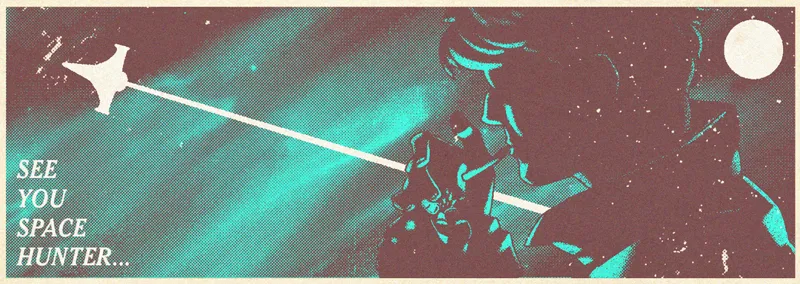

See You Space Hunter...
Hey y'all! So as some of you may know I started kicking around an idea for a small TTRPG zine a couple years back but ultimately had to set it down due to other work commitments and things. I have dipped back into it time to time over the years since but today I am here to share with you all the revised writing of where I am at. My goal with this is simple, I want to make a game that is very rules light and doesn't get in the way of folks telling a fun story about struggle, strife and whatever else comes there way as they cruise through the stars hunting bounties to earn enough credits to make it through the day.
I have tried to really strip back a lot of things to establish the core mechanics or "rules" for engaging with the world to hopefully fit them on a single page when it's all said and done. My hope is to make a very simple system that will not only work for this game but could then be taken to other games with different settings I would love to get to eventually.
So what I am sharing with you all here today is the writing as it stands now with the core mechanics and then getting into the more setting specific bits. I am not sure where this will end up in terms of depth or length but my hope is to get it out there in the coming months sometime regardless of how imperfect it may be. It's just fun to create and honestly I think at times I forget that in a chase for perfection or a doubt in myself at trying endeavors I've never really done before. I would love to hear your thoughts as well so feel free to leave a comment or if you'd prefer reach out in a message or DM on social. Thanks y'all.
__________________________________________________________________________
See You Space Hunter…
Core Mechanics: How to do stuff.
Combat - Roll 1D6 per chosen stamina. Success on 5-6. Additional die available via character traits or additional equipment. Players have two resources, Health and Stamina. Each hit reduces their health and each action or reaction costs one stamina. One stamina is replenished at the start of their turn. The only limit to actions available on a player’s turn is the amount of Stamina they have available.
Non-Combat Encounter - Roll 1D6 to determine success or failure. Additional D6 available via character traits or equipment.
Difficult Tasks/Challenges - These are challenges in or outside of combat that may require multiple successful roles. The GM will make the player aware of that ahead of time and the player must use whatever is available to them to achieve these roles. If a player needs two successes but only has 1D6 available for the role another player can assist them by rolling their die. If the players fail their Stamina is reduced by one until they rest.
Players Primary Resources - Health and Stamina
When creating their characters players will determine their health and stamina. The more health a person has the more damage they can take in combat or other situations before succumbing to injury and falling unconscious. Stamina is how much a player can do within an encounter, how many actions they can take. Health and Stamina are like a scale with them each needing to be in balance with the other, typically the more health a character has the less stamina they may have available and vice versa. These two resources are determined by a character's history.
Stamina - during combat players have X stamina points. To take an action players must use one stamina. They may use up to the max they have available on their turn. For example if a player has 3 stamina they may choose to attack 3 times. They would then roll 3D6 (plus any additional via applicable past life skills or other character modifiers) any successful rolls (5-6) count as hits on their target. One stamina point is replenished at the start of the players next turn.
Players can use stamina points to take reactions as well. Trying to take cover or dodge an attack etc.
The hope here being that players pick and choose when and where to use this limited resource to tell an engaging and compelling story within the frame of a combat encounter.
Health - Player’s have X health and for each hit they take they receive a wound. If they accumulate enough wounds they are then knocked unconscious. If a player is knocked unconscious via wounds they receive a scar. Scars are ways players characters are permanently affected via the hardships of combat and conflict. An example may be losing a limb, eye or finger. This may reflect in gameplay by altering their aim, their dexterity in traversing landscapes or their endurance in combat.
Player’s Secondary Resources - Credits and Equipment
Players are hunting bounties to earn credits. Credits are not easy to come by and everything in this world is expensive. For simplicity sake a scale of 10 creds being hard up, 100 credits being stable and 1000 credits being flush may work.
Players can buy various items with credits but must also resupply when landing on a planet or stopping at a station during long distance travel. This is the cost associated with the working life of a bounty hunter. As players explore the stars they must resupply on landing. This keeps the player’s credit supply scarce as even after a big target which may offer a nice number of credits for the bounty it also means more danger which means higher risk of wounds and scars and more materials needed to properly prepare before heading into such danger. Or fines to pay for unwarranted destruction or chaos, whatever keeps the story fun, engaging and meaningful to the players and GM.
The GM can decide the cost of resupplying at a specific destination. Use it as a way to help shape your world. Affluent locales have higher costs and maybe grant additional boons (temporary Stamina as an example) whereas rougher landings may be less credits but don’t afford such luxuries. Play with the concept and let it bleed into the narrative of the action.
Engagement with the world - Players can interact with the world in many ways, much like we as humans can with our own world. The GM will explain the surroundings and things the players may see around them through normal observation but it is up to the players to then infer and investigate if there are any more interesting or indirect things in the area. The GM may have them roll their die to see if they are successful in that pursuit.
Example: The GM may say “Player A enters the bar, it is a run down, old saloon style bar with haggard signs strewn across the walls and a floor that’s not seen the grace of a mop in who knows how long. There are a small handful of patrons sitting in silence, tending to their drinks. What would you like to do?”
Player A may then choose to look around and see if any of the people inside match the description of the person they are searching for, or they may choose to approach one of the patron and ask if they know of the person in the photograph they have and if they may have any information about them.
The GM would then determine if they must roll to see if this is a successful inquiry or if it’s something simple enough that they can just continue to progress with. In this manner it allows for the story to continuously unfold without much slowdown but still inject moments of tension and pushback when a situation isn’t so simple and the players do have to roll in order to succeed. In those situations the players would roll their dice (D6) with a success on a 5 or 6.
Character Creation Tables: Traits, History and Goals
The Good: A quirk that makes your character unique. A small trinket or other item that they always keep on their person.
The Bad: A streak of bad luck or misfortune that seems to follow them around. Something like being bad with directions or having bad hand eye coordination.
The Ugly: A decision the player’s character has made in the past that may or may not stick with them. Something they may not be proud of but is in the past. And as well all know, the past never catches up to us.
Roll 1D6 or choose one trait per table.
These are meant not as hard and fast rules of your character but small quirks that can be used to enhance encounters or the general narrative in a given situation. Tools to help players round out their character and add some nuance and texture to them during play.
And that is all for now. As always I appreciate all of the support you have given me here on the patreon and I hope I can continue to evolve as a creator and with the things I get to make and share with you all here. Thank you again and as always remember to be good to yourself and to be good to each other.
- Teeg
Comments (2)
Despite not being a D&D player to understand the full scope of play, this sounds fun and interesting.
Thanks! My hope is it will be simple enough for most folks with or without much experience with TTRPGs to give it a go.