




Static stretching
In all of the discussions of stretch-mediated hypertrophy, fitness industry commentators are starting to look at the static stretching literature in addition to the strength training studies, which is a good thing. However, it is important to understand the similarities and differences between strength training and static stretching, so we can apply the literature correctly.
.
#1. Similarities between static stretching and full range of motion strength training
Static stretching training displays some similarities with full range of motion (ROM) strength training. First and foremost, it can and does produce hypertrophy. Whether this is possible in humans was once contentious but the most recent human studies have made it clear that practical static stretching programs can and do often produce muscle growth.
.
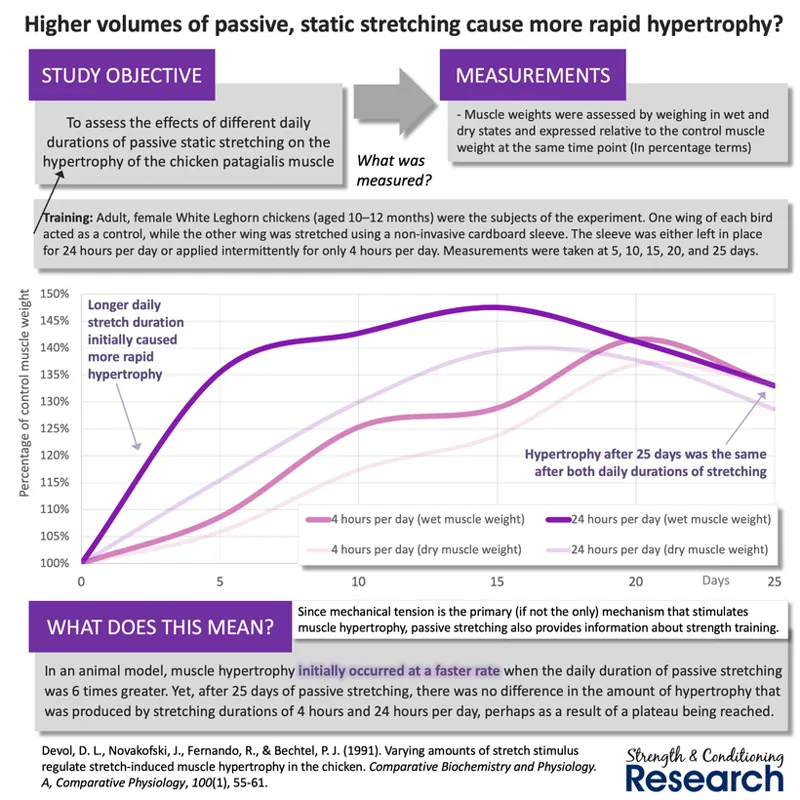
Moreover, when greater dosages of static stretching are applied, this produces greater gains in muscle size, in much the same way as strength training at a long muscle length.
.
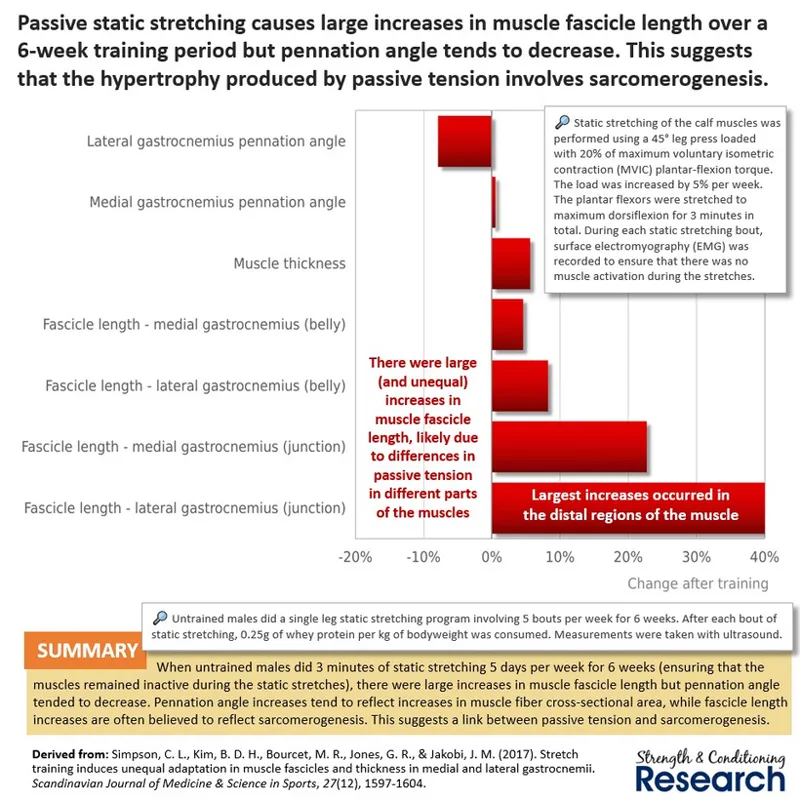
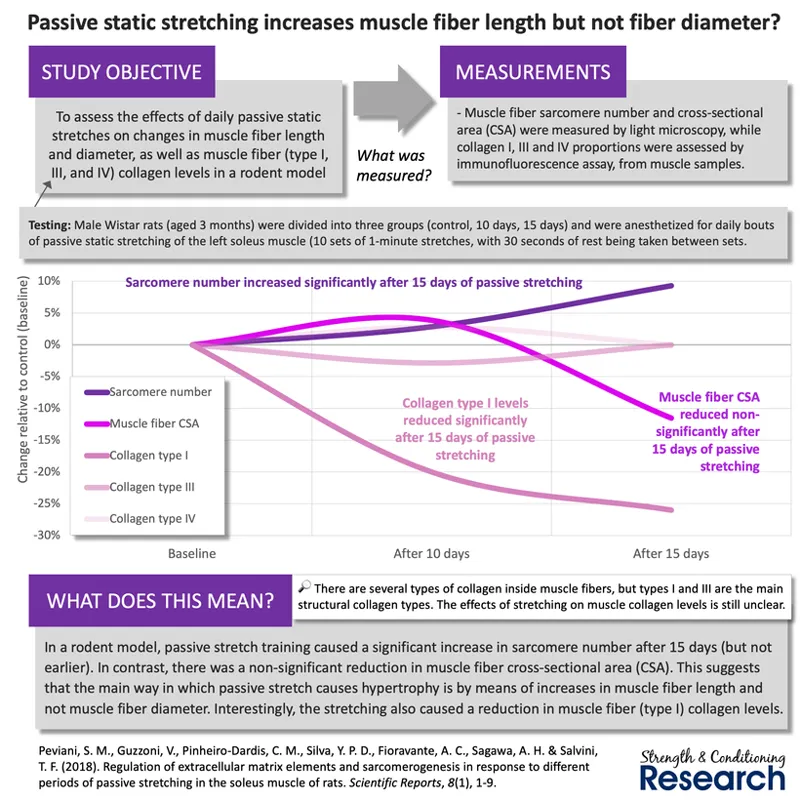
Secondly, the nature of this hypertrophy appears to be mostly the result of an increase in muscle fascicle length (which most likely predominantly results from sarcomerogenesis). Hypertrophy can result from increases in either [1] myofibrils in parallel, which can only produce an increase in muscle fiber cross-sectional area, or [2] sarcomeres in series, which tend to produce mostly an increase in muscle fiber length but can also produce an increase in muscle fiber cross-sectional area when all of the sarcomeres have to shorten in order to fit the new sarcomeres into the existing muscle fiber length.
.
Indeed, animal studies have shown that static stretching does predominantly cause the addition of sarcomeres in series and does not cause the addition of myofibrils in parallel.
.
#2. Differences between static stretching and full range of motion strength training
WHICH MUSCLE FIBERS ARE STIMULATED WITH PASSIVE TENSION?
Although static stretching and full ROM strength training both stimulate increases in muscle fascicle length (in humans) and sarcomerogenesis (in animals), it seems likely that they do this in different muscle fibers. Static stretching logically must apply passive tension to all fibers in a muscle. In contrast, full ROM strength training can only apply the passive tension to those muscle fibers that are activated in the lowering (eccentric) phase of the exercise, which is necessarily lower than in the lifting (concentric) phase. For this reason, it is likely that static stretching can be used to apply passive tension (and therefore stimulate sarcomerogenesis) in far more muscle fibers than are stimulated during full ROM strength training.
.
HOW DOES TRAINING AFFECT THE AMOUNT OF PASSIVE TENSION?
One very important feature of the way in which passive tension stimulates sarcomerogenesis is the negative feedback loop that occurs with training. As new sarcomeres are added to muscle fibers and the total number of sarcomeres in the muscle fiber increases, each sarcomere elongates less for a given amount of muscle lengthening. So, for the same muscle length, each sarcomere produces less passive tension and stimulates less sarcomerogenesis.
.
Importantly, full ROM strength training maintains the same maximum muscle length in every workout because of how the exercises are done. Thus, it suffers from this negative feedback loop. Hence, increases in fascicle length quickly plateau during full ROM strength training and fascicle lengths do not adapt after full ROM strength training in strength-trained lifters.
.
We would not expect this same limitation to occur in static stretching training programs. While it has not been studied in humans, there are some early indications in animal models that there is a consistent increase in sarcomere number while stretching training is conducted so long as the increase in range of motion is occurring. If the range of motion is maintained the same, then the increase in sarcomere number slows dramatically and even plateaus.
.
Conclusions
Static stretching and full ROM strength training both cause muscle growth, some of which growth involves increasing fascicle length (most likely by adding sarcomeres in series). However, the way in which fascicle length increases are stimulated differs between these two training methods in two important, practical ways. Firstly, static stretching applies passive tension to every single muscle fiber in the muscle. In contrast, full ROM strength training can only apply the passive tension to those muscle fibers that are activated in the lowering (eccentric) phase of the exercise, which is necessarily a much smaller number than in the corresponding lifting (concentric) phase because of the much higher single fiber forces. For this reason, static stretching can be used to apply passive tension (and therefore stimulate sarcomerogenesis) in fast twitch muscle fibers of high-threshold motor units that are not stimulated to increase in length by passive tension during full ROM strength training. Secondly, static stretching involves an increase in the maximum muscle length reached in each workout due to an increase in stretch tolerance. In contrast, full ROM strength training maintains the same maximum muscle length in every workout. As new sarcomeres are added to muscle fibers and the total number of sarcomeres in the muscle fiber increases, each sarcomere elongates less for a given amount of muscle lengthening. This means that for the same muscle length, each sarcomere produces less passive tension and stimulates less hypertrophy. This is why increases in fascicle length quickly plateau during full ROM strength training and why fascicle lengths do not adapt after full ROM strength training in strength-trained lifters. We would not expect the same plateau effect when using static stretching because of the constantly increasing maximum muscle length being used.
Comments (4)
Hey Chris. Appreciate the content as always. Unrelated question: are you and Paul planning on doing a podcast on a sports-specific training topic? Perhaps on transfer between weight training and sport? I loved your book on it but would be curious if your opinion has evolved over the few years. Thanks!
No, Paul and I won't be talking about sports performance on the podcast. It's just a hypertrophy podcast
It’s commonly stated that the eccentric is the “most important” part of the lift for muscle growth. Would you say that it’s vastly overrated then, due to low motor unit recruitment? Like I do partial concentric only reps of machine presses, from a lengthened position, and it appears I’m progressing just fine without the eccentric
Yes, the eccentric phase is very much overrated for muscle growth in the context of normal strength training. Given its low level of activation, it cannot train many of the fast twitch fibers of the muscle, no matter how much fatigue is generated in the concentric phase