





Rate coding
Whole muscle force is determined by [1] how many muscle fibers are switched on (which is called "being activated") and by [2] how much force each individual muscle fiber produces. The level of motor unit recruitment determines how many muscle fibers are switched on, while the two primary determinants of the force that individual muscle fibers produce are the force-velocity and length-tension relationships. So what then is the role of rate coding?
.
#1. What is the relationship between motor unit recruitment and rate coding?
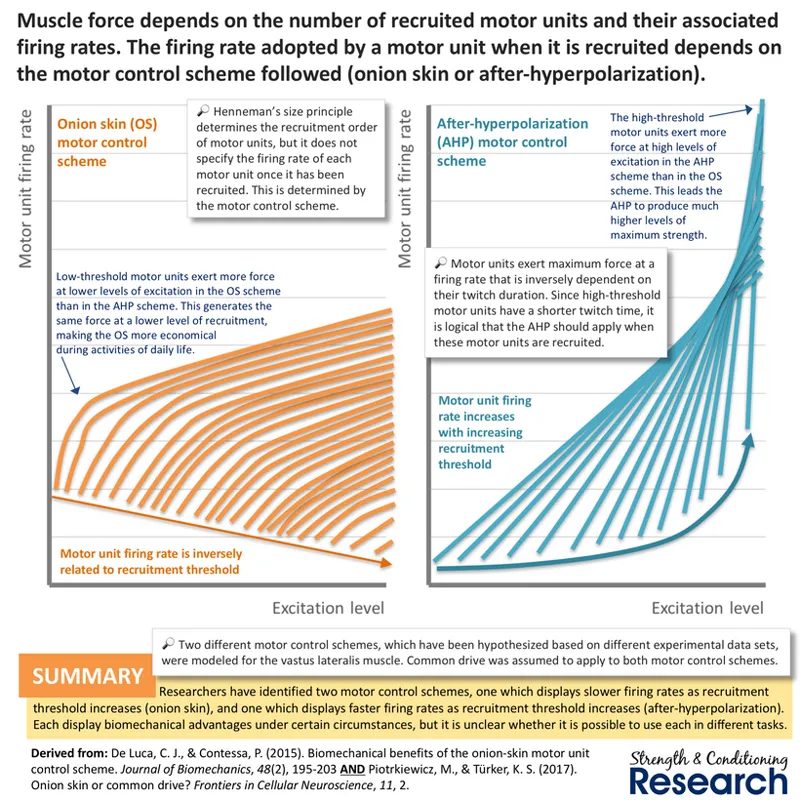
When effort is increased, central motor command increases. An increase in central motor command increases the number of recruited motor units, and can also increase motor unit firing frequency. The exact motor unit firing frequency that a muscle fiber experiences at any given level of central motor command is determined by the motor unit control scheme. Researchers have proposed various models of this motor unit control scheme but there is no single widely-accepted model. Perhaps the two most popular models are the onion skin control scheme and the after-hyperpolarization control scheme.
.
#2. How do velocity and effort affect rate coding?
When speed is increased during a movement, there is an increase in the rate of motor unit firing. The increase in rate coding is likely a compensation for the faster rate of crossbridge formation at the muscle fiber level.
.
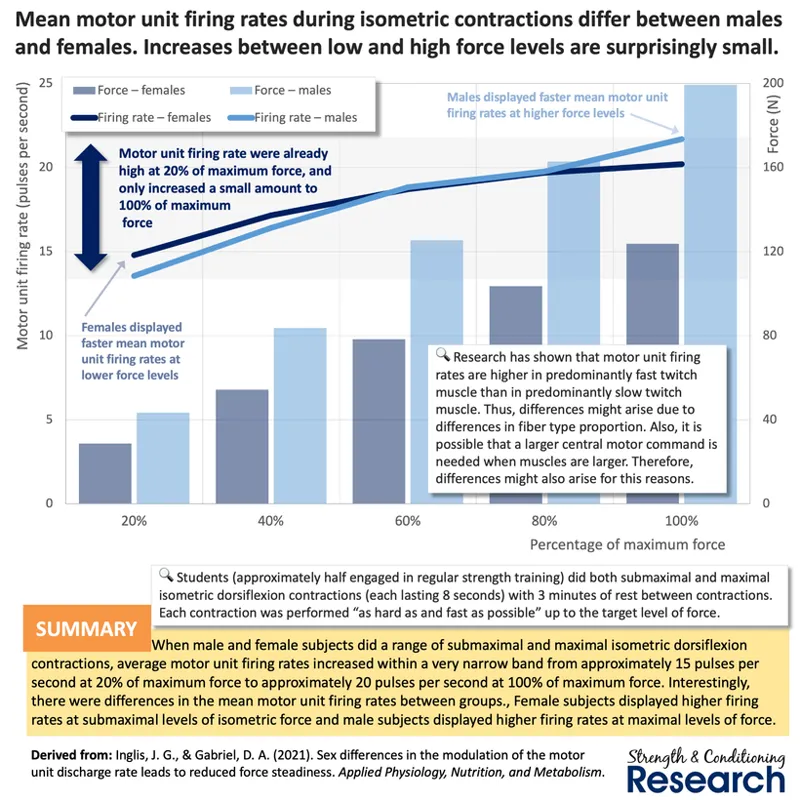
In contrast, when whole muscle force is increased in isometric contractions by way of an increase in effort, the changes in rate coding are relatively small.
.
#3. How does muscle fiber type after rate coding?
Research has found that maximum motor unit firing frequencies recorded in maximum voluntary isometric contractions are lower in predominantly slow twitch muscles compared to in predominantly fast twitch muscles. This tells us that various parameters of the motor control scheme can be influenced by local, muscular factors.
.
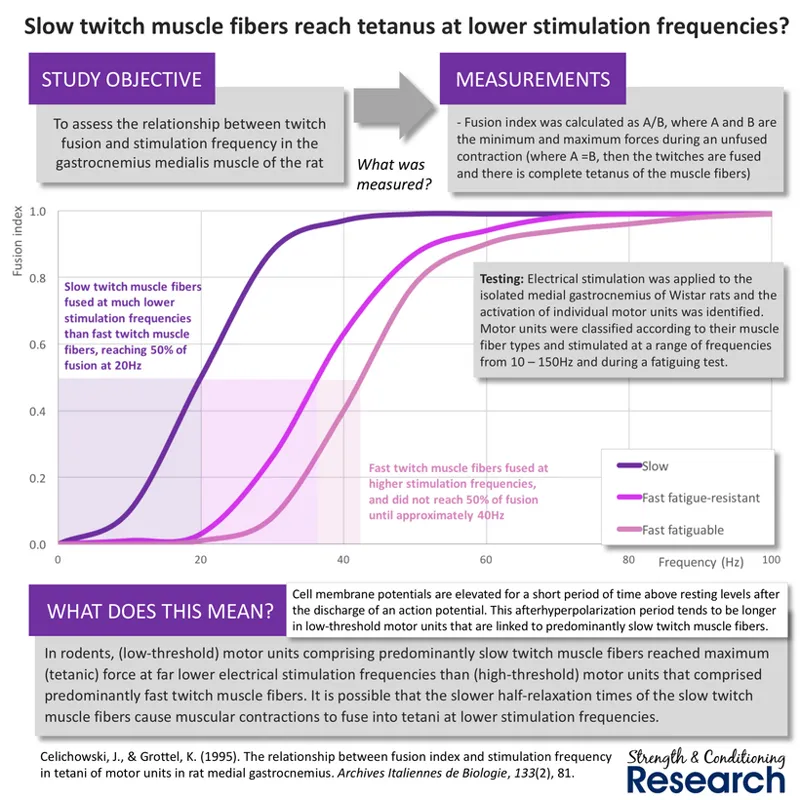
If we consider that motor unit firing frequency is just the signal for a new set of crossbridge cycles to commence, then it makes sense that predominantly slow twitch muscles should display slower rate coding on average. Slow twitch muscle fibers display a much slower rate of crossbridge formation than fast twitch muscle fibers. Consequently, they reach tetanus at much lower motor unit firing frequencies and do not need as high rate coding in order to reach maximum muscle force for a given movement velocity.
.
#4. How does fatigue affect rate coding?
It is frequently assumed that rate coding increases progressively with increasing fatigue over the course of a strength training set to failure. This is not correct. Rate coding actually increases and then decreases with fatigue during sustained isometric contractions.
.
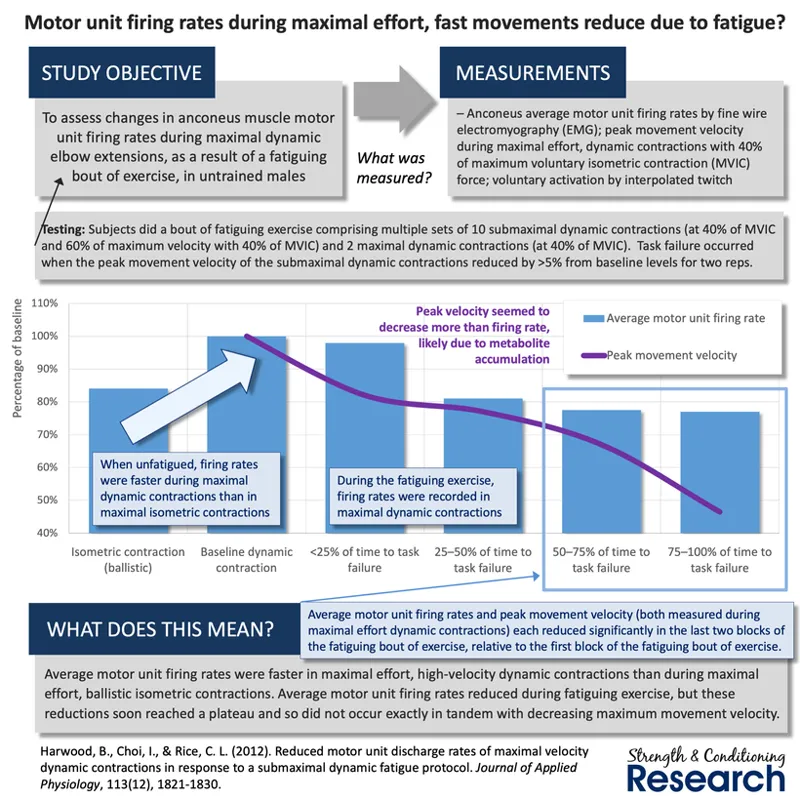
In dynamic contractions, the picture is slightly different because movement speed changes over the set as fatigue causes a slowing of contraction velocity. Thus, instead of increasing and then decreasing, rate coding slows throughout the entire fatiguing bout of exercise.
.
#5. How does rate coding affect single fiber mechanical tension?
Many critics of the stimulating reps theory have tried to argue that the changes in rate coding that occur during a strength training set invalidate the model. Their criticisms rely upon multiple incorrect assumptions in an attempt to show that slow twitch muscle fibers of lower threshold motor units will experience an increase in mechanical tension due to increases in rate coding with increasing effort levels. Firstly, rate coding does not increase that much with increasing effort. Secondly, the presence of fatigue reduces rate coding. And thirdly, since muscle fiber type affects the rate of crossbridge formation, each muscle fiber inside a muscle reaches tetanus at a different motor unit firing rate. The slow twitch muscle fibers that belong to the very lowest low-threshold motor units probably reach tetanus at very low motor unit firing frequencies.
.
Conclusions
Motor unit recruitment is the process by which groups of muscle fibers are switched on. Increasing the number of activated muscle fibers increases the level of whole muscle force but it does not affect single fiber mechanical tension, which is the stimulus for hypertrophy. On this basis, the only way in which the central nervous system can influence the magnitude of the hypertrophy stimulus at the muscle fiber level is to alter rate coding (which is the frequency at which signals from the brain are sent to the muscle). While a substantial role for rate coding in hypertrophy is often assumed, there are good reasons to doubt its importance. Firstly, rate coding increases only minimally alongside increases in effort during isometric contractions, while it increases substantially alongside increases in movement velocity. Secondly, the rate coding of a single motor unit does not increase progressively through to task failure as fatigue develops during sustained isometric contractions. Rather, it increases to the halfway point and then decreases. Moreover, when dynamic contractions are tested and fatigue causes a reduction in movement velocity, rate coding actually decreases from the very beginning through to task failure. Thirdly, muscle fiber type affects the motor unit firing frequency at which tetanus occurs. Slow twitch fibers achieve tetanus at very low firing rates. Thus, it is unlikely that any increases in rate coding that do occur can affect the level of mechanical tension that they experience during strength training.
Comments (4)
Hi Chris. How big a role does rate coding play in improving force production at high speeds? How much can it be improved?
Starting from an untrained person, increases in rate coding play a very big role in increasing speed and high-velocity force production. We do not have data showing how long such improvements can continue, but I suspect they are probably similar to motor unit recruitment. That means the majority of the changes will occur in the first 3 – 6 months, after which the improvements will be small.
So, what would be some practical issues? How can we train slow twitch oxidative muscle fibres effectively? Using BFR?
Generally, such muscle fibers have already been trained to a maximum extent after a few years of normal daily physical activity