


Stability
Every exercise or movement pattern has a degree of stability associated with it. At one end of the stability spectrum are dynamometer strength tests, in which straps are used to secure the legs and torso to provide the maximum possible amount of stability for the working joints. At the other end of this spectrum are unstable surface or balance exercises, in which a high degree of balance is needed. In between these two extremes are machine exercises, which are comparatively stable (but not as stable as dynamometer strength tests) and free weights exercises, which are comparatively unstable (but not as unstable as balance exercises).
.
#1. Less stable contractions involve lower agonist muscle activation
When a maximal effort muscular contraction is performed under a less stable condition, the level of agonist muscle activation tends to be reduced, compared to a more stable condition. Researchers have identified that this superior level of agonist activation during more stable efforts might result from two different mechanisms: (1) concurrent activation potentiation caused by bracing movements at other joints, or (2) an inhibitory effect of unstable conditions on central motor command.
.
Concurrent activation potentiation is the increase in force that occurs when a maximal strength test involving one joint (such as a knee extension) is performed together with a simultaneous contraction at another joint (such as a handgrip). The simultaneous contraction at the other joint is called a "remote voluntary contraction" and the effect is believed to occur due to a physiological phenomenon known as "motor overflow." Motor overflow is a spillover of central motor command from the muscle that is producing a forceful contraction to other muscles. To the extent that motor overflow occurs from the remote voluntary contraction to the main contraction, it could enhance the level of voluntary activation that is achieved in the muscle being tested.
.
Nevertheless, when researchers have examined the effects of concurrent activation potentiation, they have found that it plays a smaller role than the presence of stability. This suggests that a lack of stability produces a direct inhibitory effect on voluntary activation.
.
Conceivably, this inhibitory effect could be due to the increased mental effort that is involved in providing balance during the strength test. Indeed, mental effort produced from various sources is known to increase the perceived levels of effort that corresponds to a given level of central motor command. Similar inhibition can be observed during eccentric contractions, which also appear to be more complex movements for the brain to coordinate.
.
#2. Training with greater instability involves higher antagonist and synergist muscle activation
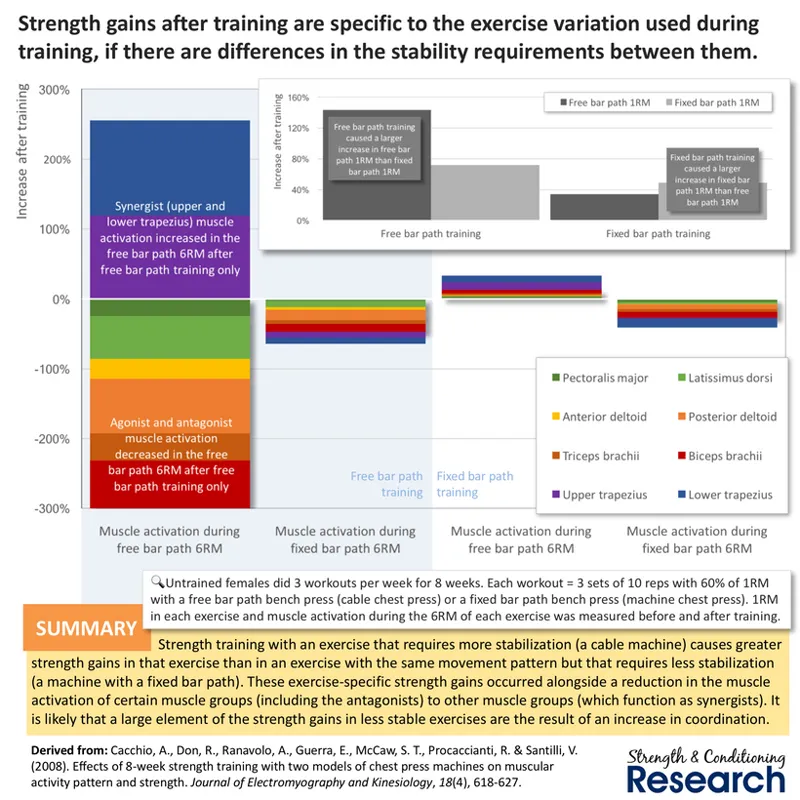
When a maximal effort muscular contraction is performed under a less stable condition, the level of antagonist muscle activation tends to be increased, compared to a more stable condition. This increased antagonist coactivation seems to be produced in order to increase joint stability. For example, when bench presses are performed under less stable conditions, the activation of the antagonist biceps brachii is increased. Clearly, this increased antagonist coactivation will reduce the level of external force that can be achieved for a given level of agonist muscle force, which helps explain why training weights are often lighter when exercises are less stable.
.
#3. Practicing training with greater instability increases synergist activation and decreases antagonist activation
When training is performed using less stable exercises, antagonist activation tends to decrease dramatically, while synergist activation increases. This suggests that a key mechanism of strength gains when using less stable exercises is transfer of activation from antagonists to synergists, as balance improves. By reducing the level of antagonist activation, strength in the unstable exercise can be improved (even if the strength of the agonist muscle is not actually altered).
.
Conclusions
Every exercise and movement pattern has a degree of stability associated with it. Consequently, all strength training exercises necessarily exist on a continuum of stability, from least stable to most stable. Strength tests in dynamometers with straps for support are the most stable, followed by machine exercises, free weight exercises, and finally exercises on unstable surfaces. When the level of stability provided by the external environment is low, the degree of agonist activation is inhibited (likely by the increased level of mental effort that is required for coordinating the movement). Thus, more stable exercises are probably slightly better for hypertrophy, since they allow higher levels of motor unit recruitment to be attained. In practice, this means that machine exercises are probably better than free weights for bodybuilding. Additionally, when the stability provided by the external environment is low, the level of antagonist activation is increased (probably in order to provide the required stability). Obviously, this reduces the external load that can be lifted with a given level of agonist muscle force, which is why lighter loads are often needed when using less stable exercise variations. Nevertheless, training with an unstable exercise causes quick reductions in antagonist activation (alongside increases in synergist activation), which allows large strength gains in the trained exercise, even when agonist muscle strength does not also increase.
Comments (5)
Thanks Chris - great article. It seems like the unstable model popularized about 20 years ago is a negative for hypertrophy. It's also harder to arrange and would seem to be more dangerous. Honestly should we really do it at all? Thanks!
Certainly, I don't think there are advantages for using unstable exercises for bodybuilding. There are advantages for athletes in certain situations, however. It depends on what the sport requires.
and a mixture of dumbell press on a swiss ball, potentially with an alternating tempo (two dumbell's at once, one slightly ahead of the other, one at a time etc.) might help to increase synergist activation and decrease coactivation when that scenario happens in a match. That being side I would guess it's unlikely that strength training in unstable environments to decrease coactivation is likely to catch on as opposed to just practising the sport.
Yes, I think there is definitely a strong rationale for targeting specific adaptations (like increased voluntary activation or decreased antagonist coactivation) by using specific types of training. In the example of the bench press, voluntary activation would indeed most likely improve most after very stable bench press training (or in fact machine-based pressing exercises), while using an unstable implement would be optimal for reducing antagonist coactivation. Skill-based drills that involve the same movement pattern might be the best way to bridge the gap to the sport.
So I guess from that description, for a wrestler looking to improve their ability to bench press someone off them (or for other grappling styles). From a neural adaptions perspective a mixture of bench pressing on a smith machine for maximal voluntary activation