



Training to failure causes more fatigue
Why does training to failure cause more fatigue both immediately during the workout and also in the post-workout recovery period?
.
#1. Training to failure causes more peri-workout fatigue
Many studies have compared the effects of training to failure and training without reaching failure. However, not many have equalized the total number of reps that are performed, and obviously training to failure involves more reps per set than stopping before reaching failure. This makes it difficult to identify whether it is the greater number of reps that causes the greater fatigue or the closer proximity to failure itself. Fortunately, some studies have equated volume load and have shown that training to failure is inherently more fatiguing, when measured immediately after the completion of the set.
.
#2. Training to failure causes more post-workout fatigue
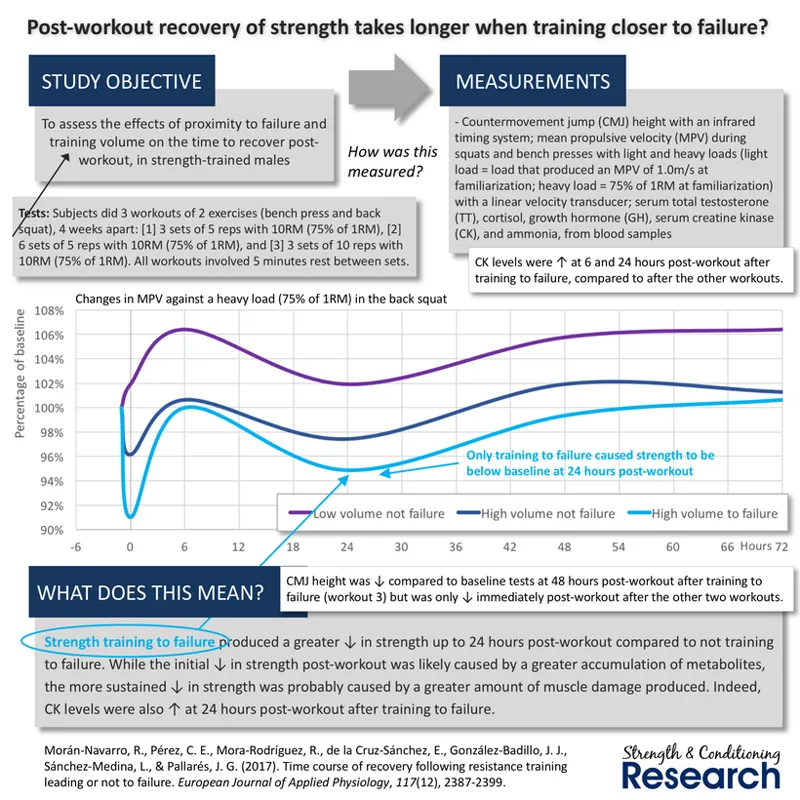
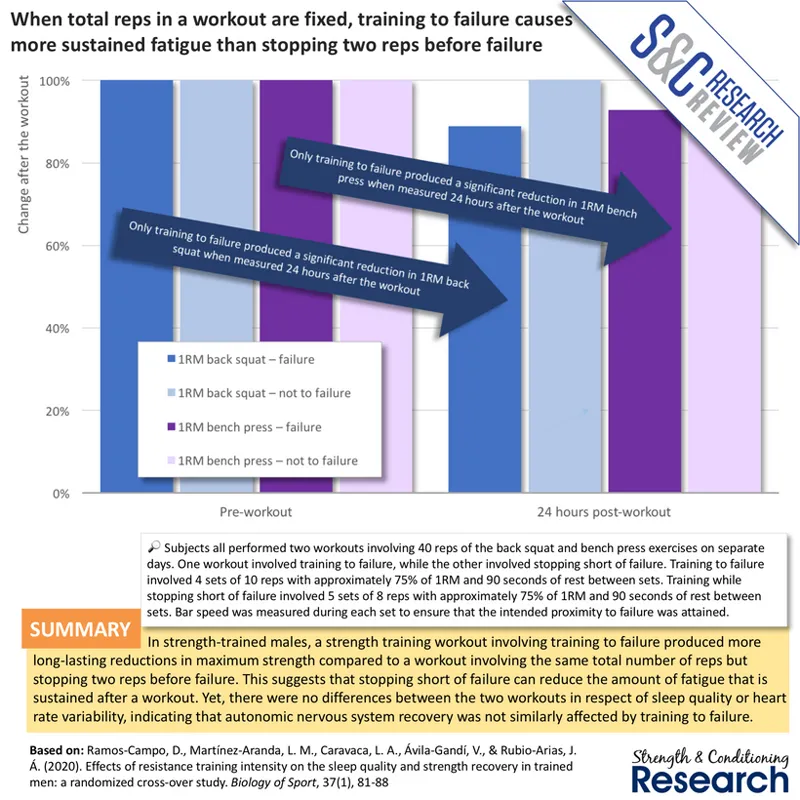
Studies have also shown that the greater fatigue that is produced by training to failure is apparent even for several days after the workout.
.
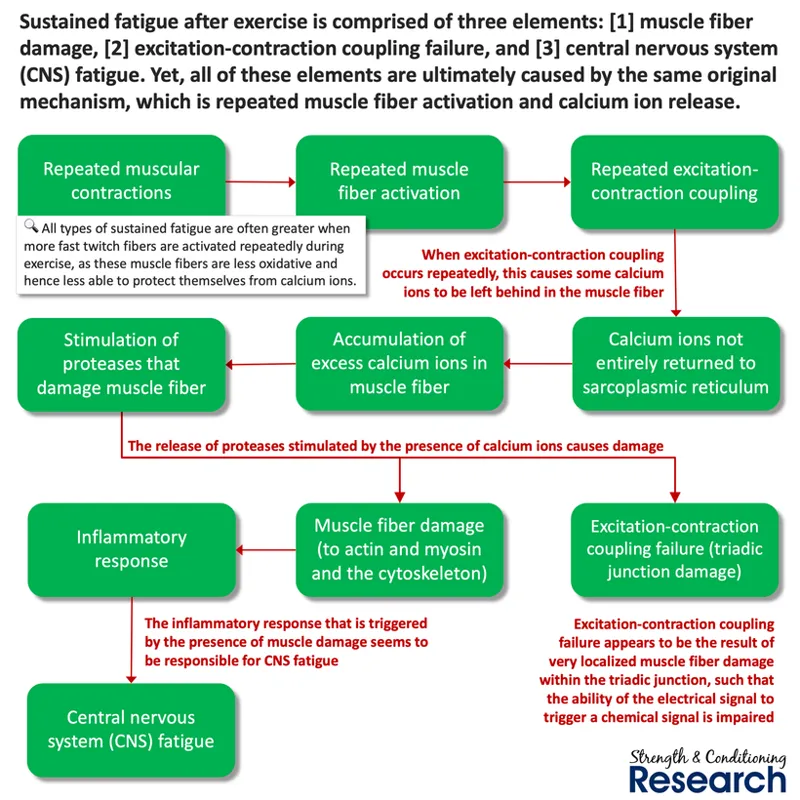
Since all post-workout fatigue mechanisms are caused by the accumulation of calcium ions during a workout, this tells us that the effect of training to failure is to cause greater calcium ion influx and then subsequently more calcium ion-related fatigue mechanisms.
.
#3. Training to failure causes more calcium ion-related fatigue
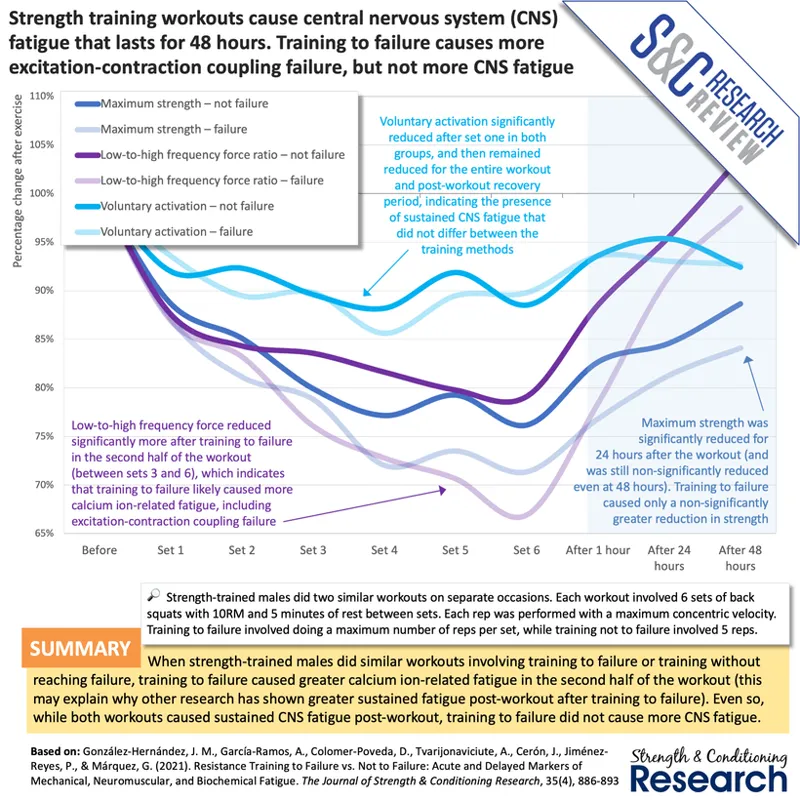
We can confirm that training closer to failure causes more calcium ion accumulation and therefore more calcium ion-related fatigue because it produces greater excitation-contraction coupling failure.
.
#4. Why does training to failure cause more calcium ion-related fatigue?
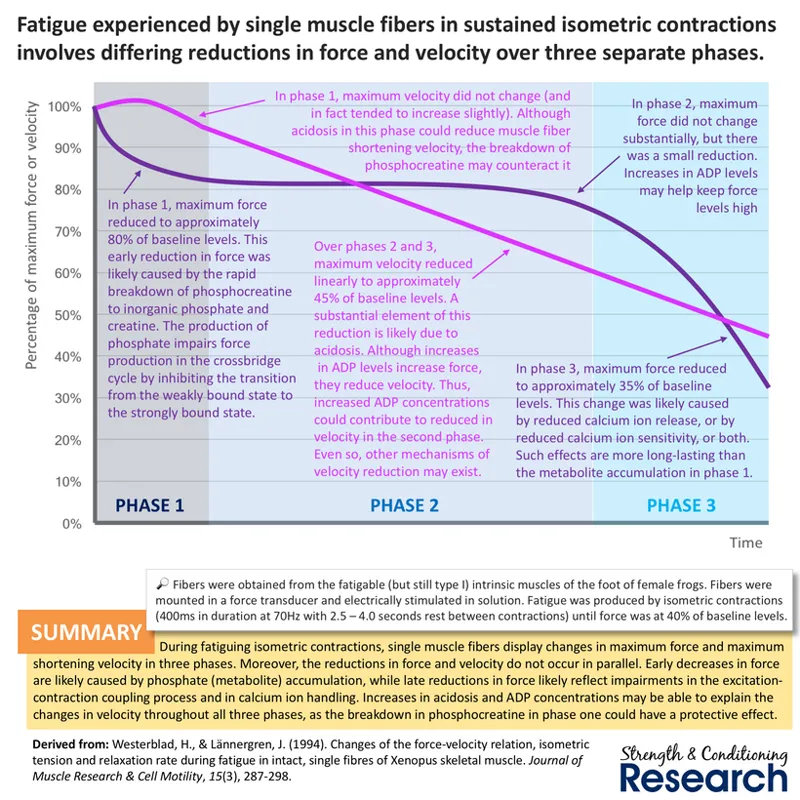
Training closer to failure likely causes more calcium ion-related fatigue because it involves a longer duration of time in which the fast twitch muscle fibers are activated. Indeed, we already know that the onset of calcium ion-related fatigue is delayed later than the onset of metabolite-related fatigue. So a longer exposure of the muscle fibers to calcium ion influx can have a meaningful effect.
.
Similarly, we know that fast twitch muscle fibers are more susceptible to calcium ion-related fatigue mechanisms because of their fewer and weaker mitochondria. Therefore, as effort and therefore motor unit recruitment are increased over the set to failure, fast twitch muscle fibers are only exposed to the calcium ion influx towards the end of the set.
.
#5. Does training to failure cause greater changes to the autonomic system?
It is often assumed that training closer to failure causes more cardiovascular fatigue, such that the autonomic nervous system takes longer to reduce sympathetic nervous system activity and increase parasympathetic nervous system activity after a workout. This is true immediately post-workout.
.
However, it does not appear to be true in the post-workout period, suggesting that there is only an effect on the early phase of cardiovascular recovery and no impact on the late phase. This study was particularly important because it shows that stopping just two reps in reserve can completely remove the post-workout fatigue effect when training with moderate loads.
.
Conclusions
Why does training to failure cause more peri-workout and post-workout fatigue than leaving repetitions in reserve (even when volume load is controlled)? Since post-workout fatigue is caused by the accumulation of calcium ions inside muscle fibers during a workout, it must be caused by greater calcium ion-related fatigue mechanisms. Indeed, compared to leaving repetitions in reserve, training to failure does cause greater excitation-contraction coupling failure, which is a calcium ion-related fatigue mechanism. Training to failure likely causes fast twitch muscle fibers in the muscle to be exposed to calcium ion influx for a longer duration of time. Since fast twitch muscle fibers are more vulnerable to the effects of calcium ions, this causes more calcium ion-related fatigue. While training to failure does also cause a greater shift to sympathetic nervous system activity immediately after a set, it does not slow the rate of parasympathetic reactivation in the post-workout recovery period. Practically, since calcium ion-related fatigue mechanisms [1] reduce single muscle fiber mechanical tension, and [2] are long-lasting, training to failure is not recommended in the early sets of a workout for a muscle group (because the hypertrophy stimulus of later sets will be reduced). Also, it is not recommended if we want to recover from a workout as quickly as possible. With moderate loads, leaving 2 repetitions in reserve minimizes calcium ion-related fatigue.