





Hypertrophy occurs before damage repair
When we look at the post-workout period, we find an elevation in muscle protein synthesis (MPS) and myofibrillar protein synthesis (MYOPS) rates. It is difficult to see which part of the curve is responsible for hypertrophy and which part is responsible for damage repair. An easy way to see why muscle damage repair is delayed compared to the hypertrophy process is to look at when muscle damage itself happens.
.
#1. When does muscle fiber hypertrophy happen?
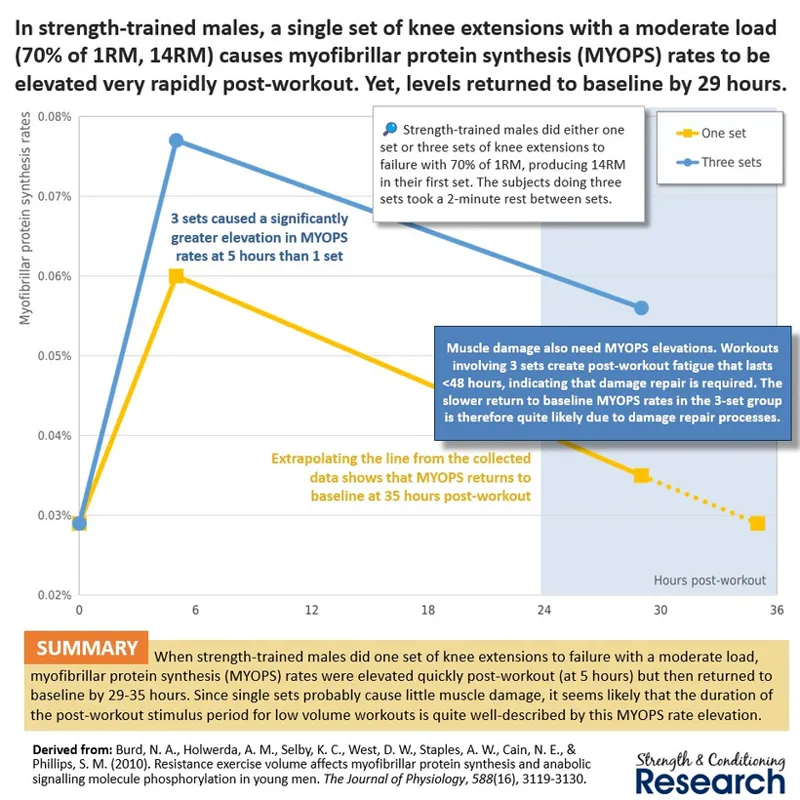
Muscle fiber hypertrophy can happen in the first 29-35 hours post-workout, at least when we do single-set strength training workouts. We can be sure of this fact because post-workout myofibrillar protein synthesis rates are only elevated for this period of time. Thus, our starting point is that hypertrophy is processed in this time period. Our next task is therefore to see whether muscle damage repair happens before this or after this in time.
.
#2. Muscle damage does NOT happen during a workout but afterwards
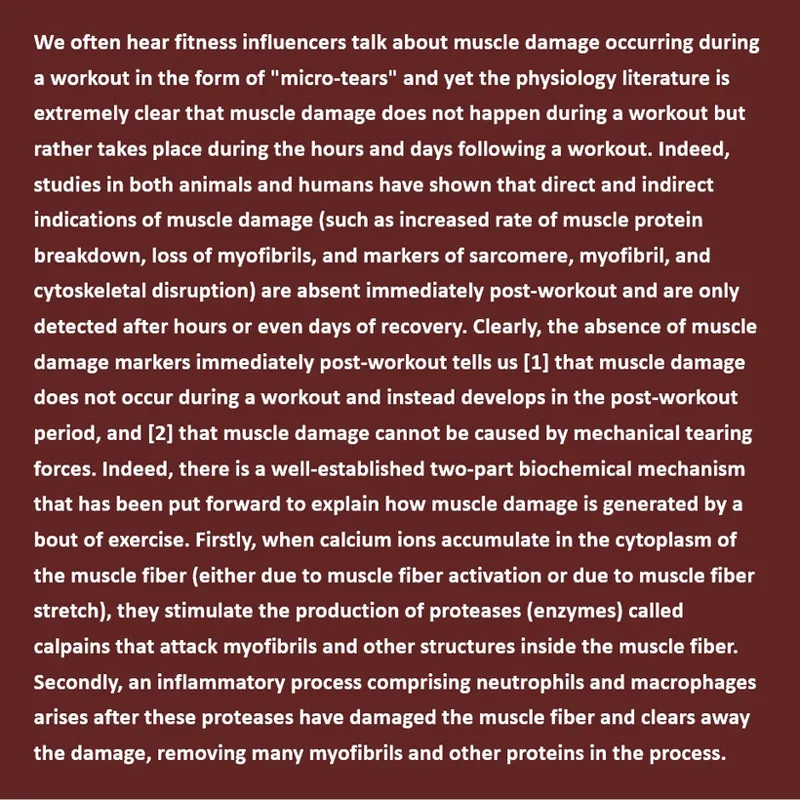
The first key point that we have to recognize is that muscle damage is not caused by mechanical tearing forces during a workout. Instead, it is produced by calcium ion accumulation leading to [1] the production of proteases (calpains) that digest the proteins inside the muscle fibers, and also [2] an inflammatory response that clears away the damage produced by the proteases. These processes do not happen during the workout but instead occur during the post-workout period (read more).
.
#3. How long do calcium ions remain elevated post-workout?
Calcium ions remain elevated post-workout for at least an hour if not several hours. During this time, they continue to stimulate the release of proteases (calpains) that digest proteins inside the affected muscle fibers. We know this because removing calcium ions from the muscle fiber immediately post-workout prevents a substantial proportion of the post-workout fatigue from happening.
.
#4. When do calpains cause muscle damage?
The calpain response to calcium ion accumulation is rapid. Calpain levels rise immediately post-workout. The duration of time for which they remain elevated probably depends on the nature of the workout, with workouts that generate more calcium ion accumulation producing a longer duration of post-workout calpain elevations. This study involved untrained subjects performing maximal effort eccentric-only contractions, so the post-workout calpain elevation was extremely extended. Less muscle-damaging workouts would be expected to let calpain levels to return to baseline much earlier.
.
#5. When does inflammation cause muscle damage?
The inflammatory response to muscle-damaging workouts is complex but clearly delayed. Some components of the post-workout inflammatory response start appearing just a couple of hours post-workout, while others appear much later on.
.
More recent studies have confirmed that inflammatory mediators initially appear just a few hours post-workout but the accumulation of inflammatory markers continues increasing and only reaches a peak after several days.
.
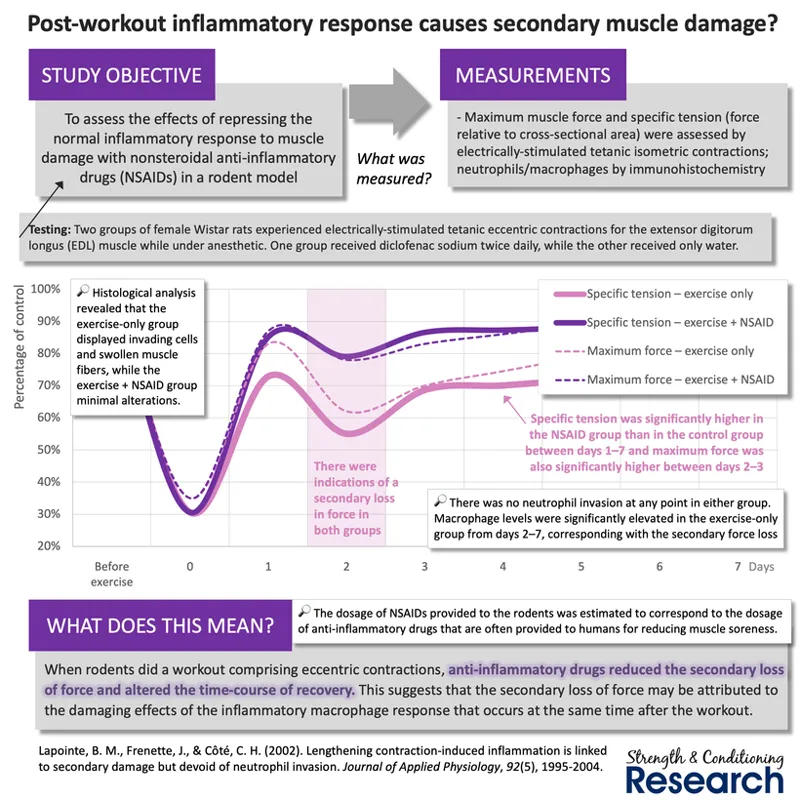
The very extensive secondary muscle damage literature shows that the peak impact of the inflammatory response on post-workout fatigue (which likely occurs because of the removal of damaged myofibrils and other structures) occurs at around 48 hours post-workout.
.
Although some researchers dismiss the secondary muscle damage effect, it is extremely well-documented in animal models and has also been observed in humans, where the exact same time-course is observed with additional post-workout fatigue occurring at 48 hours.
.
#6. When are muscle fiber structures damaged and removed?
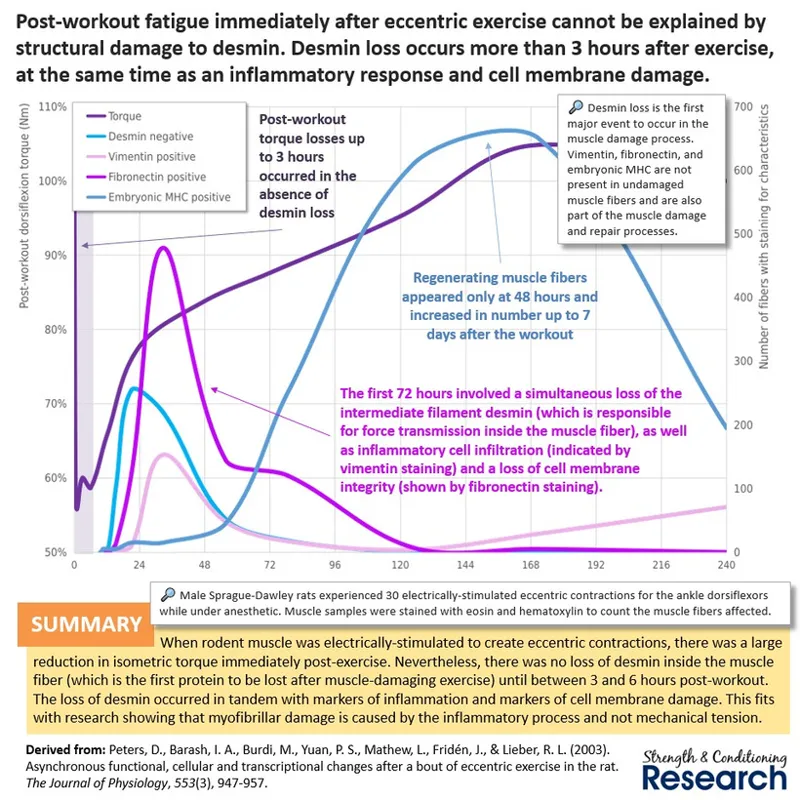
The muscle fiber damage repair process can be confusing because the repair process involves the removal of damaged structures, which can look like the damage itself. Therefore, we tend not to distinguish between the damage process and the repair process very often. Multiple structures can be damaged inside muscle fibers, including the cell membrane, the myofibrils, and the intracellular supporting structures like desmin. We probably have the best data for desmin. The loss of desmin starts to occur after several hours post-workout and peaks around 24-48 hours.
.
The loss of desmin shows a relatively consistent pattern across studies, with most showing a delayed loss that peaks around 24-48 hours post-workout. This shows that muscle damage and its repair are NOT happening in the immediate post-workout period but are instead quite delayed, at least relative to any accompanying hypertrophy stimulus that is being processed.
.
#7. When does muscle fiber regeneration begin?
Muscle fiber regeneration only occurs when muscle fibers cannot repair themselves and have to start building a completely new muscle fiber inside the old cell membrane. Muscle fiber regeneration in human muscles after normal strength training is relatively uncommon since repair processes tend to predominate. Yet, it is worth noting that signs of muscle fiber regeneration only start appearing at around 48 hours post-workout.
.
Conclusions
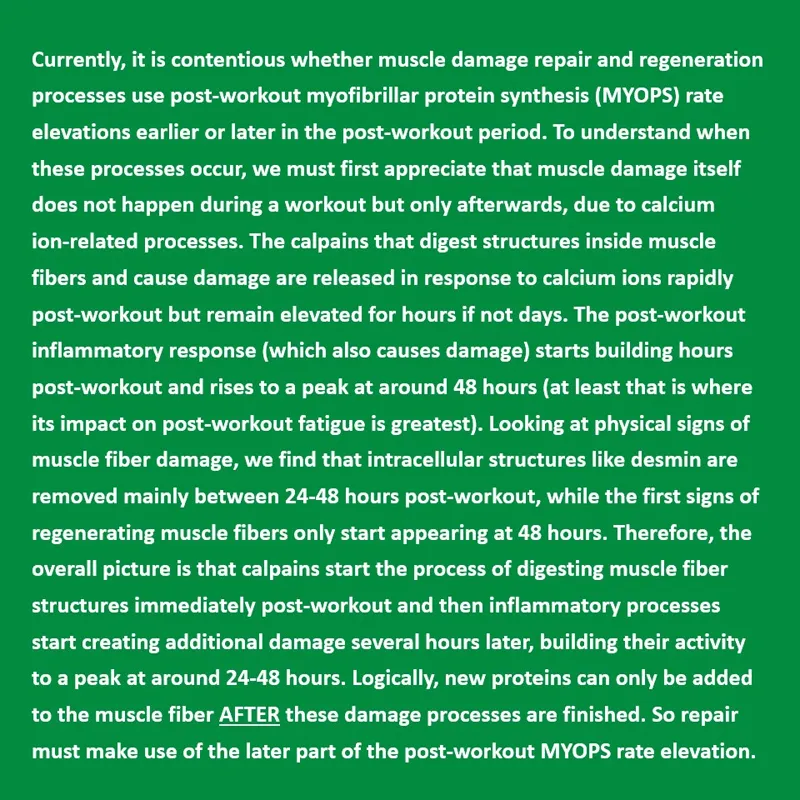
Currently, it is contentious whether the muscle damage repair and regeneration processes use post-workout myofibrillar protein synthesis (MYOPS) rate elevations earlier or later in the post-workout recovery period. To understand when these processes occur, we must first appreciate that muscle damage itself does not happen during a workout but only afterwards, due to calcium ion-related processes. Moreover, calcium ions remain elevated for hours after a workout. The calpains that digest structures inside muscle fibers and cause damage are released in response to the calcium ions very rapidly post-workout but then remain elevated for hours if not days. The post-workout inflammatory response (which also causes damage) starts building several hours post-workout and rises to a peak at around 48 hours (at least that is where its impact on post-workout fatigue is greatest). Looking at physical signs of muscle fiber damage, we find that intracellular structures like desmin are removed mainly between 24-48 hours post-workout, while signs of regenerating muscle fibers only start appearing at 48 hours. Therefore, the overall picture is that calpains start the process of digesting muscle fiber structures immediately post-workout and inflammatory processes start creating damage several hours later, building their activity to a peak at around 24-48 hours. Logically, repair and regeneration can only start AFTER these damage processes are finished. So they must make use of the later part of the post-workout MYOPS rate elevation.

Comments (3)
After a workout, once muscle damage occurs and the repair and regeneration processes begin, how can muscle hypertrophy happen at the same time? In other words, how does hypertrophy occur while the muscle is still being damaged and repaired?
Maybe not your kind of question to answer but in studies showing delayed carbohydrate consumption post training impairs glycogen replenishment and next day performance would it be because waiting until muscle damage starts to set in is impairing replenishment?
It is possible, yes. IIRC, there are a couple of glycogen replenishment studies that did test the effects of carbohydrate intake in the post-workout period but I can't remember exactly when it was consumed. Honestly, it doesn't matter that much because the fatigue mechanisms will stop damaged fibers being used irrespective of whether they have glycogen inside them or not.