





Eccentric contractions and hypertrophy
Fitness influencers are fond of arguing that eccentric contractions are able to stimulate more muscle growth than concentric contractions. Let us examine this claim as well as the research that is proposed to support it.
.
#1. Why do researchers keep coming back to the idea that eccentric training produces more muscle growth than concentric training?
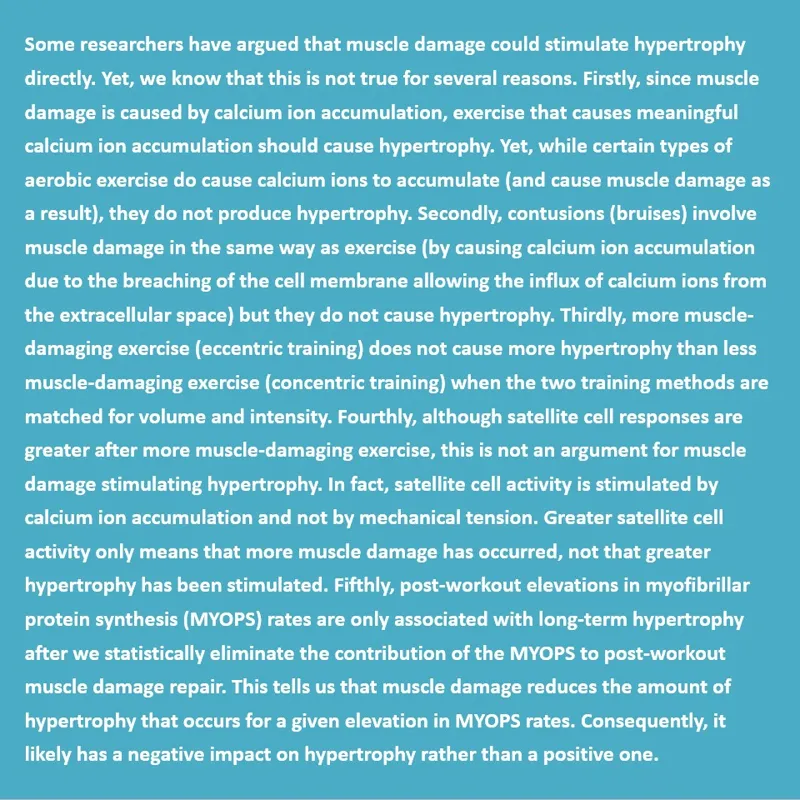
The reason why researchers (and the fitness influencers who follow them) keep coming back to the idea that eccentric contractions are better at stimulating muscle growth than concentric contractions is the muscle damage hypothesis of hypertrophy. This hypothesis (which has changed over the years) argues that hypertrophy is either caused or greatly enhanced by damaging muscle fibers. Yet, there is no evidence that this is the case and indeed there is evidence now that muscle damage impedes hypertrophy by taking away resources that could be used for stimulating muscle growth (read more).
.
#2. Does eccentric training produce more muscle growth than concentric training?
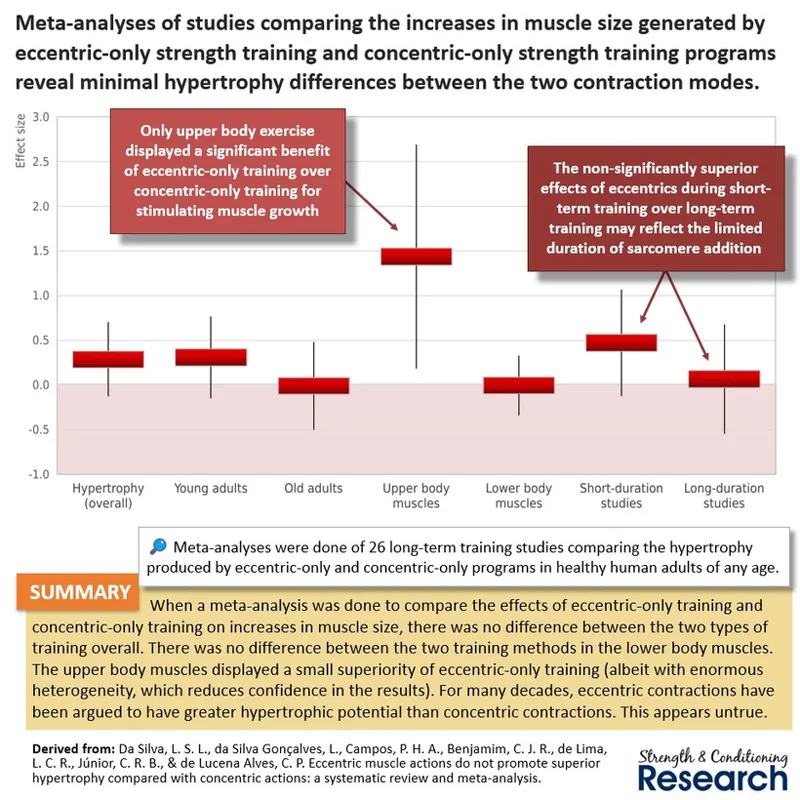
The most recent meta-analysis that has been done to compare the effects of eccentric-only and concentric-only strength training programs on hypertrophy has concluded that there is no difference between the two training methods. Moreover, any small positive effect seems to be short-term, which ties in with the idea that sarcomerogenesis is limited in duration.
.
Individual, high-quality training studies that have tried to equate the training volume between the eccentric-only training and concentric-only training groups have concluded that while the nature of the hypertrophy differs between eccentric and concentric contractions (one produces an increase in muscle fiber cross-sectional area and the other tends to increase sarcomeres in series), the overall increases in muscle volume are basically the same.
.
#3. Why do eccentric-only workouts produce greater anabolic signaling than concentric-only workouts?
Fitness influencers who argue in favor of the idea that eccentric contractions are capable of stimulating more hypertrophy typically do so by suggesting that they are "more anabolic" than concentric contractions. Indeed, it is true that eccentric contractions do generate much larger signals in the mTOR signaling pathway (as indicated by the downstream target P70S6K).
.
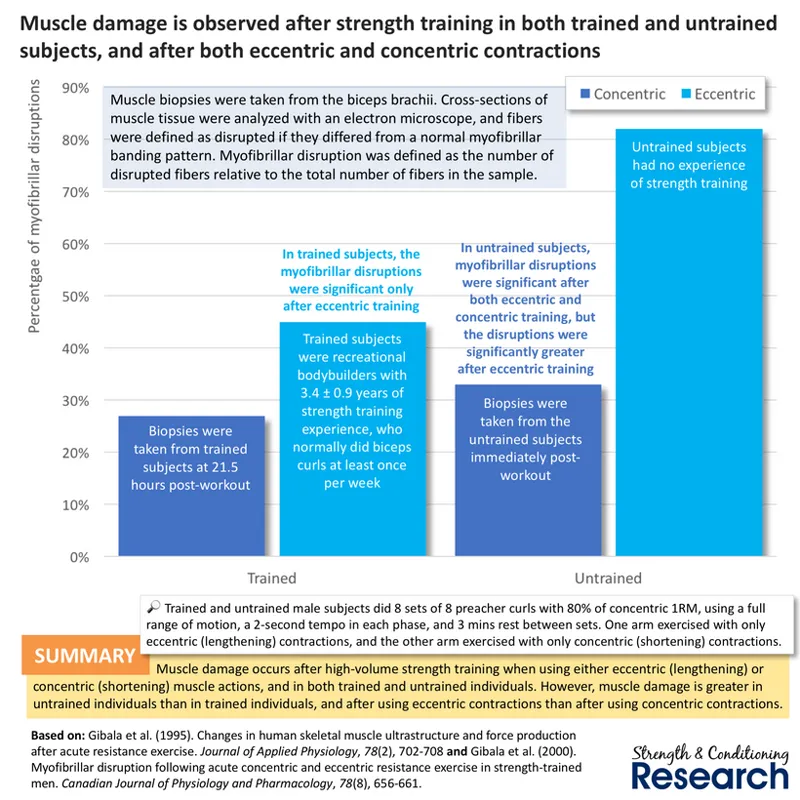
It is well-known that the muscle damage produced by eccentric contractions is greater than the muscle damage produced by concentric contractions, in both untrained and trained individuals.
.
Muscle damage repair requires both elevations in mTOR signaling and also in muscle protein synthesis rates. Hence, when eccentric contractions produce greater mTOR signaling or muscle protein synthesis rate elevations compared to concentric contractions, the most obvious explanation for this occurrence is that [1] the hypertrophy produced by the two training methods is similar, and that [2] the muscle damage repair requirement produced by the eccentric contractions is substantially greater (read more).
.
Conclusions
Fitness influencers are fond of arguing that eccentric contractions can stimulate more muscle growth than concentric contractions. Nevertheless, recent meta-analyses have reported no difference between the increases in muscle size produced by eccentric-only strength training and those caused by concentric-only strength training. So why do fitness influencers persist in arguing that eccentric-only strength training can stimulate more muscle growth than concentric-only strength training? Typically, their arguments are based on observations that eccentric-only strength training workouts produce larger post-workout mTOR signaling responses or muscle protein synthesis (MPS) rate elevations. However, both mTOR signaling and MPS rate elevations can be produced by muscle damage, even in the absence of exercise (as can be seen after contusion injury). Since we know that eccentric-only strength training workouts cause more muscle damage than concentric-only strength training workouts (in both untrained and trained lifters), it seems likely that the discrepancy between the long-term training data (insofar as hypertrophy is not affected by contraction mode) and the acute workout data (insofar as mTOR signaling responses and MPS rate elevations are greater after eccentric contractions) can be explained by the greater muscle damage repair processes that are happening after eccentric-only strength training workouts.
Comments (3)
The missing "read more" link is to this article: https://www.patreon.com/posts/112754684
If im correct both eccentric and concentric training causes the Repeated Bout Effect to protect the muscle fibers from Calpains and Ca2+ overloading and thus reduces muscle damage. Sources: Yamaguchi 2019 & 2020, Nosaka 2001, Chen 2007 Granted this only shows that RBE protects against titin degradation showing in urine so its not direct evidence
There is however data showing that blocks of concentric-only training reverse the RBE produced by eccentric-only training. See here: https://www.patreon.com/posts/115842623