





Eccentric phase = not important for hypertrophy
Several prominent fitness industry influencers claim that the lowering (eccentric) phase of a conventional strength training exercise is more important for hypertrophy than the lifting (concentric) phase. Yet, we can easily see that the lowering (eccentric) phase of a conventional strength training exercise does little in comparison with the lifting (concentric) phase.
.
#1. What is the main difference between the lifting (concentric) and the lowering (eccentric) phases of a conventional strength training exercise?
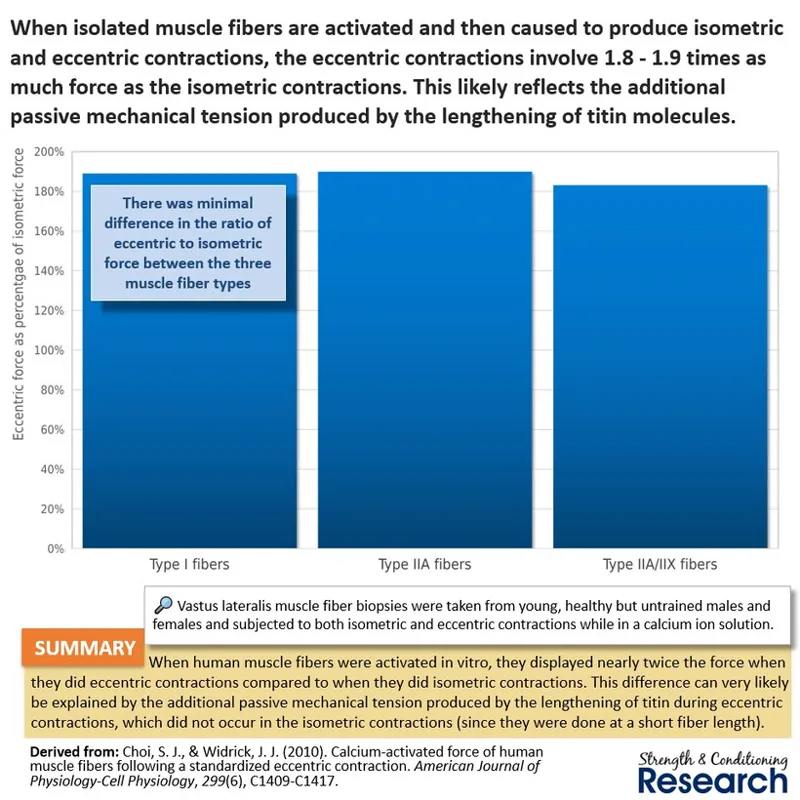
In the lifting (concentric) phase of an exercise, working muscle fibers contribute force to the lift by the formation of actin-myosin crossbridges. In the lowering (eccentric) phase, the working muscle fibers contribute force by [1] the formation of actin-myosin crossbridges, and [2] the passive tension generated by titin. Hence, the force produced by each muscle fiber during the lowering (eccentric) phase is greater than the force produced by each muscle fiber in the lifting (concentric) phase. In human muscle fibers, the increase in force per fiber is between 80–90%.
.
Since the force per muscle fiber is twice as high in the lowering (eccentric) phase as in the lifting (concentric) phase, this means that the level of motor unit recruitment and therefore the number of activated muscle fibers must be approximately 50% in the lowering (eccentric) phase as in the lifting (concentric) phase. This is not speculation but arithmetic. EMG studies confirm that the activation levels in eccentric phases are around this level. For example, the activation of the various prime movers in the pullover exercise is double in the concentric phase compared to in the eccentric phase.
.
#2. Why are low muscle activation levels problematic?
Muscle activation refers to the number of muscle fibers that are activated. A high level of muscle activation means that many muscle fibers are activated, while a low level of muscle activation (as occurs in the lowering [eccentric] phases of conventional strength training exercises) means that only a small number of muscle fibers are activated. Muscle fibers are activated in accordance with the recruitment of their motor units, in line with Henneman's size principle.
.
Low muscle activation levels are problematic because muscle growth is an intrinsic process to single muscle fibers. So we always need to activate a muscle fiber in order to cause radial growth by the addition of myofibrils or longitudinal growth by adding sarcomeres. We know that muscle growth is an intrinsic process to individual muscle fibers for a number of reasons. Firstly, the mechanoreceptors that detect mechanical tension are all located inside individual muscle fibers (read more).
.
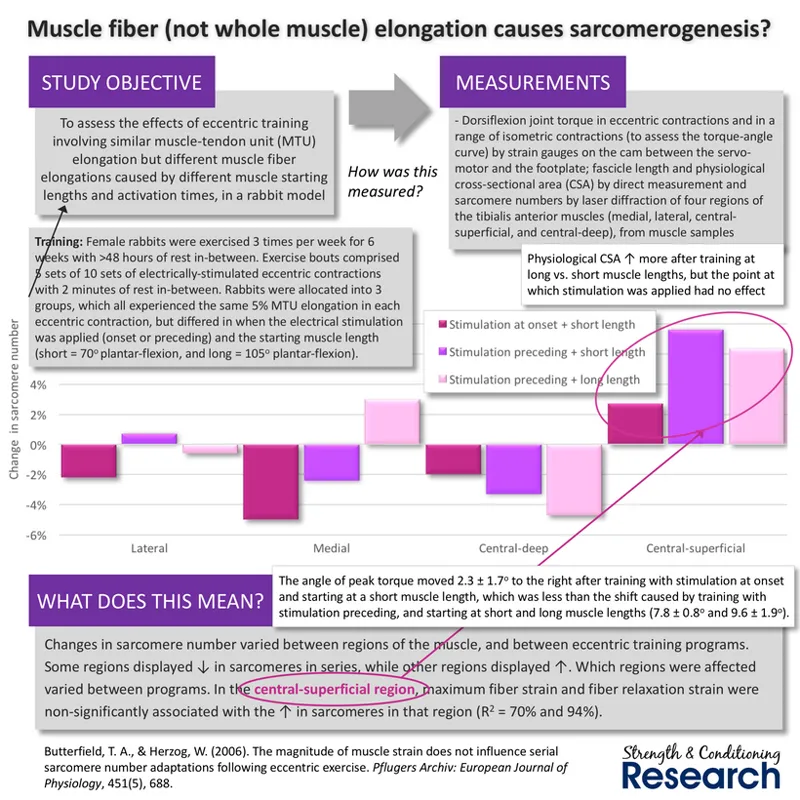
Secondly, sarcomerogenesis is regional in nature and only occurs in those regions where individual muscle fibers are elongated sufficiently while being activated. Where regions of the same muscle do not experience a combination of sufficient elongation while being activated, they do not add any sarcomeres. This shows that the addition of sarcomeres only occurs inside a specific muscle fiber that has experienced a stretch stimulus.
.
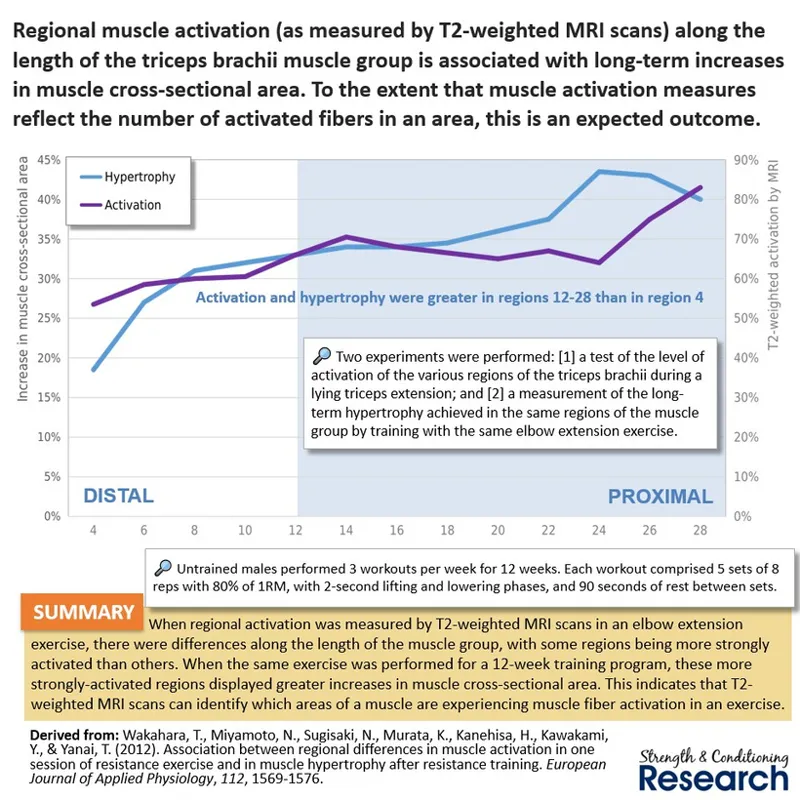
Thirdly, when muscle activation is assessed by MRI signal intensity, the areas of the muscle that display the greatest activation levels during an exercise are the same areas that grow most after training a muscle with that same exercise.
.
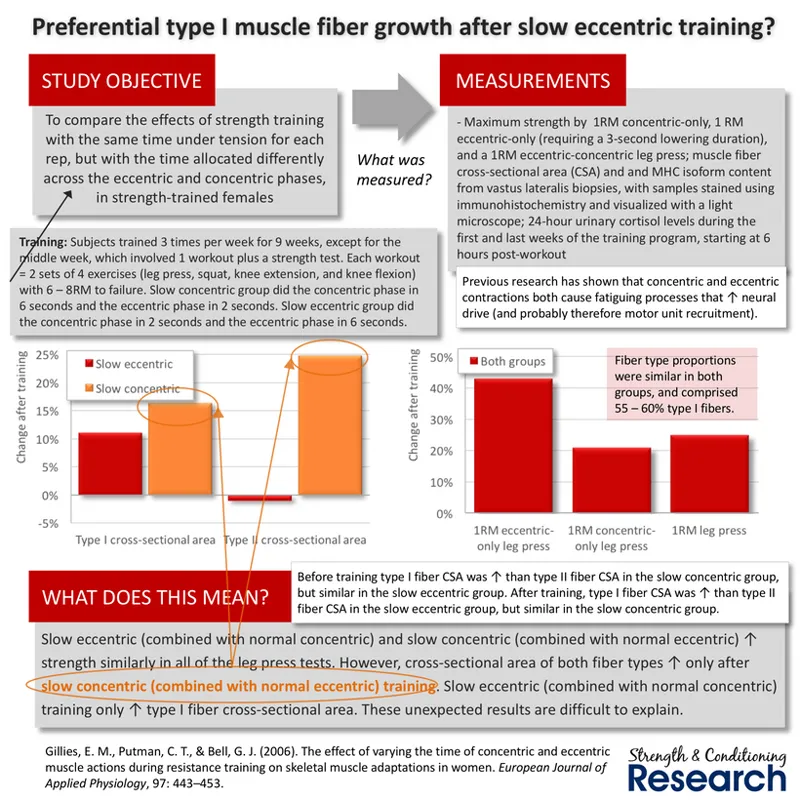
Fourthly, when muscle growth is stimulated by submaximal contractions (as occurs when adding slow lowering [eccentric] phases into a strength training program), the slow twitch fibers grow more than would normally be expected.
.
#3. How much of the muscle can the lowering (eccentric) phase of a normal strength training exercise actually target?
The lowering (eccentric) phase only provides a hypertrophy stimulus to the bottom 50% of the total motor unit pool. Also, we know that the first 30% of the motor unit pool does not grow anyway since it represents the low-threshold motor units that are used during daily life activities). Simple arithmetic tells us that only 20% of the muscle is trained in the lowering (eccentric) phase.
.
#4. Why is maximum eccentric strength 1.4 times higher than maximum concentric strength if eccentric muscle fiber force is twice concentric muscle fiber force?
In vivo human studies show that maximal eccentric torque is approximately 1.4 times maximal concentric torque on average. Evidently, this is a lot lower than the levels observed in vitro.
.
The reason for this discrepancy is the reduced level of motor unit recruitment that we can achieve in maximal eccentric efforts. Indeed, research has shown that the levels of voluntary activation are far lower in maximal effort eccentric contractions compared to in maximal effort concentric or isometric contractions. This does not affect the calculations for the single muscle fiber force because the lower motor unit recruitment is the factor responsible for the lower eccentric force, which obviously reduces the number of activated muscle fibers.
.
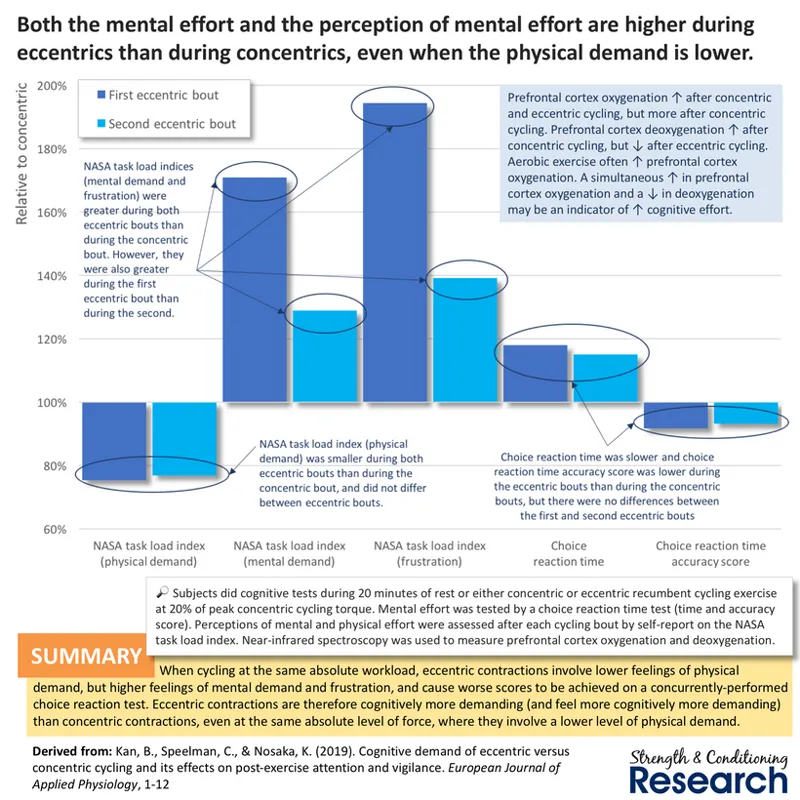
It is likely that we produce lower levels of voluntary activation during eccentric contractions due to the increased cognitive load that we experience whenever the brain struggles to coordinate an unfamiliar eccentric contraction.
.
Conclusions
Several prominent fitness industry influencers have claimed that the lowering (eccentric) phase of a conventional strength training exercise is more important for hypertrophy than the lifting (concentric) phase. Yet, we can easily see that the lowering (eccentric) phase of a conventional strength training exercise does little in comparison with the lifting (concentric) phase. Firstly, muscle fiber force is far higher in an eccentric contraction than in a concentric contraction. In human muscle fibers, eccentric force is approximately 1.8-1.9 times greater than concentric force. Therefore, when producing the same whole muscle force, we only need to activate approximately half the number of muscle fibers in an eccentric contraction compared to in a concentric contraction. This means that we should see approximately half the level of muscle activation in the lowering (eccentric) phase of a conventional strength training exercise as in the lifting (concentric) phase, which is exactly what most electromyography (EMG) studies have reported. Secondly, we know that muscle growth is an intrinsic process to single muscle fibers. So unless you activate and mechanically load a muscle fiber, it will not grow. Consequently, since the lowering (eccentric) phase of a conventional strength training exercise can only activate and load about half the muscle fibers as the lifting (concentric) phase, it is fairly useless for hypertrophy, especially when we consider that the first 30% of the muscle is made up of low-threshold motor unit muscle fibers that are used in the activities of daily life and have already reached their maximum possible size.

Comments (7)
if we have repetitive eccentric contractions with concentric or isometric in between, spinal fatigue sets in in those fibers active, and to keep the force up , would this allow the recruitment of higher threshold motor units and train them?
Is there more direct compare research for hypertrophic effect of concentric vs eccentric training? Above reasoning seems to focus too much on mechanistic studies instead of actual direct comparison. I think why people think eccentric training is more hypertrophic is because of studies like DOI: 10.1519/JSC.0000000000001983, This Meta-analysis of 15 RCT show a trend of better hypertrophic effect for eccentric training compare to concentric training “Results showed that eccentric muscle actions resulted in a greater effect size (ES) compared with concentric actions, but results did not reach statistical significance (ES difference = 0.25 ± 0.13; 95% confidence interval: −0.03 to 0.52; p = 0.076). The mean percent change in muscle growth across studies favored eccentric compared with concentric actions (10.0% vs. 6.8, respectively). The findings indicate the importance of including eccentric and concentric actions in a hypertrophy-oriented RT program, as both have shown to be effective in increasing muscle hypertrophy.”
The problem is that eccentric training involves maximum efforts during eccentric phases. Normal strength training involves about 50% effort and therefore 50% MUR during eccentric phases.
Seemed to experience some large gains in strength and size myself when I first started incorporating "accentuated eccentrics" - likely 6+ years of training experience at the time A consequence of reading this might be to assume that the most efficient lifting style for hypertrophy would be to "dive bomb" the eccentrics, minimizing effort and time there, and to spare all effort for the concentric phase. But maybe accentuated eccentric = accentuated concentric? Very fast eccentrics likely maximize the ability of elastic components in the muscle-tendon unit and fascia to contribute to the concentric and reduce the force required from the muscle fibers during that phase of the lift - through some or through all of the range of motion for a given load. Having a slow eccentric phase is likely in some way reminiscent to having a pause at the transition, or to "bottom up" lifts that start with the concentric, in that the contribution of the elastic components is reduced ...and the perceived effort in the subsequent concentric is increased. Has muscle activation in a maximal effort concentric phase been compared following a slow eccentric versus following a very fast eccentric for a given load, and across a range of repetitions? - Nicholas Simpson
Conventionally, the term "accentuated eccentric" means that the resistance is greater in the eccentric phase.
When you say the concentric force is much smaller due to the lacking passive tension, doesnt this ignore the residual force enhancement during normal (ssc) strength training?
No, because titin isn't perfectly elastic