




Supercompensation
Supercompensation refers to an increase in an outcome in the post-workout recovery period following a strength training workout (or during a taper or deload following a block of strength training). Why can supercompensation happen in respect of outcomes like strength, power, or speed but cannot happen in relation to adaptations like hypertrophy?
.
#1. Why are strength gains different from adaptations?
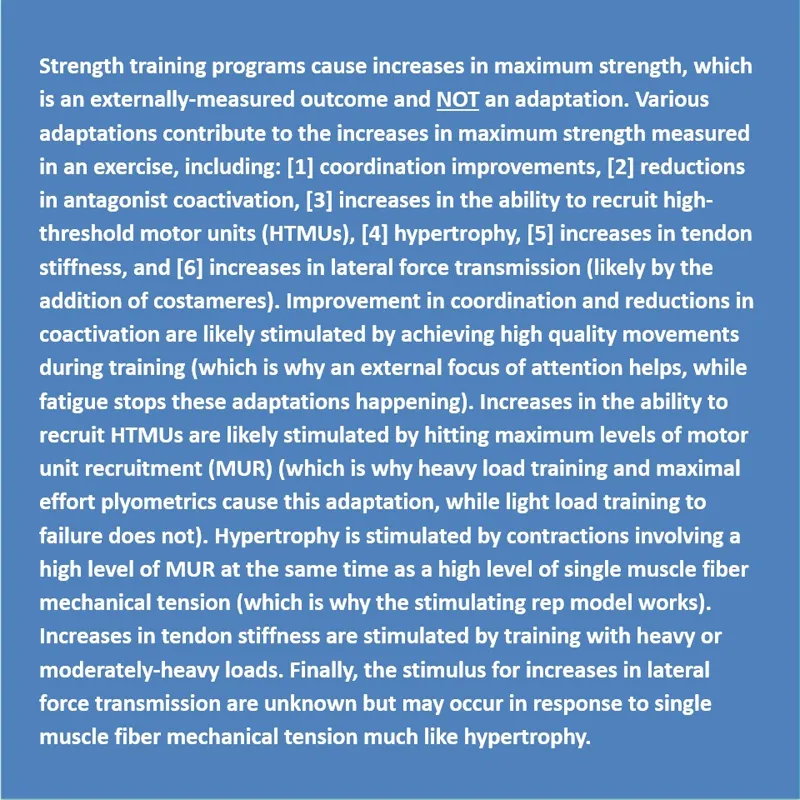
Strength is not an adaptation to strength training. It is an outcome. Adaptations are changes that happen inside the central nervous system or elsewhere inside the body. Outcomes are things that we measure externally. There are various adaptations that contribute to strength gains (read more).
.
#2. What determines our strength at any one moment in time?
Strength is determined by the net of three factors at any one moment in time: [1] our unfatigued and unpotentiated strength, [2] our state of fatigue, and [3] our state of potentiation. Fatigue mechanisms can greatly reduce our strength, while potentiation mechanisms can slightly increase our strength. Often, at many points within a strength training program, we have greatly reduced strength because of the fatigue that has accumulated from previous workouts.
.
#3. How does supercompensation of strength happen?
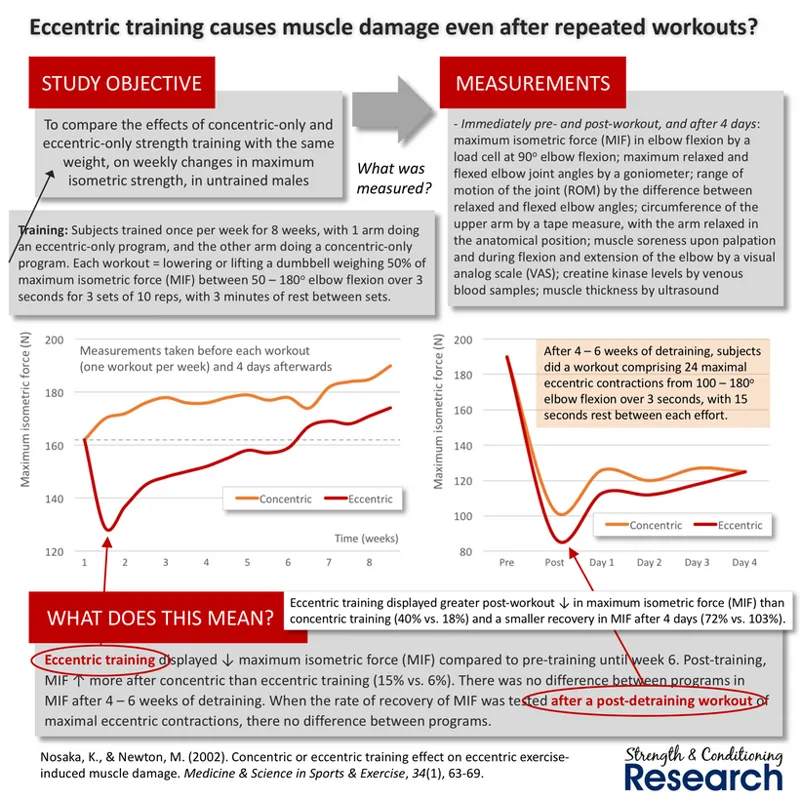
Strength can display supercompensation because it is affected negatively by fatigue and fatigue can dissipate with recovery. This is why deloads and tapers produce an obvious supercompensation effect on strength. Fatigue accumulates during the strength training program. During the taper or deload, it dissipates and leads to an increase in the net strength that we can display during a strength test.
.
#4. Why can supercompensation NOT happen in adaptations like hypertrophy?
Muscle size is determined by [1] adaptations such as muscle fiber hypertrophy and sarcomere addition, and [2] temporary swelling caused by the muscle damage and inflammation process. While only a small number of studies have investigated the effects of deloads and tapers on hypertrophy, they have confirmed that there is no additional growth that occurs in these periods. All of the growth happens during the training program.
.
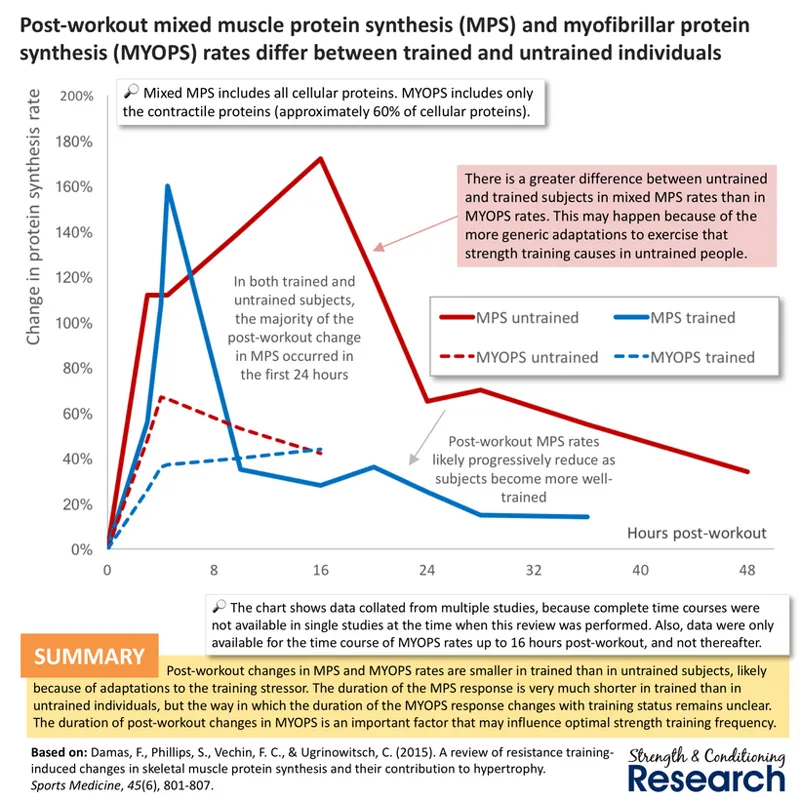
Indeed, the growth of muscle fibers occurs in the post-workout stimulus window, which probably lasts approximately 48 hours in total. In this period, there is an elevation in the rate of synthesis of proteins that make up myofibrils. Outside of this period, no such elevation happens and therefore there cannot be any hypertrophy happening.
.
Conclusions
Supercompensation refers to an increase in an outcome in the post-workout recovery period following a strength training workout (or during a taper or deload following a block of strength training). Why can supercompensation happen in respect of outcomes like strength, power, or speed but cannot happen in relation to adaptations like hypertrophy? When strength is tested after training, its level reflects three inputs: [1] the unfatigued and unpotentiated strength, [2] the state of fatigue, and [3] the state of potentiation. Fatigue mechanisms can greatly reduce our strength, while potentiation mechanisms can slightly increase our strength. Often, at many points within a strength training program, we have greatly reduced strength because of the fatigue that has accumulated from previous workouts. Consequently, during a taper or deload, we dissipate this fatigue and our net strength increases, albeit not because of any changes in underlying adaptations. In contrast, actual adaptations like hypertrophy are stimulated in strength training workouts and are then processed immediately afterwards (probably over a 48-hour period). There is no delay in the processing of the stimulus simply because of the presence of fatigue.
Comments (3)
I asked if there is any difference between the concepts of "Supercompensation" and "Overcompensation". I removed the question by mistake. I apologize. Thanks for Chris' answer: "I don't understand how those two terms are different?"
One question - if the training plan is constructed in a way that minimizes fatigue accumulation - would the deload cause any supercompensation effect? Is it possible not to accumulate fatigue?
It is possible to avoid accumulating fatigue, yes. In that case, we would not see any supercompensation of strength. It is possible to see some supercompensation of speed due to fiber type shifts.