


Weekly volume
Every day, fitness influencers receive thousands of questions about what weekly volume is optimal. However, it is impossible to provide a weekly volume target that means anything because: [1] the amount of weekly volume that we can recover from varies with training frequency, and [2] the stimulating effect of that weekly volume also varies with training frequency.
.
#1. For weekly volume to be useful irrespective of training frequency, fatigue must accumulate in the same way regardless of training frequency
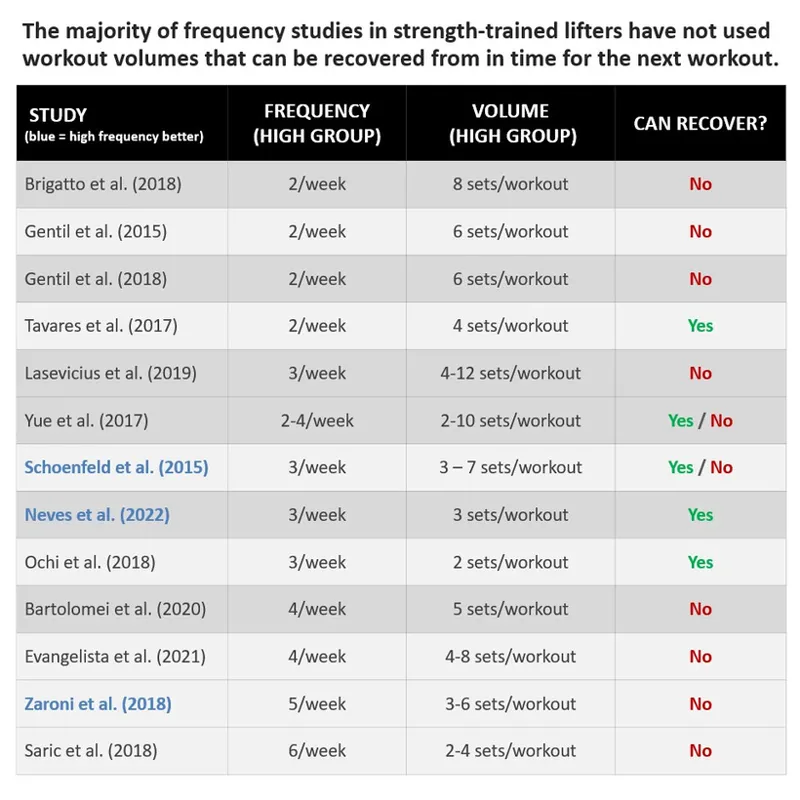
Currently, most popular training programs use workout volumes that are higher than can be recovered from between workouts. Consequently, post-workout fatigue accumulates over time. For weekly volume to be a meaningful concept while this is happening, the amount of post-workout fatigue that accumulates must be identical regardless of when that volume is performed. Yet, a review of the literature reveals that training more frequently reduces the total volume that can be done while still recovering between workouts. We can do 3 sets, 3 times per week (for a total of 9 sets), 5 sets, 2 times per week (for a total of 10 sets), or 12 sets, 1 time per week (for a total of 12 sets).
.
#2. For weekly volume to be useful irrespective of training frequency, hypertrophy must occur in the same way regardless of training frequency
For weekly volume to be an indicator of how much hypertrophy will occur from a strength training program, training frequency must be irrelevant. Otherwise, the same weekly volume will produce totally different amounts of muscle growth when training frequency is altered. Since recent meta-analyses have reported that frequency does not affect muscle growth when weekly volume is equated, many fitness influencers now just assume that this is true. However, the majority of included studies in such meta-analyses have not implemented workout volumes that can be recovered from.
.
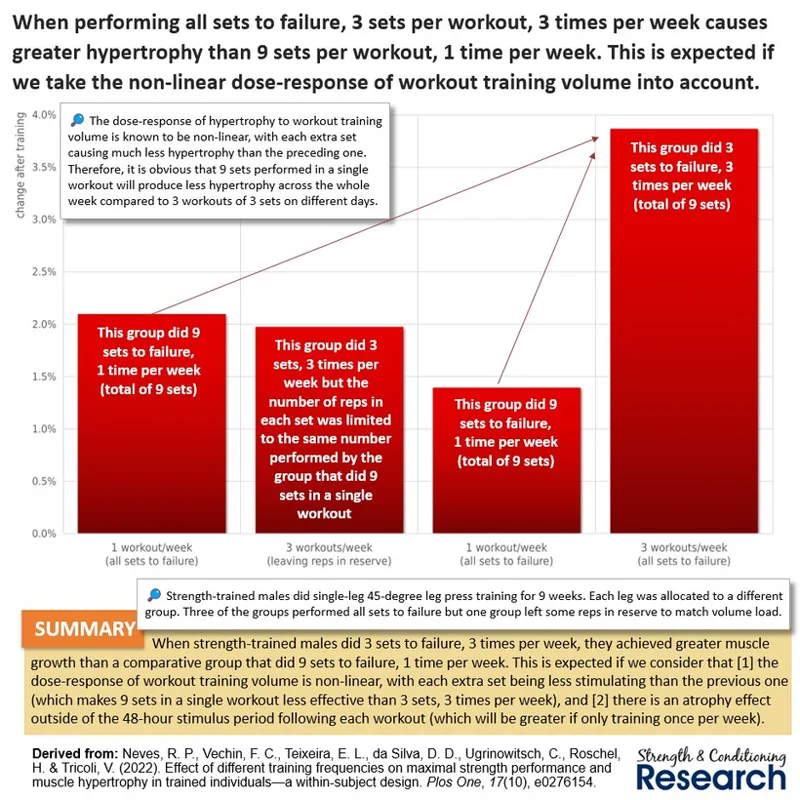
When we look at studies that have limited workout volumes to recoverable limits, we find that many of these studies do show that higher frequencies are in fact better for stimulating hypertrophy than lower frequencies (and clearly not by a small amount).
.
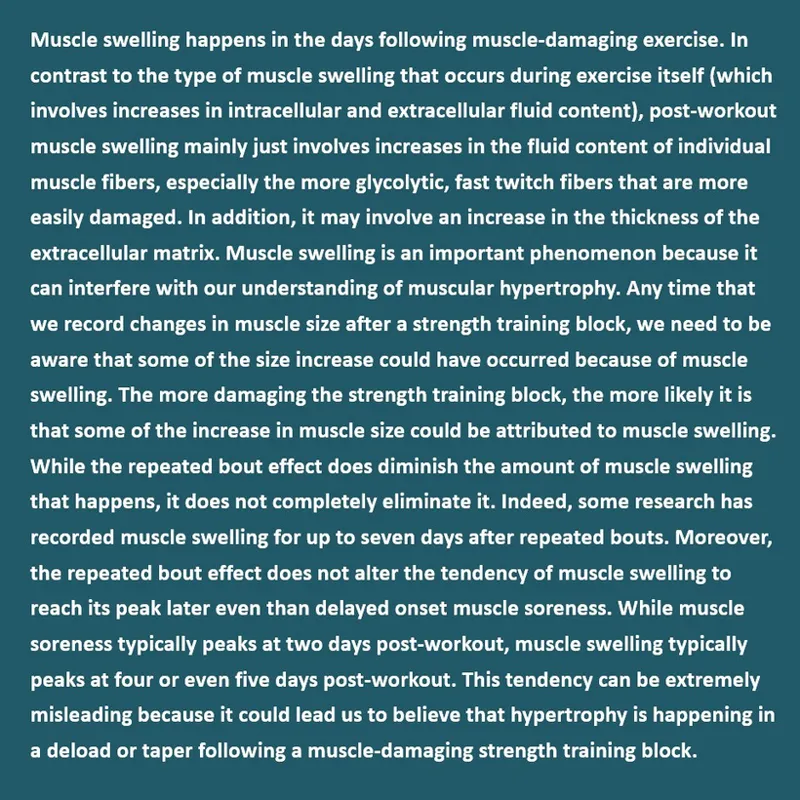
It is highly likely that muscle swelling produces a confounding effect when muscle growth is measured after strength training programs that do not permit full recovery to occur between workouts and therefore cause post-workout fatigue to accumulate over time (read more).
.
#3. Why weekly volume cannot be associated with hypertrophy irrespective of training frequency
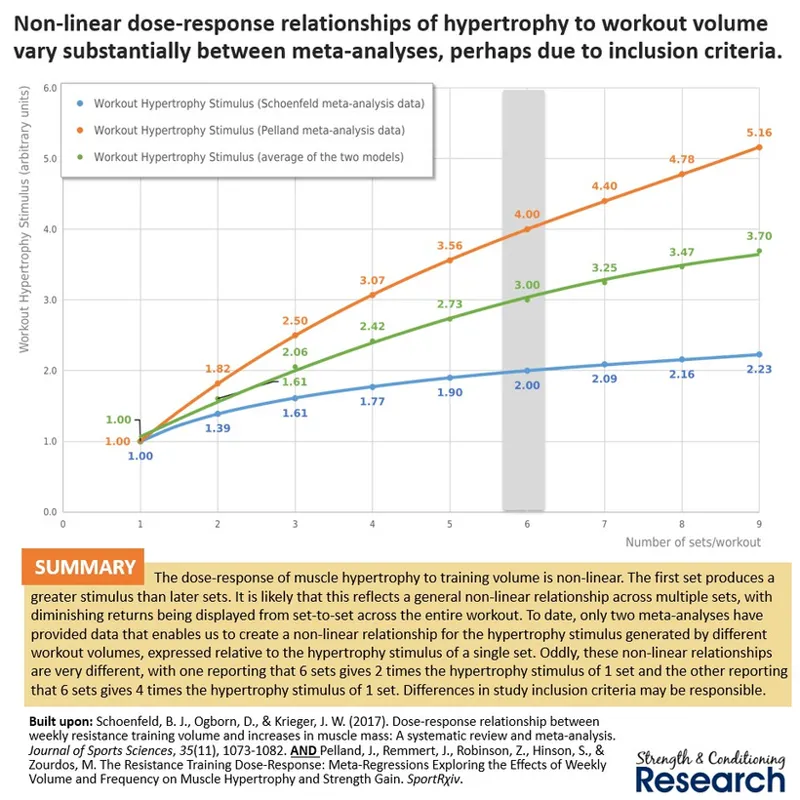
Many fitness influencers simply repeat their mantra that "frequency does not matter when weekly volume is equated" when confronted with physiology. So let us be very clear about which two physiological problems negate all of their meta-analyses. Firstly, workout volume produces a diminishing returns effect. This means that the later sets in a workout are less stimulating than the earlier sets. This observation has been made by two meta-analyses so far. Based on this fact, there is no possible way that allocating your weekly volume to one single workout can stimulate as much hypertrophy as splitting that volume up into two or three separate workouts.
.
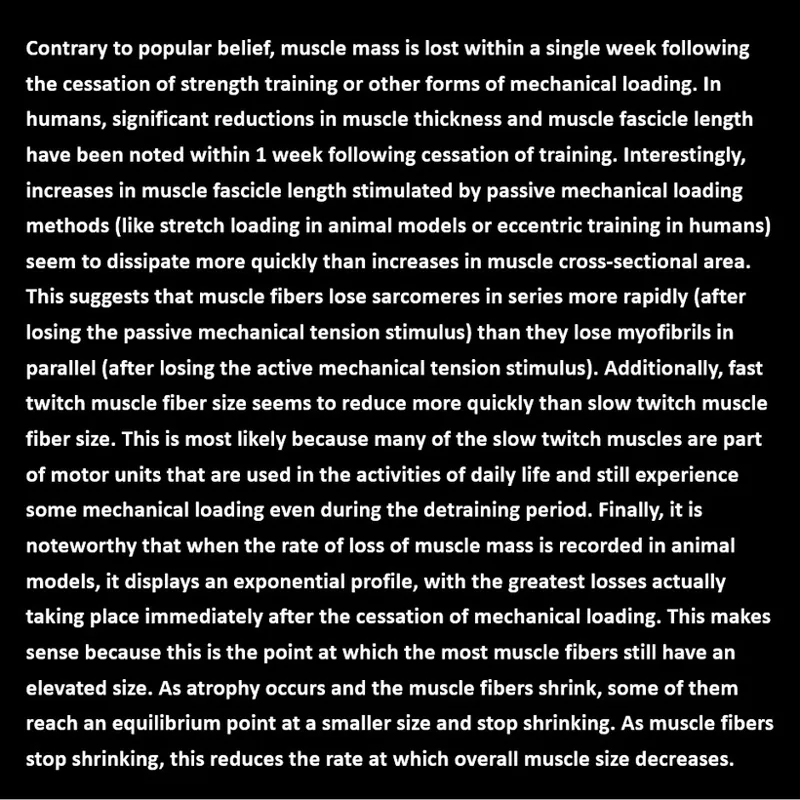
Secondly, we know that muscle atrophy occurs within a training week. This has been demonstrated by recent studies in the detraining literature as well as the maintenance literature. Therefore, even if all sets were equal and produced the same stimulating effect regardless of their location within a workout, allocating all of your weekly volume to one workout each week would still be worse than splitting it up across multiple workouts (read more).
.
Conclusions
Every day, fitness influencers receive thousands of questions about weekly volume. Yet, it is impossible to provide a weekly volume target because: [1] the weekly volume that we can recover from varies with training frequency, and [2] the stimulating effect of that weekly volume also varies with training frequency. Therefore, any recommendation regarding weekly volume must be qualified by reference to the training frequency. Despite recent meta-analyses appearing to show that training frequency does not matter when weekly volume is equated (at least when hypertrophy is concerned), we have good reasons to believe that training frequency does in fact matter. Firstly, recent meta-analyses include many studies that have programmed workout volumes that do not permit recovery to occur before the next workout. This is reflected in the finding that higher volumes do not similarly benefit strength gains in the same way as they do muscle growth (implying that muscle swelling is a confounding factor). Secondly, increasing workout volume increases hypertrophy with a diminishing returns effect, which implies that allocating the weekly volume for a muscle to one workout must cause less hypertrophy than allocating the same volume to multiple workouts (since later sets in each workout are less effective). Thirdly, gains in muscle size are lost within a training week, which means that training a muscle once per week must be less effective than training it multiple times per week even if the hypertrophy stimulus is exactly the same.
