

A History of Violence w/ Patrick Wyman
Prompted by a meditation on mercenaries, Gregk consults the henchest man in ancient history to discuss ancient forms of violence work and whether our current conjuncture is really a rupture, or more a return to form.
Follow Patrick Wyman on Bluesky
Listen to Past Lives
Listen to Tides of History
Blood Work is a Scam Goldin Production
This episode was produced by Thomas O’Mahony
Our theme song is ‘Dream Weapon’ by Genghis Tron
Our artwork is provided courtesy of KT Kobel
If you enjoyed this episode:
– Support Blood Work via Patreon
– Leave a rating or review on your podcast app
– Follow us on Bluesky / Instagram / Twitter
Image: A group of unidentified mercenaries operating in Gaza, 2025.
THIS WEEK IN VIOLENCE: WEST MIAMI ANTISOCIAL CLUB
ALSO AVAILABLE IN AUDIO
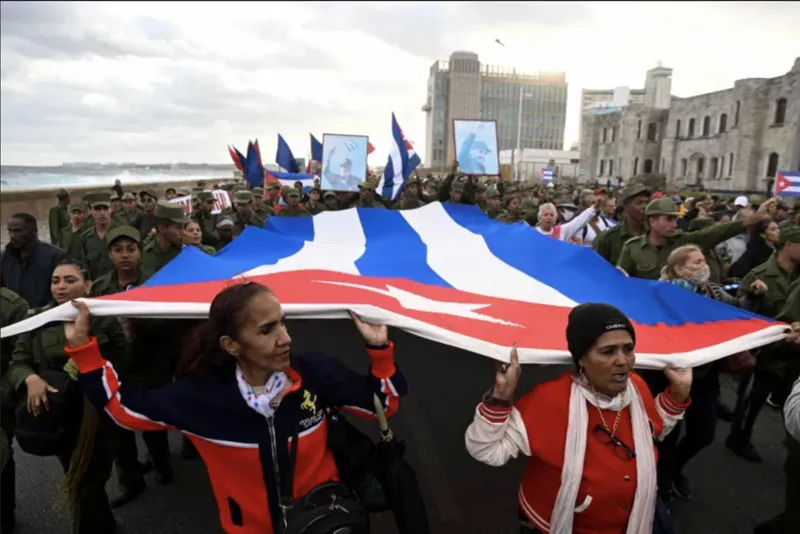
For this week’s newsletter, we situate the United States’ latest wave of aggression against Cuba within the longer histories of the the twentieth and nineteenth centuries, stripping back the various narratives the western hemisphere’s imperial master has layered, like wallpaper, over its designs on Cuba over decades.

Comments (4)
On the topic of Violence Work being privatized out of a state-managed system, the history of how the Samurai class in Japan formed is an excellent example. Initially, armies were raised by regional lords under the authority of the state, and were made up of constripted peasants. This was useful when the Japanese state was conquering the islands and needed a well supplied and organized fighting force on hand to take control of land and put down rebellions. However, after the majority of the islands were firmly under the control of the Japanese state, the need for such an institution diminished, to the point that the mandatory constripts were being put to work doing farm work for the Lord's who's job it was to conscript them. The need for a robust and centrally organized institution of Violence was no longer needed, but the need to use violence was still there. Eventually, the army was abolished, and the job of Violence Work was privatized, now relegated to a smaller number of career professionals who would sell their labor to lords who needed someone to fight other lords or put down peasant rebellions. Thus were born the Samurai. What is particularly interesting about the Samurai as an institution is how they were primarily made up of those who were part of the establishment, but who did not have access to the political, social, and economic power of that class. People who were not born to the main ruling family could not gain real power in the Imperial Court, and thus could not rise politically. Second and third born sons who had no chance of inheriting the family land or fortune. These people saw becoming a Samurai as a way of elevating their economic and social position. Through Violence Work, they could make a lot of money, and even be given land and titles of their own. Just like with ICE, these men saw this field of labor as one of the few through which they could elevate themselves in this world where the hierarchy and systems of power were well established and restrictive. The main takeaway from this I believe is that when a system based on growth and domination runs out of new frontiers to conquer, and the further accumulation of wealth and power becomes a matter of taking further control of parts of the existing system, and you end up seeing all forms of labor be privatized, including Violence Labor. It is fundamentally a cannibalization if the establishment by itself.
Great episode. I'm going to recommend the Storyville Dogs of War documentary on iPlayer (UK) about an Englishman who spent more than 40 years as a mercenary. It rips.
I don't know that I disagree with the good doctor's point about liberal democratic world order being preferable to anarchic foreign policy, so much as I feel a disquiet at that being such a flat statement followed by things which measurably disprove it. I've read Pat's work, this (excellent) episode demonstrates that the man is on the level, but I think liberal democracy's pursuit of foreign policy can only be a legitimate preference outside of a (post-modern understanding of) system of capital. Capitalism incentivises a lack of collective responsibility and furtherance, because it wants to foster competition. I'm nearly retching that I must echo the man, but Carney's line in his Davos speech about the world order not applying to the biggest dogs is the greatest undermining of the liberal world order. It stops the chaos of smaller powers from leveraging might, but if the larger powers want to start killing people, they're not *that* tied up by process and law. It'll come *back* for them, but it doesn't seem any provably less bloody than international anarchism. EDIT - okay brother won me over with his final words. He was making a qualified statement as a historian, not commenting on personal preference of what should be. Nice.
2 things: (1) amazing show. (2) AAAAAAAAAHHHHHHHHHHH...!