In a previous post, we discussed the role and structure of Rules of Engagement (ROE). This article is a follow-up of that discussion, focusi
In a previous post, we discussed the role and structure of Rules of Engagement (ROE). This article is a follow-up of that discussion, focusing on a specific and frequently employed tool within the ROE framework: the Show of Presence (SOP).
During OEF and under the ISAF mandate, coalition airpower was often required to operate under significant tactical, political, and ethical constraints. In such environments, where enemy fighters blend with the civilian population and traditional frontlines are non-existent, the application of force was as much about influencing behavior as it was about lethal effect. The Show of Presence (SOP) emerged as one of the frequently used methods of escalation of force (EOF): a non-lethal, controlled, and deliberate demonstration of presence meant to shape the enemy's decisions without crossing the threshold into lethal engagement.
In this article, we'll examine the SOP from a doctrinal, tactical, and psychological perspective. We'll discuss its role in Effects-Based Operations (EBO), break down its execution in practical terms, analyze its risks, and offer guidance for application in DCS World. By the end of this post, you'll have a clear understanding of how the Show of Presence serves as an initial escalation step, one that leverages the threat of force without its actual use, enabling you to simulate real-world CAS and COIN operations with greater fidelity.
Vocabulary Note: "Kinetic" vs "Lethal"
In common usage, the term "kinetic" is often treated as a synonym for "lethal", but this is imprecise and misleading in the context of escalation of force.
Kinetic refers to motion or physical action, especially involving energy or force. In aviation, any aircraft maneuver is kinetic by nature.
Lethal, on the other hand, refers specifically to an action intended to cause death or destruction.
For example:
a Show of Force is highly kinetic (aggressive maneuvering, flares, burner, noise), but non-lethal by design.
a directed-energy weapon (like high power LASER) might be lethal but non-kinetic in the visual or audible sense,it may produce its effect without warning or visible motion.
In doctrinal and tactical discussions, it’s best to avoid using “kinetic” as shorthand for “lethal.”
I. Definition, Operational Purpose and Tactical Effects
I.1 - Definition
The SOP is the most restrained form of escalation of force available to airborne assets.
The maneuver can be described as a medium-altitude, non-aggressive overflight intended to establish airpower presence in the battlespace. The aircraft conducts a deliberate, observable transit, typically overhead or adjacent to a point of interest, at a moderate altitude that ensures visibility without conveying immediate threat. It is not meant to simulate an attack or imply immediate lethal action. Its strength lies in repetition, timing, and psychological signaling, not aggression.
I.2 - Operational Purpose and Tactical Effects
As you can easily figure it out, the SOP is therefore a non-verbal signal to potential adversaries that they are being monitored and outmatched, without the immediate threat of lethal engagement. In the context of counterinsurgency (COIN) operations, the SOP offers a way to influence enemy behavior while maintaining compliance with restrictive ROE.
In terms of "effects" (if we stick to the Effect-Based Operations vision), the SOP is not merely a procedural flyover used as a tool for psychological shaping.
Its primary effects are:
Deterrence: the SOP communicates to the adversary that coalition forces are aware of the battlespace, that airpower is overhead, and that continued hostile intent will not go unnoticed.
Disruption: the visible and audible presence of a fast jet overhead can force insurgents to delay, relocate, or even abandon their planned actions, such as ambush setups or IED emplacement.
Area Denial: repeated SOPs over key terrain (e.g., Highway One, main valleys, chokepoints) signal that the area is actively monitored, making it less attractive to enemy forces.
Reassurance: For friendly ground forces, the SOP confirms that airpower is responsive and available. For local populations, it may demonstrate the presence and protection of coalition forces, although this effect can vary depending on cultural and political context.
The Afghanistan "Ring Road" was a crucial logistical network that was carefully monitored by coalition forces, and that was subject to frequent SOP.
So, when Is a SOP appropriate? It should typically be employed in the early phases of an engagement, or when no active engagement has yet occurred but there is reason to suspect hostile intent. Such scenarios include:
Preemptive presence: flown in the hours before a planned ground operation to unsettle or displace enemy observers.
Routine area patrols: used in known hot zones to deter movement or demonstrate control.
Non-specific threat indications: when ISR or ground elements report suspicious activity, but no clear understanding of the enemy's intent can be determined.
Urban or civilian-dense areas: where the use of lethal force would risk collateral damage, but a presence signal may cause the enemy to disengage.
In all cases, the goal remains the same: use airborne visibility, noise, and threat implication to shape enemy behavior without the need to fire a shot.
II. How to execute a Show of Presence
The SOP should not be improvised, but carefully thought in order to minimize risks posed by MANPAD and AAA threat. It's not a mere flyby to greet the troops, it’s a tool of influence, designed to demonstrate control of the airspace and deter hostile action without escalating to aggression.
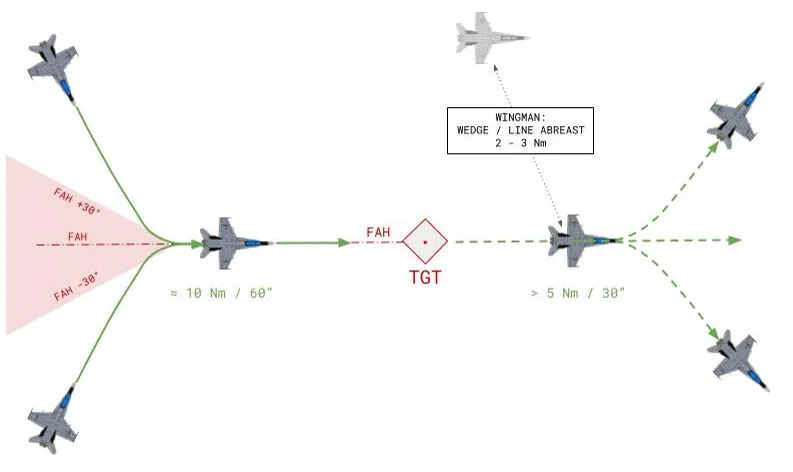
A standard SOP run is flown at approximately 5,000 feet AGL, high enough to remain above small arms fire (SAF), but low enough to ensure visibility and acoustic impact on the ground. The aircraft will approaches from a distance of around 10 nautical miles, descending as much as needed to establish the run-in profile. A sharp dive may be used, depending on terrain and airspace, followed by a climb-out in the +15° to +30° range in order to maintain speed.
Example of vertical profile for a SOP.
If possible, the speed is in the high subsonic range, typically around 540 knots true airspeed, using BUSTER. This ensures a strong visual and auditory signature without overextending fuel or increasing IR signature with afterburner. The pass should be flown directly over, or slightly offset from, the area of interest, often a village, road, ridgeline, or suspected enemy location.
SOP can be more effective when flown in formation. A two-ship in wedge or line abreast, with 2-3 nautical miles of lateral spacing, maximizes ground coverage and visual impact from multiple angles. While the maneuver is non-threatening, aircraft systems should still be fully configured for survivability: RWR and MWS active, dispensers set to AUTO, and jammers configured according to threat environment. Radar altimeter warnings should be active and set with an appropriate safety margin below your planned altitude.
Horizontal profile of a SOP: whenever possible, avoid diving directly towards the intended target, so as to remain as unpredictable as possible.
We can note that timing is critical. A single pass may be enough to deliver the intended message, particularly when ground forces are nearby or the local threat level is low. In more active or ambiguous environments, SOPs can be repeated, either on a schedule or integrated into CAS taskings. However, repetition must not become routine. Predictable timing creates patterns, and patterns invite ambushes. Randomized intervals and varied approaches help maintain the psychological effect without exposing aircrews to avoidable risk.
Importantly, the SOP does not include flares or afterburner use unless specifically required, since it is not an aggressive act. Instead, presence is communicated through silhouette, engine noise, and the unmistakable message of a fast mover in controlled flight overhead.
III. Risks and Mitigation
III.1 - Tactical Misinterpretation
One of the primary risks is misinterpretation, by the enemy, by friendly forces, or by civilians. If flown too low or too aggressively, an SOP may be mistaken for a Show of Force, or worse, a prelude to an attack. This can trigger unintended escalation or panic on the ground. On the other hand, if flown too high or too casually, it may fail to register with the intended audience, reducing its psychological impact to nearly zero.
Mitigation lies in strict adherence to profile discipline and coordination with ground elements. The SOP must be pre-briefed and executed exactly as intended, neither too timid nor too aggressive. Ground forces, JTACs, and other aircraft in the stack must be aware of the plan to avoid confusion or overreaction.
III.2 - Threat Exposure
Though not a low-level maneuver, the SOP still places the aircraft within visual and acoustic detection range, and in most cases, well within reach of opportunistic AAA or MANPADS. Therefore, as stated above, SOP must be executed with full defensive systems active: RWR and MWS on, dispensers armed or in AUTO, and jammers configured per threat expectations.
The SOP is often flown in areas without confirmed enemy contact, which makes threat ambiguity a constant factor. Crews must treat every pass as potentially contested, maintaining a combat mindset even during non-lethal operations.
Example of a typical MANPAD's envelope (a Stinger here): at 5,000'AGL, you're flying in the heart of the missile's firing domain: whenever possible, flying with the sun in your back is still the best defense in this situation.
IV. Practical Application in DCS World
DCS World offers a level of fidelity that allows us to train the discipline and judgment required for real-world procedures like the Show of Presence. While the platform is combat-oriented, simulating restraint under pressure is a valuable skill...
IV.1 - For Mission Creators
A well-designed SOP scenario in DCS could include:
Friendly ground elements (e.g., patrols, convoys, or FOBs) that you’re supporting;
Suspected enemy activity: possibly not positively identified, maybe hinted through scripting (e.g. triggers based on player proximity);
A reason for restraint: civilians nearby or ROE limits.
You can use triggers to simulate reactions, like AI units that scatter or disappear upon SOP pass, and JTAC voiceovers or scripted radio calls acknowledging the overflight.
IV.2 - For Players
I'm sure that most DCS players find high-speed, low-altitude attack runs thrilling, but flying a SOP mission well, with patience and purpose, is a different kind of satisfaction. It’s a chance to model strategic airpower behavior: presence, restraint, and precision.
Real CAS crews often spend hours on station without releasing a weapon, but their influence is no less real. The Show of Presence trains you to think like them...
Conclusion
As you have understood it now, the Show of Presence is more than a flyover. It is a deliberate, measured, and disciplined action. In the complex operating environments of OEF and ISAF, where lethality was often the last resort and perception shaped every engagement, the SOP became an important tool of airpower.
In DCS, mastering the SOP requires a shift in mindset.; it's not all about triggers or tonnage... Done right, it trains restraint, enhances mission realism, and gives weight to the decisions that follow.
In a next post, we’ll take the next step in the escalation ladder: the Show of Force, which is a maneuver that moves from presence to intimidation, bringing us closer to the threshold of kinetic engagement without yet crossing it.