Illustration: a pair of F-15E Strike Eagles deploying 2,000 lbs JDAMs during Operation Hammer Down, an offensive operation in Kunar Province, Afghanistan, 2011. Such operations required specific ROE that authorized deliberate and sustained use of force against identified enemy positions.
Rules of Engagement (ROE) are the invisible framework behind every trigger pull, every bomb release, and every show of force. As a (virtual) combat pilot, these rules define what is authorized or not, with a direct consequence in terms of legality: following the ROE is the insurance that you won't get indicted if your bombs inflict damages to persons or properties.
In Afghanistan during OEF and ISAF mission, ROE were far from static. They evolved continuously, reflecting not only the legal obligations of coalition forces, but also the political and strategic goals set by commanders on the ground, and more importantly, by individual nations.
Throughout the campaign, combined (multinational) joint (multiservice) commanders adjusted ROE to shape the conduct of operations. Under General James Mattis, ROE aimed at giving commanders and aircrews the flexibility to engage decisively, with a focus on destroying enemy forces and enabling offensive action. In contrast, under General David Petraeus, the ROE were deliberately tightened to emphasize restraint, minimize civilian casualties, and support the broader strategy of winning over the local population (the so-called “hearts and minds” approach fundamental to counterinsurgency (COIN) doctrine).
On June 23, 2010, President Obama stands with Gen. David Petraeus as he announces that Petraeus will replace Gen. Stanley McChrystal.
These shifts weren’t just policy nuances. They directly impacted the decisions made by pilots, JTACs, and ground commanders in the heat of battle. The difference between a permissive ROE and a restrictive one would mean a very different approach to combat operations.
In this introduction, we’ll explore what ROE are, the key concepts that underpin them, how they are communicated to pilots and JTACs, and the practical impact they have on operations. As virtual pilots seeking realism and depth in your missions, understanding the reality behind ROE will bring you closer to the mindset of the aircrews.
I. What are ROE?
ROE are the authoritative instructions issued by a competent military authority that define the circumstances, conditions, and limitations under which forces may initiate or continue the use of force. For any combatant, ROE form the bridge between the legal right to apply force and the operational or political intent behind how that force should be used in a given mission. In other words, ROE are the framework that tells you not just what is lawful, but what is authorized, and sometimes, what is expected or prohibited, in a particular context.
National law, as each nation may impose further restrictions based on its constitution, laws, or political direction.
Political and military policy, as commanders and governments align military force with strategic objectives, public opinion, and mission goals.
The Law of Armed Conflicts as approved by UK MOD in 2004.
Note that ROE do not assign missions or direct tactics. The mission comes from operational orders (OPORDs, ATOs, FRAGOs) while tactics are designed by individual units to achieve that mission. ROE simply set the boundaries for how force can be lawfully and legitimately applied within those missions.
For example, a pilot may be tasked to destroy an enemy position, but ROE may define:
what degree of force may be used (e.g. direct attack only with PID on target),
what conditions must be met before engaging (e.g., no collateral damage risk to civilian structures),
or what approvals are required (e.g., higher commander release authority for certain munitions or targets).
In very long campaigns like OEF, ROE were not static, they evolved with the mission, reflecting shifts in strategy, operational environment, and the overarching political aim.
II. Key Concepts Linked to ROE
To apply ROE effectively, you must understand the core concepts that underpin them. In COIN scenarios like Afghanistan or Iraq, these concepts were central to aircrew decision-making.
II.1 - Self-Defense
At the heart of all ROE, regardless of how permissive or restrictive they may be, is the inherent right of self-defense. This right exists at several levels:
Individual self-defense: this is the right of a person to defend themselves from an attack;
Unit self-defense: this is the right of a military unit to defend itself and other friendly forces in the vicinity;
National self-defense: this is the right of a nation to defend itself against armed attack, as recognized under Article 51 of the UN Charter.
Importantly, self-defense under ROE typically authorizes the use of necessary and proportional force in response to a hostile act or hostile intent.
However, it is important to understand that self-defense is not defined identically by all nations, and these differences can have significant operational implications in coalition environments like ISAF.
For example:
US doctrine generally permits what it terms preemptive or anticipatory self-defense. Under US ROE, forces may respond not only to an actual attack but also to a clear, imminent threat of attack. This is reflected in US policy and legal interpretations that allow commanders and individuals to act decisively when they perceive that an attack is about to occur, the classic “don't wait to be hit first” approach.
In some other nations, self-defense is interpreted more narrowly. Their forces may require a higher threshold before engaging, often demanding more concrete evidence of an actual attack or a more immediately demonstrable threat. These nations may not recognize the same anticipatory right.
These differing legal and policy positions mean that in a multinational force, what one nation’s forces see as justified self-defense, another may view as an unauthorized or excessive use of force. This divergence must be accounted for in mission planning, coordination, and ROE dissemination, particularly for aircrews that can be quickly retasked to another coalition partner.
While ground forces often operated side by side, aircrews could be rapidly retasked to support different partner nations, requiring them to operate under different ROE depending on each nation’s caveats.
As a pilots, this underscores the importance of knowing not only your own ROE, but also the limitations and authorities of the forces you are supporting . Misunderstanding these differences could lead to friction or unintended escalation, and it requires careful communications to make sure that intents between the two parties align.
II.2 - Proportionality and Necessity (in Self-Defense)
When force is used in self-defense, it must be:
Necessary: no other means are available to prevent or counter the hostile act or hostile intent.
Proportional: the level and nature of force must not exceed what is required to eliminate the threat. This does not mean the force must match the enemy’s means (e.g., rifle for rifle), but it must be limited to what is needed to stop the threat.
For example, employing air-dropped bombs against a group of persons, and not a large structure, inevitably raises questions of proportionality. And as the saying goes: when your only tool is a hammer, it’s tempting to see every problem as a nail...
Note: this proportionality in self-defense is distinct from the proportionality rule under LOAC (Low of Amred Conflicts), which governs incidental civilian harm relative to military advantage in planned attacks.
II.3 - Hostile Act and Hostile Intent
A hostile act (HA) is the use of force against friendly forces or other protected persons or property. For example, if ground forces or aircraft are fired upon, that is a clear hostile act, and specific measures may be taken in response, even once the actual attack has ended (which is the case for Self Defense where the response must be immediate).
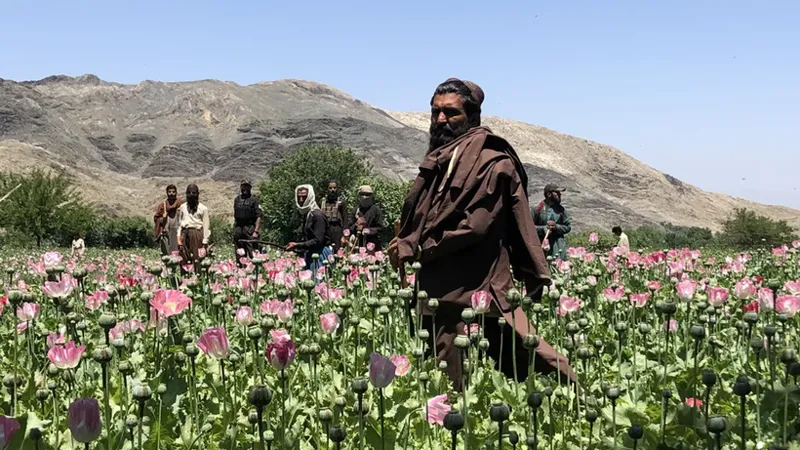
Hostile intent (HI) refers to the threat of imminent use of force against friendly forces. This is often the harder concept to assess in real time. Recognizing hostile intent requires judgment, and is largely simplified by providing clear examples. For example, is that vehicle speeding toward a checkpoint an IED threat? Is that individual aiming a weapon at a patrol or simply carrying it lawfully? In Afghanistan, where many civilians lawfully carried weapons and cultural patterns of life were complex, distinguishing hostile intent from normal behavior was sometimes a real challenge...
Positive Identification is defined as a reasonable certainty that a target is a legitimate military objective in accordance with ROE. PID is fundamental to preventing fratricide, civilian casualties, or unlawful engagements. In air operations, PID might be established directly, for example visually or via sensors, or indirectly through coordination with ground controllers.
In CAS environment, PID is nearly always required, in order to minimize risks of fratricides for example. In more offensive situations, PID can be optional, for example for a pre-planned strike on a target that was elaborated following a thorough targeting process.
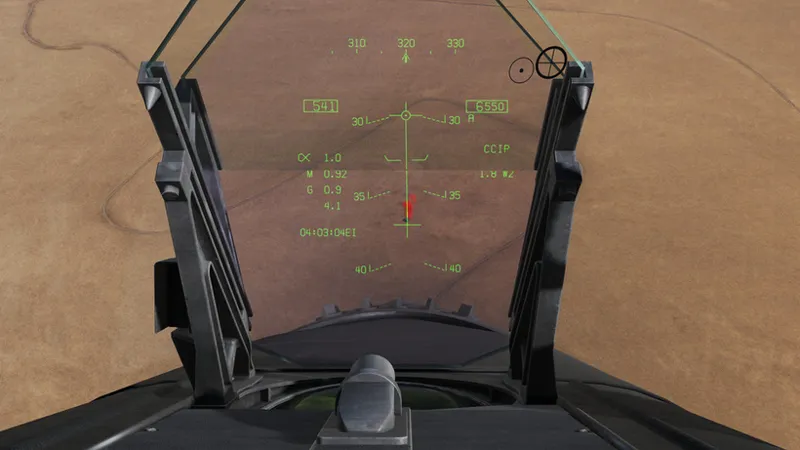
You might remember that in the series about PWY II delivery profiles, dive bombing is advised when PID is required: the pilot can check during the dive that the HUD cues actually align with the target that was previously observed visually or via the TGP.
In dive bombing, seeing the targeting cues on the HUD will guarantee PID.
III.5 - Escalation of Force (EOF)
ROE usually require, when time and tactical circumstances allow, the use of graduated measures before employing deadly force. This might include radio warnings, shows of force or warning shots. Escalation of force procedures were heavily emphasized in ISAF operations to minimize unnecessary casualties and maintain local support.
Example of a SOF (Show of Force) in Afghanistan.
III.6 - National Caveat
In multinational operations such as ISAF, national caveats play a significant role in shaping the application of ROE. These caveats reflect each nation’s political, legal, and strategic considerations, and they can have a direct and sometimes limiting effect on how airpower is employed in coalition operations.
These caveats exist because contributing nations must ensure that their military participation is in line with domestic political realities, legal frameworks, or public accountability. For aircrews, these restrictions are not theoretical concerns, since they might define what missions can be flown, what targets may be engaged, and under what circumstances force may be applied.
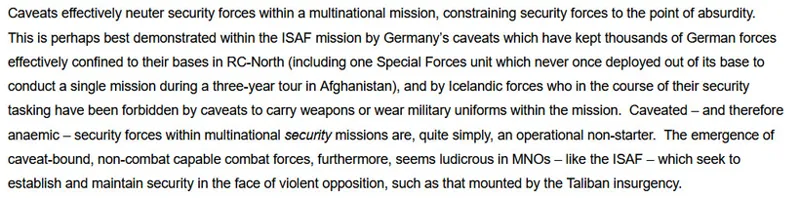
The impact of national caveats on air operations is significant. Some nations restrict their forces from conducting offensive combat missions entirely, while others prohibit specific types of operations, such as night strikes, certain targeting tasks, or missions in defined geographic areas. In many cases, caveats impose additional layers of approval before munitions can be employed, even in situations where the ROE would otherwise authorize immediate action.
For aircrews operating in this environment, it was not enough to know their own national ROE. They had to understand the constraints of those they supported, and just as critically, ground forces had to be aware of the limitations imposed on the air support they received. This was often a source of friction. Many ground units were not fully educated about the national restrictions that applied to coalition aircrews. The complexity of national caveats, combined with the tempo of operations, meant that ground forces frequently defaulted to what they were used to, and in most cases, that meant US air support.
A-10s at Kandahar: despite the numerous deployments of fighter aircraft by other NATO members, US aircraft represented the majority of the assets on the theater.
Since US aircraft flew the majority of coalition sorties, sometimes accounting for nearly 80 percent of tasked missions, ground forces developed habits and expectations shaped by US ROE and the flexibility typically provided by US aircrews. When they were supported by aircraft from nations with more restrictive caveats, those same ground forces often found it difficult to adjust their expectations or tactics. The result was not only operational frustration, but sometimes hesitation or confusion at critical moments. In these instances, it was the aircrew whose national caveats proved hardest for ground forces to account for, simply because those caveats were not always well understood, and did not fit the patterns of support to which the ground units had grown accustomed...
An added layer of complexity came from so-called "black caveats", that is to say national restrictions that were not disclosed to partner nations, even at the operational level. These caveats, known only to the aircrew and their national chain of command, could silently limit what action was authorized, even when all visible permissions and approvals seemed to be in place. In such cases, a strike might appear fully cleared from the perspective of the supported ground force or coalition headquarters, yet still be withheld because of hidden restrictions that the aircrew were obliged to follow. The existence of black caveats further complicated trust and coordination in coalition air operations, highlighting the tension between national sovereignty and multinational unity of effort...
Conclusion
The key concepts underpinning Rules of Engagement, like self-defense, hostile act, hostile intent, etc... form the essential framework within which aircrews operate in coalition warfare. These principles define the boundaries of lawful and authorized use of force, but as we have seen, their interpretation and application vary between nations, shaped by differing legal traditions, political oversight, and strategic priorities.
In a next article, I will build on this foundation by introducing the NATO “numbered” ROE system, which is the structured, standardized approach that NATO employs to provide clear, scalable authorizations for the use of force across different mission types and environments. We will explore how these numbered ROE can be applied in practice during operations like the ones in Afghanistan. And obviously, we will try connect these concepts to DCS World, showing how realistic ROE constraints can add both authenticity and tactical depth to your virtual missions!