Following the Show of Presence, the Show of Force (SOF) is the next step in the escalation of force. Where the SOP signals presence, the SOF simulates imminent attack... Commonly used in OEF when lethal force was not yet authorized or tactically wise, the SOF allowed coalition aircrews to apply pressure without crossing the threshold of engagement.
Let's try to cover here the purpose, execution, and risks of the Show of Force, along with practical applications in DCS World.
I. Definition and Role of the SOF
A Show of Force (SOF) is a non-lethal, tactical maneuver flown at low altitude and high speed to deliver a clear and deliberate message to enemy forces: you are seen, you are vulnerable, and we are seconds away from engaging. It is a deliberately aggressive form of escalation, intended to influence enemy behavior through the simulated threat of immediate lethal action.
Unlike the more passive Show of Presence, which communicates surveillance and control, the SOF conveys intent to strike without crossing the threshold into actual engagement. It is used when hostile activity is suspected, confirmed, or ongoing, but when Rules of Engagement (ROE), tactical considerations, or collateral concerns do not yet permit lethal force.
The SOF is often employed in support of ground forces:
to deter further enemy action during a developing engagement;
to break contact when troops are under fire;
to buy time while PID is established or higher authorization is sought;
to deliver non-lethal support to local security forces in the absence of coalition troops on site, demonstrating coalition support and responsiveness.
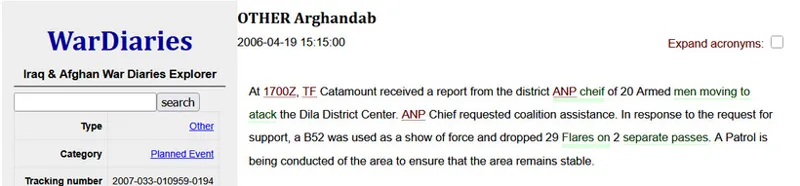
These two examples show that a Show of Force can be a very effective way to task airpower to support local security forces (local governor or Afghan national police), without the need to have a qualified coalition JTAC on the spot.
Its effectiveness lies in perception: fast jets appearing suddenly at treetop level, deploying flares just above the adversary, and climbing away at full power simulate the last seconds of an attack run. For insurgents or irregular forces without a strong morale, that perception alone may be enough to force retreat or abort an attack.
Note that while this post focuses on tactical-level SOF in the context of COIN, it’s important to recognize that the Show of Force concept exists across all levels of airpower employment.
At the operational and strategic level, a Show of Force may take various forms like:
deploying a carrier strike group to a region in crisis;
forward-positioning bomber aircraft in theater during political tension;
conducting long-range strike exercises or strategic overflights;
demonstrating nuclear readiness through visible alert postures or coordinated global sorties.
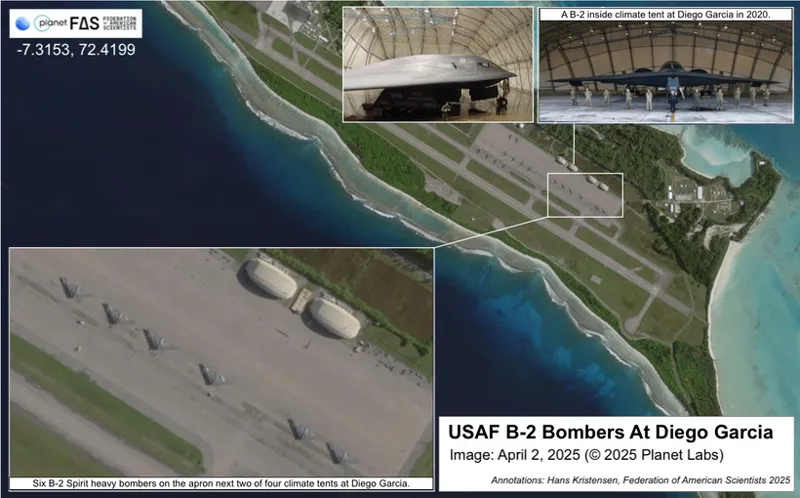
In April 2025, six B-2 Spirit bombers were forward-deployed to Diego Garcia, signaling strategic readiness and reinforcing US deterrence posture during high-stakes negotiations with Iran. Source: FAS.
These actions serve the same fundamental purpose: to signal capability, intent, and resolve, without initiating direct conflict. Whether it's an F-16 making a low pass over a hostile ridgeline, or a B-2 conducting a 36-hour global power sortie, the SOF is airpower’s way of shaping decisions through presence, posture, and the credible threat of escalation.
II. Psychological Effects of the SOF
The SOF is a classic example of airpower used not to destroy, but to shape behavior. Its purpose is not tied to physical damage, but to the psychological effect it produces on those who witness it, primarily enemy combatants, but also civilians, local authorities, and friendly forces. As discussed previously for the SOP, in an Effects-Based Operations framework, the SOF is designed to influence decision-making through presence, noise, speed, and perceived intent.
When properly, a SOF creates several possible effects:
On the Enemy:
Deterrence: convincing adversaries that they’ve been detected and that continued aggression will bring lethal consequences;
Disruption: forcing the enemy to halt movement, break contact, or delay planned actions.
On Friendly Forces:
Reassurance / morale boost: for troops in contact, a low-level pass with flares confirms that airpower is present, alert, and capable of intervening. It shows the ground force that they are not isolated and that escalation options are available;
Tempo control: gives ground commanders a non-lethal option to regain initiative or stall an engagement until ROE conditions are met.
The morale boost to friendly forces is obvious in this video!
On Local Civilians and Host-Nation Forces:
Demonstrated control: SOFs communicate dominance of the airspace, reinforcing perceptions of coalition strength.
Note that SOFs can be used both reactively, in response to a developing threat, or preemptively, to shape the environment before an operation, intimidate potential threats, or reassert control over a sensitive area.
II. How to execute a Show of Force
The SOF must be aggressive enough to be unmistakable, but controlled enough to avoid unnecessary risks to the aircraft: we are not in a situation justifying losing a fighter jet!
II.1 - Standard Flight Profile
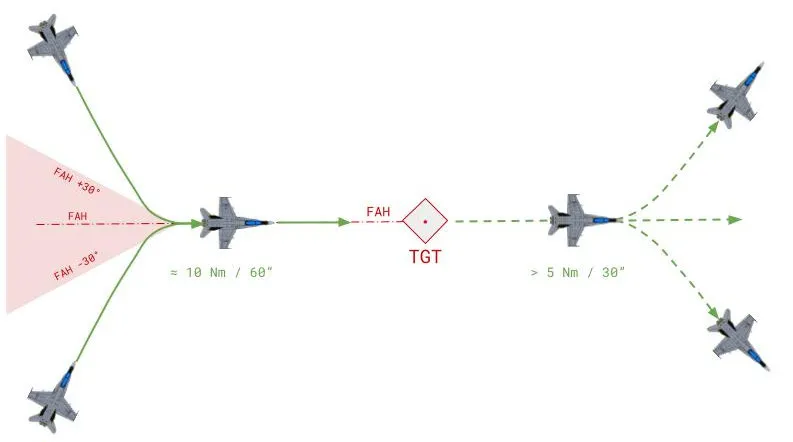
A typical SOF run should begin at least 10 nautical miles from the area of interest, in order to make a transition to low altitude away from enemy sight, in an effort to be unpredictable. As for the SOP, it's better to avoid descending directly towards the target area.
Horizontal profile of a SOF.
The aircraft will initiates a steep descent, typically a dive angle approaching -30°, targeting a low-altitude pass between 150 and 250 feet AGL. Terrain and airspace permitting, this low-level ingress maximizes both visibility and acoustic presence.
The pass should be flown at high speed, typically around 540 KTAS, using BUSTER. The pilot should aim to overfly or closely offset from the suspected threat location, ensuring the maneuver is unmistakably directed and tactically relevant.
Vertical profile of a SOF.
Once the pass is complete, and at least 30" after the target, a sharp climb-out is initiated to quickly regain altitude, with terrain study essential to avoid ensure that the aircraft has actually the energy to jump over the mountains...
II.2 - Wingman's role
SOF runs are generally conducted as a two-ship formation, with the tactical lead flying the low-level maneuver at the designated base altitude, while the wingman is offset vertically by approximately 1,000 feet. This vertical separation ensures deconfliction when the tactical lead will climb back to high altitude.
The wingman plays a critical support role during the maneuver. While the lead aircraft executes the pass, the wingman should focus eyes and sensors (TGP) on the target area, scanning for any indication of hostile fire, particularly AAA bursts or MANPAD smoke. This overwatch position allows the wingman to issue an immediate threat call or abort directive if necessary.
In some terrain conditions, especially in mountains, the lead aircraft may temporarily drop out of radio contact with the JTAC or ground force. In these cases, the wingman must be prepared to act as a comms relay, relaying time calls (e.g., "30 seconds out") or post-pass reports.
II.3 - Risk mitigation
Terrain Awareness
One of the most common hazards in SOF execution is misjudging descent angles, especially during transition from high altitude to very low level. This risk is magnified in featureless terrain like deserts, or in complex environments such as steep valleys or during night operations with NVGs, where depth perception is degraded. Keep in mind that in theaters like Afghanistan, higher altitudes and temperatures reduce aircraft maneuverability.
To control descent and maintain terrain clearance:
Use a conservative dive angle rule:
3,000 ft AGL = Max -30°
2,000 ft AGL = Max -20°
1,000 ft AGL = Max -10°
etc...
Set radar altitude warnings at appropriate minimums with safety buffers.
Keep HUD brightness low during descent to preserve contrast and terrain visibility, and study the sun’s position to avoid glare.
Airspace Deconfliction
CAS airspace can be busy, especially near the ground. Helicopters or ISR platforms may be present below terrain masking, and may not be known to the JTAC at the time of your dive.
To mitigate this risk, increase efforts in visual, especially below 5,000 ft AGL: treat any low-level SOF as a multi-aircraft environment, even if other traffic hasn’t been declared...
Threat Exposure
Though MANPADs and AAA are less likely to be effective due to the short engagement window, small arms fire (SAF) presents a persistent and underestimated threat. A single round striking an engine or flight control system at 250 feet AGL can result in a lost aircraft. Enemy fighters may fire randomly into the air with minimal accuracy, but they only need to be lucky once...
In order to mitigate this risk, whenever possible, plan your run from enemy-controlled terrain toward friendly or neutral ground. If you must eject, it's better to come down over blue territory or open desert than into enemy hands.
In 2011, a French Mirage 2000D crashed in Afghanistan during a Show of Force, due to engine failure... The crew had to eject, and they were quickly rescued by ground forces. This is the story of the crashed aircraft recovery. This incident is also briefly covered page 213 in the book "Afghan Air Wars" that I covered last year.
As with SOPs, MANPAD threats still deserve some consideration. Ingressing with the sun at your back remains one of the most effective passive countermeasures against IR-guided missiles. For egress, deploy flares aggressively: first at the initiation of your climb, and again around 5,000 feet AGL, where you’ll be well within typical MANPAD engagement envelopes.
At this altitude, your airspeed will likely drop to around 400 kt, especially if you're pulling into a steep climb. That reduced speed makes you a more vulnerable target, particularly if you’ve decided to use GATE and are radiating significantly more heat.
Fuel Planning
A properly executed SOF consumes more fuel than you might anticipate. Two minutes at low level in high RPM, plus the energy required for a steep climb back to altitude, adds up fast. Always establish a JOKER fuel state that guarantees you can climb out and recover above BINGO...
Conclusion
As you have now understood it, the Show of Force is one of the tools of airpower: loud, fast, and aggressive, yet deliberately non-lethal. Its purpose is to break contact, disrupt enemy intent, and signal that escalation is imminent. When done right, it delivers a powerful psychological effect without firing a single round.
In DCS, the same principles apply. In order to be well integrated within a realistic mission, a well-thought SOF requires more than a low pass and some flares, it requires a real integration with ground forces to make it meaningful.
In a next post, I'll release a couple of kneeboard pages summarizing both the SOP and the SOF, and we'll be ready to move to the final post in this series, where we’ll examine the warning shot, the final non-lethal step before engagement.