In this first post, I'd like to introduce the Tarnak Range, a purpose-built air-to-ground training complex for DCS World, modeled after a real-world range located southeast of Kandahar Airfield (KAF), Afghanistan.
I. Real-World Legacy: Tarnak Farms
Before we get into the tactical side, it’s worth talking a little about the real range history.
The southern section of the current Tarnak Range includes the area once known as Tarnak Farms, an infamous al-Qaeda training camp during the late 1990s. It was here that Osama bin Laden was filmed by U.S. surveillance in 2000, and where early CIA targeting efforts began.
Oussama Bin Laden was identified on a video taken at Tarnak Farms the year before 9/11.
This site became one of the first focal points for covert action during the lead-up to OEF, and was totally destroyed on the first days of the operation.
US CENTCOM daily brief for October 30th 2001, showing the strike on terrorist facilities at Kandahar: Tarnak Farms complex was destroyed!
Pre-strike picture of Tarnak Farms complex.
Post-strike picture of Tarnak Farms complex.
Following the 2001 US invasion of Afghanistan, the area around Kandahar evolved into a NATO stronghold. Tarnak Range, located just 2.0 NM southeast of KAF, was established as a live-fire training range, primarily used for ground-to-ground training, but also occasionally supporting fixed-wing and rotary CAS platforms throughout OEF and ISAF operations. It provided real-world JTACs and aircrews a combat-realistic environment to integrate fires and refine ordnance delivery.
Unfortunately, Tarnak Range is also known for the Tarnak Farm Incident that took place in 2002. On 17 April 2002, four Canadian soldiers conducting a live-fire night training exercise at Tarnak Range were mistakenly engaged by a U.S. F-16 pilot, resulting in the deaths of four soldiers and injuries to eight more. The pilot had misidentified ATGM smoke as a MANPAD fire, and the muzzle flashes as hostile fire, leading to the release of a 500-lb bomb without proper clearance.
Killed in the bombing on 17/04/2002 were Sergeant Marc Leger, Private Richard Green, Private Nathan Smith and CorporalAinsworth Dyer.
This incident became one of the most high-profile fratricide cases in the Afghan campaign and highlighted the absolute necessity of procedural control, radio discipline, and terminal attack authority. As a result, NATO tightened ROE for CAS operations, and range procedures were significantly revised to reinforce positive clearance protocols, deconfliction, and real-time JTAC authorization.
II. Why creating a training range in DCS World Afghanistan theater?
While the Tarnak Range in DCS is not a one-to-one replica of the real-world targets, procedures, or JTAC coordination used during OEF, it remains an important tool for any virtual pilot aiming to improve precision and discipline in air-to-ground employment.
This range is built to train you to deliver weapons accurately, under procedural control, along mandatory attack headings. If you're planning to fly operationally complex missions, this is where you should start to improve your flight precision and discipline.
I strongly encourage you to fly the published patterns, adhere to soft/hard deck and attack geometry, and begin working with basic time-on-target (TOT) calculations. Stick to strict weapon release parameters, as they have been discussed in the Paveway II series for example, even when it’s just you on the range. These habits translate directly to tactical fluency when you’re operating under more pressure.
If you're new to air-to-ground, and you don't really know where to start with, I strongly encourage you to watch this Basic Surface Attack series by Mike Solyom.
The range will support the full spectrum of ordnance delivery, from dumb bombs to guided munitions, rockets, guns, and missiles like the AGM-65. Both fixed and moving targets are available, offering realistic engagement profiles for CAS platforms of all kinds.
If it's not already available on initial mission release, I'll make sure that scoring is eventually handled through the integrated MOOSE Range Script. It provides immediate hit feedback, logs your results to a text file, and allows for structured post-flight debriefs.
Even though radio comms in DCS remain relatively basic, this range is an excellent place to build the habit of proper calls. “IN” and “OUT” transmissions, along with profile, weapon, and laser status, should become natural. If you're flying with human wingmen, being clear and predictable over the radio will directly affect overall efficiency.
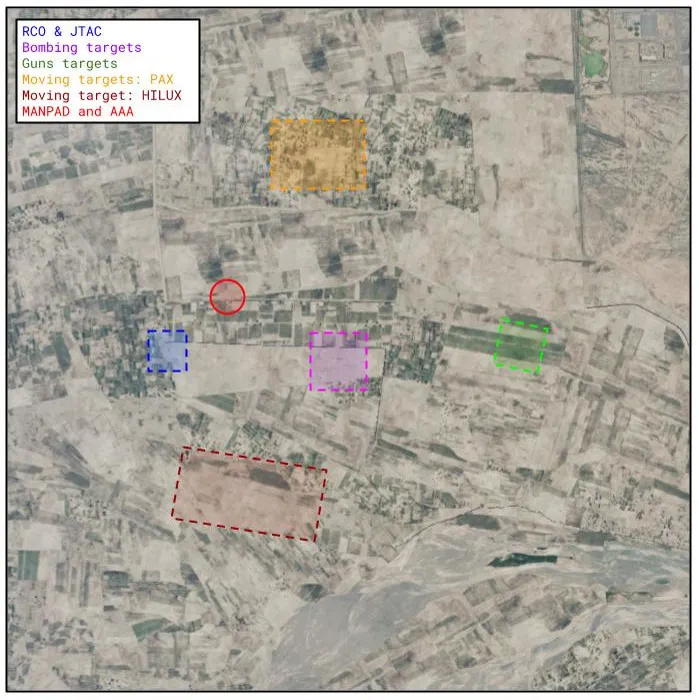
A manually activated MANPAD and AAA threat sits at the center of the range, offering a simulated adversary to factor into your game plan. MOOSE can simulate missile hits, but AAA cannot be spoofed, if it’s active and you don't take it into account, you will get hit. Learn to time your passes, manage your angles, and respect the threat envelope. Use IR countermeasures preemptively and reactively...
III. Airspace and Comms
Operating at Tarnak Range requires a clear understanding of its surrounding airspace and the simulated communications procedures that govern it. The range is located just two nautical miles southeast of Kandahar Airfield (KAF), placing it within controlled airspace that must be respected during every phase of the flight.
Map of Tarnak Range.
The airspace structure includes Kandahar Class D, which extends from the surface to 6,000 feet AMSL within a 5 NM radius of KAF. Above that, and throughout the broader 30 NM sector, you're operating in Class C, from 1,000 feet AGL up to FL200. That means you’re sharing this airspace with inbound and outbound traffic to KAF and potentially deconflicting with adjacent range users, especially rotary-wing elements training in the nearby Texas Helo Range, just five nautical miles southeast.
You obviously can use this range as a free training zone. But you will see that you have a really higher reward when you make your altitudes, entry/exit routes, and pattern adherence matter. Deviations without coordination increase risk and reduce the realism this environment is built to simulate.
In-game satellite picture of Tarnak Range.
In order to simulate a real range, all activity within Tarnak should be coordinated with the Range Control Officer (RCO), callsign SPARTAN, on PURPLE 1 (126.200 MHz). Contact is mandatory before entering the range or beginning any live-fire runs. In reality, the RCO would clear you for ordnance delivery but would not handle airspace separation. If you need deconfliction or are entering from high altitude, coordination with Kandahar Approach would be required. In the future, a realistic RCO for Tarnak Range might be released by the AI_ATC team!
You can note that there's an AI JTAC co-located with the range tower. You can use it by contacting callsign BADGER 1 on MAROON 2 (345.500 MHz). As any AI JTAC, BADGER 1 can provide 9-lines, laser designation, and target marking. An on-demand "client" JTAC is also included, in order to let you use the range for CAS training in multiplayer. When using the JTAC, consider that he's acting as RCO instead of SPARTAN, and follow its instructions and attack clearances.
Conclusion
Tarnak Range aims to offer a semi-realistic environment to sharpen your air-to-ground skills in DCS, not just with pure weapons employment, but with the communication, pattern work, and threat management that operational missions demand.
In the next post, we’ll take a closer look at the target layout and attack patterns. You’ll get the tactical detail you need to plan, brief, execute and debrief effectively, just like you would in the real world.