
Engage with your community
You ask your community a question, and a few responses start rolling in. Someone shares a story. Another member jumps in with a “me too!” Before long, people are talking to each other, not just responding to you.
That’s community engagement. It’s people actively participating in the community you’re building. It’s fans or members showing up to not only interact with you, but to also contribute their own ideas, experiences, and energy to the space.
That participation gives people a role in your community. They can share what they know, learn from each other, celebrate wins, and build relationships around the work that brought them together in the first place. As members get more comfortable connecting with each other, you don’t have to be the person driving every conversation.
Start conversations people can join
So how do you get those conversations rolling to begin with? There are lots of prompt types you can use and adapt for your specific community. The goal is to open up discussions that your members can easily join and build on together.
Open-ended questions are a great starting point because the conversation can go in lots of different directions. Let’s say you have a community full of pet lovers. Asking "Do you like cats or dogs?" might get you a quick answer. But asking "What was your first pet? Tell us about them" encourages members to share stories which can lead to them responding to each other’s answers.
You can think of community connection as social interaction, using conversation starts to get the discussion flowing. You can also consider engagement tactics to inspire your community to have conversations with you, and each other, based around your work. You can ask questions about their favorite guest you've had on your podcast and don't forget to prompt them to include why. Or you can ask your community for ideas or gut check something you're working on. Start the conversation!
A few other prompt types that might spark conversation include:
A poll: Give members a few options when you want a quick reaction from the group.
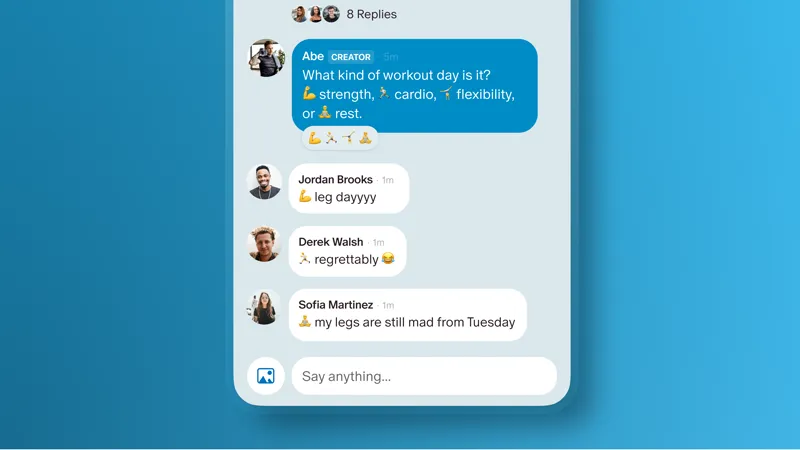
An emoji check-in: "What kind of pet do you have? Drop a 🐶, 🐱, 🐦, or your own emoji below."
A recurring ritual: Ask everyone to share their meme of the week, a weekly win, or something they're looking forward to.
A playful prompt: "Starting a working session. What songs should I put on my playlist to keep me focused?”
Mix and match based on what fits your community and the conversation you want to start. A quick emoji can make it easy to jump in, while a recurring prompt gives members something familiar to come back to.
And yes, yes-or-no questions have their moment too. Picking a date for your next Live? That's exactly the time they come in handy.
Find your community's engagement rhythm
Once you have some ideas for getting conversations started, try creating a regular rhythm for them. Many creators start with one planned community post a week to get a feel for how their members like to participate.
Then pay attention to what happens. If people are jumping into the conversation, great! Keep going and see what you learn. If responses are quieter than you hoped, switch things up. Try another kind of prompt, post at a different time, or experiment with a different rhythm.
You can also make it easier to participate. Maybe an open-ended question feels like a big first step for a quieter community. Try a poll or an emoji check-in instead. A few low-lift interactions can help members get comfortable participating before you ask them to share a story or jump into a bigger conversation.
And if members still aren't responding much, you're not alone. Some people love following a community without commenting themselves. They may be reading other members' responses, picking up ideas, or simply enjoying being part of the conversation from the sidelines. Keep experimenting and give yourself time to learn what participation looks like in your community.
Community in practice: Abs with Abe
Abe starts posting a weekly check-in in the Abs with Abe chat asking members to share their fitness goals for the week. The first few are pretty quiet.
So he lowers the lift. The next week, he posts a poll asking what everyone’s focusing on: strength, cardio, flexibility, or rest.
This time, more members jump in. Abe looks at the results before deciding what to ask next. If cardio gets most of the votes, he might follow up with, “What’s your favorite way to get your cardio in?” or ask members to swap workout playlists.
If the results are split pretty evenly, he could have a little more fun with it: “Okay, now which one do you avoid the most?” 😄
Each response gives Abe a little more information about what his members are interested in talking about, and he can use that to keep the conversation going.
Go with your community's flow
You’ve got ideas for starting conversations and a rhythm you want to try. Now think about how your engagement plan fits into the lives of the people in your community.
Plan around what you know
You probably already know enough about your members that can help you anticipate when they may have more or less time and energy to engage. If your community is full of teachers or parents, the first few weeks of a new school year might be especially busy. You may want to keep participation simple during that stretch and save a bigger community activity for later.
Your own publishing calendar can help you anticipate those moments, too. If you’ve just released a new podcast episode, video, or project, your members have something fresh to react to and discuss. During a quieter stretch between releases, you may need to give them a little more to get the conversation going.
On the flip side, some moments naturally give people more to talk about. If you have a community of cosplayers, the weeks leading up to a big convention could be full of excitement as members finish costumes, make plans, and get ready to attend. That might be exactly the time to invite people to share what they’re working on or swap advice.
Those are the kinds of moments you can see coming and plan around. But there may also be moments that catch you by surprise.
Adjust when the moment calls for it
Something may happen in the world that changes what your community is thinking or talking about that day. A natural disaster or unrest may affect people in your community. When the moment calls for it, you can change what you had planned and decide how you want to show up. You might acknowledge what’s happening, reach out to someone you know personally, or give people some space.
There’s no perfect script for a difficult moment. You’re a person talking to other people, and it’s okay to respond like one.
Those moments can also be a reminder of what community makes possible. Members may check in on each other, share something that helped them, or simply make space for someone who needs it. You don’t always have to create the connection yourself. Sometimes your role is to notice what your community needs and give people room to show up for each other.
Follow where your community takes you
That same kind of member-to-member connection can take your community in unexpected directions on ordinary days, too. Someone drops a hilarious comment that turns into a running joke. A member asks a question and suddenly everyone has a story to share. When your community finds something they’re excited to talk about, follow that energy and see where they take it.
Planning gives you something to work with. Paying attention helps you know when to adjust the plan.
Let your members lead, too
One of the most rewarding parts of building a community is watching members start to make it their own. The conversations you spark can lead to members answering each other’s questions, celebrating wins, swapping advice, and eventually starting conversations without waiting for you.
That’s something to encourage. You’ve created the space and given people opportunities to connect. Now you can give them room to take the lead sometimes.
If someone asks a question, see if another member jumps in before you answer. When members start swapping stories or ideas, let the conversation unfold. You can still join in, add your perspective, or cheer people on without needing to guide every interaction.
As members become more comfortable contributing, they bring more of their own knowledge, personalities, and relationships into the community. They get to play a meaningful role in the experience you’re creating together, and keeping the conversation going doesn’t rest entirely on your shoulders.
🧭 Your next steps
Community engagement starts with giving people reasons to join in, then paying attention to what they do with those opportunities.
You don't need to figure out your community's perfect rhythm right away. Start a conversation, see what gets people participating, and build from there.
Try one prompt that fits the kind of conversation you want to encourage.
Experiment with a regular engagement rhythm and adjust as you learn what works.
Give members room to respond to each other and take the lead.
📌 How helpful was this material? Click to let us know: 👍 | 👎