
Set your community expectations
Think about a community you've been part of.
Maybe it was an online group you loved, a local running club, or even a workplace where everyone seemed to understand how things flowed.
You probably figured out the culture pretty quickly. You noticed what behaviors people encouraged, how conversations usually unfolded, and what was expected of everyone in the group. Sometimes those expectations were written down. Sometimes you picked them up simply by being there.
The clearest communities make those expectations visible and understandable. That's exactly what community guidelines do.
Every community on Patreon starts with a shared foundation: Patreon's Community Guidelines. They create a baseline for respectful participation across the platform.
Your own version of that - we’ll call them community expectations - builds from there. (You may also see these called “rules”, “code of conduct”, or “guidelines” elsewhere.) They're your opportunity to show people what kind of community fans are joining and how everyone can help create that experience together. And they work alongside Patreon’s own policies.
Clear expectations make everything easier
Clear expectations create a stronger community because everyone starts from the same understanding.
People know what's expected of them, what's appropriate in the community broadly, and what to expect both from other members and from the space itself.
That shared understanding makes it easier to join conversations, ask questions, contribute ideas, and celebrate each other's wins because everyone is participating within the same set of expectations.
Simply put, community expectations are really just shared boundaries.
Think about joining a new community. You're naturally looking for clues about how people treat each other. Is it okay to ask beginner questions? Will people celebrate your progress? Can you disagree respectfully? Community expectations answer those questions before someone has to learn the hard way.
That's why visibility matters. An expectation you've thought through but never shared can't help you or your community. Make your expectations easy to find, easy to understand, and easy to come back to so everyone starts from the same place.
⚡ Pro Tip: On Patreon, a pinned post or Quip on your page is often the easiest way to make your expectations visible.
When a situation does come up, those same expectations become something you can point back to. You're reminding people of an agreement your community already shares, not inventing a new rule in the moment.
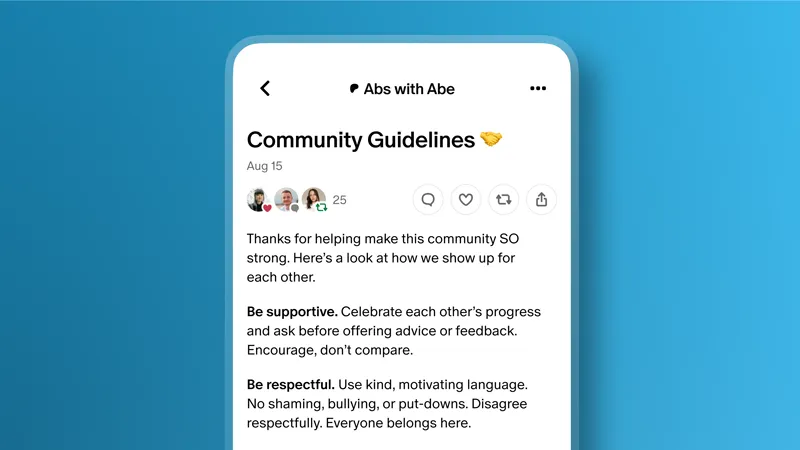
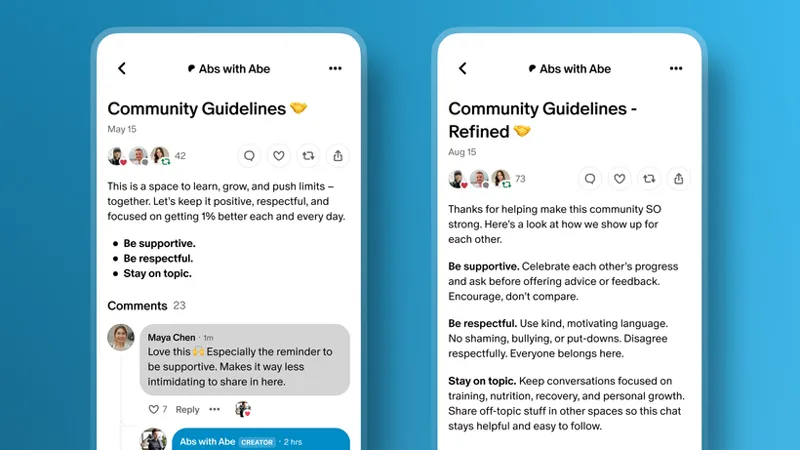
Community in practice: Abs with Abe
Abe notices the same thing happening every week.
Members are excited to help each other, but advice often starts flowing before anyone asks for it. Some members appreciate it. Others find it overwhelming. Abe notices that replies can be a mixed bag; some hostile and some warm.
At first, Abe's guideline simply says:
Be supportive.
After seeing the same situation come up week after week, he realizes people need a little more clarity. He updates the guideline to:
Celebrate each other's progress and ask before offering advice or feedback.
The next time the conversation comes up, members already know how feedback works in Abe's community. Nobody has to guess what's expected, and everyone is working from the same shared understanding.
Write community expectations for what actually happens
You likely already have a sense of the community you're building or wish to build, and some of the situations that may come with it.
Start there. If your community gathers around a story, show, or series, you might set an expectation around labeling spoilers. If members are welcome to share their own work, you can be clear about where sharing ends and repeated self-promotion or solicitation begins. If members regularly give each other feedback, you can spell out when and how you'd like that feedback to happen.
Then you can continue refining your community expectations with time.
Every conversation teaches you something about the kind of community you're building. You might notice the same question coming up, a boundary that members interpret differently, or a behavior that keeps creating friction. Those patterns can show you where another community expectation would make the space clearer and safer for everyone.
Start with what you know today. As your community grows, let your community expectations grow with it.
Different spaces need different expectations
The way people interact can change from one space to another. Your community expectations can adjust with that change, too.
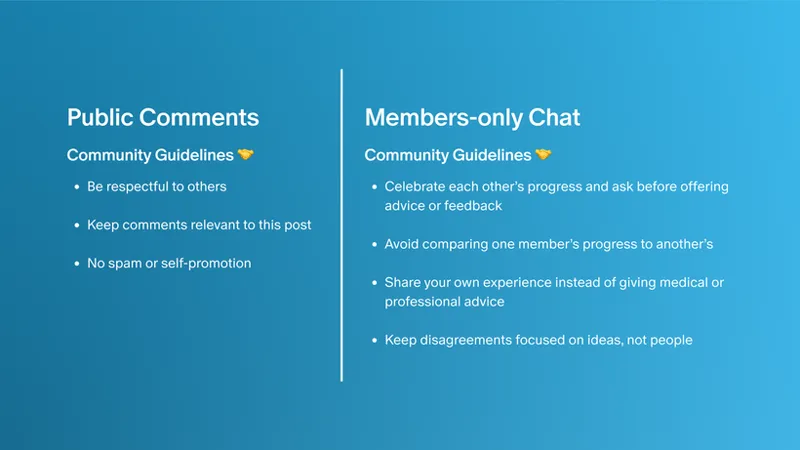
A public comments section often works well with a few simple expectations because conversations are usually centered around you and the post itself.
A members-only space often benefits from more guidance because members are interacting directly with each other. That's where expectations around giving feedback, handling disagreements, welcoming new members, or sharing advice can make a real difference.
Community in practice: Abs with Abe
Abe's public comments and members-only chat have different goals, so they have different expectations too.
Community expectations grow alongside your community.
As new situations come up, you'll learn more about the conversations your members are having and the kind of community you're creating together. Revisit your community expectations from time to time so they continue reflecting the experience you want people to have.
🧭 Your next steps
Community expectations help create a shared understanding by making expectations visible, helping people feel confident participating, and giving everyone the same foundation to build your community together.
Read through Patreon's Community Guidelines if you haven't recently.
Consider drafting two or three community expectations for your own space.
Think about whether your public and members-only spaces would benefit from different expectations.
📌 How helpful was this material? Click to let us know: 👍 | 👎
Comments (3)
How can we pin a post after we make something like this?
The problem is Patreon is now trying to be too many different things. I’ve had this setup since I opened my account here, and NOBODY reads it. I send reminder posts, etc. The UI simply needs to be simplified and there should be an option to have this info visible when people sign up. The burden shouldn’t be on the creator to constantly remind people, the base design should be able to do this.
Great