
March 24, 2026 - Daily News Digest
On this day: in 1603, Tokugawa Ieyasu is granted the title of shōgun from Emperor Go-Yōzei, and establishes the Tokugawa shogunate in Edo, Japan.
QOTD: “Ensuring that the Strait of Hormuz remains open, secure and accessible is essential for the whole world,” Modi wrote in a social media post.
IRAN/ENERGY/PROTECTION RACKET - Iran Charges Some Ships Hormuz Transit Fees for Safe Passage
https://www.bloomberg.com/news/articles/2026-03-24/iran-charges-some-ships-hormuz-transit-fees-for-safe-passage?embedded-checkout=true
Iran has started charging transit fees on some commercial vessels passing through the Strait of Hormuz, another sign of Tehran’s control over the world’s most important maritime energy channel.
Payments of as much as $2 million per voyage are being sought on an adhoc basis, effectively creating an informal toll on the waterway, according to people familiar with the matter, who requested anonymity to discuss sensitive dealings. Some vessels have made the payment, though the mechanism wasn’t immediately clear — including the currency used — and it doesn’t appear to be systematic, the people said.
The payments show Iran’s influence over Hormuz, through which normally about a fifth of the world’s oil and gas, and vast amounts of food, metals and other materials are shipped every day. With the war in the Middle East now in its fourth week, it also highlights the desperate need for some consumers to ensure continued energy flows.
People familiar with the matter said the payments have been handled quietly. The lack of transparency and uncertainty over who might be targeted next is adding a fresh layer of friction to the shipping lane. Only a trickle of vessels have crossed the waterway since the war, many of them Iranian-linked. Some of the few others appear to have taken similar routes close to Iran’s coastline.
[If this works for Iran in Hormuz and the Houthis in the Red Sea, in a deglobalized world without US backing of free and open trade, this will work in the Turkish Straits, Malacca, etc.. -MNNO]
MORE: Chinese-Owned Tanker Transits Hormuz Along Iranian Coastal Route
https://www.bloomberg.com/news/articles/2026-03-24/chinese-owned-tanker-transits-hormuz-along-iranian-coastal-route?embedded-checkout=true
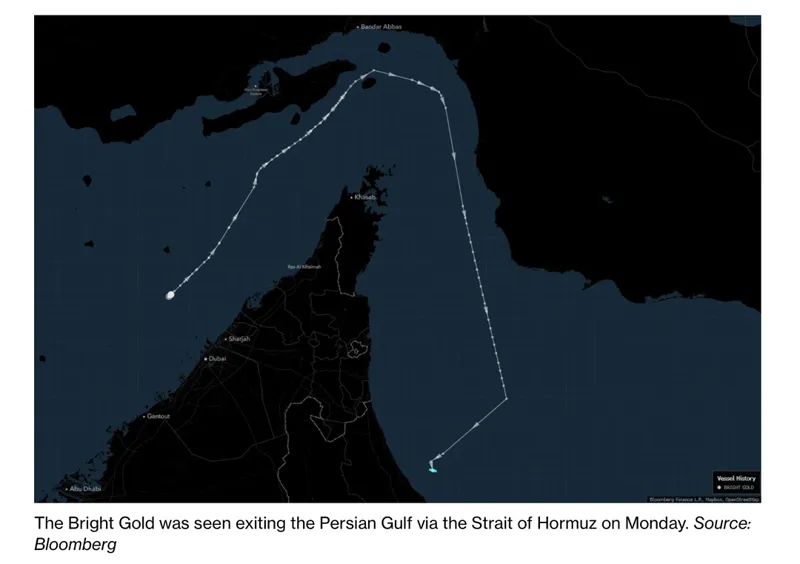
A Chinese-owned fuel tanker has sailed through the Strait of Hormuz from the Persian Gulf, following a route that’s been used by other vessels with the approval of Iran.
Bright Gold, an MR2 tanker, had taken on around 2,700 tons of diesel via a ship-to-ship transfer about two weeks ago, Vortexa data show. The fuel was originally loaded from Ruwais in the United Arab Emirates early this month.
The Bright Gold left the Gulf on Monday morning via a channel between the Iranian islands of Qeshm and Larak, signaling that it had Chinese ownership. Two India-flagged gas carriers also used the route this week after New Delhi said it had discussed the safe passage of the ships with Tehran.
IRAN/MIL/GCC - Gulf States Edge Toward Joining Fight Against Iran
https://www.wsj.com/world/middle-east/iran-gulf-states-offense-decision-b8d98ff9?mod=WSJ_home_mediumtopper_pos_3
U.S. allies in the Persian Gulf are inching toward joining the fight against Iran, getting tougher following persistent attacks that have disrupted their economies and risk giving Tehran long-term leverage over the Strait of Hormuz.
The recent steps support America’s ability to carry out airstrikes and open up a new line of attack on Tehran’s finances. They don’t yet go as far as deploying their militaries openly in the fight, a line the Gulf’s rulers have hoped not to cross, though pressure is building as Iran threatens to exert greater sway over the energy-rich region.
Saudi Arabia recently agreed to let American forces use its King Fahd air base on the western side of the Arabian Peninsula, people familiar with the decision said. The kingdom said ahead of the fighting that it wouldn’t allow its facilities or airspace to be used for attacks on Iran, an attempt to stay out of the war that failed when Iran began raining missiles and drones down on important Saudi energy facilities and the capital, Riyadh.
Crown Prince Mohammed bin Salman is now eager to re-establish deterrence and is close to a decision to join the attacks, the people said. It is only a matter of time before the kingdom enters the war, one of the people said.
“Saudi Arabia’s patience with Iranian attacks is not unlimited,” Saudi Foreign Minister Faisal bin Farhan told reporters last week after a series of Iranian attacks on Gulf energy infrastructure. “Any belief that Gulf countries are incapable of responding is a miscalculation.”
MORE: Saudi Prince Is Said to Push Trump to Continue Iran War in Recent Calls
https://www.nytimes.com/2026/03/24/us/politics/saudi-prince-iran-trump.html?campaign_id=60&emc=edit_na_20260324&instance_id=172988&nl=breaking-news®i_id=58167012&segment_id=217146&user_id=f22dffe809afecaa0742b8d4e86f9d6b
Saudi Arabia’s de facto leader, Prince Mohammed bin Salman, has been pushing President Trump to continue the war against Iran, arguing that the U.S.-Israeli military campaign presents a “historic opportunity” to remake the Middle East, according to people briefed by American officials on the conversations.
In a series of conversations over the last week, Prince Mohammed has conveyed to Mr. Trump that he must press toward the destruction of Iran’s hard-line government, the people familiar with the conversations said.
Prince Mohammed, the people familiar with the discussions said, has argued that Iran poses a long-term threat to the Gulf that can only be eliminated by getting rid of the government.
Prime Minister Benjamin Netanyahu of Israel also views Iran as a long-term threat, but analysts say Israeli officials would probably view a failed Iranian state that is too caught up in internal turmoil to menace Israel as a win, while Saudi Arabia views a failed state in Iran as a grave and direct security threat.
GIFT LINK: The Back-Channel Diplomacy Behind Trump’s U-Turn on Iran
https://www.wsj.com/world/middle-east/the-back-channel-diplomacy-behind-trumps-u-turn-on-iran-b70efc60?st=R8RQJ3&reflink=desktopwebshare_permalink
Foreign ministers from Egypt, Turkey, Saudi Arabia and Pakistan gathered before dawn Thursday in Riyadh for talks aimed at finding a diplomatic off-ramp to the war in Iran.
But there was one big problem, according to Arab officials involved in the discussions: finding a counterpart in Iran to negotiate with. Earlier that week, Israel killed Iran’s national security chief, Ali Larijani, who had been considered a viable partner who could engage with the West.
Egyptian intelligence officials managed to open a channel with Iran’s Islamic Revolutionary Guard Corps—the paramilitary group that protects the Iranian regime and is the country’s most powerful security and political entity—and put forward a proposal to halt hostilities for five days to build confidence for a cease-fire, some of the officials said.
Those discussions laid the groundwork for an abrupt reversal more than 7,000 miles away in Florida.
On Saturday night, President Trump, who spent the weekend at his Mar-a-Lago club, gave Iran an ultimatum to reopen the Strait of Hormuz within 48 hours or the U.S. military would “obliterate” the country’s power plants. Two days later, as word of the discussions in Riyadh made its way to the White House, Trump reversed course, embracing diplomacy with Tehran and putting his threatened strikes on hold.
REUTERS INVESTIGATION/BAHRAIN/MIL - Patriot missile involved in Bahrain blast likely US-operated, analysis finds
https://www.reuters.com/investigations/patriot-missile-involved-bahrain-blast-likely-us-operated-analysis-finds-2026-03-22/
An American-operated Patriot air defense battery likely fired the interceptor missile involved in a pre-dawn explosion that injured dozens of civilians and tore through homes in U.S.-ally Bahrain 10 days into the war on Iran, according to an analysis by academic researchers examined by Reuters.
Both Bahrain and Washington have blamed an Iranian drone attack for the March 9 blast, which the Gulf kingdom said injured 32 people including children, some seriously. Commenting on the day of the attack, U.S. Central Command said on X that an Iranian drone struck a residential neighbourhood in Bahrain.
In response to questions from Reuters, Bahrain on Saturday acknowledged for the first time that a Patriot missile was involved in the explosion over the Mahazza neighborhood on Sitra island, o
Offshore from the capital Manama and also home to an oil refinery.
In the statement, a Bahraini government spokesperson said the missile successfully intercepted an Iranian drone mid-air, saving lives.
“The damage and injuries sustained were not a result of a direct impact to the ground of either the Patriot interceptor or the Iranian drone,” the spokesperson said.
Neither Bahrain or Washington has provided evidence that an Iranian drone was involved in the Mahazza incident.
The use of costly, advanced weaponry to defend against attacks by far cheaper drones has been a defining feature of the war. The incident points to the risks and limitations of this strategy: The blast from the powerful Patriot, whether or not it intercepted a drone, contributed to widespread damage and casualties, while Bahrain’s air defenses were unable to prevent strikes that night on the nearby oil refinery, which declared force majeure hours later.
When asked for comment, the Pentagon referred Reuters to Central Command, which did not immediately reply to questions.
In response to questions sent to the White House, a senior U.S. official said the United States was “crushing” Iran’s ability to shoot or produce drones and missiles. “We will continue to address these threats to our country and our allies,” the official said, adding that the U.S. military “never targets civilians.” The official did not answer specific questions about the Patriot attack.
UK/CYPRUS/MIL - Anger in Cyprus as Iran war spotlights 'colonial' UK bases
https://www.dw.com/en/anger-in-cyprus-as-iran-war-spotlights-colonial-uk-bases/a-76502214
If you spend a day soaking up the Cypriot sun, you'll notice a few subtle signs that this Mediterranean island was once a British colony.
You have to drive on the left side of the road here. Power outlets have three holes, unlike most other parts of the EU. On the beach or high in the mountains, you'll find plenty of people who speak English.
But if you drive half an hour or so outside holiday hotspot Limassol, you'll find something much more concrete: Sovereign British territory, and a British Royal Air Force base.
It's one of two parts of Cypriot soil that remained officially British under the 1960 treaty that set out the terms for Cyprus' independence.
And when an Iranian-made drone crashed into the Akrotiri base in the early days of the US-Israel war with Iran, it blew open a debate that's been simmering in Cyprus for years.
DPRK/NUKES - Kim Jong Un says North Korea’s nuclear status is irreversible, threatens South
https://www.reuters.com/world/asia-pacific/north-koreas-kim-pushes-new-five-year-economic-plan-nuclear-deterrent-parliament-2026-03-23/
North Korean leader Kim Jong Un said his country would permanently strengthen its nuclear forces and treat South Korea as its most hostile state, as he set out policy priorities in a speech to parliament, state media KCNA reported on Tuesday.
Kim said Pyongyang's status as a nuclear-armed state was irreversible and expanding a "self-defensive nuclear deterrent" was essential to national security, regional stability and economic development.
He rejected the idea that nuclear disarmament could be exchanged for economic benefits or security guarantees, saying North Korea had already proven that maintaining nuclear forces while pursuing development was the correct strategic choice.
"The current world reality, where the dignity and rights of sovereign states are mercilessly violated by unilateral force and violence, clearly teaches what the true guarantee of a state’s existence and peace is,” Kim said in the address on Monday to the Supreme People's Assembly, the communist-run country's rubber-stamp legislature.
Nuclear weapons had deterred war and allowed the state to focus resources on economic growth, construction and living standards, he added.
ISRAEL/LEBANON - Israel says it will take control of large buffer zone in southern Lebanon
https://www.bbc.com/news/articles/cy91j9qwp4do
Israeli troops will control a large swathe of southern Lebanon as part of their campaign against Hezbollah, Defence Minister Israel Katz says.
Katz said troops would establish a security zone up to the Litani River, about 30km (19 miles) from the Lebanon-Israel border and displaced residents would not be allowed back until northern Israel was safe.
Five bridges "used by Hezbollah for the passage of terrorists and weapons" had been blown up, he said.
The latest escalation began after Iranian-backed Hezbollah fired rockets into northern Israel in retaliation for the killing of Iran's supreme leader and near-daily Israeli attacks on Lebanon despite the November 2024 ceasefire.
ITALY/POL - Referendum defeat brings Italy’s Meloni crashing down to earth
https://www.politico.eu/article/italy-judicial-reform-referendum-defeat-giorgia-meloni/?reg-wall=true
Italian right-wing Prime Minister Giorgia Meloni’s crushing defeat in Monday’s referendum on judicial reform has shattered her aura of political invincibility, and her opponents now reckon she can be toppled in a general election expected next year.
The failed referendum is the first major misstep of her premiership, and comes just as she seemed in complete control in Rome and Brussels, leading Italy’s most stable administration in years. Her loss is immediately energizing the fragmented opposition, making the country’s torpid politics suddenly look competitive again.
Meloni’s bid to overhaul the judiciary — which she accused of being politicized and of left-wing bias — was roundly rejected, with 54 percent voting “no” to her reforms. An unexpectedly high turnout of 59 percent is also likely to alarm Meloni, underscoring how the vote snowballed into a broader vote of confidence in her and her government.
CHINA/TAIWAN - China Isn’t Rushing Taiwan—It’s Squeezing It Slowly
https://www.wsj.com/world/china/china-isnt-rushing-taiwanits-squeezing-it-slowly-58bc99df?mod=world_lead_pos1
For years, the West has been fixated on the “Davidson Window”—the 2021 warning by Adm. Philip Davidson that China would move on Taiwan by 2027. But last week, the U.S. intelligence community essentially told everyone to chill. Its latest assessment suggests there is no “fixed timeline” on Xi Jinping’s desk.
But don’t mistake a lack of a deadline for a lack of a plan.
In his new book, “Defending Taiwan: A Strategy to Prevent War with China,” Eyck Freymann argues that Beijing isn’t preparing a kinetic strike but rather pursuing a slow-motion strangulation—what he calls a “campaign of exhaustion.” It consists of constant incursions into Taiwan’s airspace, cyber strikes on the island’s power grids and hospitals, as well as a military presence staged so close to its coast that it feels like a new normal.
You can see the gears turning in the culture, too. In this column, I wrote about a high-profile spy drama released last year that casts unification as righteous, worth any sacrifice, and historically inevitable. And when state-owned drama troupes are approved only for war-themed productions and other genres are sidelined, it signals a top-down push to steer culture toward the national struggle.
The goal is to break the will. Beijing wants to make resistance feel so costly and so tiring that, eventually, Taipei and Washington simply give up.
Freymann, a fellow at Stanford University’s Hoover Institution, argues that the historical U.S. playbook for the Asia-Pacific is losing its efficacy. For decades, the sheer weight of American military might has stabilized the region. As China rapidly builds up its military and narrows America’s edge, he notes the U.S. can no longer rely solely on the threat of a large-scale counterstrike to preserve the status quo across the Taiwan Strait—namely, that China doesn’t invade and Taipei doesn’t declare independence.
To counter China’s multidimensional strategy, Freymann argues that American deterrence must be equally coordinated. He suggests that Washington must “integrate its military strength, economic leverage, technological leadership, and diplomatic influence into a single, coherent plan to prevent war.”
Comments (2)
Qeshm Island would make a gorgeous Okinawa; no?
MNNO, do you envision a scenario where the Danes, with the backing of the Scandinavian partners (or perhaps, NATO) set-up a "toll" between the North Sea and Baltic Sea primarily targeting shipments from/to the small Russian territory along the Baltic around Kaliningrad?