


March 6, 2026 - Daily News Digest
On this day: in 1836, Battle of the Alamo: After a thirteen-day siege by an army of 3,000 Mexican troops, the 187 Texas volunteers, including frontiersman Davy Crockett and colonel Jim Bowie, defending the Alamo are killed and the fort is captured.
QOTD: "There will be no deal with Iran except UNCONDITIONAL SURRENDER!" Trump wrote.
"After that, and the selection of a GREAT & ACCEPTABLE Leader(s), we, and many of our wonderful and very brave allies and partners, will work tirelessly to bring Iran back from the brink of destruction, making it economically bigger, better, and stronger than ever before."
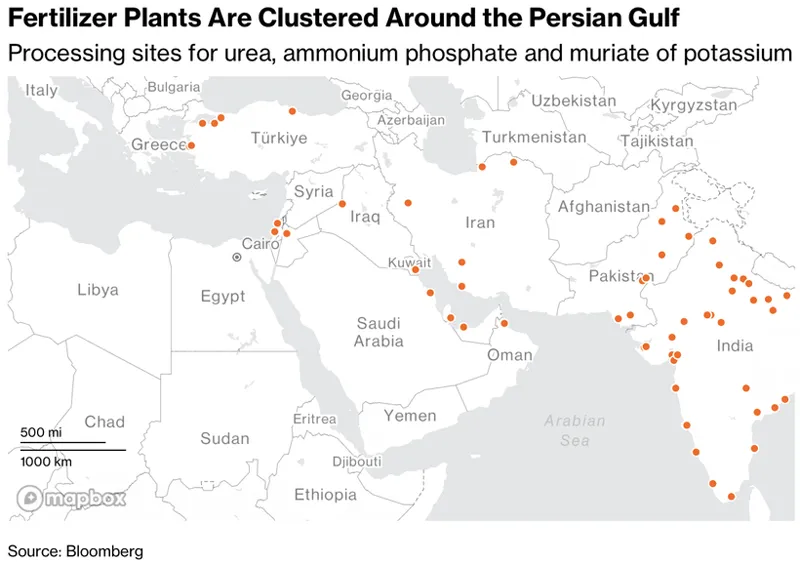
US/IRAN/MIL/FERTILIZER - Iran War Threatens Vital Supplies for Feeding the World
https://www.bloomberg.com/news/newsletters/2026-03-06/iran-war-s-impact-on-strait-of-hormuz-threatens-fertilizer-supplies-food-prices?cmpid=business-of-food&utm_medium=email&utm_source=newsletter&utm_term=260306&utm_campaign=business-of-food
Supply Panic
More than a century ago, two German scientists devised a process that takes nitrogen from the air and hydrogen to nourish farmland. Fed by natural gas, the Haber-Bosch technology went on to fuel a boom in crop yields and help alleviate global hunger. Now, food’s link to energy supplies is again getting tested by the Iran conflict.
Nitrogen fertilizer underpins roughly half of global food production. The US and Israel’s war on the Islamic Republic has disrupted the energy-rich Gulf, a major fertilizer hub. The Strait of Hormuz, where maritime traffic ground to a near-complete halt, handles a large share of the global trade for the nutrients while the region is also crucial to supplies of gas that feeds production elsewhere.
That’s laid bare the vulnerability of the supply chain that ensures a steady output of anything from corn and palm oil to fruit and vegetables.
The prospect of a fertilizer crunch is a throwback to when supplies were severely tested following Russia’s full-scale invasion of Ukraine four years ago, inflating costs, boosting crop and food prices while worsening hunger in places like Africa. The situation in the Middle East adds to the wave of inflation threats just as the world also tries to recover from the effects of the Covid-19 pandemic and weather shocks.
Fertilizer prices were already high before the Iran conflict erupted. Now farmers in the northern hemisphere are preparing to apply products to their fields knowing that they are likely to increase further.
AI-generated content may be incorrect.">
US/ECON - Live Updates: U.S. Employers Cut Jobs in Sign of a Shakier Economy
https://www.nytimes.com/live/2026/03/06/business/jobs-report-economy?campaign_id=60&emc=edit_na_20260306&instance_id=172083&nl=breaking-news®i_id=58167012&segment_id=216257&user_id=f22dffe809afecaa0742b8d4e86f9d6b
Job growth fizzled in February, a sign of unexpected weakness in the labor market.
Employers cut 92,000 jobs in February, the Labor Department reported on Friday, and the unemployment rate rose to 4.4 percent. The job losses cut across nearly all major sectors, including health care, which was weighed down by a nurses strike in California.
The report dimmed the picture of the labor market and all but shut down the prospect of a resurgence in growth after an anemic year of hiring that was weighed down by economic uncertainty. Many economists had forecast that employers would shake off their reluctance to hire this year.
Here’s what else to know:
Wages solid: Wage growth remained healthy, at 3.8 percent over the year. Average hourly earnings have been slowing very gradually, but remain relatively steady.
Participation drops: The share of people in their prime years who were either working or looking for work fell slightly in February, to 83.9 percent.
Job concentration: Health care employment fell by 19,000 jobs in February, dragged down by a nurses strike in California that kept 31,000 people out of work. The health care industry has powered job growth, driven by the country’s aging population. But that dominance has raised concerns that the job market is more vulnerable than top-line numbers suggest.
Low hire, low fire: Employers for months have been in something of a holding pattern. The number of job openings in December, the most recent month for which data is available, fell to its lowest level since September 2020. At the same time, initial claims for unemployment insurance have stayed low, indicating that employers overall are not laying off workers in large numbers despite some headline-grabbing jobs cuts at major companies.
Labor supply: The Trump administration’s immigration crackdown has contributed to slower growth in the supply of labor. That has made it difficult to determine if a slowdown in job growth is caused by decreasing demand for workers, fewer available job-seekers or a combination of both.
Fed implications: The report is certain to stoke divisions at the Federal Reserve, which holds its next meeting on March 17-18. Some officials appear highly concerned about the health of the labor market and willing to cut rates to support it, while others seem more focused on the risk posed by inflation, especially given the conflict in the Middle East.
AI-generated content may be incorrect.">
FINLAND/NUKES - Finland plans to lift decades-old ban on hosting nuclear weapons
https://www.bbc.com/news/articles/c14m5llnrlpo
Finland plans to lift its long-standing ban on having nuclear weapons on its territory, in a move the government says would align the country more closely with Nato's deterrence policy.
Defence minister Antti Häkkänen Finland and Europe's security environment had "fundamentally and significantly changed" since Russia's full-scale invasion of Ukraine began in 2022.
The Nordic nation abandoned decades of military neutrality to join Nato in 2023 over mounting concerns about the threat posed by Russia.
Under Finland's 1987 Nuclear Energy Act, the import, manufacture, possession and detonation of nuclear explosives is prohibited on Finnish soil - even during wartime. The government proposal would change that, making it possible to "bring a nuclear weapon into Finland, or to transport, deliver or possess one in Finland, if it is connected to the military defence of Finland", Häkkänen said.
"The amendment is necessary to enable Finland's military defense as part of the alliance and to take full advantage of Nato's deterrence and collective defence," he told a news conference on Thursday.
Nato's founding principle of collective defence - that an attack on one member nation would be treated as an attack on all - underpins the alliance's nuclear deterrence stategy.
As it contains several nuclear powers, this means a direct attack on a member brings with it the risk of a nuclear response. US nuclear weapons are stationed in several European nations, according to the Center for Arms Control and Non-proliferation.
The Finnish government's proposal requires changes to both the country's Nuclear Energy Act and the criminal code.
US/CHINA/ENERGY - U.S. Has a Big Ask for China: Buy Less Oil from Russia, More From America
https://www.wsj.com/world/china/u-s-has-a-big-ask-for-china-buy-less-oil-from-russia-more-from-america-3935df4b?mod=world_lead_pos5
Ahead of President Trump’s visit to Beijing, Treasury Secretary Scott Bessent is considering putting a tricky trade-off on the agenda for coming talks with his Chinese counterpart: reducing China’s oil purchases from U.S. adversaries like Russia.
In private consultations held in recent days with former U.S. officials, business executives and policy analysts, Bessent described a continuing effort to try to get China to instead buy American oil-and-gas products, said people familiar with the meetings. Bessent is thinking about raising the energy issue, the people said, in a meeting with his Chinese counterpart, Vice Premier He Lifeng, in Paris in mid-March. They are planning to firm up a framework for the summit between Trump and Chinese leader Xi Jinping, currently slated for the beginning of April.
Reducing Russian oil purchases would be a big ask for China, which gets crude from its strategic ally at a significant discount. American oil would be much more expensive, and shutting out Russian crude would undermine Beijing’s relationship with the Kremlin and undercut Moscow’s position in the Ukraine war.
In addition, the people said, Bessent is also considering asking China to reduce purchases of Iranian oil. While most of Iranian oil is currently offline following the U.S.-Israeli strikes, Washington wants Beijing to reduce its long-term dependence on Iranian barrels should they resume.
Xi is also expected to present a significant demand of his own when he meets Trump, potentially pressing the American leader to adopt a more proactive U.S. stance against Taiwanese independence in a bid to undermine confidence in the self-governing democracy that Beijing views as part of its territory.
Bessent also indicated in those private meetings, the people said, that Washington is seeking expanded Chinese purchases of American soybeans and Boeing jets, as well as a relaxation of Beijing’s export controls on rare-earth elements, which are essential to the manufacturing of a range of electronics.
INDIA/RUSSIA/OIL - India Is Turning Back to Russian Oil
https://www.nytimes.com/2026/03/05/business/india-russian-oil.html
ndian officials spent six months in agony after President Trump decided last summer to punish the country for buying crude oil from Russia, as they struggled to negotiate around his demand. Mr. Trump exerted pressure by placing sanctions on some Indian refiners and imposing a punishing 50 percent tariff on Indian goods to cut into revenue for what he called Moscow’s “war machine.”
On Thursday, Scott Bessent, the U.S. Treasury secretary, said in a social media post that the Trump administration would grant India a limited, 30-day waiver to buy sanctioned Russian oil currently stranded at sea to keep oil “flowing into the global market.”
In joining Israel to launch a war against Iran, Mr. Trump made it nearly impossible for India to get oil from its alternative suppliers, which are mostly in the Persian Gulf. Supplies from the region were cut off by the fighting, which has escalated since it began on Saturday. That leaves India with few options to feed its growing economy’s need for fuel, 90 percent of it imported. Russia looks like the obvious solution.
Sumit Ritolia, a research analyst at Kpler, which tracks international shipping, had anticipated the reversal and noted that India had not yet quit its Russian supply anyway. It takes nearly a month for tankers loaded in Russia to reach Indian ports; cargoes loaded before the trade deal was announced were still being delivered.
SWITZERLAND/US/MIL - Swiss expect to purchase 30 F-35 jets after cost increases
https://www.reuters.com/business/aerospace-defense/swiss-expect-purchase-30-f-35-jets-after-cost-increases-2026-03-06/
Switzerland now expects to purchase around 30 Lockheed Martin F-35A Lightning II fighter jets, six fewer than initially projected, because of cost increases in the order, the government said on Friday. In December, Switzerland said it would no longer buy 36 of the jets as planned, and Defence Minister Martin Pfister said rising costs meant the government was requesting an additional credit worth 394 million Swiss francs ($505 million) from parliament.
The Swiss government last year announced that the United States was delaying delivery of Patriot air defence systems to Switzerland in order to support Ukraine. Pfister said on Friday he expected that delay to be around four to five years.
As a result, the government is considering acquiring a second air defence system, Pfister said. Preference would be given to a system made in Europe, the government said.
TURKEY/UK/SYRIA/WTF - Exclusive: Turkey asks Britain's MI6 to step up protection of Syria's Sharaa, sources say
https://www.reuters.com/world/middle-east/turkey-asks-britains-mi6-step-up-protection-syrias-sharaa-sources-say-2026-03-06/
Turkey’s intelligence agency asked its British counterpart MI6 last month to take a larger role in protecting Syrian President Ahmed al-Sharaa after recent assassination plots, according to five people familiar with the matter.
The request highlights efforts by foreign allies to shore up a country still shaken by sporadic violence 15 months after the overthrow of president Bashar al-Assad, with the U.S.-Israeli war on Iran now rattling the wider region.
hose allies see Sharaa as crucial to preventing a relapse into sectarian fighting or civil war, after 14 years of civil conflict drove millions of refugees abroad and allowed Islamic State to control swathes of Syria.
The militants last month stepped up attacks on military and security personnel across Syria and declared Sharaa, a former rebel, their "number one foe".
It was unclear what specifically Turkey’s National Intelligence Organization, or MIT, had asked of MI6, or what new role, if any, MI6 had taken up.
ANXIETY RISES IN SYRIA OVER ISLAMIC STATE
Turkey, Britain and the U.S. last year threw their backing behind Sharaa to try to reunite and rebuild his country of 26 million. London and Washington have scrapped most sanctions on Syria and on Hayat Tahrir al-Sham (HTS), the Islamist group he once led.
KUWAIT/OIL/WHERE WILL IT GO? - Kuwait Cuts Oil Production as Storage Fills Up
https://www.wsj.com/business/energy-oil/kuwait-cuts-oil-production-as-storage-fills-up-3766b2eb?mod=world_feat1_middle-east_pos2
Kuwait has begun cutting production at some oil fields after running out of room to store its bottled-up crude, people familiar with the matter said, signaling a broader storage crisis that poses new risks to the global market.
The country, a founding member of the Organization of the Petroleum Exporting Countries, is discussing limiting its production and refining capacity further, to just what it needs to cover domestic consumption, the people said. A decision on those broader cutbacks is expected within days, they said.
Data provider Kpler said it has seen indications that Kuwait has started to cut production, adding that the country would have to cut more output in the coming days, as storage would otherwise fill up in around 12 days.
Shutting in an oil well risks long-term damage to reservoir pressure and incurs high restart costs, usually making it a measure of last resort. Restarting production can take days or even weeks depending on the reservoir.
“It will not be all back the same day exports are possible again,” said Giovanni Staunovo, commodity strategist at UBS.
US/IRAN/WAR/WORDS ARE WIND - After week of war, Trump demands Iran's 'unconditional surrender'
https://www.reuters.com/world/middle-east/trump-urges-iranian-kurds-attack-iran-war-widens-2026-03-06/
U.S. President Donald Trump demanded Iran's "unconditional surrender" on Friday, a dramatic escalation of his demands a week into the war he launched alongside Israel, which could make it more difficult to negotiate a swift end to it.
Trump made the remarks on social media just hours after Iran's president announced that unspecified countries had begun mediation efforts, one of the first signals of any diplomatic initiative to end the conflict[…].
The surrender demand, and the likelihood that this would complicate any quick path to ending a conflict that has interrupted global energy supplies, caused immediate shock in financial markets. European share markets, open at the time of Trump's post, suffered a sudden swoon. Wall Street opened sharply lower soon after.
On Thursday Trump had told Reuters in a telephone interview that he was demanding the right to help select Iran's new supreme leader, to replace Ayatollah Ali Khamenei, killed in the war's first day.
[I am not trying to be cute or too partisan here, but either: a. US President Trump doesn’t really understand that he’s saying when he says he wants to pick a new Supreme Leader, or b. we’re all of us enduring this mess and regime change isn’t even on the menu anymore.]
US/IRAN/MIL/TECH - What is the PrSM missile that the US used for the first time in Iran?
https://www.aljazeera.com/news/2026/3/6/what-is-the-prsm-missile-that-the-us-used-for-the-first-time-in-iran
The United States used Precision Strike Missiles (PrSMs) for the first time during its ongoing war with Iran, US Central Command (CENTCOM) said on Wednesday.
The war entered its seventh day on Friday, with attacks continuing across Iran and other countries in the Middle East.
CENTCOM stated in an X post that PrSMs provide an “unrivaled deep strike capability”.
“I just could not be prouder of our men and women in uniform leveraging innovation to create dilemmas for the enemy,” the post quoted Admiral Brad Cooper, head of CENTCOM.
It is unclear where these PrSMs were launched from, or which specific targets they hit in Iran.
So what is the PrSM, and why is it significant that it has been used by the US for the first time?
What are Precision Strike Missiles?
PrSMs are described as long-range precision strike missiles by their developer, the Maryland, US-headquartered defence firm Lockheed Martin, which delivered the first PrSMs to the US Army in December 2023.
PrSMs can hit targets ranging from 60km (37 miles) to more than 499km (310 miles) away, according to Lockheed Martin.
The company’s website adds that PrSMs are compatible with the MLRS M270 and HIMARS family of launchers, both also developed by Lockheed and used by both the United Kingdom and US armies.
MLRS stands for multiple-launch rocket systems, used to launch missiles. The UK sent a number to Ukraine in 2022. HIMARS stands for High Mobility Artillery Rocket System. In 2022, the US sent a number to Ukraine, as well.
M-142 HIMARS is a high-tech, lightweight rocket launcher that is wheel-mounted, giving it more agility and manoeuvrability on the battlefield. Each unit can carry six GPS-guided rockets, or larger missiles like Army Tactical Missile Systems (ATACMs) and PrSMs, which can be reloaded in about a minute with only a small crew.
Comments (5)
Sweden just boarded a Russian shadowfleet in the Baltic like an hour ago. https://www.svt.se/nyheter/inrikes/carl-oskar-bohlin-bordade-misstankt-falskflaggat-fartyg
In the world that’s coming, “winning” is going to look a lot like “losing”. If you are the upper class, you will be mostly unaffected, or, more likely enriched. If you are lower class, you either starve, slave, or shoot. And those are the only two classes there will be. Not even Orwell could have conceived what’s on the way, this time. I have never hoped to be more wrong, in my life, than I am, about this…
I'm not sure to whom you refer as "upper class", but the educated elite are going to take a real beating with the introduction of AI and the rise of alternative sources for higher education using internet to reach more student with fewer active teachers. Right now, universities are firmly in control by virtue of credentialing. But the drift away from effectively educating graduates to beome competent adults and toward indoctrinating this vacuous idea of virtue is eroding the credibility of the credential. Once they loose their monopoly on credentialing, those in the elite class that is supported by tax money (a non-wealth producing function that can only exist if others produce sufficient wealth to support them) will most certainly be negatively affected.
Where else can you get HIMARS, fertilizer and Finland. I always feel balance when I read his stuff. Not a refuge for the blue hair /stuffed animal crowd and not a refuge for MAGA. THANK YOU!!!!!!!!!!
It pains me to say it, but I think Trump was right, I’m getting sick of “winning”