





How to Use a Vintage Layette: Dr. Josephine Baker.
In our last post, we examined an early 1920s Dr. Josephine Baker layette sewing pattern in detail.
I really enjoyed writing that post and researching much more about Dr. Baker.
Both her career, and her contributions to the health and survival of babies in the U.S. were extraordinary. Anything I could write here would be just a pale shadow of the marvelous article I discovered on the Women in Medicine Legacy Foundation website. I very much recommend reading the wonderful article Dr. Sara Josephine Baker: A Lasting Legacy in Public Health published in June of last year.
But back to her layette patterns...
My experience with babies being quite limited, I was rather curious about the assembly and wear of these layette pieces. Luckily, my massive research library provided an article answering all of my questions in the Ladies' Home Journal New Fashion Book from 1929.
The article, Clothes For the Newest and Youngest Member of the Family By Dr. S. Josephine Baker, was just too interesting not to share.
Enjoy!
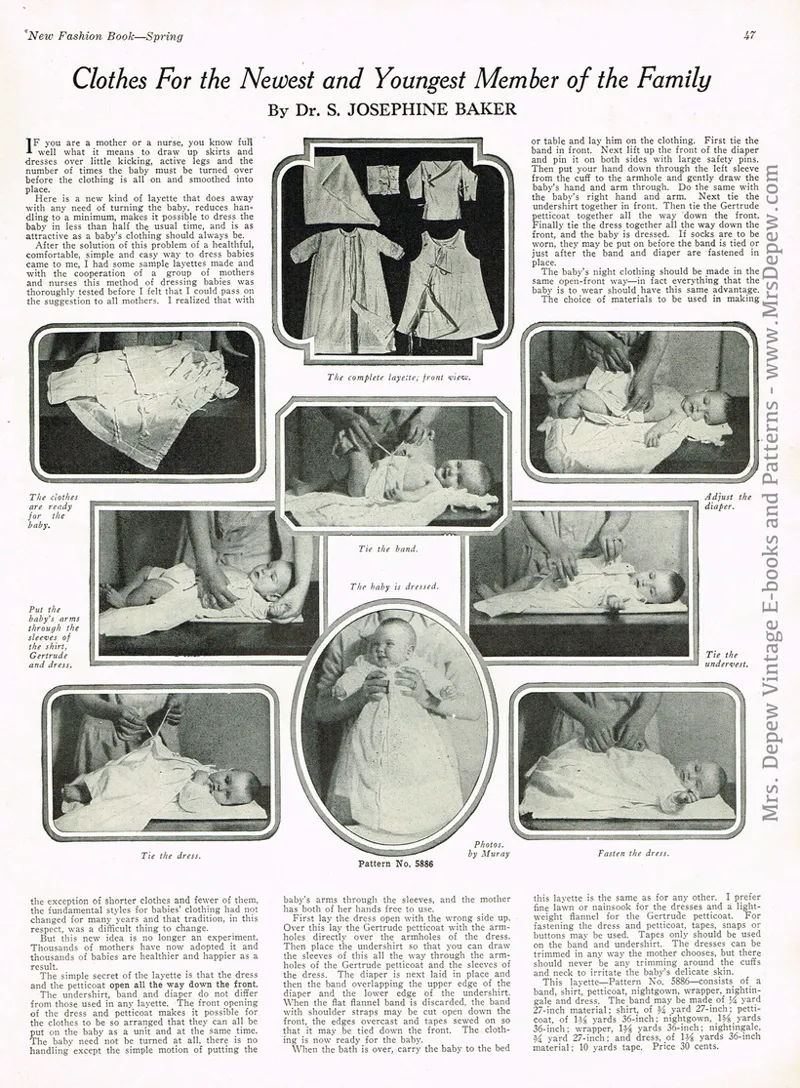
"If you are a mother or a nurse, you know full well what it means to draw up skirts and dresses over little kicking, active legs and the number of times the baby must be turned over before the clothing is all on and smoothed into place.
Here is a new kind of layette that does away with any need of turning the baby, reduces handling to a minimum, makes it possible to dress the baby in less than half the usual time, and is as attractive as a baby's clothing should always be.
After the solution of this problem of a healthful, comfortable, simple and easy way to dress babies came to me, I had some sample layettes made and with the cooperation of a group of mothers and nurses this method of dressing babies was thoroughly tested before I felt that I could pass on the suggestion to all mothers. I realized that with the exception of shorter clothes and fewer of them, the fundamental styles for babies' clothing had not changed for many years and that tradition, in this respect, was a difficult thing to change.
But this new idea is no longer an experiment. Thousands of mothers have now adopted it and thousands of babies are healthier and happier as a result.
The simple secret of the layette is that the dress and the petticoat open all the way down the front. The undershirt, band and diaper do not differ from those used in any layette. The front opening of the dress and petticoat makes it possible for the clothes to be so arranged that they can all be put on the baby as a unit and at the same time.
The baby need not be turned at all, there is no handling except the simple motion of putting the baby's arms through the sleeves, and the mother has both of her hands free to use.
First lay the dress open with the wrong side up. Over this lay the Gertrude petticoat with the armholes directly over the armholes of the dress.
Then place the undershirt so that you can draw the sleeves of this all the way through the armholes of the Gertrude petticoat and the sleeves of the dress. The diaper is next laid in place and then the band overlapping the upper edge of the diaper and the lower edge bf the undershirt.
When the flat flannel band is discarded, the band with shoulder straps may be cut open down the front, the edges overcast and tapes sewed on so that it may be tied down the front. The clothing is now ready for the baby.
When the bath is over, carry the baby to the bed or table and lay him on the clothing. First tie the band in front.
Next lift up the front of the diaper and pin it on both sides with large safety pins.
Then put your hand down through the left sleeve from the cuff to the armhole and gently draw the baby's hand and arm through. Do the same with the baby's right hand and arm.
Next tie the undershirt together in front.
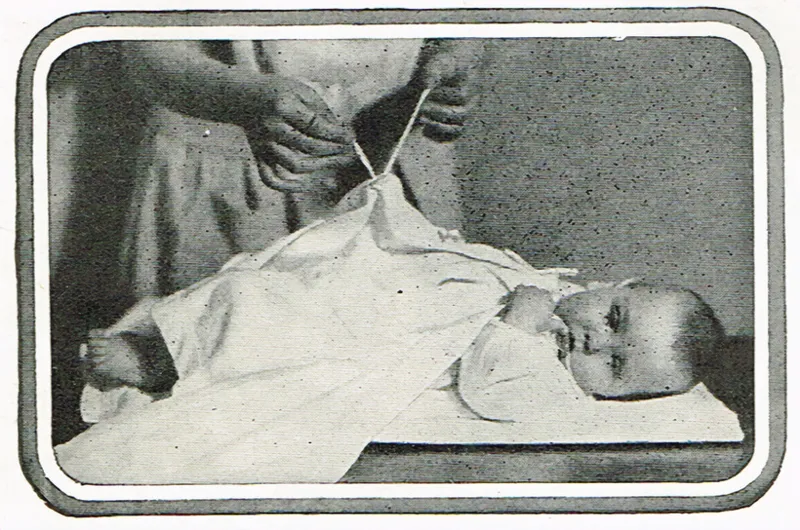
Then tie the Gertrude petticoat together all the way down the front.
Finally tie the dress together all the way down the front, and the baby is dressed. If socks are to be worn, they may be put on before the band is tied or just after the band and diaper are fastened in place.
The baby's night clothing- should be made in the same open-front way- in fact everything that the baby is to wear should have this same advantage.
The choice of materials to be used in making fine lawn or nainsook for the dresses and a lightweight flannel for the Gertrude petticoat. For fastening the dress and petticoat, tapes, snaps or buttons may be used. Tapes only should be used on the band and undershirt. The dresses can be trimmed in any way the mother chooses, but there should never be any trimming around the cuffs and neck to irritate the baby's delicate skin.
This layette - Pattern No. 5886 - consists of a band, shirt, petticoat, nightgown, wrapper, nightingale and dress."
(The article of course refers to pattern Ladies' Home Journal 5886, not illustrated in the book.)
Comments (1)
This is a great post. Thanks so much. The belly band thing is so curious, and all those layers. So interesting.