




All About Patterns: How to Determine Your Figure Type
In our last All About Patterns post, we learned some of the history of tissue paper patterns from Mary Brooks Picken's 1939 book All About Patterns.
To continue this thread, Mrs. Picken teaches how to determine one's figure type. Note that in the text that follows, the sizes referenced are vintage sewing pattern sizes, not modern sizes as they are currently numbered. Please also keep in mind that during this era, the language used to describe the unique variances in each woman's figure was often less-than-positive. Take the advice below with a grain of salt and remember that the MOST important thing is not your figure type and how it looks in an outfit but rather how your clothes make you FEEL when you wear them.
-------------------------------------------------------------------
HOW TO DETERMINE YOUR FIGURE TYPE.
"Most of us develop figures that are as characteristically our own as our faces and hands. Some come to have large busts; others, large hips; some lose their waistlines; others develop round shoulders, and so on.
In the book, Your Physical Self, we give information about foundation garments as well as variations in figure types and the essentials of correct body carriage. Conscientious practicing of body balance will improve your figure. However, you should know what figure irregularities you have, so that you can select styles to minimize and make pattern adjustments to subordinate them to the point where you may forget them.
Look at your nude figure critically in a full-length mirror. Observe how you carry yourself, how you walk, how you rise from a chair and sit down. With a tape-line, take your measurements, and know where they vary from the standard for your type. Put on a well-fitting foundation garment, a slip of correct length, and shoes with comfortable and becoming heels. Then look at yourself in the mirror and again take your measurements.
Remember, your foundation garments are worn to give smoother, more uniform lines - not to compress or distort natural body lines. Do not feel that you have an ugly figure just because you need adjustments in your pattern. The working schedules of alteration rooms - and every store has them - tell the story of adjustments that must be made in ready-to-wear to have garments fit individuals satisfactorily.
Only two women in one hundred can buy a dress or a pattern and not require some slight change in its proportions to have it fit correctly. If you know your size and where your measurements differ from those in a perfect pattern or ready-made - 16, 36, or 40, for example - you will find adjustments easy to make.
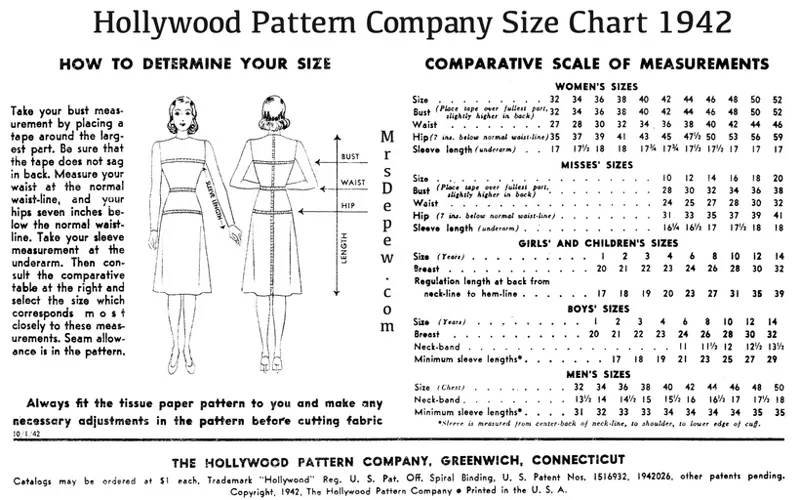
(This size chart from a 1942 Hollywood Patterns catalog shows the standard measurements at the time All About Patterns was written.)
Corset companies say there are twenty-four types of figures to design foundation garments for. Designers and pattern makers know there are six types in the normal sizes that must be recognized in creating clothes and patterns. Those we consider here.
Your bust measurement may tell you correctly that you are size 14 or 12, 16, 18, or 20. But are you an average size? Are you short or tall? Or are your shoulders broad? Are your hips broad or narrow? Do they measure size 12, while your bust size is 14?
If you are shorter or taller than your average, the problem is simple. On pages 14 and 15 you will learn in two minutes how to make your pattern right in length for you. If your shoulders are broad in proportion to your other measurements, then you may find it an advantage to buy two patterns, one right for your bust and one for your hips. Reconcile these two at the waistline, and you have a garment that seems designed for you and that will require a minimum of fitting.
If your hips are decidedly larger or smaller than your bust measurement, buy a second pattern that has a correct hip measurement for you. Usually it is a simple matter to slash a skirt pattern lengthwise or lay a fold to make the skirt right in hip and waist measurements.
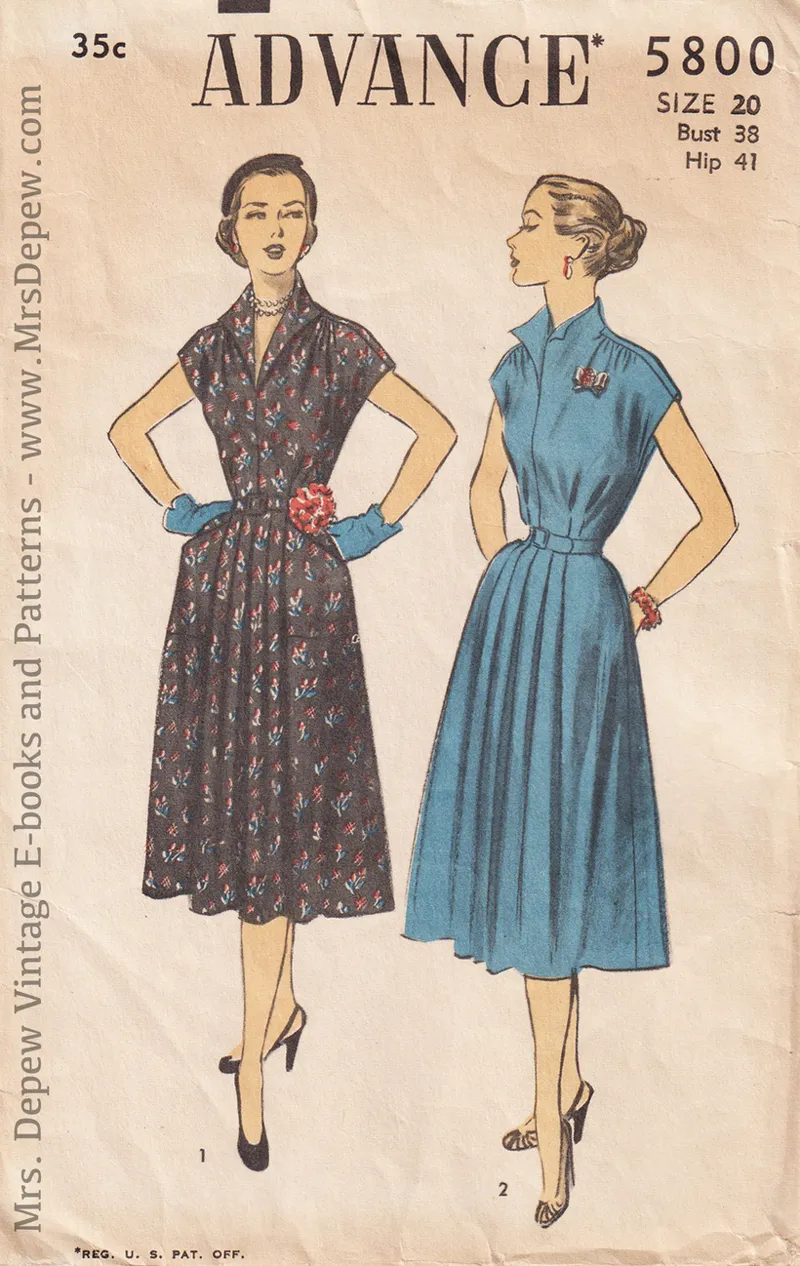
(Advance 5800 from the 1950s illustrates a vintage size 20, 38" bust and 41" hip.)
WHEN YOU ARE SIZE TWENTY OR OVER
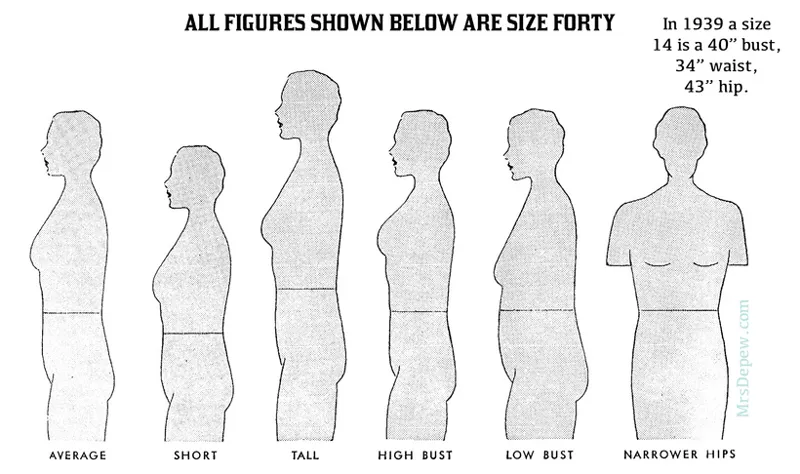
Don't have a size complex, but know your size. Know how and where it varies from the average. Excess flesh is usually what makes oversize. This is not always distributed evenly, as the figures at the bottom or this page illustrate.
A "perfect 36" is an average size with a bust line measuring from 35" to 37", hip line from 37" to 39", and height or 5' 5" in stocking feet. When you are tall and a size 38-which is practically a 20-you are still close enough to the perfect 36 to have few worries as far as
slenderizing lines are concerned. It is as easy to fit a large figure as a small one, and it may be more interesting if you know the measurements and what to do to retain style and gain a correct fit. But when you are short, you have a problem and must seek lines that give height, just: as sizes 10 and 12 must.
Persons having slender or petite figures need to watch that they do not look lost in their clothes, and those having larger figures need to guard against clothes that fit too snugly or too loosely. Perfection in fit is a great aid to good appearance for all figures larger or stouter than average.
If you are size 20 or over, sit down right now, determine your figure type, and read what to do. Buy patterns and fabrics, and make the required pattern adjustments that will insure becoming clothes for you.
ALL FIGURES SHOWN BELOW ARE SIZE FORTY
The average SIZE 40 or over is large, with flesh evenly distributed. The "shorts" have the same bust size, but are shorter than 5' 5", just as the "talls" are taller.
Often figures that have put on weight, reasonably quickly or over a period of years, have flesh concentrated at the bust, hips, or all through the body from shoulders to knees. There are these three definite types.
If you are one, recognize your type. Learn how to adjust patterns so that your clothes will fit with a minimum of fuss, and then select and style clothes that will subordinate your figure irregularity and give you the feeling of being correctly dressed.
Women who have borne children, and especially those who have not worn the proper foundation garments afterward, develop a low bust line and a full abdomen.
If there is considerable excess weight through the hips, it is advisable to buy two patterns to obtain a perfectly fitting garment for such figures. Those who have not had children often have slender hips and heavy shoulders and busts. Invariably they must buy patterns to correspond to the bust and narrow the skirt gores to have them agree with hip measurements. Some call this figure "top-heavy"; others, "slender-hip"; others, "the Junoesque."
(Butterick 6116 from the 1950s illustrates a vintage size 42, 42" bust and 45" hip.)
If you come in this group, know what your differences in measurement are and just what pattern adjustments you require. Study these figures, and if you are size 20 or over, decide which type is yours.
There is perhaps more advantage in sewing for herself for the woman who is larger than a size 20 than for any other, because she does not have to have matronly looking clothes (which seems to be the only kind made in large sizes). She can choose fabrics in color, texture, and quality that are in every way right for her, and she can have a large choice in pattern styles.
One thing a large woman should always remember is to avoid sleazy, cheap-appearing fabrics. People of size 20 or over should not choose bulky fabrics, but buy the best quality they can afford, and choose finer weaves -worsted rather than tweed; crepe rather than taffeta or bulky satin; chiffon rather than organdie, etc."
Butterick 1187 in a bust size 48" - proof that a larger-sized figure doesn't need to wear a matronly 1920s evening gown!
---------------------------------------------------------------------
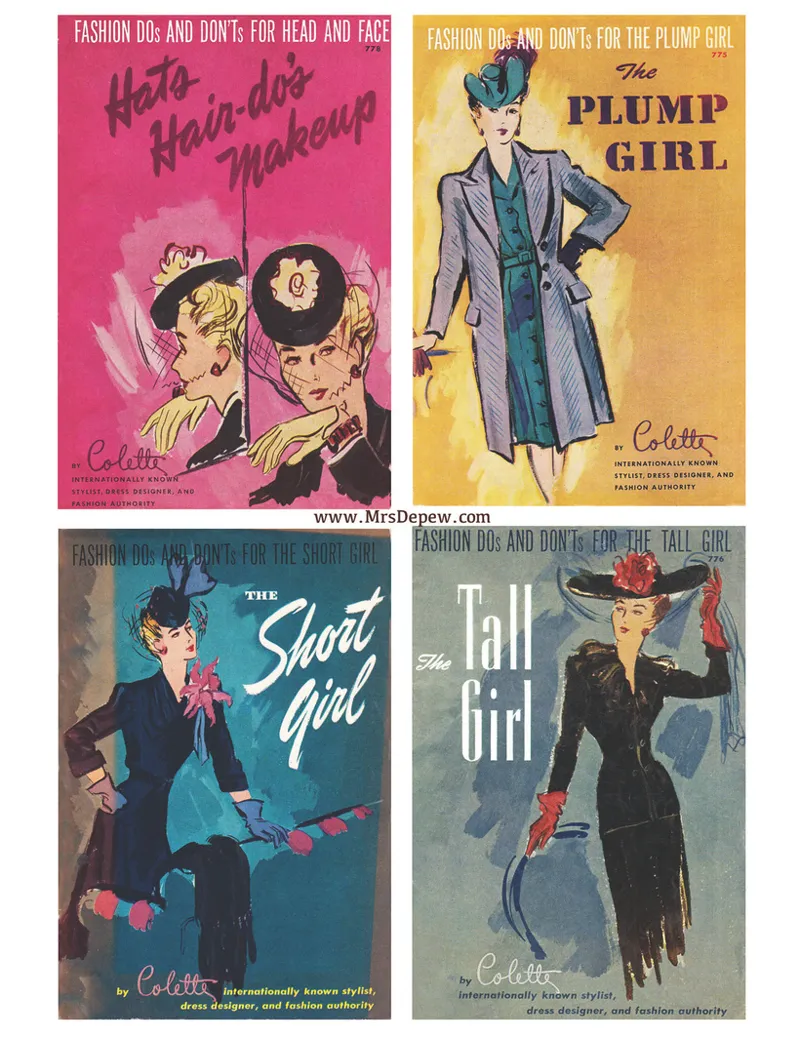
For more vintage figure-type and fashion advice, you might also like to read Fashion Do's and Don'ts for the Plump Girl, Fashion Do's and Don'ts for the Short Girl, Fashion Do's and Don'ts for the Tall Girl, Fashion Do's and Don'ts for Hats, Hair-dos, and Make-up.
Comments (1)
I know the writing style isn't for everyone, but I really appreciate Mrs. Picken's straight shooting. Also, the advice about avoiding "sleazy, cheap-appearing fabrics" certainly holds up over time, and is a big part of the reason why I sew!