

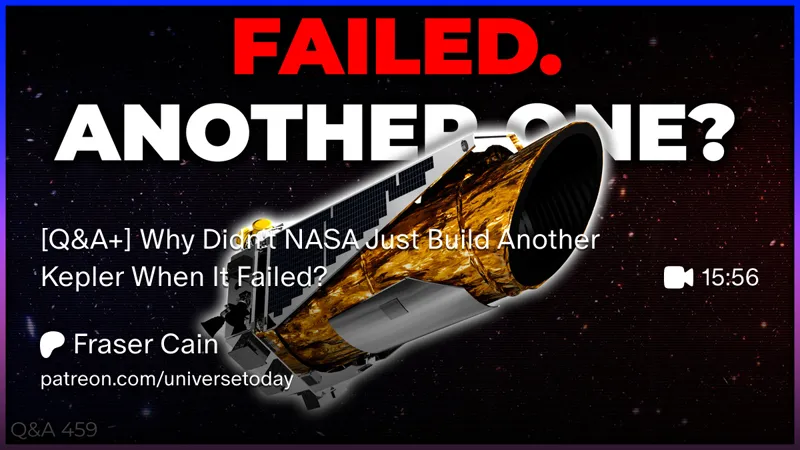
[Q&A+] Why Didn't NASA Just Build Another Kepler When It Failed?
BONUS QUESTION STARTS AT 09:07
Watch the video here (with no ads) or on YouTube: https://youtu.be/koZUXaCXpYA
When Kepler failed, why didn't we just build another one? Do we know about all the potentially dangerous asteroids? Could one just come out of nowhere? And in Q&A+, which planets are more difficult to visit (the answer will surprise you)?
00:00 Intro
00:22 [@paulcockerill4260] Why didn't NASA build another Kepler?
05:16 [@SeanMann-o6v] Are the near earth asteroids all known?
09:07 [@davew1959] Which planets are easier to visit?
13:49 Final thoughts
Comments (3)
Question. You talk often about inflation solves the 'uniformity' problem of the universe. But why would you expect the universe to be non uniform to begin with? When it started and all the forces are all united, wouldn't the universe kust be able to do just one thing and be uniform by default???
Foxes and deer are pretty common in UK, but loved a "Canadian's surprise" on it. haha
One might argue that a second Kepler should cost less to build than the original because a lot of the engineering for that specific project scope is already done and the expertise already exists . . . but lately the U.S. has been pretty bad at retaining infrastructure and talent.