
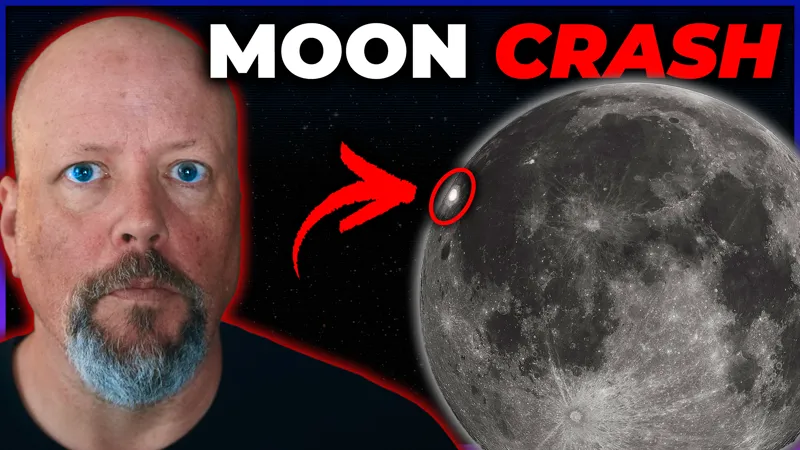

[Space Bites+] SpaceX Slams Into The Moon // Liquid on Pluto // Venus Isn’t Dead
BONUS STORY STARTS AT 19:40
Watch here (with no ads) or on YouTube https://youtu.be/rV0bRCA2cSs
🔵 Vote for the best story here: https://www.youtube.com/@frasercain/posts
Interviews mentioned:
👉 Interview with Dr Matt Weller https://youtu.be/R18W6VVZMhc?si=RasWhg-Y9sfKvXys
👉 Interview with Dr Paul Byrne https://youtu.be/VXuhaJu-GNM?si=A-lFy8XUQHJLqvL-
Venus might not be completely dead. Evidence of liquid flowing on the surface of Pluto. Can primordial black holes cause supernova? And on Space Bites Plus, what happened to Neptune's rings and moons when Triton showed up?
00:00 Intro
00:18 Three Worlds Not One https://www.universetoday.com/articles/the-asteroid-that-may-be-three-worlds
02:22 Venus Isn’t Dead https://www.universetoday.com/articles/venus-isnt-dead-after-all
06:04 Liquid on Pluto https://science.nasa.gov/blogs/science-news/2026/08/05/nasas-new-horizons-finds-evidence-of-recent-liquid-on-plutos-surface/
07:47 Charon Was Spinning Much Faster https://www.universetoday.com/articles/charons-mountains-reveal-moon-once-spun-10x-faster
09:00 Primordial Black Holes and Supernovae https://www.universetoday.com/articles/primordial-black-holes-can-trigger-type-ia-supernovae-and-astronomers-should-be-able-to-find-them
12:05 SpaceX Slams a Rocket Into The Moon https://x.com/SpaceX/status/2085121782315446613
13:53 Vote results https://www.youtube.com/@frasercain/posts
14:48 Voyager 2 Avoids Shutting Down More Instruments https://www.jpl.nasa.gov/news/nasa-engineers-help-prolong-voyager-2s-science-mission/
17:05 Quick Update on New Glenn https://x.com/davill/status/2085074404627915059
18:07 Rescuing the Rescuer https://arstechnica.com/space/2026/08/heres-how-engineers-plan-to-save-the-satellite-sent-to-save-nasas-swift-mission/
19:40 Bonus story https://www.universetoday.com/articles/smashed-ice-worlds-formed-neptunes-inner-moons-and-rings
20:50 Hank Green's AI controversy
Comments (14)
I think I've finally got a question. What is the maximum speed you could achieve with a perfect once in a lifetime, planetary alignment, with current engine technology. In order to send at least a probe out of the solar system? Would it reach a speed that would be useful in a lifetime or two? Keep up the good work!
My first thought was the Voyager spacecraft were launched in 1977 and they have gone far and are still returning useful data in a lifetime. Do those qualify as an answer to your question? New Horizons holds the record for the fastest launch speed from Earth, but it will never get as far from the sun as the Voyager spacecraft since New Horizons had fewer planet flybys. Here's what a search gave for the answer to with today's technology, how fast could a interstellar probe go. Their proposal is to go out to Jupiter, cancel most forward momentum, drop toward the sun, then do an Oberth maneuver to pick up the maximum velocity. There's still problems to be solved, like surviving the heat near the sun. https://www.centauri-dreams.org/2021/10/06/assessing-the-oberth-maneuver-for-interstellar-probe/
Thanks for the content. It was informative with a personable delivery. I like the balanced AI policy too.
this what I want to be in reality
any good friend to inbox me on WhatsApp 0970553925
Fraser, could you please show a little enthusiasm? ;-)
Thanks for NOT being an AI shop channel. Your AI approach is smart.
Hi Fraser and team, Was just reading Universe Today and saw a photo of Neptune with its rings and moons. The picture was taken in Near Infrared by JWST. The picture is not clear, why? Is there something about using Near Infrared that makes it hard to get a crisp image? Jim.
I just wanted to record my endorsement for the quips and sight gags. 🤓
Hahaha
Another awesome space bites Thanks so much, Fraiser. It’s always good to see you and see you’re well.
This is my kind of Heavy Metal. Thank you.
Fraser Cain for head of NASA! “We have to go back” Cain they will call him. Budget be damned!
Maybe a video on reaction wheels and why they suck...