
















GAMES FOR CRABS DEBRIEF
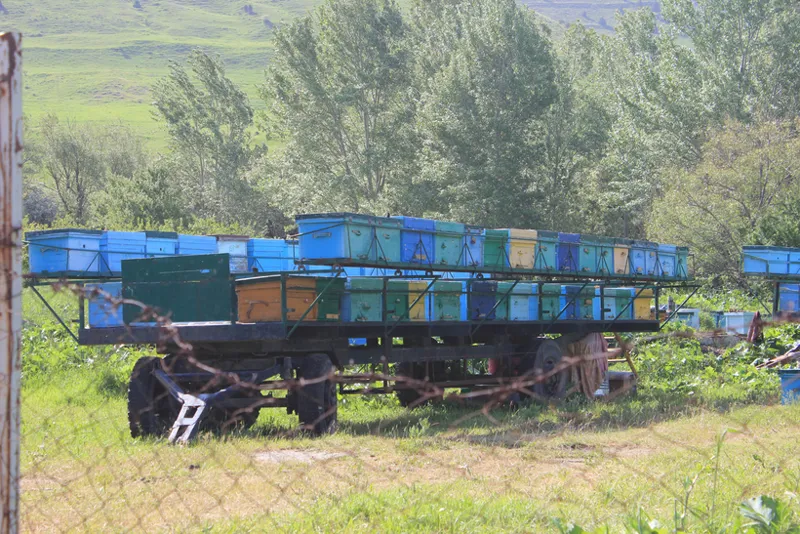
This weekend I wrote a game about different bronze-age philosophies put forward by a theoretical civilisation of superintelligent beehives.
It involves making uninterrupted eye contact with a stranger until I tell you to stop.
WAIT, A BEE ISN’T A CRAB!
You’re damned right.
Let me explain - Games For Crabs was a weekend event put on by Dave Winterbottom, who’s been scudding about in the murky waters of experimental games design for several years now. Dave works for a PC game company and, as they have a day job - perhaps in spite of it, I don’t really know them all that well - is keen to focus on the theoretical and artistic endeavour behind games rather than the often rather grimy business of making a thing that makes money.
I’ve not interacted much with Dave’s oeuvre before, but I heard that Games for Crabs was taking place at the Garrison Hotel, which is about an hour’s walk from my front door, and it felt rude not to attend.
Games for Crabs was an exploration of non-human games design.
All the games we make are games for humans, and our design choices are informed by that; they’re reflective, I’d argue inescapably, of the cultural and sociological pressures placed upon us by our environment and other members of our species. I’m not dreadfully happy with the political views of, it seems, the majority of the English-speaking world - and some of the non-English speaking world is on my shitlist too, but it’s harder to keep pace with ‘em - and I keep writing games about how much the government sucks and god wouldn’t it be nice if we could do something about it before we got too bored or sad or tired to make an impact.
(I actually don’t know what the difference is between sociological and cultural. Don’t tell me if you know and don’t tell me if they’re the same thing.)
Part of those pressures, I’d argue, is the coiled snake of depression that sits greasy and bleak in my head. Maybe I was born with the wrong chemicals pumping around up there; maybe Dad instilled a bunch of values and beliefs in me I’m still struggling against on an instinctual level, same way his dad did, same way his dad’s dad did, etc; maybe you’re not supposed to comprehend this many people all at once without going Jane-Grey-plugged-into-Cerebro mad.
Maybe none of the above and it’s a demonic curse on my bloodline - whatever the reason, I keep writing games about dying in glorious or tragic or brutal or ironic or meaningful ways.
(I’ve been heavier, of late, with regards to the old brain. But in my thirtieth year of suicidal impulses and self-loathing, and with the benefit of some useful therapy under my belt, I’ve come to pity the poor black dog that crouches toothless and decrepit on my shoulders. It growls and sputters; it’s all bark and no bite. I need to take it for walks, show it the sunlight, let it sniff some butts. We’ll get there.)
What else? White guilt, but that ties back into the politics bit. Some light arm’s-reach class struggle from the cosseted middle of the system, more angry than helpful, bound up with my personal disgust at capital. Frustrations at following often obfuscated societal rules routed through the being of anarchic bears in hats.
It’s hard to pull your own work, or even the work of other humans making games for humans, out of the environment in which they’re created - to even see the assumptions we’re making, the affordances we’re offering, the defaults to which we’ve defaulted.
All of the things I’ve managed to pry loose are societal; none of them are biological. I guess I primarily make games you have to read, and humans are I believe the only thing that can read, although the way octopuses are going it’s probably not too long before they start turning out damp novellas.
This is what Games for Crabs was about: starting with some loose biology, we assigned human-level intellect (and human-style intellect) to a species and had a think about what would happen. What sort of societies would they form? How would it relate to, and differ from, our own? And, crucially, because this is a weekend about games, what role would games play in the imagined culture?
Our brief wasn’t to make a playable game, although we could if we want - Dave was very clear on the fact that this weekend wasn’t a games jam, and we weren’t supposed to make products. We were supposed to think about what we’re doing through some interesting lenses and take that away to our other work. Some suitable things to make included:
- A game written by humans intended for use by non-humans
- A game translated from the non-human into words we can comprehend, fragmentary or complete
- A game for humans intended to evoke a similar but not directly translatable game written by and for animals
- Records of an actual play session of a game for non-humans
- An examination of evolving play practices within a non-human society
Anything, really, as long as it decentralises humans.
WE CHOSE BEES
We were offered five different things to make games - or game-like explorations - for:
- Crabs, as alluded to in the event’s title
- The Hive, being any theoretical multi-part intelligence
- Fungi, and god that’s a tricky one
- Bats, everyone’s favourite flying mice
- Flower Pixies, in case any of us wanted to dabble in fantasy
I chose the Hive, and a group coalesced around me - Michelle Kelly, who filmed an AP for our current Kickstarter project Children of Time with EUphoria, and Dave - and the other two teams picked Fungi and Bats.
(And: you’re right, the events of this weekend were very similar to what you do in the planet-side half of Children of Time, which is currently live on Kickstarter if you fancy backing it. I would, if I were you. It's good! It's got pangolins in! And, like, it's a pretty superlative example of GMless games design whilst being a faithful representation of the source material. But no-one gives a shit about games design so just focus on the pangolins and gimme yer fuckin money)
The weekend was divided up into four rough blocks: extrapolating a fictional society from the biology of the creature we chose, figuring out the role of play and games in that society, having a bash at making something about one or more of those games, and playing them with or presenting them to other groups for feedback and refinement.
Our options for hive minds were ant nests, bee hives, termite mounds and the nameless sprawling megastructure containing a theoretically massive quantity of naked mole rats - we opted for bees, as I already knew a couple of fun things about bees (having made the Deep Apiarist class for Heart, which necessitated at least minor research on the matter) and none of us really liked any of the other component animals.
Here is a list of fun things I know about bees without looking anything up:
- They make their own homes out of wax they goosh out of their bodies
- Can communicate distance and direction of important objects by waving their butts around
- When they sting something they die, usually
- When they mate they die (the males do, anyway, and you can hear it happen)
- Some of them engage in multi-bee threat displays to freak out hornets
- Most of ‘em live for, like, two months tops
- As a defensive measure, they can dogpile an invader and all vibrate their bodies so hard they cook the bastard
- Just the one of them - the Queen - lays all the eggs for a colony but if she does it wrong they kill her (via vibration!) and make a new one, so it’s more of a Mandate of Heaven than a Divine Right of Kings affair
I learned over the course of the weekend that the other two groups did extensive research on their subjects, much of which wasn’t used in the final presentation because it was too broad or not related to the topic at hand - in ours, we actively avoided looking anything up.
I don’t quite know why - perhaps we were all overconfident and wanting to appear knowledgeable. (As you have seen from the list above, I have approximate knowledge of bees.) Perhaps we couldn’t be bothered and the phone signal wasn’t great inside the stone structure.
I like to think it was because we were having fun making things up with one another, and knowing the difference between the types of the bees that vibrate things to death and the type that don’t wouldn’t help us much when making broad societal decisions.
Anyway: I feel like our game was actively uneducational, and I actually might know less about bees than I did when we started.
BIRDS DO IT, BEES DO IT - EVEN EDUCATED FLEAS DO IT - LET’S DO IT, LET’S ACKNOWLEDGE THE SANCTITY OF THE SELF AS WITNESSED IN THE OTHER
I think the difficulty of understanding the nature of a hive mind was what spurred us on throughout the weekend - it’s so unlike what we do brainwise, I figure, having only the briefest understanding of cognition and biology. We all seemed to agree it was wildly different from the standard brains that most things have, at least, and maybe we could play with that.
In our imagined world, hives were micro-nations unto themselves with a single occupant each. Every bee inside the hive was akin to one of our cells, or perhaps a fingertip or something, and they had little in the way of intellect. The hive is the consciousness, and it lives within physical space - like our brains - although it’s able to format and reshape itself in such a way as to display itself more broadly. Maybe our bees could build memory and history into the walls, rather than holding it in their heads (which are very small). The hive is art. The hive is self. The hive is territory. The hive is truth.
In a broader sense, bees got smart. Bees got big. (They can still fly, because bees.) Bees tamed fire and began to work metal. In the hives across the valley, they’ve developed copper stings. They surgically remove the drones’ organic sting and replace it with a copper one that won’t come out when used. (I get that the function of a bee sting is that it comes out of the bee, the same way the dart part of a tranquilliser dart stays attached to the needle, but don’t worry about that.) Just like in our world, the technological advance is causing upheaval, and hives - once isolationist weirdos - are trying to find ways to talk to each other because they’re scared of getting coppered to death.
I was reminded of when I fell in love as an adult, properly, for the first time. I fancied a bunch of people, sure; I had fallen for girls when I was a teenager, and younger than that, and honestly I’ve spent a larger percentage of my existence than I’m happy with dealing with the fallout of my first breakup at age 10 and subsequent shuddering mix of lust and fear that filled my being whenever a member of the opposite sex paid me the slightest attention.
But Maz, my first proper love, and current spouse? Maz was a whole other person, a whole complex multifaceted beautiful being, as weird and difficult and strange as I was.
Falling in love was like realising someone else existed for the first time.
I thought: could that be fun? A game where we teach beehives how to fall in love? We broke for lunch.
I’ll admit that knocking back a pint and a kingsize roast pork sandwich for lunch alongside a spliff, while it was definitely the sort of meal that winners eat (and drink, and... smoke), it hampered my creative efforts in the afternoon session. I definitely took part but, unlike the freewheeling can-do verve of the morning, I stumbled a bit. As engaging and low-stakes as the prospect of thinking about games that don’t exist for societies that also don’t exist for a whole weekend might be, the reality of what amounted to working 10-5 all weekend dawned on me: maybe I’m getting old. Maybe now my job is sufficiently creative that my weekends of dead-eyed unfocused isolation are crucial to the process. Maybe I was taking a step back and ceding authority to the others in the group.
Maybe it was the pint and the spliff and the fist-sized lump of meat I hustled down my neck in four minutes flat. Who’s to say.
HEXCITING DEVELOPMENTS
We started bumbling (hah) around with concepts, and Dave absent-mindedly sketched out a hexagonal pattern on a bit of paper, and we figured - could we fill in the gaps between them with words? Could it read like poems, meaning different things in different orientations. Could that generate something profound? Is that anything? It turns out it wasn’t, but Dave remembered they had brought a set of blank hexagonal cards as supplies for the event, and the day was fuckin’ saved.
I’d like to thank not only Dave but the makers of those fine hexagonal cards, whoever they might be, as if we hadn’t had those we would have had to hand-draw all our hexagons. If we learned one thing over the course of the weekend, it would be that none of us present could turn out even one decent hexagon. (The bees make it look easy, but I guess that’s pretty much their only trick. Bet they’d fuck up a square.)
So: we had cards that could fit together on six different sides, and the game was fitting them together in a way that was pleasing as a simulation of reaching common ground with a foreign hive. We left the session with a few questions to think about:
- What are we writing on the cards?
- Are we getting the players to write them, and if so, what are the themes?
- Do we go high-falutin or mundane?
- What’s the desired end state? Is it agreed-upon, judged, binary pass/fail?
- How can the players rotate, swap, remove, edit and otherwise modify the cards?
- Can we generate something even slightly meaningful from the exercise?
- What, aside from the six-sided cards, does this have anything to do with goddamn bees?
EXPERIENCE THE FULL RICHNESS
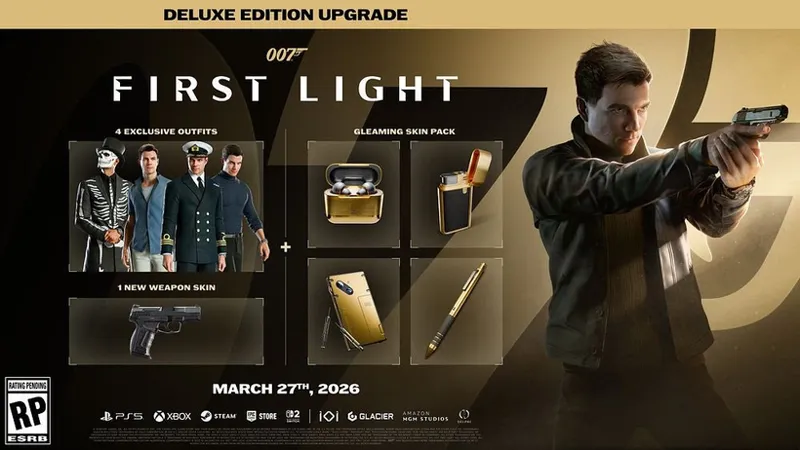
Reader: I thought about none of them. Instead I played 007: First Light on the sofa and took some more drugs. Please listen to my complaints about a video game I recently purchased.
I had completed it the weekend before, and felt vaguely dissatisfied with the whole thing. It’s made by IO Interactive, makers of the Hitman series, and while I have a fondness for the Bond ecosystem in a way that I struggle to express coherently - I enjoy watching Roger Moore do things on camera, I think Daniel Craig is great and they kept giving him shithouse villains to go against, I find a certain comfort in the formulaic nature of the stories, also I usually fancy the women involved - I really enjoy the Hitman games, especially the ones released within the last decade where they nailed the “murder this very bad man ten different ways for points” element.
I never really liked the main character, though. Hitman - Agent 47 - is an intentionally blank character who doesn’t appear to take much pleasure or umbrage with the things he’s asked to do, and whose main hobby (aside from murder) is dressing up in other peoples’ clothing, so I was excited to have some of the same gameplay beats pinned around a character with, like, thoughts and feelings.
(Not buckets of thoughts and feelings, mind. It’s still wee Jimmy Bond we’re talking about here. But some.)
The bit in First Light where you play the game - where you grab mooks and bonk them off walls, when you shoot some guy’s gun out of his hands and knock him unconscious, when you grab an ashtray and pitch it straight at a goon’s chops to interrupt his attack, where you shove a dude off a gantry or hack a piece of technology with your magic watch to smack someone in the face with a rogue door - is great. Not since Arkham Asylum have I had this much fun brawling.
The three options you have at any given time - grab, punch, dodge - manage to mix together into something that looks and feels tremendous. They love zooming the viewpoint in to emphasise impact, and I’m an absolute sucker for that shit. The game rewards you for using the environment, and much of what you do when you use it destroys said environment, so battles become a free-wheeling affair which see you traversing the level as you do them in search of more things to shove guys into.
But every other bit, when you’re not playing the game? The bits where you’re briefly allowed to drive a car down a very restricted course? The bits where they take the standard rhythm of infiltrate - bluff - punch - brawl - alarm - shoot - hide and cut out all of the elements aside from shoot, turning it into a by-the-numbers cover shooter? Any of the boss fights? Any of their attempts to make Bond seem like anything other than a flimsy cipher?
And, worst of all, the bits where they’re trying their best to do a Bond film and it comes across as, and this is a reference that only Brits will get so apologies to everyone else, a bit... Sunday evening ITV?
It’s just a bit naff.
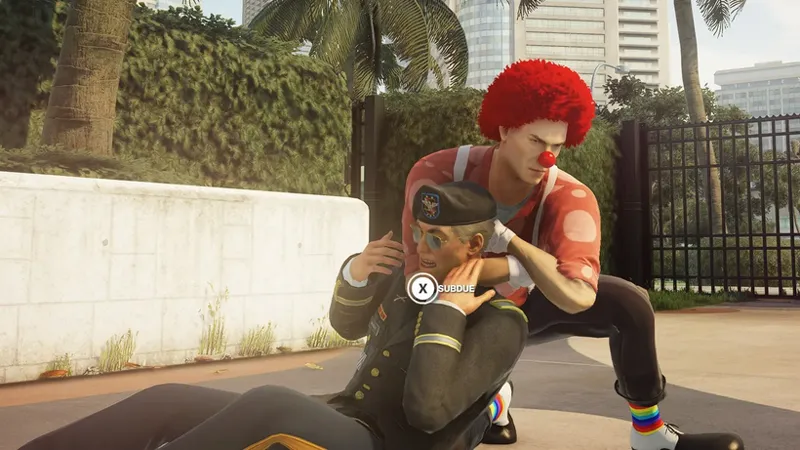
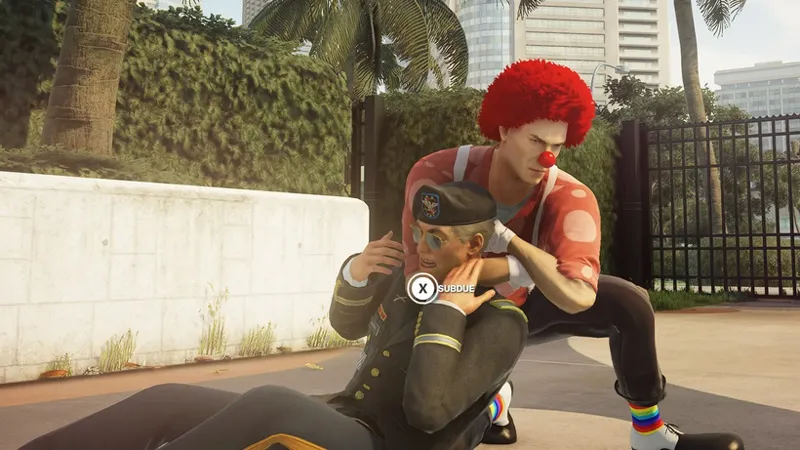
Anyway; I saw a loading tip that said to experience the “full richness” of Jimmy B’s First Light I ought to sign into the online mode, and I’m allergic to online modes since I was invaded one time during a game of Dark Souls and nearly had a heart attack about it. I wanted to have a go on the VR bits, which promised some of those good Hitman-style murder playgrounds I adored: missions with escalations, increasing challenges, more and more awkward objectives, goofy shit where I dress up as a clown and contrive a poisoned dinner for a disreputable executive. That sort of thing.
They only made five levels of it. Two of them are tutorials! Each level has three challenge grades, and most of aren’t very good.
“Full richness” my arse.
I’d like to thank drugs for making the experience even slightly enjoyable. I took some more and did the washing up instead.
DIFFICULT LIKE SUNDAY MORNING
On day two I shuffled down to Hillsborough on foot and grabbed a McDonald’s breakfast. I’m not averse to a sausage egg mcmuffin meal; it’s a lot of calories in a small handful, and it’s hot, it’s reasonably priced I guess, and the coffee is better than it has any right to be. Plus you get a hash brown with it.
It’s bad for you, obviously - bad in a holistic way, something spiritual, something that blocks your chakras with melted cheese and pork patties the texture of packing foam. But it does the job.
Arriving at the event, we all seemed a little worse for wear. Dave because they’d stayed up drinking and wandering around Penistone Road at 3am looking for food; Michelle cause she’d slept at the wrong angle in the heat; and me on account of the drugs I mentioned, although it was scant minutes before that second black coffee was due to bring my brain online and kick the game design juices into gear as normal.
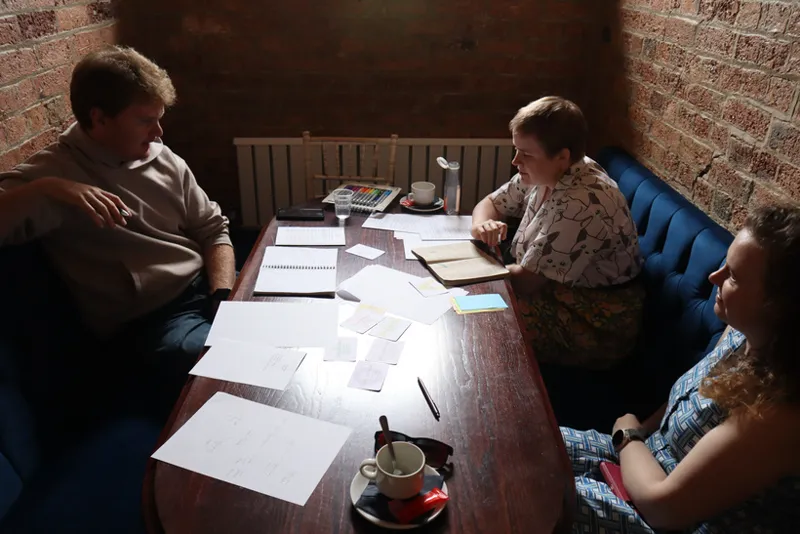
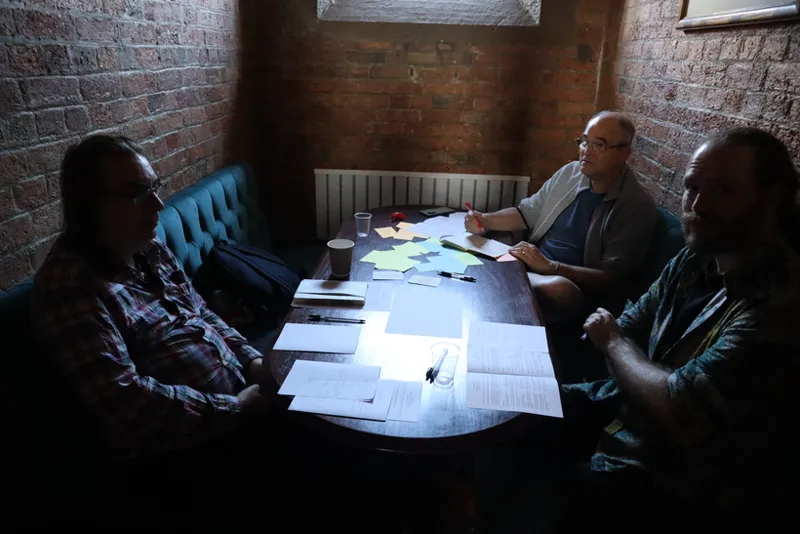
Everyone went off into their separate groups; the fungi group split into three and made serious faces while they worked on things independently, the bat group started arranging coloured plastic cubes on a sheet of paper to illustrate the movement of theoretical megachiropterae across a playing field, and we sat cross-legged on the astroturf balcony and Dave lead us in a brief meditation.
I usually rebel against this sort of thing - partly due to a combination of pre-emptive masculine distaste for anything mildly interrogative or spiritual, partly due to a desire to demystify the often arduous process of creation and centre it around human endeavour instead of mystic connection - but it worked.
We pretended to be flowers. We decided on something that a flower would want to have, or be. (I decided on a suitable opening for a bee to rummage around inside. The other two chose sunlight.) We crossed our legs, closed our eyes, wiggled our fingers around, and afterwards something shifted from “oh gods, what are we going to do” to “hey, look at all the things we could do!”
I forget who said it first, which means it wasn’t probably me, but we started discussing the idea of programming some more social awkwardness into the game. It was about alien minds meeting for the first time - “Arrival but Amy Adams and the Heptamorphs are both sixty bees” - so could we program some of that in? Could we hotwire human connection to make it more awkward and more fun?
We resisted a little, because it seemed gamey - the sort of thing you’d do in a parlour game, or a drinking game, and not the realm of high-minded connection. I can see the argument. We had positioned the game as a religious experience - something led by a third-party priest character who mediated discussion between the hives with strict ritual limitations, as a measure of overcoming the fear of the other.
But then we decided that it might be fun to make people hold uninterrupted eye contact for thirty seconds, and that was that.
CULTURAL TRANSGRESSION AS GAME MECHANIC
A decade and change ago, I ran a game called Spirits Walk in Melbourne during the strange chapter of my life where I trailed around the world behind my partner’s job. Spirits Walk (apostrophe deliberately left out) was the culmination of several years of livegame design where we poked at the edges of social transgression as a means of play.
(All play is social transgression! It’s just that some magic circles are better than others.)
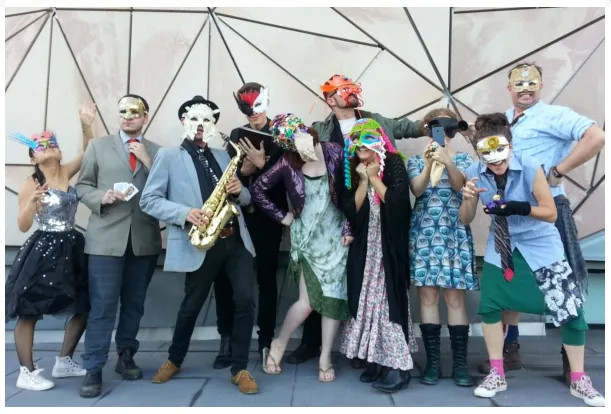
Spirits Walk was a mix of Unknown Armies and Neverwhere; Melbourne manifested spirits for one night a year, and they were planning a big parade in the city centre to celebrate. Players were given a blank mask and a little guidebook with a map, and told to seek the spirits and get tokens from them in exchange for tasks; at the end of the night, they stick the tokens to their masks (along with performing some other light arts and crafts upon them) and marched with us, all bells and trumpets, whilst wearing them.
All those tasks were geared, in some way, around breaking a low-grade social taboo. You don’t dance in the street, so we got you to pair up and share an MP3 player in order to please The Stepping-Girl. The MP3 player contained one song, an instrumental version of Laura Viers’ July Flame off her soundtrack album for Hello I Must Be Going, and I never asked her if I could use it, so sorry Laura.
I also got a friend - a singer, with a professional-sounding voice - to read two different sets of dancing instructions and piped them into the left and right earbuds, and the instructions were designed to simulate one person enjoying the dance and one person being uncomfortable, right down for things for them to say to each other and whether or not they should smile in response.
I think the Stepping-Girl, Lady Lightsup, She-Who-Dances-Between-Worlds (phoned in the last title there), was the best expression of what I was going for: not only were you dancing in public, but you were dancing with someone you maybe don’t know very well, and then I also made it so even if you did know the person you were being programmed to seem like you weren’t getting along.
The others followed similar themes, perhaps not so fiendishly expressed:
- Defend people (who were not in on the gag) crossing a bridge from invisible enemies with cardboard swords
- Find some useful-looking rubbish or debris and bring it to the bird-woman crouched by the river
- Tell a secret to a man in an alley, who would then anonymise it and write it on a placard for the parade later on
- Convince someone to give you something of worth to exchange with the Jack of Trade for hell money
- Give something - anything - to The Hungry Waif; one man gave her a shoe and struggled to get it back after the game
- Sing Somewhere Over The Rainbow in Fed Square with the God of Buskers, because that was the only song the actor could reliably perform on saxophone
It lit a spark under me, and I remember fizzing with excitement at the prospect of running it in Sydney, in Norwich, in London, everywhere, forever. I wanted to reshape the way people saw their cities and turn them from something boring and everyday to places where they’d brushed up against magic, or novelty, or art, or fuckin something. I wanted to do immersive street theatre.
Then I moved to New York, again following my partner’s job, and I don’t think I’ve ever been as desolate and isolated and sad as I was for those nine months in Brooklyn before we bounced back to London on the heels of another promotion. I didn’t gel with New York: too loud, too expensive, too eager, too brash, too cold, too hot. Too much everything. Plus my brain went off like doorstep milk in summer and it took me four years to claw my way out of the nightmare pit I had fashioned for myself.
(I mean: I was sad before New York, I should clarify. I’ve been sad since I was ten years old, and I was a moody little sod before that, and after I clawed myself out of that pit there was a solid year-long relapse over Covid quarantine, and then I found a therapist that worked, and it only took another four years of therapy on and off to get my brain to a state where I don’t dream of razorblades and revolvers every time something goes even slightly awry.
So it’s not all New York’s fault, but as an important counterpoint, fuck New York it reeks and the pizza isn’t even that good)
Spirits Walk, and the rest of my live games, and the heart-flutter towards immersive street theatre - can you imagine! Me! Sheffield cryptid Grant Howitt, known hermit and misanthrope, capering around the city streets for art! - fell to the wayside in favour of being Very Sad Almost All The Time and writing books instead.
But the fascination with doing the correct thing in public, and not knowing what that thing is, and the tension between wanting to do it more than anything to fit in please and definitely not wanting to do it because I’m an avant-garde iconoclast remained.
SPEED-RUNNING SOCIAL AWKWARDNESS
HIVE MIND, our game about bee hives trying to fall in love, consisted of three decks of cards.
It is a human adaptation of a hive game, one of a collection of ritual diplomatic exercises called Seeing Games or Understanding Games. Hives would send forth delegations of bees to play with each other; we make do with our single brain.
Deck one was blank, and hexagonal. Each player got four cards, and the first part of the game consisted of us asking them to write down words on the edges around a theme or an inspiring word.
Things like:
- Profane and Sacred
- Dangerous and Safe
- Unknown and Known
- Desired and Disgusting
(We eventually reformatted the themes to be a bit less fancy, and got down to Weird and Normal and Useless and Useful, as that was hopefully easier for players to write and had less overlap.) Once completed, the third player - the GM, or Priest as we called them - arranged three of each players’ cards in a loop on the centre of the table.
The aim of the game is to get the words on touching edges of the hexagonal cards to make a sort of logical sense, or to share a connection. It was vague on purpose; the GM can arbitrate whether or not it’s worked.
Deck two had a list of actions you’re allowed to perform to the hexagonal cards on a given round:
Things like:
- Rotate any two cards.
- Change a word on a card written by the other player
- Swap positions of any two cards
- Replace an opponent’s card with the one card you’ve been holding onto
- Write a new card together
- Write new cards separately around a theme you do not outline
Each round, the GM drew a card from deck 2, and read it aloud. At the end of the round, if a player believes that the words are sufficiently connected, they place the special HIVE MIND hex in the middle of the loop, and the other player must justify the connections. If they can’t, play continues.
Before I outline the mechanics of deck three, it should be clear that at the start of the game you are told that you cannot talk to or look at the other player at all unless permitted to by the cards in deck three.
At the start of each round, the GM draws a card from deck three and reads it aloud.
Permissions included:
- Before the next round starts, hold uninterrupted eye contact for thirty seconds.
- Before the next round starts, pay the other player a compliment.
- Before the next round starts, whisper a regret into the other players’ ear.
- Before the next round starts, give the other player something from your pocket or bag for them to keep.
- Before the next round starts, do the same dance. You may look at each other, but not make eye contact.
- Before the next round starts, mirror the other players’ facial expression until the Priest tells you to stop.
- Hold hands for the whole round.
RUMMAGING THROUGH THE PUDDING IN SEARCH OF PROOF
The last part of day two was playtests or demonstrations with members of other groups, feedback, some light refinement, and then some presentations to camera. I ran one of our playtests; Michelle ran the other, while Dave quite rightly got a handle on the other two groups which made sense on account of them being the organiser.
Here are some learnings from the playtest:
- It takes quite a while to come up with and write down twenty-four words, especially if you’re trying to show off that you know all the best words like I tend to do. It felt like an age to me; the players didn’t mind at all, though.
- Thanks to an elaborate set-up lore piece from me, one of the players was roleplaying as a beehive. Fair enough; I didn’t tell him not to, and it makes sense, it’s just less vulnerable that way. We would go on to tell players that they could be themselves or pretend to be a different person, if that made it easier for them.
- Thanks to the peculiar rhythms in his head, the other player had decided to be a disruptive influence on the game as a means of testing it. (He mentioned this during the feedback section afterwards.) I tend not to write games for disruptive or difficult players; they’re free to stop playing at any time and fuck off, which means I don’t have to try and fence them in or out with extensive rules. You need a buy-in, you need everyone to take part, otherwise it’s not worth doing it. I really wish he hadn’t done this; it didn’t help.
- Michelle’s test ended in a win on round three, even with her attempts to disrupt early signs of togetherness by stacking the deck. I called my text to an end after round four, judging (correctly) that we were fucking miles off making the connections required and also maybe intuiting that one of my players was being a kind of a dickhead (his words), even if he was doing it out of a desire to stress-test the system.
- The social awkwardness deck didn’t really land for me. Michelle’s group enjoyed it. It just sat on top of a strange card game, in my test; I don’t think I quite bought into it enough, didn’t give it the weight it deserved. The whole not being able to look at each other or speak thing was interesting, though, and it made a really simple task difficult in what I hope was an interesting way.
- The players wrote with right and left hands respectively, so getting them to hold non-dominant hands had no real impact on the game aside from the fact that I had to take their pen lids off for them so they could write on cards.
- Neither me nor Michelle had the guts (or desire, to put it more kindly) to play with the decks as random as we’d intended them to be. We both just picked whatever cards we liked and sort of half-claimed that it was chance, which I don’t think anyone was buying.
- I quite enjoyed being able earnestly say things like: “Stop talking to her. Talk to me, and I’ll tell her if it’s important” or “Don’t look at him. Look at me.” I’m not sure what that says about me. (Just kidding! I’m exactly sure what that says about me.)
SHOW AND TELL
And then we tweaked the game a bit, and delivered our presentations to each other (and to camera, and you can watch them here).
TEAM BAT
Team Bat had made an exploration of the fictional game BATS VERSUS HUMANS, a game by bats for young bats. Played in a cave (so all demonstration was theoretical, and done with tokens on paper), teams would compete to gather fruit - either actual surplus fruit or stone tokens - and one team was banned from flight, or using echolocation to find their way, because they were stupid humans who can’t do those things. Humans could catch and “kill” bats by jumping on them; first team to get all the fruit wins. The way that bats are “killed” by humans was reflective of the existing relationship between the two species; the game is, in part, a warning.
The game would go on to evolve to a more complex version relating the ongoing relationship between humans and these larger-than-normal, societal bats. Hunters appear, who are a Human-team player specifically devoted to killing bats - the other half are Guards.
And then, we see a version of the game in an enlightened future where bats and humans play together. There are rules for inter-species tagging, so not to hurt the little bats, and teams are now symmetrical in terms of their abilities and limits - some of them are actual bats, some of them are actual people, and they’re all trying to nick fruit from the opposing team’s base.
TEAM FUNGI
Team Fungi made something more traditional - a TTRPG where you were an offshoot of an massive extra-terrestrial fungus colony called, appropriately, Humungus. Players were in charge of an intelligent lump of mushrooms from space, kicked out by their space dad, and dispatched to earth to take part in a clandestine alien war being fought under our clueless noses.
Characters had a few stats, mostly governing how easy it was for them to mess around with infected humans without being caught by the CDC (or equivalent); each named host had a handful of stats, too, the standard three you’d expect and my personal favourite, Appearance, which was a measure of how much they looked like the baddies from The Last Of Us and as such whether they could go outside and do normal things for you. You can read more details on this associated blog, written by one of the team.
I have not named the game yet because it seemed as though the creators themselves were unhappy with the title; everyone who offered feedback said they should change it, and they didn’t speak it aloud during the presentation. You can guess what it was. It’s the first pun you can think of. The replacement title, which didn’t seem to land super well with them either, was Spore Losers.
Thinking over their project now, I’m reminded of one of my particular favourite things to do, which is to make fake character sheets for games that don’t exist. It’s great fun. We even did a jam, a few years ago, to make character sheets for various editions of CRUX.
(CRUX is a joke that Chris and I enjoy, and it’s a short-form for any overcomplicated, usually late-90’s design sensibilities. You know the sort: four pages of character details, different skills for “Throw Knife” and “Throw Improvised Weapon,” some inscrutable shit about Essence Activation, five different kinds of defence stat, etc etc. CRUX only exists as character sheets and you are not allowed to say that it’s fake.)
I think I might have had fun trying to make a roleplaying game for humans designed by bees, and I’d only have to write the character sheet, and that would be enough. That’s basically postmodern.
IN CLOSING
Good weekend! Would weekend again!
Maybe a bit of a busman’s holiday, given that this is what takes up a significant portion of my average week, but being freed from the considerations of having to make something that earned money or resonated with our audience or even that was any good was very pleasing.
We spent hours and hours thinking about context, some real genius-brain shit, and how to unpick ourselves from the assumptions we make about each other. I got to spend some time with some people I didn’t know very well, which given my recent hermitude, was good for the soul.
And I thought about bees a lot, which is always nice.
I have attached something of a working draft of the game as a PDF. Maybe you can play it. I’m not sure if it works, but it’s a great excuse to be very stern and controlling towards people who are ostensibly your friends.
Dave has some more plans to run something similar next year, and I recommend you follow them on Bluesky here to stay abreast of any developments.
Stay beautiful,
Grant "Hive Mind" Howitt
P.S. I have also attached Michelle's version of our game, which unlike mine has art and layout and examples and, generally, the sort of professional touches you can add when you don't spend a week writing a blog about making the damned thing
Comments (2)
This was genuinely lovely to read, Grant. Thanks for sharing it! As a fellow bee enjoyer (raising hives was my dad’s midlife crisis on the farm, so I have fond memories of being a ridiculously small person in a beekeeper outfit and bumbling around trying not to make any of them mad), this all made me really happy AND got creative juices flowing just in time for GenCon.
See, this was interesting. This unpacks an unusual game design process that resulted in an unusual game, with all the necessary asides and addenda, all in one package. This, as much as for the games themselves, are we were subscribed.