








WHAT IF TOO MANY PEOPLE PLAYED A GAME ALL AT ONCE?
This month, I have mostly been writing 30-player six-table TTRPG scenarios in advance of GenCon 2026.
(Last month, technically. I spent too much time writing the scenarios and now this is late.)
Let’s talk about what’s fun, and what’s interesting, and what’s unfortunately dull about that:
TO DIE WOULD BE A GREAT (MEANING LARGE OR IMMENSE) ADVENTURE
I have the DIE RPG to thank for this.
Kieron Gillen, author of same, came with us to GenCon 2024 and had an idea for a big game of DIE that needed thirty people to work correctly, and we did what we could to facilitate that. It was the sort of metatextual onanism that Kieron loves as much as overwrought puns and 90’s alt-pop: he, the noble and valiant indie comic book author Kieron Gillen, was magicked into a roleplaying game by his evil alter-ego, also confusingly called Kieron Gillen, but this one wore a leather jacket so you knew he was a bad guy right from the get-go. He played both.
The thirty players were divided up into six tables of five, each of whom played through the same scenario which involved rescuing their GM from an evil GM, I think? A microcosm of the broader plot, anyway, and - spoilers, I guess - each one of them unlocked one sixth of the magic word needed to defeat the malevolent Leather Gillen.
The word in question was E-D-I-T-O-R, which is a nod to the fact that when we received the initial manuscript for DIE it was roughly twice as long as it was at the time of publication - and even then, the final book is massive. If Kieron had published it in that state you’d need a wrist brace to carry the fucking thing. The only thing capable of defeating his worst impulses is the cruel hand of an editor to take a machete to his masterpieces and make them readable in a single human lifetime.
When the magic word was spoken aloud, I - technically one of the editors on the project, although more in a “cut this chapter” than “change this word” sort of way - kicked in a side door, humiliated Kieron in front of the crowd, and made him apologise for wasting their time with something as trite and self-centred as recruiting them to defeat his alter-ego. A brief round of light accusations against him followed, from the audience, and then he promised to never do it again.
(I got to rip the piss out of a writer that I have great respect for; Kieron got to have a large man harangue him in front of a crowd while he begged for mercy, and honestly I think we both maybe enjoyed it a bit too much to examine it any further.)
IT’S NOT LIKE IT WAS BACK IN MY DAY (I ASSUME)
The DIE megagame - which is what we called it at the time, despite that not being an accurate name (megagames are technically low-barrier-to-entry oneshot LARPs with a tight scenario) - gave us a taste for big games. Seeing as we had all collectively decided to just sort of ignore the ongoing global pandemic now we had shots for it, we wanted to make something more of conventions.
It used to be that conventions might be the only way you could buy certain games, or talk to a designer, or meet like-minded dorks and play a game together - now, with that damned useful internet taking over the world, you can order almost anything sent to anywhere. You can DM your favourite designer with a question about rules mechanics which, if they’re anything like me, they’ll have no idea how to answer. You can play seven games a week with people all over the globe without ever leaving your office chair. So part of attending cons - which are an absolute boondoggle, almost never result in us turning a profit and are rationalised only as a sort of elaborate marketing exercise - is coming up with something that makes it special.
We’ve experimented with convention-only products (time-consuming, expensive, difficult, awkward, not anyone’s job technically so production ends up sitting with me and I suck at production), signings (I am not popular enough, Kieron is too popular and people keep asking him to sign comics they brought from home instead of buying a game off us), codephrases (you could get a free game at UKGE 2025 by saying “I’m interested in big gay orcs” to a staff member, because we’re immature) etc. But the real winner, for us, has been multi-table games.
They’re not a new idea, by any means. I remember watching one happen in 2006 at a 24-hour games day back at University, and I’m sure Arneson and friends were doing something similar a decade before I was even born. Maybe there are twenty a week happening behind closed doors in private roleplaying clubs; I don’t know. But we decided to take Kieron’s idea and run with it as hard as we could to justify the expense of flying four of us out to the United States.
OH BY THE WAY WE PAY OUR GMS
On the subject of expenses: you know most companies don’t pay their GMs at cons? I get it - there are a lot of them, if you’re looking to promote something major. And it’s fun to run games, right? I know of a couple of larger publishers that recruit over a hundred GMs for an event like GenCon, and they pay them in convention passes and sourcebooks. Running a game isn’t an easy job, nor is it one you can easily or quickly learn how to do - and it is a job, even if you actually like doing it - and the goal is to earn money for the company that printed the book. It’s exploitation.
(Passes are not usually hard to come by, or especially expensive. And if you’re a big enough fan of the games to run them for free all weekend surely you’ve already got all the books?)
I think things start to get a bit wiggly and weird around paying people for working at cons, mainly because all every event starts out as something small that everyone’s doing for free, and over the years they mutate into something that presumably makes money for someone. Someone’s gotta be earning money out of GenCon. (Sure as shit isn’t me.)
No-one cares about profit at the beginning, because you’re desperate to share something and get together with people, so you run out of a church hall or a school or in a park or something - and then a few years down the line fucking Reedpop and the like show up and start snuffling around for rent.
(Reedpop are the pop culture arm of RX Events, a honking great multinational, and they run MCM and ComicCon and a bunch of other hypercolour advertising gauntlets. I have never had a good experience at a Reedpop con.)
So clearly these things are big business, and they’re a big business founded largely on unpaid volunteers or underpaid staff, and maybe I’m just discovering capitalism again. Point is, one of our tenets as a business is “Everyone Gets Paid,” because why the fuck shouldn’t they, and as such we pay fifteen bucks an hour for running our games - same as working on the stall. You’re working; you should get paid for it. This is, perhaps, another reason why we don’t make any money at conventions.
ANYWAY, BACK TO IT
We wanted to do something special, and the something special we had lined up was multi-table games.
Having never written one before, I immediately leapt into it with both feet and my eyes screwed shut, and thankfully it turned out okay. We did four different games in year one, we skipped year two, and year three is this very year which I’m currently skiving off from by writing this blog post.
Here’s a thorough breakdown of trying to write and then run six games at once:
YEAR ONE
THE DIE RPG: KIERON GILLENS' VERY SPECIAL DAY
DIE went swimmingly, and we had very little oversight on the whole process; it’s such a brisk system, and it relies so heavily on player and GM negotiation, that you don’t have to balance it or really write much down past the briefest outline of a scenario.
The most important thing we learned from this, although I’m not sure I’ve really internalised it as my later scenario-writing will show, is that a multi-table game - anything you run at a convention, really, right down to demos or performance APs - doesn’t really use the system.
That’s not what it’s about. It’s about putting on a show, and more reliant on the impressive group activity than any individual table’s experience - which means most of your normal rules and pacing go out the window. Instead of “when the players overcome or give up on obstacle X, proceed to the next part of the scenario” it’s “when two and a half hours have elapsed, the next thing is happening whether you’re ready or not.”
Kieron’s game had plenty of waypoints like this. The last half hour was, basically, scripted; it didn’t really matter what the players did, because for the ending to make sense there was one viable outcome - everyone beat their challenges, and they did it in under three hours regardless of what the dice said and what actions they chose.
It can feel a bit insincere at times, but the important thing to remember is that the audience - the players - are in on the joke. They want to help. They want to make everything go smoothly. (Most of ‘em do, anyway. You can’t predict whether or not you’ll get a bellend in the room, but for the most part, the vast majority of our participants are happy to play along.)
And, crucially: it’s okay! All roleplaying games are like this; we’re just unable to hide the seams because we’re trying to do it six times at once. A dungeon is a series of very limited choices in a closed environment with a monster at the end of it. Vampire: the Masquerade used to encourage you to write ten sessions of prep before the campaign even started. Eat the Reich is almost impossible to lose - like, you’d have to try - and the ending is predetermined. You kill Hitler, and go home for blood and medals, pip pip tally ho etc. The fun doesn’t come from an unexpected twist or novel plot development, but rather the play between the players as they come up with things and riff off one another.
The other important part about the DIE game is that every table played the same scenario and provided some light twists themselves, improvised between the players and the GM live on the day. This saves time, leaves room for surprises and player action, and speeds up the job of writing it significantly.
SPIRE: END OF AN ERA
Conversely, our Spire megagame was six tables each playing a fully different scenario in which they were to assassinate one of the seven council members.
I teamed up with Producer Chant to write them, and when I say “teamed up” I mean I came up with a loose pitch for every table and he wrote five full-length one-shot scenarios almost without being prompted, leaving me one to write myself.
In addition, seeing as that’s six tables for seven council members, the last one - Captain Wander-the-Lost, a figurehead ex-warrior poet and keen drug addict - also played a part. The players had to keep the Captain alive as a vital patsy, and he had a propensity to wander Baby’s Day Out-style into the most dangerous thing in the area. (Which were, as far as I can recall: other peoples’ duels, a baying mob of dissidents, a mind-linked hive of murder scientists, an alien implantation ritual to call the World-Mother and a specially-constructed mass slaughtering machine for Autumnal sacrifices.)
I would play Wander-the-Lost. This was when I was under the impression that perhaps our players might like some face time with me, one of the writers of the game, and that might help justify the ticket price. (We were mainly charging for tickets because, as aforementioned, we needed to pay our GMs.) I did not think about the difficulties of there only being one of me, and also how ramshackle I would feel from international travel; I spent quite a long time “knocked unconscious” on the floor having a nice lie down.
(I learned this trick in New Jersey where I accidentally ended up playing an aspiring Klan member in a Cthulhu LARP after turning up kinda late, kinda drunk, and in search of an NPC to be. A well-meaning inhabitant of the town knocked me out with a chair, and I just lay on the floor for about half an hour while things happened around me.)
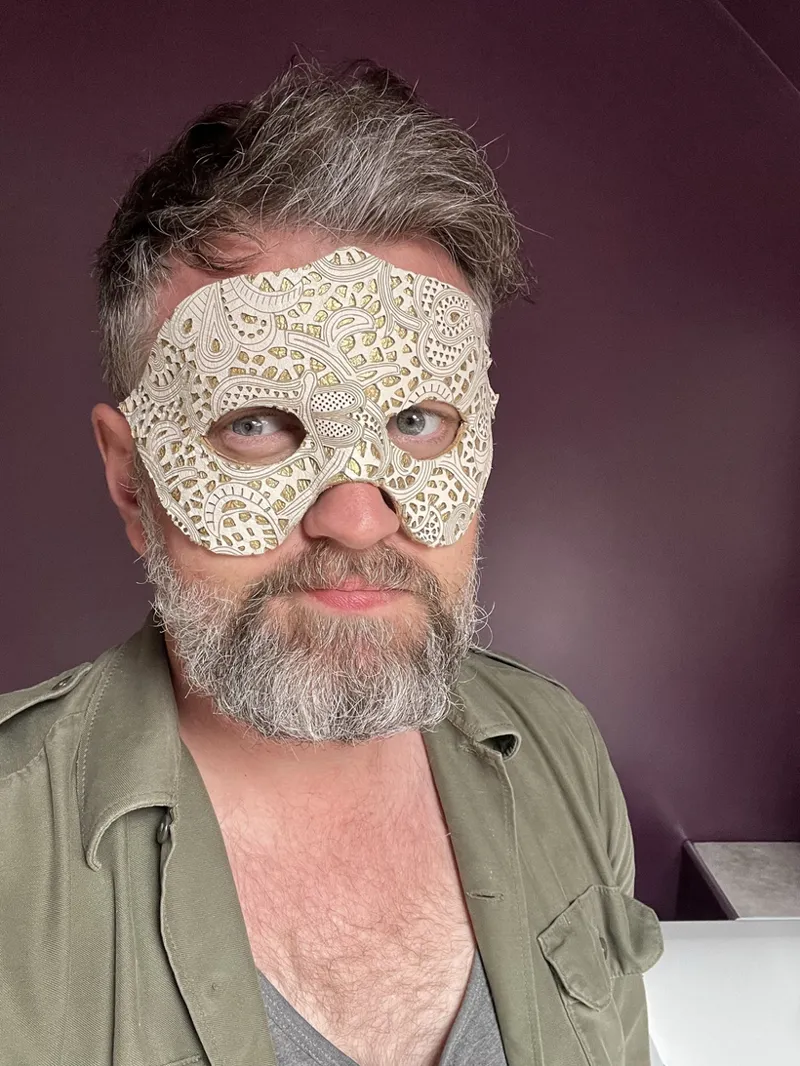
Also, and this is important, I had to wear a mask. Aelfir wear masks; I ought to at least stretch to that. It is my unfortunate duty to inform you, if you were not aware, that any sufficiently bearded man in a half-mask - as is the mask style we lean into in the books, so you can eat and talk and things - looks like a sex criminal.
(Oh! Wait! I took a picture of myself. In the mask, for the blog, as you can see:
And I don’t look like a sex criminal any more. Something happened and now I look like someone’s dad wearing a mask. (I guess it’s better than sex criminal.))
(Chris said the picture makes me look like I’ve accidentally attended an orgy being held in a garage and now I can’t work out how to leave.)
Now: I did have a lot of fun playing a feckless monied dickhead six times over, confecting a reason to leave each time and passing out as often as I could. (At one point, I said to a guy: “Hey! You look strong. I’m going to go limp now. Can you carry me over to table 5, please?” Never seen someone happier to oblige.)
There’s something quite tragic about the canon Wander-the-Lost, an ex-soldier who clearly committed atrocities in the Nujab war and is hooked on Blues, the drug that lets aelfir feel sadness, as a side-effect of trying to process that. I played the Captain much closer to one of Bertram Wooster’s foils by way of Withnail and - as a fun little mannerism - kept examining people’s teeth when I was talking to them as though I was buying a horse. I’d say things like “Oh! A sacrifice machine! Capital! Let me have a rummage around inside, I know a thing or two about machines” and “Listen old fruit, if you’re trying to drug my wine, you’ll need more of whatever you’ve put in here to put me out for the count. This is barely touching the sides”, that sort of thing.
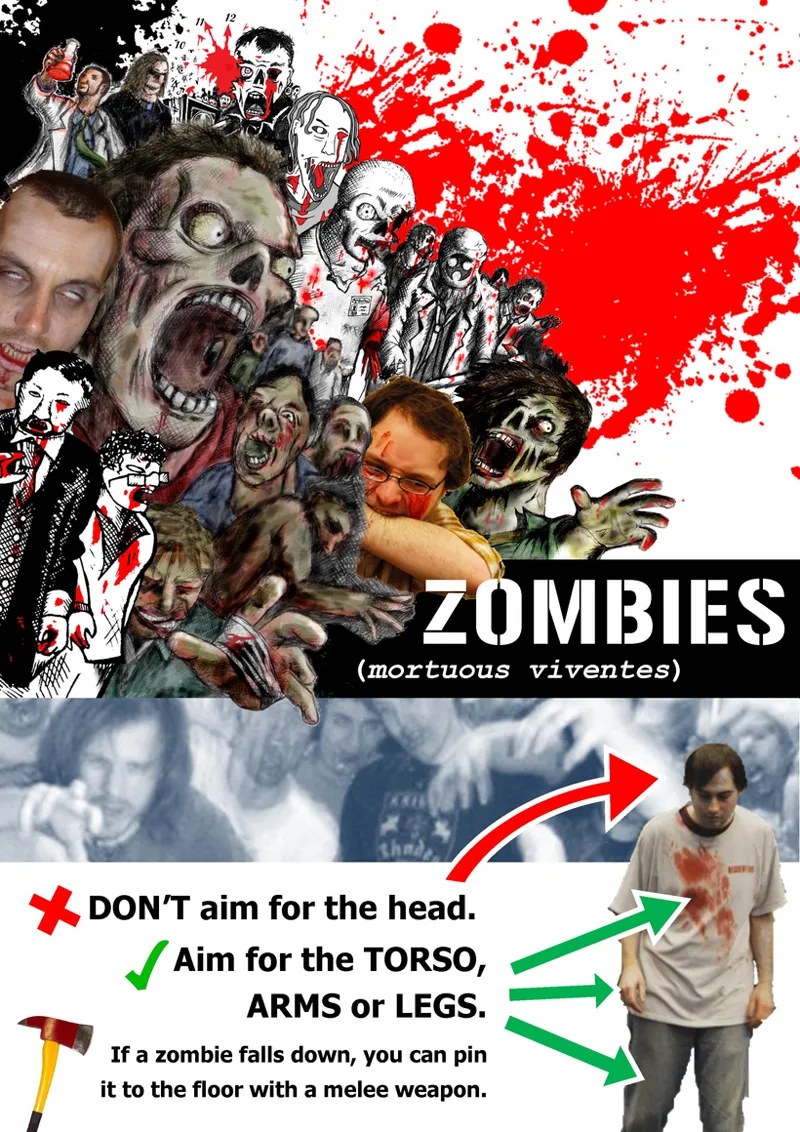
I am reminded of my role in Zombie LARP, back in the day, which was to be a fruitful disruption. Clearly, at multiple points during the night, I would have an absolute cracker of an idea which I just had to implement immediately, usually whilst the game was running without any prior testing. It was Maz’ job - my current husband, and my then co-GM - to make sure whatever I did didn’t completely fuck up the rest of the game. I feel like every other GM in the room had to make space for me, and I was the main attraction, and I wasn’t great as the main attraction.
We learned that having a central NPC, whilst providing a fun change in pace for the tables (who were otherwise knocking through some fairly straightforward three-act one-shots, ably written by Chant), acted as too much of a bottleneck in proceedings. Some tables couldn’t finish without me turning up; others finished ahead of time, and I often stumbled into a scenario without much in the way of drama.
Plus, the ending was weird. Everyone exploded into bees. We had justified it in the metaplot - something about the Hive, the thing that powers the Deep Apiarists, enforcing control over Spire - but forgot to write it down in any of the adventures. So it was just a bunch of incongruous bees. I’d probably change that were we to run again.
HEART: LAST TRAIN TO DERELICTUS
Our Heart scenario also involved a single NPC who had to visit all the tables. (We were still learning. And all we had to work off was Kieron’s example of playing himself twice at the same time.)
Here’s the pitch: the Vermissian, Spire’s cursed mass transit network and the best thing I’ve ever named (it means “worm-like!”) is going critical. There’s 1 (one) train rocketing from the end of the Pulse Line all the way to Derelictus, and the players are doing everything they can to a) make sure it can pass through their station unharmed whilst b) jostling for one of the very exclusive seats aboard it.
The tables weren’t playing through completely unique scenarios - instead, Producer Elaine and I came up with a template for a session, a couple of Delves, some baddies to fight, some obstacles we didn’t know how to overcome to force them to be creative - and much of the excitement came from the Conductor, who was in charge of the train, visiting the tables and mocking the players. The texture in the scenarios came from coming up with some slightly interesting (and different) things to happen on the Delves, but there wasn’t a lot of inter-table communication so it didn’t overly matter that the scenarios were all kind of the same.
Then, when the players finally got aboard the train, they were confronted with a gang of long-dead, still restless aelfir riders who demanded to know how this riff-raff got into their bloody carriage and immediately had at them with spectral rapiers. The train had its own table and GM, and from what I can tell she just had to make the entire thing up as she went along.
We made physical tickets for the train, which was a nice touch, and gave players something to take away at the end of the game. I liked that, and it’s the sort of thing I never have the brainspace/gumption to achieve; I’ll probably spend an hour swapping out adjectives that’ll never be read aloud instead, because I’m a Words Man at the end of the day.
ON THE SUBJECT OF MAKING IT UP AS YOU GO ALONG
Another aside, although it’s more on topic than the previous one - I ran a session in a multi-table Heart game at Play Bologna geared around House Gryndel’s interdimensional Hunting Clubs: a sort of on-purpose House of Leaves with a franchise license and a well-stocked drinks cabinet. There was some stuff about a magic mirror, which the GMs had made out of painstakingly-sheared apart clear plastic, and which they divided up between the tables before encouraging us to start wandering around in search of them in-character.
It was a three (four?) hour session, and all the guidance I received was to with the last hour with the mirror. Up until that, I was instructed to “run Heart” and bring the players to a Hunting Club door in Briar, down on Tier 3. That was it. Now, I can run Heart - I don’t know exactly how it works for the Pope, but much like him whatever I say Heart is is Heart so I’m by default infallible - but I was surprised to see such a hands-off approach.
I think we ought to give our GMs slightly more than that; I’m still finding a balance.
HONEY HEIST: DO THE CRIME, DO THE TIME (TRAVEL)
I wrote the Honey Heist multi-table with CJ, and Honey Heist really resists scenario design because there aren’t really any mechanics in there to push against or play with, but we came up with some fun ideas: after the bears ate some chrono-reactive honey uncovered from an Egyptian pyramid, they were flung through time to six different eras of HoneyCon and charged with stealing crucial components to ensure that honey exists not only in 2017, when the game is set, but throughout all recorded history as well.
Anyway; I was genuinely ill by the time the Honey Heist game rolled around - I spent the entirety of the last day of GenCon 2024 face down in bed under a fan trying not to breathe too extravagantly - and I don’t know how it went. I’m writing the whole thing off. I believe we gave people little plastic straws full of honey at the end of it, so I hope none of them were unexpectedly vegan or pregnant.
HOLLOWS: POOR SALLY KRAKEN
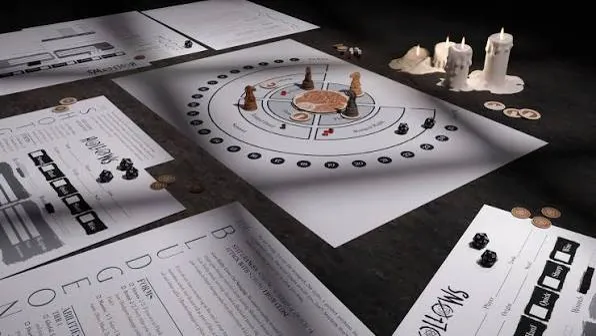
Hollows is an interesting fit for a multi-table game. On one hand, it’s mechanical enough that you have to think and play quite carefully with concern to balance and pacing, and the actively-encouraged adversarial stance on the GM’s part means that players are generally less amenable to fudging for the sake of everyone else’s game.
But on the other hand, you can run MMO raids in it when you get enough people together, and it works.
I’ve never done one myself - I don’t have that many friends and don’t enjoy hobbies where you’re letting people down if you’re not good at them yet - but that doesn’t matter, because Maz wrote this one. Maz used to raid once a week, and still dips into FFXIV now and again, and loves a good raid. One of the popular features in raids - I’m assured - is bosses denying big sections of the battlefield and forcing players to run around and stand on safe areas, and our tactical grid is tailor-made to emulate that.
(I’ve never raided but back in 2014 - before Rowan, Rook and Decard was a twinkle in our collective eye - Chris, Maz and I would all play The Secret World together. The Secret World was a cracking MMO about the interdimensional cosmic war between bees and slime and the occult weirdos caught in the crossfire; we would play five-man dungeons as a three-person team, because Chris is good enough at healing to keep us alive and Maz is good enough at DPS to kill everything. We channeled my natural aptitude for getting hit into tanking, so at least it might happen on purpose and be to our advantage.)
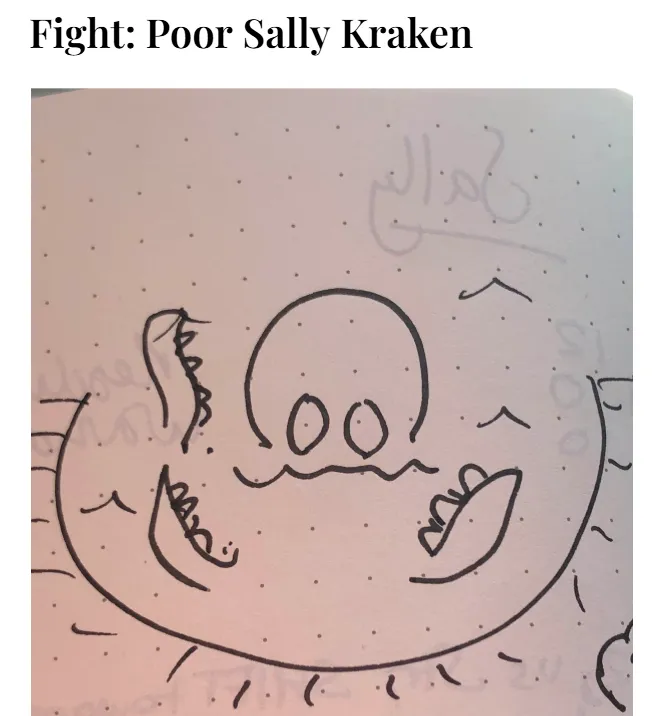
So Maz wrote POOR SALLY KRAKEN with some light assistance from the rest of the Hollows team, and then got profoundly ill several days before GenCon 2023 and couldn’t go, so it was down to me to run it. Thankfully, it was a straightforward enough scenario: Sally was a murdered naval bride, chucked overboard en route to a distant colony, who turned into a honking great sea monster on account of Fury with a side order of Grief. The Hunters played through her courtship and marriage, suitably up-gunned into a few fights, with a final conflict against Sally’s tentacles (one per table) and her head (a shared table in the centre of the room).
Maz skewed close to efficiency on this one, writing a page of unique stuff for each table’s scenario - three gags, quick descriptions, each with a mechanical wrinkle - that ensured everyone had their own adventure but didn’t require a shedload of work to implement. The two fights - one against a scuttling insectoid smuggler, and the other against the Kraken herself - were identical.
It went well! I didn’t work out how to communicate victories between tables, so halfway through the end battle - which involved players being rocketed to the central table via a waterspout attack, and back to their original fight with a tentacle slap - I realised that I hadn’t been informing players how many wounds the big lass had left compared to how much they’d just inflicted, so I began encouraging some half-hearted, confused cheering between the tables. But showmanship aside, the system managed to support thirty people fighting seven things at once pretty cleanly.
ON WRITING DIFFERENT THINGS
I get a bit caught up in this stuff, myself. Once I start writing - if things are going well - I get too many ideas, and I want to use them all. I want good bits in everyone’s game. I want to prove to them that I’m a great designer, and not only a game designer, I can design adventures too! I promise! Look!
And: the relationship between what I write and what a player experiences is, perhaps, never more tenuous or brittle. You write a scenario, and you have to communicate it to a prospective GM in such a way that they can remember it, but not feel limited by it, but still definitely run it in a recognisable way. And then they communicate that to the players, who have their own agency, and there’s five of the buggers running around in different directions at any one time. And then we’ve got fucking dice to worry about, so there’s never a sure thing.
That’s just a normal game - now, you do all that six times and have them cross over, and suddenly the GMs are sifting through your notes written four months previously trying to find a way to connect them to this hot afternoon instant in Indianapolis where half the tables have finished early and the other half are nowhere near the end.
But gods if I don’t prefer it - writing up six different scenarios, I mean, in detail, with gags and “run this if there’s time!” bits and NPCs with desires and special rules and equipment and and and. I want to do a good job. I want to make something worthwhile. And no matter how much time we save on doing one scenario and rearranging the toppings into different shapes for different tables, it doesn’t feel good.
It feels like I’m cheating the players out of something. And I’m not. It just takes about six times longer, and it only really makes the scenarios better to read - not to play, particularly - but here we are.
ORC BORG: BOMB FUNK APOCALYPSE
Anyway. Enough whinging. This was an unmitigated success.
Here’s the secret, I think: I like writing Orc Borg more than I like writing anything else. Writing Orc Borg is like going on holiday for me. I’m spending my weekends doing it at the moment; Rollin and I have had a bunch of ideas for wee supplements. Keep an eye out.
For the uninitiated, Orc Borg is Mork Borg with the M removed and the K changed to a C to avoid the attention of Games Workshop’s copyright lawyers; it’s Space Orks, from Warhammer, in a Space Hulk, all of which are Copyright Big Jimmy Workshop 1989.
Mork Borg is all about nihilism in the face of a coming apocalypse; Orc Borg is all about relentless enthusiasm in the face of a coming apocalypse which is the orcs are trying to accelerate by any means necessary, because they believe they are going to crash their spaceship into heaven.
But BOMB FUNK APOCALYPSE (always in caps) was made up of six entirely different scenarios designed to be played all at once, each set in different parts of the space hulk. We’ve got a Dominion Warship (NOT an Imperial Cruiser, thank you) full of cyborg helots (NOT servitors) and hovering scrivener skulls (NOT servo-skulls). We’ve got a living Space Elf ship containing one fully nude penitent Star-Prince locked in a dreamscape. We’ve got a royal wedding in a literal iron church.
We’ve got a club-temple with rules for space drugs in the sacred bathrooms. We’ve got a cultish gang of humans worshipping a chicken soup machine. We’ve got diminutive aliens sacrificing orcs to demons in The Grand Malevolence. Every scenario focuses around gaining control of a control panel that still sort of pilots that part of hulk, and it’s those control panels that let us play the last third of the game: the Crash Pandas bit.
Crash Pandas is my second-most-popular one page game (because Critical Role only played it once, rather than three times like Honey Heist) and it lets you play five raccoons all driving the same stolen cop car; the core mechanic involves picking an action without conferring (things like TURN LEFT or ACCELERATE) and then revealing them all at once. The GM fiddles around with toy cars on a map to represent whatever the fuck happened, and play continues appropriately - it’s fuzzy, vague and chaotic and turns out to be great fun as well.
So for BOMB FUNK APOCALYPSE, we adapted those rules (barely) and put a drawing of the space hulk on the left side of the central table. Folks had drawn space junk on loose bits of paper to put in its way, and it had to navigate its way off the right side without crashing too much. While defending the control panels, representatives from each table were sent up to the central map to assess the situation and report back to their team, and then every fifteen minutes or so I’d get everyone to yell out their orders and fiddle around with the ship to represent whatever the fuck happened.
And: it was great! I had fun writing the scenarios. (I’ve re-used the Orc Royal Wedding one on several occasions, because orcs engaging in etiquette is inherently good fun, and the one set in a techno club that’s also a church is solid too.) I had fun shouting myself hoarse. I had fun moving the little ship around. The players had fun being orcs and kicking stuff around. The GMs had fun roleplaying my doofy little NPCs (or my honking great NPCs, depending on scenario and NPC).
What’s more, the play became emergent. That’s what you hope for, as a designer - or I do, anyway - as, having banned people from talking between tables to co-ordinate their orders, they started to come up with ways to chat to one another. One table grabbed a demon by the neck and forced it to open a portal to an adjacent table that they could yell through. Another reprogrammed spare nightclub speakers to project their intentions down every air vent on the ship. I believe one lot got outside and wandered around on the airless hull waving improvised semaphore flags.
THE REAL TREASURE WAS YELLING
But the best thing, bar none, the highlight of my GenCon and most likely my year, was calling together all thirty players in a rousing chant of “DOOM! DOOM! DOOM!” (Doom is an important concept in Orc Borg, being as it is their deliverance to heaven, and as such people started slamming the tables and bellowing it with very little provocation.)
I had uncovered the secret to running a good multi-table game: synchronised yelling.
And why not? It works at football matches! It works in churches! And protest marches, and the military, and concerts, and the bit in Battlestar Galactica where they bark so say we all and you get a bit tingly about the scalp, and groups of people eight beers in outside my flat at 2am, and when you think about it, a solid portion of all human interaction after we worked out how to make noises with our mouths.
You can plot out as many twists as you like. You can write tragic and elegant motivations for your NPCs. You can have your GMs working as a well-oiled machine, running six games in tandem - not just parallel. You can wear all the dad-at-an-orgy leather masks you can afford.
Nothing is ever going to excite a room full of people than getting them all to yell the same thing at the same time.
YEAR TWO
After being asked to choose between a decrepit pedophile grifter with a proven history of failure and - heaven forbid - a woman, America voted entirely incorrectly and put the pedophile in charge. Given that several staff members have publicly remarked on their distaste with the current regime, and that Maz in particular is an ex-journalist which means they might as well have “DETAIN” written on their fucking forehead, we decided not to go to GenCon in 2025.
YEAR THREE
While we’re not dispatching half of the company across the Atlantic any time soon, thanks to an insurance loophole, we’ve figured out that it’s cheaper to send Matt out to GenCon for a week than it is to try and cover the people working our stall while he isn’t there. We weren’t planning on it - it’s kind of a last minute thing - but he’ll be supporting Maura, our woman on the ground in the states, who runs the RRD stall and games on our behalf through her company CONcentric. (He’s happy to go. I think the mild opsec is quite exciting to him, and if he doesn’t meet at least four new potential B2B leads every six months he starts to overheat.)
Whether or not any of us are physically present, we’re doing more multi-table games - in part because it sounded like fun and in part because we’re secretly working (very slowly, as is our style) towards writing up several proper scenarios for game stores to run that focus around our newer or more expensive games, because by gum I’ve got bills to pay.
We won’t make things just for the money, because really the money isn’t that good on its own, but if they can earn money as well as being interesting that’s always a plus in terms of, you know, mortgages and shoes and that.
Which is why you won’t see a Honey Heist multi-table game in the lineup; there’s nothing to sell afterwards. We’re doing Hollows, which when I started writing the scenario was due to be on sale at GenCon but now thanks to the vagaries of Chinese printing presses isn’t. We’re doing Heart, because people like Heart and Quinns made that video about it so it sells. And we’re doing Orc Borg again because I love Orc Borg and it was good, and I guess you can buy it too if you’d like.
Despite the heft of this blogpost, we're still working out what functions and what doesn't. But
hopefully, as we refine the formula and experiment around the edges, we'll be able to come
up with some interesting games that could be run anywhere there's thirty people, not just at
cons that we're also attending. We want to give games stores and clubs the opportunity to
run our games and have them be special, and maybe multi-table games - along with a new
pivot to getting our games ready for quick, no-prep demo sessions with cue cards - can help.
If you’re planning on playing any of the scenarios, be warned: I’m not going to spoil anything I wouldn’t tell you in person before the game because I’m overexcited about it and keen to share, but I am going to talk about some of the mechanical and plot decisions we made. If you want to come to the session as a completely blank slate, don’t read them!
Now: let’s see if I learned from my earlier mistakes.
HEART: MOONSHOT
I did not.
This game has six unique, detailed adventures.
It has a central NPC; an overdramatic scryatrix.
Thankfully, we have plenty of opportunities for synchronised yelling and inter-table play: Sillion and I have planned out a fairly exciting game focused around the summoning of The Moon Beneath itself to the eponymous cathedral on Tier 1 of the Heart, the sanctum of which forms the central table.
Player characters are all shards of five reincarnated saints, or hallows, who’ve been called to the cathedral to defend it against the onslaught of flesh that the Heart is sending in to disrupt the summoning ritual (a ritual which ought to involve some yelling). We’ve got six different Seven Samurai-style defend the town adventures lined up, and all of them have something special going on.
And: if players who have the same characters ever meet each other, they immediately combine into a single body housing their intelligences.
To reflect the incredible power inherent in their sainthood, when the body acts, all players roll all their dice pools and pick high - and they gain access to unique powers that can affect the whole room. We’re hoping that they’ll sync up together more as the game continues, with several reborn hollows going nova towards the end of the scenario.
And: I’ve written mass combat rules for Heart. They’re exactly as vague and vibes-based as you’d expect them to be.
For it to go well, we’re relying a lot on the table and head GMs to work together and improvise the ongoing story, so consider this an elaborate playtest ahead of writing it up properly. And: how can we balance a game where we divide the number of active characters by five, but multiply the number of dice the surviving character is rolling by the same number? Will it be fun to roll fifteen dice and pick high? (A couple of times, probably, yeah.)
HOLLOWS: THE FALL OF BLACKABBEY REACH
The beats for this one are very similar to POOR SALLY KRAKEN - six scenarios with minor, often cosmetic changes. An intro fight against a downpowered Entity designed to lose, then a middle fight against something a bit more complex, and finally a fucking massive brawl against multiple animated wizard towers (that you can climb!) controlled by a storm of masonry and bad magic on the central table that you can go visit and kick in the teeth.
There’s an extra fight in there, but I’ve cut back on the tragic murdered bride angle and made the Lord of the Hollow(s) an absolute monster so the “learning about the Lord” bit should be a bit brisker and less empathetic. He’s a real rotter. After his body was interred in a Blackabbey Reach exclusion tower, it hollowed and took over all the surrounding towers too, imprinting them with the worst things he’s ever done. So each tower is about that one thing, and you get to see it from one, maybe two angles? That’s enough for Hollows. You get the joke. Go kill something.
I hope the players can grasp Hollows combat quickly enough to knock through those fights. Or that the GMs can fudge it. We’ll see.
ORC BORG: BOMB FUNK APOCALYPSE
We’re just doing it again. Six unique scenarios. No central NPC, some light inter-table play, and more yelling than you can shake a goblin at.
I polished the scenarios up a bit, and Mina laid them out in a garish manner approximating Rollin Kunz’ Mork-Borgian flair, and they’re ready to go. This time, I believe we’re getting our own room, which means the frequent spontaneous howling and table-punching will be less disruptive.
Plus, I have an official warning about what being an orc does to your throat:
Maybe the year after this one I can work out whatever it is death metal singers do to preserve their voices and institute that, but for the time being, it’s Strepsils and apologies all the way.
A SINGLE TAKE-HOME SECTION
If you’re looking to learn something useful from this meandering blog, this is it.
I had determined that a successful multi-table game needed the following things, in order of increasing importance:
GENERIC SCENARIOS WITH LIGHT DETAILS CHANGED
- Ensures balance, in as much as everyone’s doing the same thing
- Makes multi-table pacing easier, or at least theoretically possible
- Brisk scenarios can be edited/improvised around on the fly
- Saves time on writing; only one-sixth of the player base will ever see a particular scenario
NO CENTRAL NPCS
- Makes for bottlenecks in play and difficulties pacing
- Main character behaviour and it doesn’t look good on us
- If it’s not the designer of the game, it’s just some guy in a mask, which is even less exciting
OPPORTUNITIES FOR MONITORED INTERACTION BETWEEN TABLES
- Often with a central hub table that players can visit, whether it’s a headquarters or a big boss fight (or both)
- Limiting the interaction makes it feel important and encourages players to cheat a bit, which is fun
- Kind of the point of the whole thing, otherwise we might as well just run six separate games of whatever-the-fuck
A LAISSEZ-FAIRE APPROACH TO THE RULES
- Pacing is more important than mechanical consistency
- Tell a story and put on a show first, run a game second
- Players are on your side
SYNCHRONISED YELLING
- Feels good to yell the same thing as other people
- Most yelling should be led by the staff
- Allow opportunities for spontaneous yelling that becomes synchronised (easy chants, call-and-responses, etc)
I have also determined that I am unable to follow this list.
Hopefully you’ll be able to get more out of it than I have.
- Grant “How Many Tables?” Howitt
Comments (5)
Hi Grant, We’re a tabletop RPG association based in Trento, Italy, and we’re planning to run a multi‑table Spire event next year. I read your post about the multi‑table games you ran at GenCon, and it was incredibly helpful. I’d love to ask you for some quick feedback: any advice on what works best for Spire in this format, pitfalls to avoid, or scenarios/structures you think fit well. If it’s easier, I can reach out privately via email instead of writing here. Thanks for all your work on Spire — we really love the game.
Many bees across your megagames I notice 🐝 Great post!
As one of the 2024 GM's I can say they were great fun. This was an interesting look into the behind the scenes stuff as well as a pleasant reminsce on a really bright time.
Great read. A multi-table Hollows raid is on the bucket list now! Good inspo to declutter some ideas by writing scenarios too.
Okay, that settles it, I am seeing if I can still get a ticket for GenCon's Saturday session.