






Coin-Op Collection Presents: Mat Mania & Mania Challenge
Thank you to everyone who has supported us over the last few months while releases were on hold. The time was spent adding additional infrastructure to the K3 framework enabling Midway Z/Y/T-Unit support for the MiSTerFPGA platform, which has been one of the most requested arcade platforms. This was not a trivial undertaking and would not have been possible without the K3 framework, a proprietary platform built from scratch over the past 18 months. Your continued support through this period has not gone unnoticed. There will be patreon polls, additional information, and new releases every day this week. I've been busy laying the groundwork for everything covered below, in previous posts, and we're finally ready to move forward with all Q1 releases!
Today's release for the Analogue Pocket and MiSTerFPGA platforms covers Technos Japan's Exciting Hour / Mat Mania and its successor, Mania Challenge. Both titles are spiritual successors to Technos Japan's 1983 debut, The Big Pro Wrestling! / Tag Team Wrestling, published by Data East. We'll be covering that title in next week's release of Technos arcade titles.
Mat Mania was a cultural phenomenon in the mid-1980s arcade scene, ranking as the highest-grossing table arcade unit in Japan and the top-selling conversion kit in the United States. It put Technos Japan on the map before Double Dragon and the Kunio-kun series defined the company's legacy.
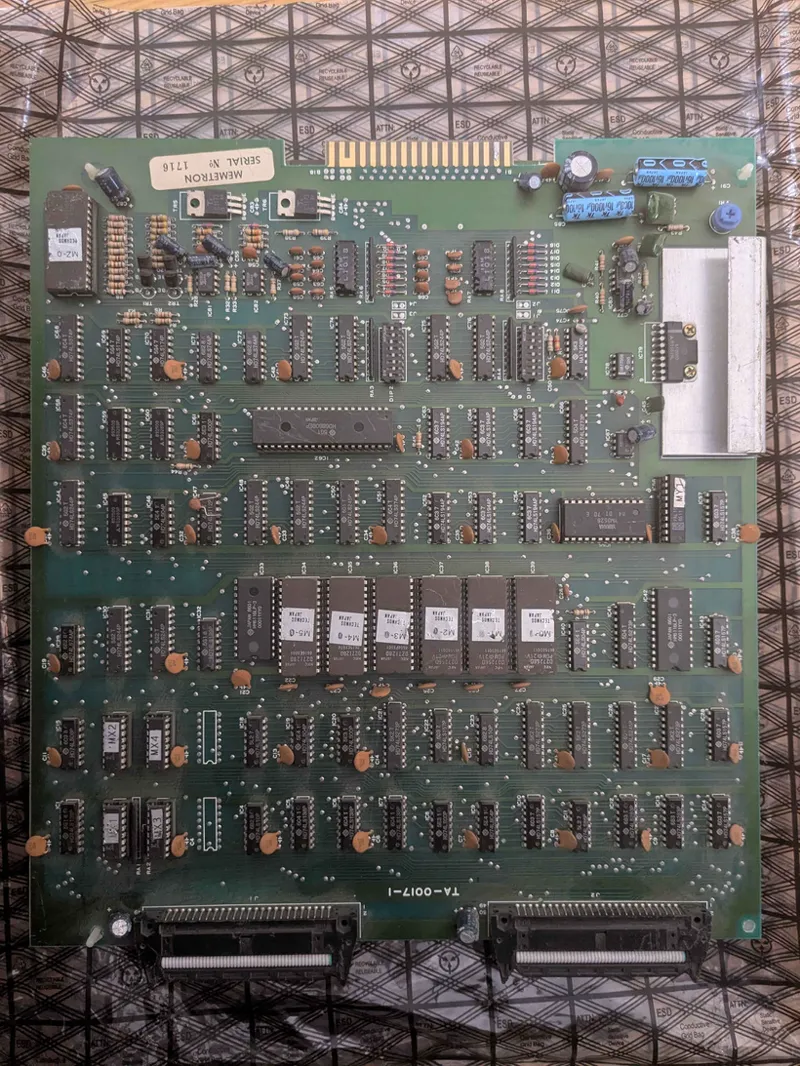
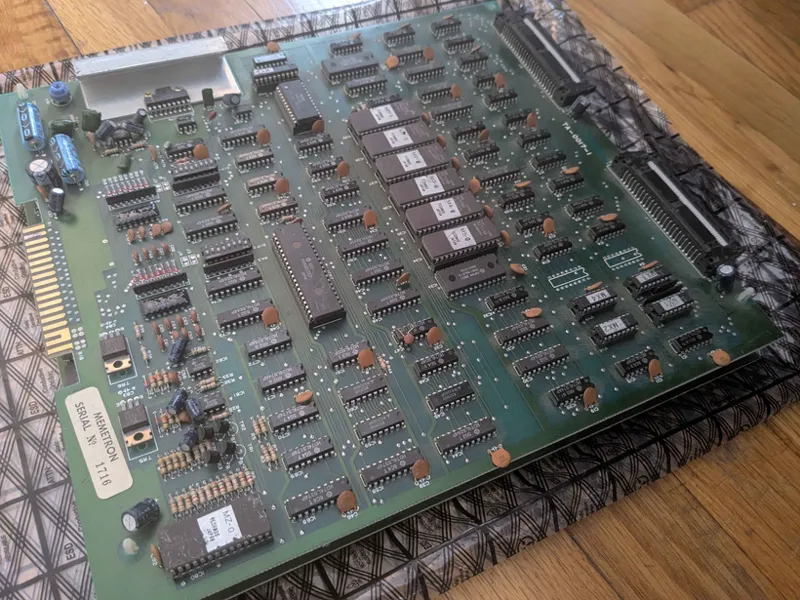
This post covers a technical overview of the TA-0015 (Mat Mania) and TA-0017 (Mania Challenge) hardware along with updates on other projects.
Overview:
Mat Mania runs on Technos Japan's TA-0015 hardware, a two-board PCB set built around a pair of MOS Technology M6502 processors. The main CPU runs at 1.5 MHz handling game logic, while a second M6502 at 1.2 MHz drives the sound system. Audio is produced by two AY-3-8910 PSGs paired with an 8-bit DAC for voice samples.
The video system outputs 256x240 at approximately 59.185 Hz in a counterclockwise vertical orientation. There is no screen flip dip switch on this hardware. Graphics are rendered across three layers: a foreground character layer using 8x8 tiles, a scrolling background layer using 16x16 tiles with page selection, and a sprite layer supporting up to 24 objects at 16x16. All graphics are 3bpp planar, with an 80-color palette split between 64 PROM-based entries for characters and tiles, and 16 RAM-based entries for sprites.
Mania Challenge shares the bottom PCB (TA-0015-P1-0) but replaces the top board (TA-0017-1), upgrading the sound system to a Motorola MC6809E paired with a Yamaha YM3526 (OPL) for FM playback. It also adds a Motorola MC68705P3 microcontroller at 3 MHz for protection and doubles the background tile ROM, expanding the tileset from 512 to 1,024 tiles.
Development Challenges:
The core was developed as a unified codebase producing two separate builds, with Mat Mania serving as the primary reference since it represents the simpler baseline hardware. Once Mat Mania was stable, Mania Challenge was brought up by integrating the replaced sound system, the required MCU for protection, and the expanded video tileset.
Both games use a MOS 6502 for their main CPU, driven by the open source T65 core. The T65 is BSD licensed and had not been updated since 2020. The existing implementation was missing correct NMI interrupt handling. I reworked the NMI handling to use cycle-based encoding per the MCS6500 manual, moving NMIAct clearing to the vector fetch cycle and restricting interrupt polling to the penultimate cycle of each instruction. These changes were required to get correct interrupt-driven behavior in Mat Mania, where both the main CPU and the sound CPU rely on properly timed NMI and IRQ responses.
Beyond the fixes needed for Mat Mania, I implemented the complete R65C02 Rockwell variant with all 59 new opcodes, new addressing modes, and six new ALU operations. On top of this, I added full HuC6280 support including memory paging registers for 21-bit address translation, five block transfer instructions, T-flag memory operations, speed control, VDC direct writes, and relocated stack and zero page. This was a significant effort but lays the groundwork for future projects that require these processor variants. Once I have completed refinements to the T65, I will publish a new T65 CPU core written in Verilog to the Development-Modules repository.
The AY-3-8910 PSG in Mat Mania is handled by my x8910, a cycle-accurate implementation in Verilog. The design was verified against the General Instruments PSG Data Manual and a reverse-engineered silicon schematic. It implements the correct master clock divider, 17-bit LFSR noise generator with zero-detect feedback, all 10 envelope shapes, and a logarithmic DAC matching the sqrt(2) voltage steps based on the reverse-engineered documentation.
The MC68705P3 in Mania Challenge is handled by my x68705, a cycle-accurate M6805 CPU core I wrote in Verilog. Existing open source implementations of this MCU are tailored to specific games and do not function correctly as a general purpose solution.
The required configuration for Mania Challenge has the host CPU and MCU communicate through a pair of latches that track whether each side has pending data. The MCU drives port B edge detection to coordinate reads and writes. A falling edge on PB1 triggers a read from the host, and a rising edge on PB2 commits a write back. If the timing between the two is off, the main CPU stalls waiting for a response that never arrives.
Both the x8910 AY-3-8910 PSG and the x68705 MC68705P3 CPU have been open sourced and are available in the Development-Modules repository under the Coin-Op Collection GitHub organization.
The VBlank signaling on this hardware is unusual. Rather than a standard full-duration VBlank flag, the CPU only sees VBlank as active for four scanlines (128 to 131), reported through bit 7 of the DSW1 port. Emulation of both games has been missing the crowd cheering effects during matches. The correct CPU VBlank window is what triggers this, and is separate from the video timing itself. I traced and measured this on my TA-0017 PCB. The effects can be seen on original hardware videos of Mat Mania and Mania Challenge available on YouTube. The crowd cheering effects are also present in the Arcade Archives release.
The required code changes, video timings, and the CPU VBlank window have been pushed to MAME and FBNeo. Whether these changes are accepted to MAME is beyond my control. The empirical evidence from original hardware, measurements from my PCB, and code changes that produce the correct effects speak for themselves. I don't have the bandwidth to provide additional verification at a moment's notice beyond what has already been submitted. There are several fixes in MAME that stem from work previously done by myself or other team members that have never been given proper attribution. Going forward, FBNeo will be the primary project I contribute emulation fixes to. The FBNeo team provided positive feedback and thanked me for the contribution within hours of submitting a pull request.
Core Options:
Both cores are built on the K3 framework. The MiSTer core includes video settings for aspect ratio, vertical scaling and cropping, scandoubler effects, and H/V positioning and sync adjustments. The refresh rate toggle is disabled in this core due to the original hardware timing dependencies. Audio settings provide toggle and volume control. Game settings include per-player auto-fire with adjustable rates and cheats accessible from the OSD. Arcade dip switches are directly accessible from the OSD.
The Pocket core has auto-fire with per-button configurability and adjustable rates selectable through the interact menu. Cheats and dip switches are fully configurable as well.
History, Gameplay, and Regional Information:
Exciting Hour released in September 1985 as Technos Japan's follow-up to The Big Pro Wrestling!, their 1983 debut published by Data East. Distributed by Taito in Japan and Memetron in North America, it became a commercial phenomenon.
Exciting Hour ranked as the highest-grossing table arcade unit in Japan for October 1985, with approximately 3,000 cabinets shipped. In the United States, Mat Mania was the highest-grossing arcade conversion kit of 1986 and the third highest-grossing overall arcade game that year.
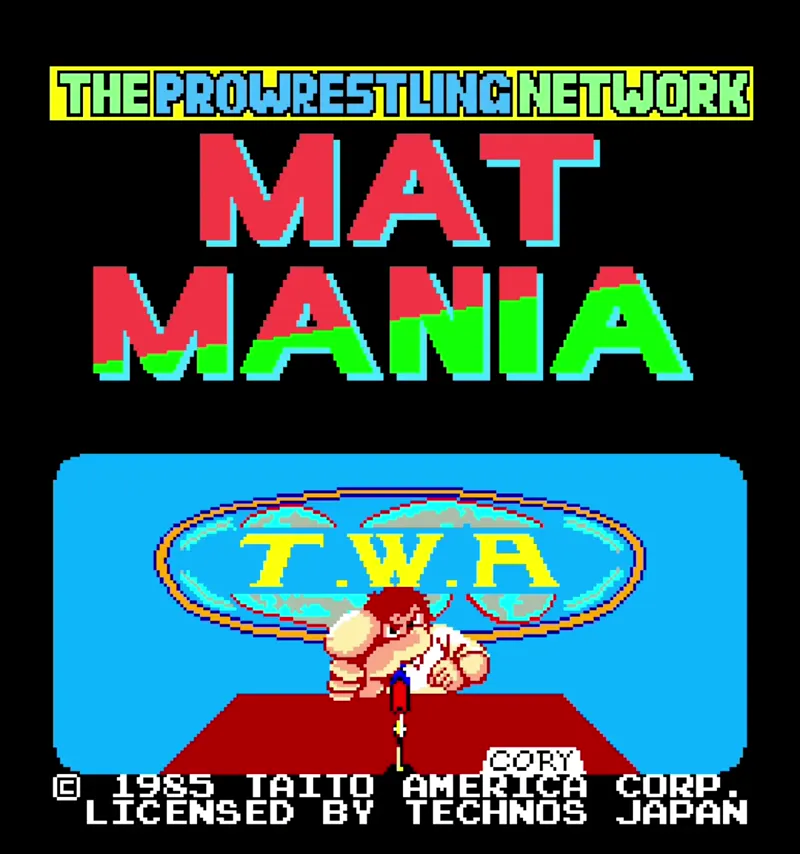
The game is presented as a televised pro-wrestling broadcast by the fictional Technos Wrestling Association (renamed Taito Wrestling Association in the US). A wrestling host named Nari (Cory in the US) appears during intro sequences and intermissions, announcing upcoming bouts. Players control an 8-way joystick with two buttons for punch and kick, with both buttons pressed simultaneously to run.
Matches follow a single-player tournament structure against five CPU opponents in fixed order, each with a three-minute time limit. Victory is achieved by pinfall, 20-count ring-out, or disqualification. After winning the championship, the player defends the title against the same five opponents in randomized order across subsequent loops.
Combat revolves around a grapple system where walking into the opponent initiates a headlock. From there, directional input combined with a button determines the move. A rule of three limits consecutive grapple moves before the opponent can reverse, requiring players to mix up their attacks. Stamina is tracked invisibly, with knockdown recovery time indicating how worn down a wrestler is. When player health drops critically, the background music shifts to signal danger. Players can fight outside the ring under a 20-count, attack from the turnbuckle, and bounce off ropes for running strikes. Overusing turnbuckle attacks triggers a disqualification.
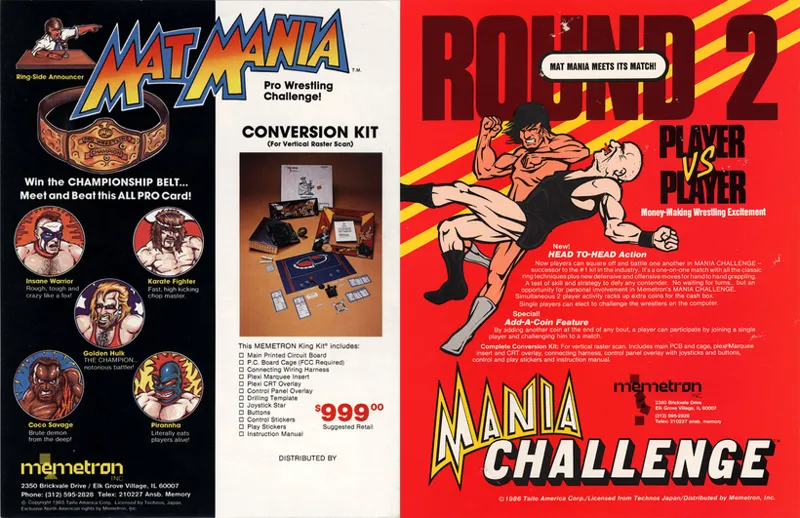
The five opponents draw heavily from real-world professional wrestlers popular in 1980s Japan. Insane Warrior (Insane Worrier in the Japanese release) is modeled after Road Warrior Animal. Karate Fighter reflects the martial arts crossover with wrestling. Coco Savage is inspired by Bobo Brazil and is widely considered the most difficult opponent due to his speed and counter-fighting ability. The Pirania is a masked heel modeled after Mil Mascaras. The final opponent and TWA champion, Blues Bloody (renamed Golden Hulk in the US to capitalize on Hulk Hogan's popularity), is modeled after Bruiser Brody, who was enormously popular in All Japan Pro Wrestling during this era.
Regional differences are minor. Beyond the title, the wrestling association name, announcer name, and champion name were localized. Core gameplay and mechanics are identical across regions.
Mania Challenge released in 1986 as a US-only update to Mat Mania, published by Taito America and distributed exclusively by Memetron. The game was never released in Japan and no Japanese variant exists. The primary addition is two-player simultaneous competitive mode, with Player 1 controlling Dynamite Tommy and Player 2 controlling Hurricane Joe. New moves include the drop kick and counter techniques such as the atomic drop and suplex. The single-player roster is reduced from five opponents to three: Insane Warrior, Golden Hulk, and the opposing player character controlled by the CPU.
Updates:
Thank you all for your patience. It's been over two months since the Sky Shark release in January, and I appreciate the continued support while we've been heads down on development. New releases will be going out daily from today until Friday. I will be addressing all of the pending and newly developed platforms throughout the week. Tomorrow marks the first entry to the Data East DECO-16 platform. Check the news channel in the Coin-Op Collection Discord for the latest updates!
As always, please allow time for the MiSTerFPGA and Analog Pocket updaters to sync. You can pull the files locally from their respective repositories found here or from the post. Thanks again and you'll be hearing more from us tomorrow!
Disclaimer: All product names, trademarks, and registered trademarks mentioned are the property of their respective owners. "Analogue", "Analogue Pocket", "MiSTer", "MiSTerFPGA", "OpenFPGA", "Data East", "General Instruments", "Memetron", "MOS Technology", "Motorola", "Taito", "Technos", and "Yamaha" and all derivative works are trademarks, registered trademarks, or copyrighted materials of their respective holders. Use of these names does not imply endorsement or association with this post. All rights reserved to their respective owners. This post is for educational and research purposes only.
Comments (5)
Awesome guys. Thanks for the update
Great work and awesome writeup, kudos to the team.
Can you please run a few roms through a LLM and release as Kai? Please ensure the improvements was what the original Japanese prime minister envisioned.
Wow! Mat mania! I love this game! (and I hate Coco Savege, that guy always pin me down!). Thank you, team!
Coco Savege is a beast! I keep getting choke slammed!