
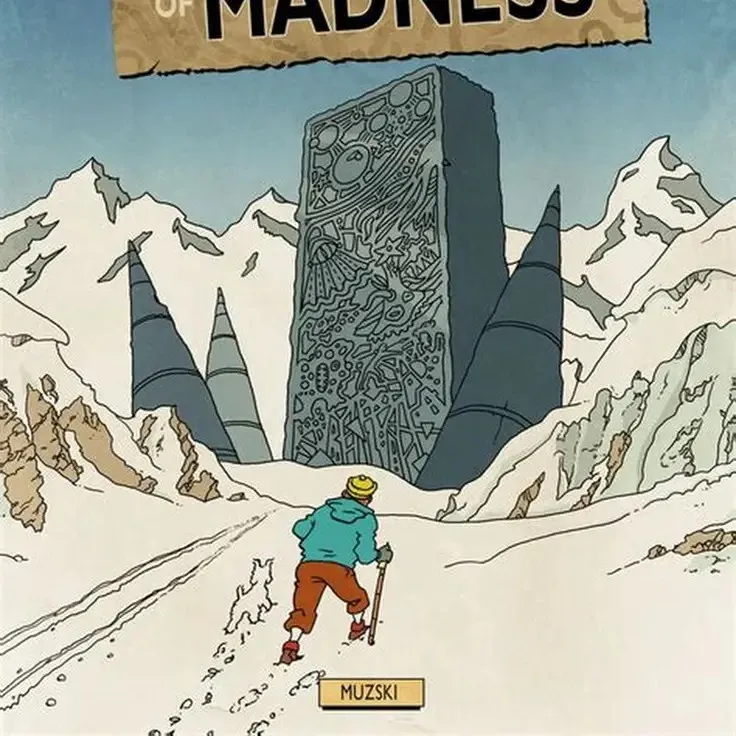
Lovecraft Retrospective: At the Mountains of Madness
George and I finally snuggle into in our parkas, strap on our mountaineering gear, and embark on an assault on the north face of Lovecraft's towering, snow-capped masterpiece... and find ourselves decidedly unimpressed by it, at least as a narrative or as prose. We do find plenty of interesting stuff to talk about though...
Is it really possible to have an interesting story with only rudimentary characters, little in the way of actual scenes, and no dialogue? Are Lovecraft's best habits also his worst? Why do so many fans love this so much? Can we trust the version of events we're given by the story's narrator? Can the Elder Things be represented visually? Did Edgar Allen Poe read the Necronomicon? Is Lovecraft actually too nihilistic to be a proper ideological reactionary? Is he an accidental Modernist? What even are Shoggoths? Are we Shoggoths? I've been a Gothic Marxist for ages... am I becoming a Shoggothic Marxist?
Comments (7)
This was an excellent and honest look on the actual quality of this thing as a story. It's really not that good. I remember loving it as a teenager, but I was absorbing everything Lovecraft at that time, and my critical faculties were not as developed. Now, after a re-read a few years ago, it's obviously Lovecraft trying to tie a story framework around his need to write an essay on his "mythos", or at least some sort of story bible for his future work, which he could then reference, even if he didn't share it to the public. For better or for worse, he did, and we get this slog of a short novel, that has neat ideas better explored in his other work. Conan and Kull writer Robert E. Howard, who as you probably know, often corresponded with Lovecraft, and due to this they shared elements of each others work in their stories. Howard wrote his essay "The Hyborian Age" slightly after this (1932, I believe, where Lovecraft first wrote "Mountains" in 1931, but saw it published later in 1936), which is very much a similar reference bible to his Conan tales, but it does away with any story framework. A much better approach, I think.
Great comment, Lee. HPL's apparent aim for the story to be a kind of consolidation of his mythos so far, and a Bible for it going forward, was something I forgot to talk about. I'm interested by that Howard essay you mention. I'll have to look that up.
I suppose the matter of influence hinges a lot on Who Goes There?, in as much as The Thing (1982) was a direct adaptation of that, and has in turn I imagine been a major influence on all subsequent iterations of the scenario. The Thing From Another World (1951) may also have influenced earlier ones, though if nothing else the crinoid/krynoid link shows that The Seeds of Death at least was drawing directly on Mountains. So a lot depends on to what extent one thinks John Campbell was following Mountains, and I have no idea what the reckoning is on that.
A brief wiki-holing of this led me to read The Thing in Amundsen's Tent, the iteration before Mountains, whose approach to the Weird problem of describing or circumventing describing an indescribable monstrosity, the sight of which would assail the beholder's sanity and leave them never the same again...well, I fear for me it rather tips over into funny.
The word you're looking when discussing the kind of people who are fascinated and crave the fictional world histories is Worldbuilding. And yes, Lovecraft is good at it in his own way. As for the way the character interprets a whole history of the Elder Things, it's also something Lovecraft does all the time. It's like something intrudes into the narrator's mind and GIVES them the answers somehow.
Very interesting, too, that Dyer was the name of some of Lovecraft’s ancestors– it opens the possibility that he and professional geezer Danny Dyer are related 🤣
I enjoyed this immensely! Like your review of “The Fly”, it’s difficult not to charge into the comments and start filling them up with random riffs that your discussion has stimulated! I actually got a graphic novel adaptation of “At the Mountains of Madness” by the Japanese artist Gou Tanabe as a present this Christmas and it’s interesting to see the changes he made to make it work in that medium. The characters are more fleshed out for a start (there is even dialogue!) but what stands out most in light of your discussion about the description of the Elder Things in the story is how the artist varies his style throughout the story. That is, in the “human” parts of the story at the beginning, his style is very direct and clear, but when the Elder Things show up, it becomes much more disturbing. There’s some influence of Giger, but in places, such as the depiction of the battle between the Elder Things and the Spawn of Cthulhu, it almost becomes abstract– everything bleeds together into a writhing mass of light and dark in which it’s nearly impossible to make out individual figures. It’s a clever way of portraying a story that almost resists a visual interpretation