
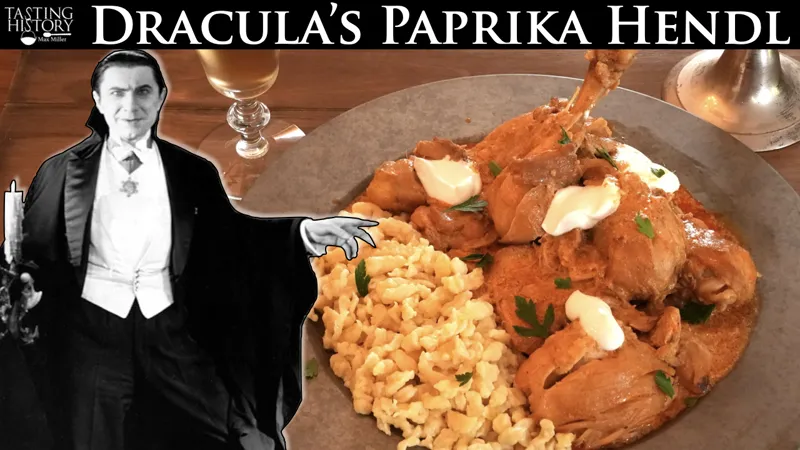
Dining with Dracula - Paprika Hendl from the 1897 novel
Comments (24)
Goddamn, we love a good paprikash. Spent the last five minutes trying to remember the word when looking at this thumbnail and kept saying “shredded pasta, shredded dough…” when my partner finally asked “spaetzle?” I’m glad I can identify it from afar, but also can’t recall the name.
I was wondering since sour cherries are really hard to find. Could you use cranberries? What do you think. Great episode. And it did look like you were drinking blood. We plan on doing that for all hallows eve 😃.
I ran out and bought Slivovitz. It tastes like what you think Bram Stoker would think things should smell like 🧛🏻♂️📖
Hello Max! Loved the video as always, sending lots of love for covering the most famous fictional inhabitant of my hometown's (Bistritz) metropolitan area! :D As a tangent, on the subject of "mămăligă" - a professor at the University of Amsterdam (not van Helsing) has actually recently published a book about this, albeit simple, quite historically-interesting dish ("The Making of Mamaliga: Transimperial Recipes for a Romanian National Dish"). Might be an interesting reference for you!
Time to dust my old spatzle maker and shop for some quality chicken. When Max makes that delighted face, the recipe totally deserves a try. I'm already smelling paprika.
Tidbit: Learned this from Hungarian grandmother, regional differences: She used heavy cream instead of sour cream. She taught us to use fat off the chicken when we cut up the chicken into serving pieces. Instead of simmering the onion first, we brown the chicken on the skin side only to a dark golden brown, and set it aside and use the onion to deglaze the pan adding it once the chicken is browned, and adding the liquid to the onion once it is clear, and adding the paprika then and the chicken back in to simmer. For the Spaezle: Try browning them in butter before serving after they float.
That isn't a šljivovica - schliwowitz! It is a clear liquor, not brown coloured! Well, at least in home made variety, or one found in western Balkans.
Just like with most liquors, it just depends on if it’s put into a barrel or not. This kind is put in oak so it’s brown.
The interesting thing about this recipe is the lack of tomatoes or peppers, which are common to add these days. There are some Western adaptations that even (gasp) use a whole can of stewed tomatoes. Not good. Nice job warning about burning the paprika and tempering the sour cream -- which wasn't mentioned in the original recipe - these books expected people to already know how to cook! Pro tip: sprinkle some more paprika onto the surface of the dish and let it absorb into the surface fat, 20 minutes before the end to add an extra layer of "fresh" paprika flavor. Tarhonya or felvert (whipped) galuska is what the recipe suggests serving it with, and though tarhonya seems to be translated as egg barley all over the place, it's not actually barley. It's dry, grated, wheat flour pasta. That would have been an interesting choice because it's less common than galuska. I don't know what felvert galuska is. There's a version of it in the book on page 19 but it's meant to be used with shrimp. Maybe she means that. In any event, we don't put butter or milk into galuska (flour, egg, water, salt -- maybe semolina) and if we use a fat we use pork fat (or maybe duck or chicken). We're Hungarian, not French, after all. The book has a water galuska without eggs, but I don't think that's it and that wouldn't ever be my own choice because I always like the consistency that eggs bring. Interesting tidbit: I'm reading a different Hungarian food history book (Kakastaréj) and apparently, some of these old cookbooks are counterfeits and are even adulterated by the publisher, or written by different people using the same pseudonym, depending on which revision you get. I have a modern reprint that is a reprint of the second release -- I don't know if that matters. I'll have to investigate now that I know.
Oh, felvert galuska is as simple as whipping up the eggs before adding them to the flour. Simple enough. Everytime I make an authoritative statement like "we don't use milk or butter" I end up eating my words. Searching for felvert galuska -- there's a recipe with milk -- there's one with butter. Ok. Typically, we don't. I don't. Most people I know in my little world don't... and maybe most recipes I see? Now I'm doubting myself. Maybe I don't pay enough attention to galuska recipes.
It's still called robber's meat in Hungary, or rablóhús.
Those little noodle-like things are also called spaetzle in Germany/Austria.
Lost to modernity, conflation and bad translations, is that spaetzle are supposed to be Northern German, longer, worm looking dumplings and nockerl is the actual Southern German / Austrian version that we see here. In Hungarian those translate to spécli and nokedli (these) here. Galuska (as he calls them from the cookbook) means dumplings and is also a name for them in Hungarian. Since I'm Hungarian and this is a Hungarian recipe, not a German one, I'd prefer to see them referred to by their Hungarian names: nokedli or galuska.
This is a look at water troughs in London, England. https://www.onlondon.co.uk/vic-keegans-lost-london-132-water-troughs-of-a-horse-drawn-past/. I’m trying to find an article I read years ago about there was friendly competition between towns to have decorative horse troughs and fountain. The article claimed that many of the fountains found in traffic circles were at one time horse troughs.
The Transylvania garlic beef is a family fave (So good!) and I have high hopes for this. Thank you for the fascinating history. Hi Jose!
There is a prologue of sorts to Dracula. It was written by Bram Stoker : "Dracula's Guest".https://www.gutenberg.org/files/10150/10150-h/10150-h.htm
I’m also one of those people who is prone to falling down rabbit holes when studying history! It’s solving a mystery and very satisfying even when you realize you’ve spent hours in pursuit of a random fact. Great episode !
I have the falling down rabbit holes syndrom too when studying genealogy, which leads to learning a lot more about history then I ever did in school.
I've gotta say that in the context of real people (past and present) Count Dracula actually seems like a relatively decent guy?
Very fitting halloween episode. :) By the way, "Hendl" is actually an Austrian term particularly for cooked or roasted chicken. "Hendl" alone is not so common in Germany. In Germany, particularly Bavaria, we more commonly use the word "Brathendl", which literally translates to "roast chicken". The galushka, we call "Spätzle". Famous dish in Bavaria, called Käsespätzle, is to just serve them with cream, molten cheese and fried onions. So good.
I can still hear Billy Crystal teaching Meg Ryan how to say paprikash in an "old man" accent in When Harry Met Sally. PAP-reee-Kaaaash.
Now I'll have something to serve the count when he stops by for a visit this Halloween season. 😉
Plum brandy - I remember Grandpa drinking it and yeah, it had a bite.
I truly smiled at the plum brandy: several years ago, I went to France and traveled off to Langres on October 5 to celebrate Diderot's birthday in his home town. There's a museum for him there, but it was Sunday so wouldn't open till afternoon. And so, I went to a restaurant to while away the time. On the drink menu was Calvados, which I knew was apple wine. I'd never tried it, so decided to now. It came to me in a tiny glass. And so I realized that this wasn't "wine" but more like a brandy, which I had never had (I'm not a drinker). I gave it a cautious sip, and could feel it kind of flow warmly all through my upper body, all the way to my finger tips. Wow, what a sensation! I didn't even so much taste the brandy as feel it. After a long, slow enjoyment of this and the lunch, I did make it to the museum, accompanied by a kitty cat I'd found under a car, and had a great time the rest of the day till it was time to grab the train back to Paris. One of the many interesting days I spent in France!