
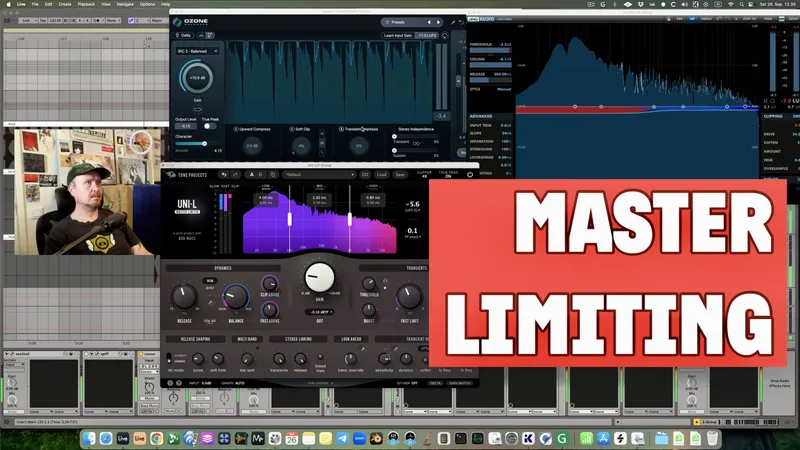

Master limiting session
Let's talk master limiting.
I'll show you a recent client case where I'm going loud-ish with mastering, but, while doing my usual master limiting, I'm getting distortion I cannot accept.
This obviously happens in my daily work as an engineer, and I always need to find ways to tackle it.
We'll call this a master limiter stress test and I'll wiggle myself out of the distortion, talk about limiting in general etc. Tech house here, but this is not genre-specific at all.
🎧 This will need headphones and some detailed, patient listening. You will get nothing out of this with phone or laptop speakers.
This is not a short topic in any regard - not something you'd TikTok about or cover it in 2 minutes if you actually want to teach others.
Here I'm using Izotope Ozone, DMGaudio Limitless, and new Tone Projects Uni-L, which quite honestly may be the new sheriff in town. I will cover it a bit more as I get more familiar with it, but there are reasons why I am actually stoked about it - you will hear them here.
FWIW, I did pay for it, so this is not a promo campaign (I only ever post about good tools that help me in my daily work).
I've taught you how I rock my master limiting and also done a little limiter talk, so if you have missed those, you'd do well checking those out.
RELEVANT VIDEOS:
Master limiter lesson and also Why Ozone is great and how I use it shows you my usual tools.
Limiting and clipping for punchy masters and Hitting maximum loudness may be relevant.
Getting relative levels right are covered here and here: they need to work before limiting.
📺 Way more mixing and mastering in this big collection.
📝RECAPPING (a really detailed long topic):
Most of the time I use two Ozone limiters in mastering. A lot of times I limit my bass bus, get my levels right, and then have the master limiters do their job.
But every now and then I end up in a place where I need to find something to tackle the distortion in mastering.
I always start with trying to make the master limiter speed slower.
Slower limiting is less prone to distortion, but beyond a certain point, it feels softer and less loud, not aggressive enough.
If making Ozone isn't doing the trick, I will always pull out Limitless, as its dynamic flex with detail is great, and it often solves the distortion.
If it doesn't, I need to look into the mix and limit things even more. Sometimes but not by default ever I'll then limit my kick, vocal, bass even more (you can limit it a lot but make sure you don't lose intended level or sub or distort it), and also check relative levels.
Limiting a master signal ain't no small feat, as the limiter has to tackle fast transients and also slower signals with a lot of power (bass). The louder you go, the more you are asking your master limiter to handle.
This is why it matters to be able to get into the details, and that's why master limiting isn't always fast (sometimes it is, especially with not-so-loud stuff): hitting -7 and louder, the challenges start.
Comments (9)
Great video as always. I have been using Ozone 10 and don't have the pennies to get myself a copy of 12. How would I do the dual limiter technique using Ozone 10? It has a threshold adjustment not a db/gain knob.
You’d duplicate the plugin on the track. And yes, in Ozone, you bring down the threshold down (as seen on some of my videos); end result is 100% the same.
A thought about clippers in general, as it may be relevant now. I’ve rarely used clippers unless some clients want that -3 loudness - I guess the lack of detail kind of bothers me in some. I mean e.g., Standardclip - why roast the whole signal? Distorts easily, easy to overdo. A little control would be great on it. So on UniL it’s welcome. First, imho as long as you're staying within -6 or so, they simply are not necessary - i've proved this hundreds of times on client mixes, my own productions etc. Second, most of the time there's a tradeoff: you easily lose some weight, and technically you are always adding distortion, and i dont want it. In some controlled moderation, it can be fine, and UniL is prob trying to do exactly that. You can actually try and define what is a transient that the clipper will handle, and the rest will be handled by the two limiter stages in it. When someone wants to smash - like this week, US dubstep mix+master hitting 2.8 - then we smash with Kraftur and do some dynamic honing on tracks (often limiters). UniL could prob do that now too.
why don't u use IRC 5? it seems to hold the transients the best.
I did use that here too: no difference in this case. I always use either IRC III or V, but here, no difference. Why it ended up showing IV is I tried that last as I rarely use it.
It came out a little too short))) Definetley looking for more investigatiion and analysis, as Jungle is waiting )))))
Ha, yeah, I could go on longer! Will cover more styles. Theres a DNB production thing coming soon for example ✌🏻
🔥🔥🔥
✌🏻🙂