

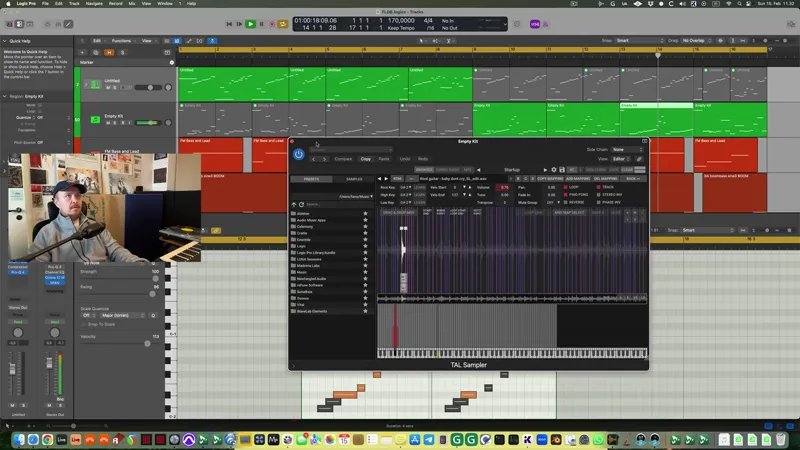
Let's talk about proper DRUMS in DNB! ("drumfunk" crash course)
I want to teach you the ways of proper breakbeat DNB drums (aka "drumfunk") as well as I can.
While it's always been my strength to make those drums (as those who have been listening to my music made and released in the past 20 years know), teaching them and talking about them has always been challenging.
I'm now trying my absolute best to teach you them as well as I can in this 33-minute mini masterclass.
I will put you on your path to ge t better with this style of drumming.
I talk about: what to listen to, what to take into account with your tools, how to get your chops right etc. Nothing here is DAW-specific.
Below, I'll give you a few good drum break downloads to get you going!
DOWNLOADS ⬇️
Sharon Jones & The Dap-Kings - Funky Little Drummer Boy (processed)
Third Guitar - Baby Don't Cry (vocals removed)
Chester Randle's Soul Sender's - Soul Brother's Testify
James Brown - Cold Sweat (Alternate Take)
Comments (12)
So I was looking at just how many slices I made for a track I have finished, and the 4 breaks had 519 sliced hits. And while there was lot of time put into getting them sliced, they are now sliced and I can save them as Renoise instruments.
Good job! 👊🏻😎
One thing I have noticed from slicing breaks is that you can see as well how a break uses beats that are rushing, or dragging, the beat. Some of the breaks I start to notice that the snares might be off the 2 and 4, but consistently in the range of what a human drummer can stay within the beat, which is 2 msecs. Numbers are easier for me to understand, mostly because I haven't done the ear training as much. But, my point is that even with slicing breaks taking a lot of time, you can learn about things by doing it and paying attention to the breaks identifying pattern. Also, I will have sometimes have some media playing to hunt for vocal samples in the back ground. I think I have some of your breaks sliced that are 32 to 64 bar patterns. Doing that you can see where the main groove is, and where you add fills in as well, and how you are using them. The Funky 16 Corners is a compilation I think from Now-Again Records, which was associated with Stones Throw Records. Now Again records has a few good funk compilation albums worth checking out as well. Armando Drum Breaks is a great place to find some breaks on YouTube. Lastly, with Redux, can you do the ping pong tail loop in that program? I think it was in a short I saw you mentioning this recently, but I think it was done in Ableton.
Redux can ping pong, yes!
DJ Shadow used Baby Don't Cry on the excellent The Numbers Song. I wonder how he took out the vocal? Did he have a super rare instrumental version as there was no stem seperation in the mid-90's!
There are parts you can use between the vox :)
Nice video. Always keen for more content on chopping. Out of interest, what features in Redux make it so appealing as a sampler for you?.
Thank you. Redux is another light sampler that offers fast, convenient one-click chopping, unlike many DAW samplers. That's why it's great.
One of my favourite things about this Patreon is I just typed a whole question out after watching that vid and by doing so got the answer. Cheers dude
Boom :) Thanks for watching!
Great video! Some of the stuff I wrestle with in this style of music: 1) Modern vs classic processing. It's difficult to know how far to push a drum break, especially when trying to reach modern loudness. How do you get these breaks loud without destroying them? The best drumfunk producers seem to have pushed the breaks hard but then rounded off the distorted high frequencies somehow. I haven't managed to do that in a consistent way. 2) The spectral balance of these breaks can sometimes be pretty wild. That's part of the character. What does a good tonal balance for these breaks look like to you? 3) Do you ever combine modern techniques like grouping all the kicks from the break and side-chaining the sub? I instinctively try to do this but it changes the vibe a lot and takes it away from the 90s roots a bit. 4) There's a line between syncopated drums with a lot of interesting variations vs totally destabalised rhythm that's hard to follow. How do you go off-piste with the rhythm and then somehow anchor it back to a stable foundation every bar or whatever? To be honest I hear commercial tracks from other artists that don't get this right for my taste - almost like aphex twin edits or whatever, but very subjective of course!
1. To me, loudness often is just about EQ. Sometimes a wee bit of some compression (FET), sometimes a bit of harmonics pushing (saturator, Orion etc)...but not a lot. And yeah, watch the high-mids and highs, ca. 4K and up is harsh easily. 2. I don't really look; it's misleading. These days I just listen and find the spots that sound harsh and cut there. On the main break here, I'm using Bloom that is great for addressing complex rez. 3. Sidechaining bassline sub? Yes. Layers? Depends; not that often. If I want to respect the tone of the break, just EQ. 4. Yeah this is THE hardest thing to teach, and I have zero rules. That's one reason for this video, and I'm telling people to listen to and copy funk patterns, to learn the aesthetics. Fact is there's a whole lot of hectic drumfunk out there, but if one isn't great with drum patterns, it won't sound good or natural. Easy to do hectic drums, but much harder to do it with style.