
The Adventurer: Huscarls
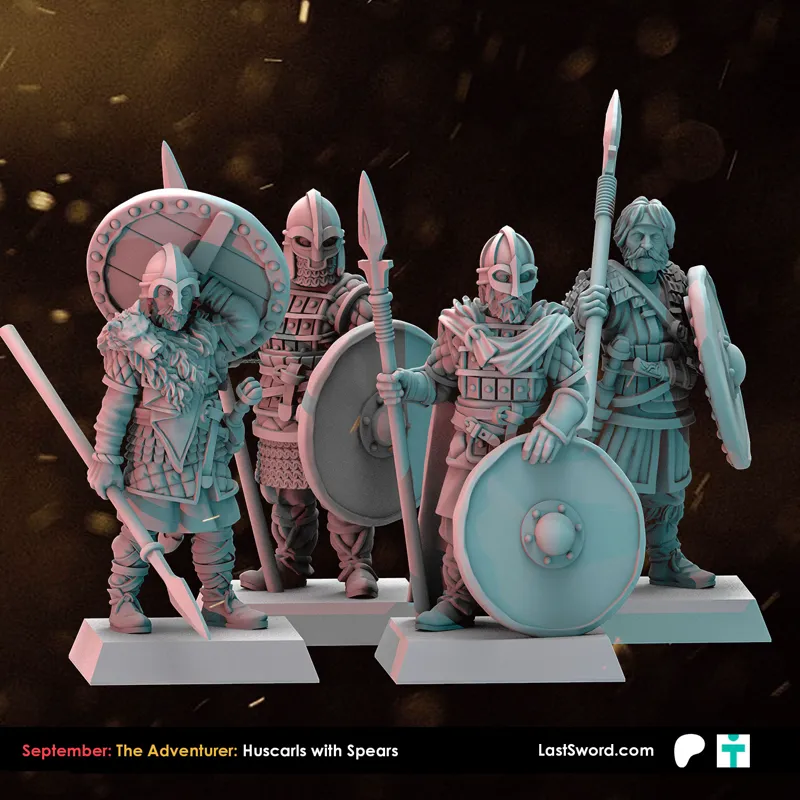
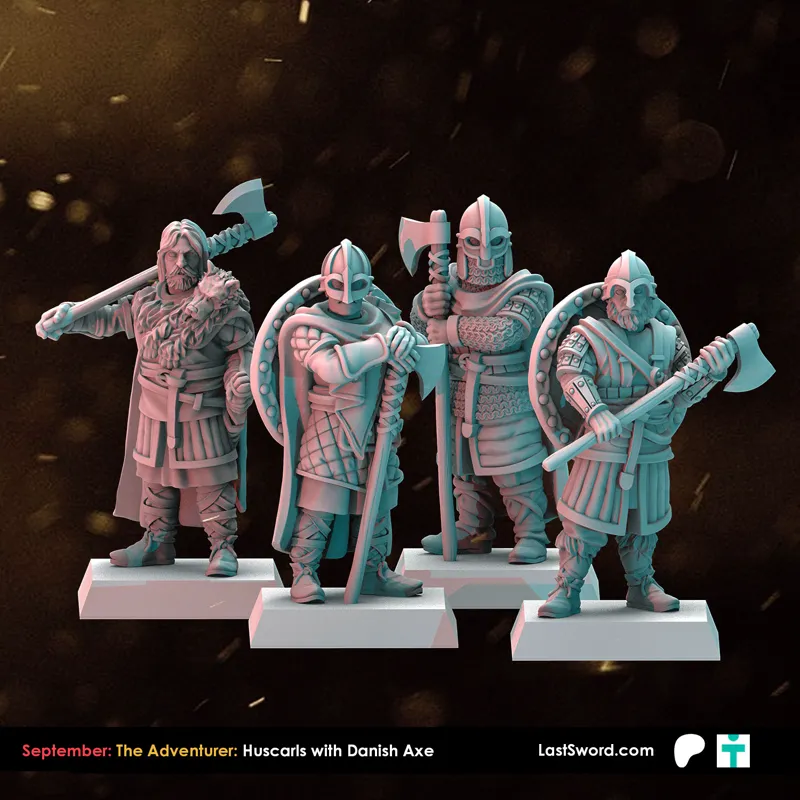
Here’s a small preview of what the new tier will include. We’ve created 8 miniatures: 4 with spears and 4 with Danish axes.
This is Adrian’s first month on our sculpting team, and we’ve focused on teaching him things like fitting, proportions, and the level of detail we seek in our miniatures.
That’s why these miniatures aren’t as modular as you might be used to. We’ll be taking that step next month with the Bondi warriors.
Considering this is his first approach to our way of working, I can say that I’m very pleased with the work he’s done, even though he still needs a bit more time to reach the level of our other ranges.
I hope you find this interesting! :)
Comments (4)
These are more fantasy than historical mini's. More Hollywood style. We have a clear enough view how a warrior from 8 to 11th century would have looked like. That said, I will certainly subscribe, I will not use them for my historical projects as there are better and more historical appropriate alternatives, but these are great to expand the human part of your fantasy range. So love it that it is happening, but not for historical tabletop wargaming (imo ofcourse).
they are perfect for a Norsca themed army indeed. just ad some chaos stars and call it Warhammer. (wich is as far as i know more or less what GW did.)
Sadly fantasy vikings with gambeson, lamellar armour and shoulderfur and bracers.. I would have preferred more historic minis, so you lost me for these. If you like the renactorism look how ever they are great, just not my cup of tea.
I understand your point of view, and it is true that the number of archaeological finds for certain items like helmets and lamellar armor from the Viking Age is extremely low, making it difficult to definitively state whether they were used or not. However, this doesn't mean it’s impossible that these items were in use. For example, the case of helmets is particularly interesting: the only relatively complete Viking helmet that has been found is the Gjermundbu, which suggests that while rare, their existence or use in combat cannot be ruled out. Regarding lamellar armor, although evidence of its use in Scandinavia during the Viking Age is minimal and mainly associated with foreign contacts (such as in Birka), we also cannot dismiss the possibility that some warriors, especially those with access to foreign influences or luxury goods, might have worn this type of armor. History, after all, is built on the interpretation of available evidence, and the absence of evidence is not necessarily evidence of absence. Additionally, it’s important to highlight that the historical interpretation of these items has been influenced by Anglo-Saxon and Norman sources, leading to a somewhat distorted representation of Viking equipment. Therefore, the historicity of certain items, like helmets and armor, remains open to interpretation and debate. This leaves room for different approaches in historical reenactment and miniatures, depending on which aspects of the past one wishes to emphasize. Our miniatures are not meant to be 100% historically accurate, as without having been there, historicity depends on the source and the interpretation of the time. What we have aimed for, however, is for them to be 100% plausible. Uniforms are a thing of the modern age, and unfortunately, if we limit ourselves only to proven elements, the resulting miniatures would be identical, and equally distant from reality.