

Q&A 41: On comedy
Three questions on a similar theme:
Megan Gearhart enquires:
"I'm reading Solver again this time on WebComics, and I've been enjoying it more in the long format simply because it makes me read more attentively and I catch more of the jokes on the first read. Which makes me appreciate how joke dense your writing is. Tina Fey wrote in her biography something to the effect that the goal for joke density on 30 Rock was so high many jokes went unnoticed on the first pass. Do you have a joke density philosophy or goal when writing?"
Coming from newspaper-style strips, I am very attuned to punchlines. If i have to write a three/four panel strip, I know where the joke has to be and how to tee it up. In my very early days, I was clueless about how to achieve this, so I had to reverse engineer the rhythm of a newspaper strip. I read a lot of Calvin and Hobbes and Bloom County collections, "clever comics", so see how it was done. I don't think my early jokes were strong, but the rhythm was established. When I've reverted to the newspaper rhythm in later years (for example, on Bobbins.horse) I can, with a list of rough ideas for the direction of the little stories, type the dialogue straight onto the lettering page, moving the balloons about to get things just so.
In some ways I prefer doing strips to full pages (it's quicker, i can do more and move things along more quickly) but they're awkward to collect in print and readers seem to overwhelmingly prefer the full-page format. But I chose one at random from 2019, when I was churning them out, and it illustrates my approach well enough. I think there are two good jokes here, "pulse lung" and "grandfather me onto the forklift truck team". In both cases those are phrases that hopefully no-one had ever heard before. "Pea vat" is a nice turn of phrase, "moonlight flit" is a fun and unusual colloquialism.
This period (when I was in and out of periods of overwork and burnout) was my "bare minimum" system for writing - characters I knew very well, four identically sized panels and type the same size as the Calvin and Hobbes lettering. My only rule was to get something of interest into each panel. It never has to be a joke. If the characters were well enough established (even within the context of a single strip), they would hopefully carry whatever mild amusements were possible at the time.
I've written so many jokes at this point that it's very hard to make me laugh. I'm pretty jaded. There are a few friends who can really crack me up, make me properly go, but it's very tricky for me to know, writing alone, what's funny. I get very little feedback from people telling me they laughed at something. So I throw everything at the page. Let me find a relatively recent one:
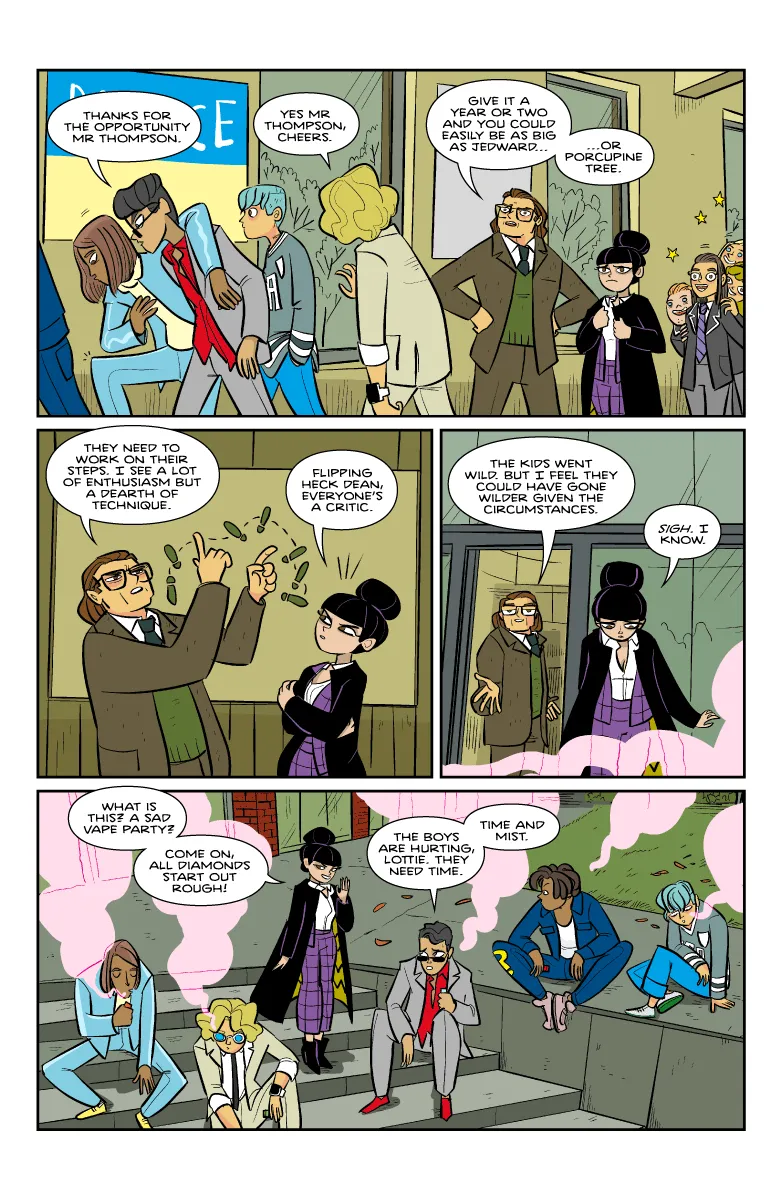
So on this page, I have attempted (successfully or unsuccessfully) to amuse the audience in every panel.
Panel 1: D-Slide have pivoted from on-stage too-adult sensuality to being slightly cowed schoolboys. They talk to a teacher like he's a teacher. Dean's reference points are a deliberately insane juxtaposition, Irish talent show twin-act Jedward, and respected modern prog rock act Porcupine Tree. That's a joke for the four people reading with familiarity with both those acts. It will only land occasionally.
Panel 2: Dean shouldn't have an opinion on choreography. "Dearth" I always think is a funny word. Lottie has pivoted to straight woman here, which plays against type.
Panel 3: Another good line from Dean.
Panel 4: The vape party is a good, pathetic scene. "Time and mist" is profoundly meaningless. Again, I'm trying to use a phrase no one has used before. It's the same as the Bobbins strip, hopefully tickling the reader by catching them unawares.
So I think the answer to the joke density question is that I will take every opportunity offered to get a good line in. Hopefully that means the comics bear re-reading. I'd not thought about what it would mean on a platform like Webtoon, when every panel is isolated for the scroll. Thus far, my experiment with those platforms has yet to find a new audience, so we will have to wait for that to happen for the data to start rolling in.
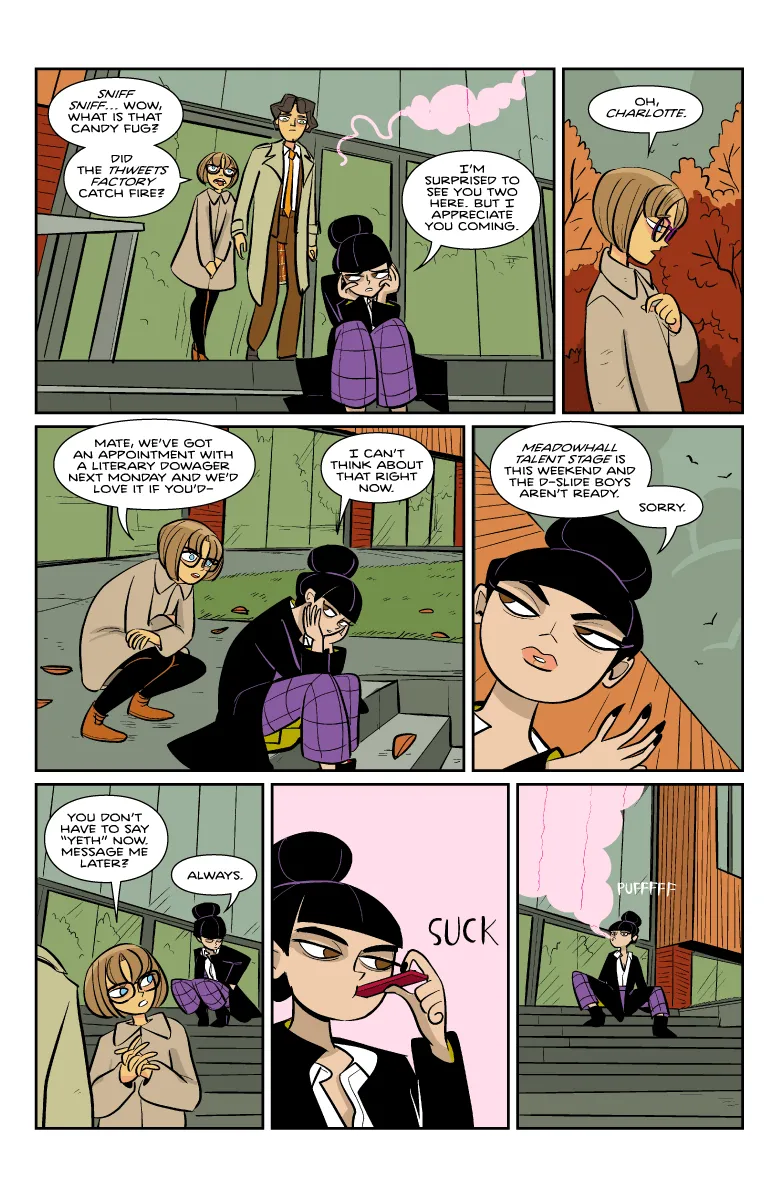
All this is not to say that I have to throw the kitchen sink at every page. This (below) was the next page. The only jokes are in Claire's first utterances of the first panel. Then the tone changes. There has to be a break or it's too much. I think this is probably why people like the full page proper stories better. I've got much better at pacing them since my adventures in monthly American comics.
John Cannan asks:
"How do you stay funny?"
I've damaged my mind writing "jokes" (see above) for 28 years. I don't think like I used to. I've continued to write my comics through some extremely personally difficult periods of my life, periods that were so very, very far from funny. I'm not sure there's a concrete answer to this question, but I try to remain open-hearted and as uncynical as I can. Ideally, at the most difficult times, visiting my little cartoon kingdom should be a welcome distraction. I'm sure there are life events I could not continue to write through.
John Smith wants to know:
"Have you ever thought of doing a comic that wasn't a comedy or even a dramedy? Or would that be too weird."
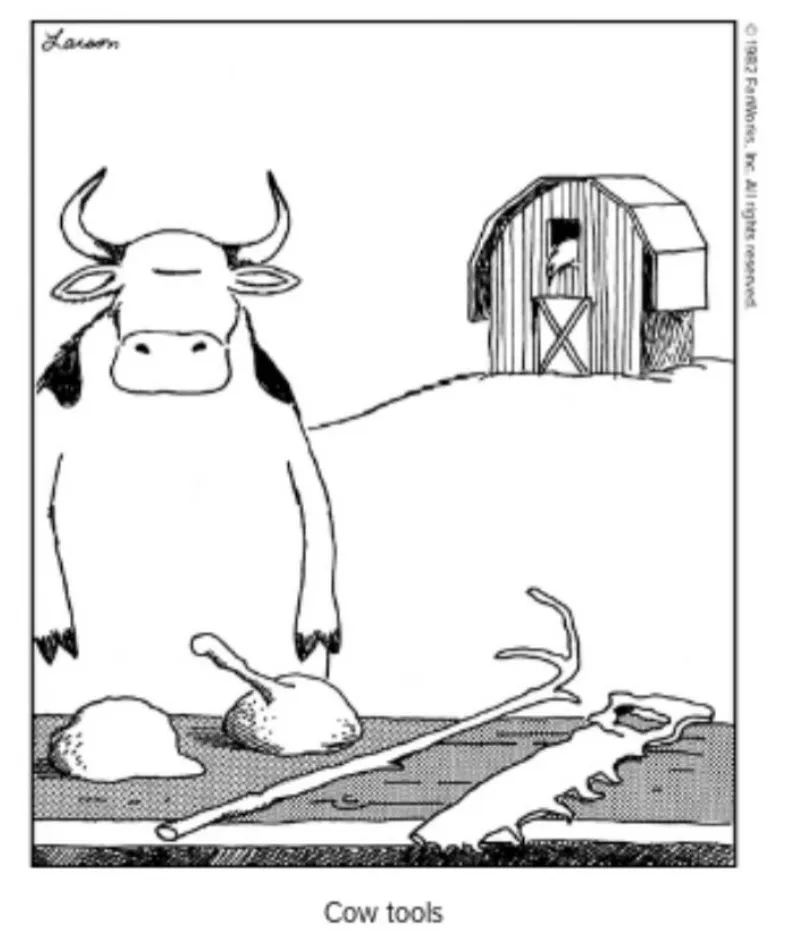
Comedy is a part of life. Laughter and humour are vital in even the darkest situations - apposite to the subject matter, of course. It might be very dark, coping-mechanism humour. I don't think I'd ever write something unremittingly bleak, or po-faced. The lack of humour in a lot of comics is reflective (to me, at least) of how poorly they are written. I think the funniest comics are the best comics, to the point where the art barely matters. But then, I like cow tools.
Comments (22)
The density of your writing is something I've always loved about it. Near-every panel has something going on, be it a funny turn of phrase, a visual gag, or an interesting composition… that page you use an example of one without jokes still has that from-below close-up of Lottie in panel 4, for example. It's what drew me to your work back in the SGR days, since it stood out from all the other webcomics of the era that strictly adhered to the "set up -> punchline" format.
I've never had cause to explore why I like John Allison's work, but upon reflection the number one reason is absolutely his clever dialogue. The man really knows how to turn a phrase.
"familiar with both acts". I wonder who the other three are? I remember first reading that particular comic and thinking that Jedward/PT/KPop made a lovely little contrast triangle. Very distinctive, very different.
I think your interest in writing phrases that no one has ever heard before is one of the things that has kept me coming back to your comics since the early days of SGR; phrases like "pulse lung" will never stop amusing me.
Also keeping me coming back are panels like the second one in today's Solver page (the coffee machine), which has several individually amusing elements that are, together, vastly funnier. "Flursh" is the best new onomatopoeia I'll read today, I'm sure.
I raised an eyebrow a bit at the original question, as I don't really think of Bad Machinery as having jokes as such. I think of a joke as a set-up and punchline, and even if you laugh the first time you hear one, you don't the second time (heard it before!). But your lines have wit and levity and a refreshingly off-beat viewpoint. They make you smile, and lift your mood, and they continue to do so on repeated readings, so they're better than jokes.
I always refer to it as "writing my little jokes" to people. Having seen what was considered a "joke" back in Victorian times, I think the term is very flexible. I will try to recall the source of all the deathly jokes I read.
My 9-year-old is now a second generation John Allison fan and I can tell you, the jokes land with her. Even if I have to explain some contexts. (She's a big Bad Machinery fan. It was one of your jokes about "moth balls" that led to my needing to explain that slang term for testicles, so you're helping out with important parenting conversations too.)
I must say, you do often achieve unexpected phrases that I've never read or heard before. A lot of them are real gems, including my favorite line you've written (from late SGR): "Do not attempt to truncate my dolor!"
"Pulse lung" is also hilarious, of course. And now for some reason I'm imagining Ryan singing a Patti Smith cover, but naming it "Pea Factory."
Man goes to doctor. Says nothing makes him laugh any more. Doctor says, "Treatment is simple. Great comic creator John Allison has written humorous stories about South Yorkshire youths. Go and read his comics. That should pick you up." Man bursts into tears. Says, "But doctor...” ...which is to say that it's a rare page of yours that doesn't elicit at least a couple of chuckles, and your comic timing in the best of them is impeccable.
I do often find my mind drifting back to the Lottie vaping panels whenever I feel similarly low, they really capture a desperate sadness better than words can - perhaps an unfitting comment on a post about comedy but I think it's worth saying. There's a lot of barmy antics in Boys Like Fun and the contrast between the silliness and the sadness in the characters helps lift both higher than if it was all one or the other.
Cows also like them. https://www.theguardian.com/science/2026/jan/19/back-scratching-cow-veronika-bovine-intelligence
ICYMI : https://www.npr.org/2026/01/25/nx-s1-5686475/videos-of-cows-using-tools-are-drawing-attention-back-to-a-cult-favorite-cow-comic
There's always that irreducible gap between the cartoonist and the audience about what reads as good/funny, too. My favorite line in the middle page was Lottie's "Flippin' heck, Dean. Everyone's a critic," which may not *seem* to be a laugh line but got me chuckling all the same.
That's just character-based comedy rather than gag-based, isn't it? You can feel the beat before she replies and hear her tone of voice. (also, thanks for making me realise that you're on Patreon and that I should be supporting you)
I remember the first Far Side comic I ever saw, around '80. It had a porcupine lying on a mattress and two more porcupines standing by and looking impressed, or anyway interested, and no caption. It took me weeks to figure out because I didn't know the Far Side grammar yet. I haven't seen that one in any of the Far Side collections, so it must be even more obscure than Cow Tools.
some not very insightful discussion of it here: https://www.reddit.com/r/TheFarSide/comments/1c64f54/not_porcupines_surely/
A friend recently recounted a conversation we'd had while I was on what we all thought would be my death-bed. I had no recollection of it (there's little but shades and scraps from the time), but [1] it sounded very much like me, and [2] it was hilarious. How does one stay funny? I'd tell you if I knew. Wokka wokka.
Thanks for sharing!
Cheers, John. I for one appreciate the throwing of all things and will gamely attempt to catch them all, along with the bathos breaks to pacing and the emotions. Maybe you'll enjoy this story. Somehow a group at my university (what we call unis) roped Gary Larson into giving a talk. Apparently, and by "apparently" I mean this was something he stated about a dozen times, he didn't really give talks, and had no idea what to say. But he did show a few of his Far Sides and I remember what he said about on in particular. It was the one with a house and a snowy yard, which featured a snowman with an enormously disproportionate head. Inside, you could see the people of the house, who we shaped as such. He said he got letters from people who didn't get it, and he'd mail back, "Look closely at the footprints in the snow."
I enjoyed it very much!