



Q&A 27: scripting process
sjlxndr asks: "A question, John: when you are writing, are you also drawing? I mean do you write out a screenplay, so to speak, then flesh o
sjlxndr asks:
"A question, John: when you are writing, are you also drawing? I mean do you write out a screenplay, so to speak, then flesh out the storyboards? Or do you always draw when you write? Particularly curious as it pertains to working with another artist."
---
I think I might have answered this one before, but I get asked it whenever anyone sees screengrabs of my scripts.
I type out a numbered list of pages with all the story beats, any odd bits of dialogue I've thought of ahead of time - about 1000 words for 22 pages. I'm collating from loose handwritten notes done mostly out of the house. Below is a typical extract, from the just-finished Solver issue:
Now some things will inevitably be finessed when I come to write properly. In the final issue, the strategy meeting:
1. wasn't named in a way guaranteed to confuse and
2. degenerated into a cyberpunk dystopia. But I have the basic shape of the issue nailed down.
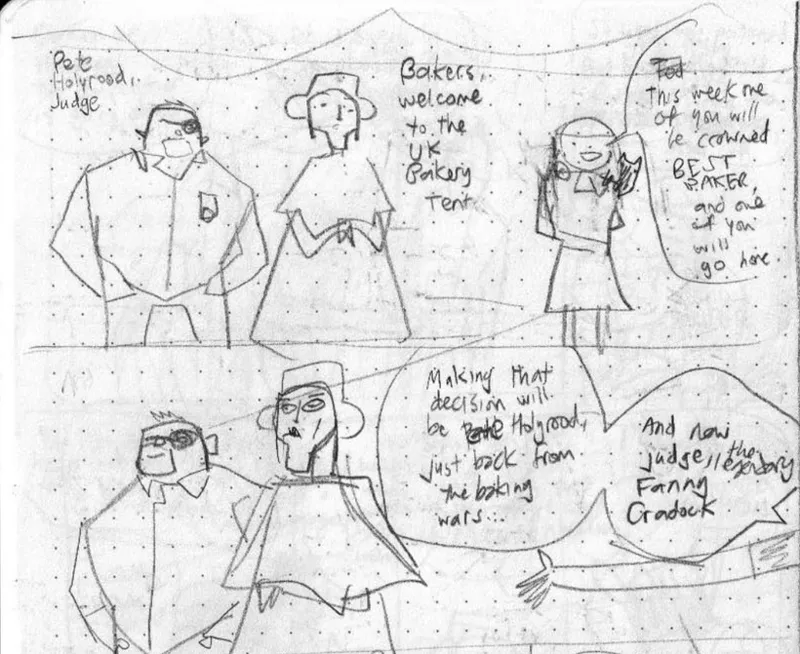
I then use the breakdown to write and draw very rough pages with all the dialogue and panelling and action laid out. For my recent work with Max Sarin, I supply a screenplay style script to the editor, but I also supply the rough comic version, with the proviso that anything can be moved or changed to improve it visually, as Max is a more flamboyant artist than me. But you would recognise the finished versions from my rough versions.
Here's a post with the whole rough breakdown for Great British Bump-Off issue 1.
I developed this technique scripting for myself to draw, to save time (and avoid writing things that I couldn't draw) but it works for me and Max because our approach is similar, so saves them time breaking down scripts. And it has improved me as an comic artist immeasurably (the first time I did it was very late in Giant Days). I started doing it after reading Bakuman, where every chapter ends with the writer's "name" (rough storyboard style script) next to the artist's rough layouts.
It does make more work for me when working with an artist, because I have to type up what I've just drawn, to explain it clearly (and for the letterer to letter from, and colourist, who may need information). But even if I am just typing out a script, as I did up until Wicked Things, I still have to work out very simply what is actually happening on the page, even if no one is going to see those doodles. I am not a very visual thinker so there is extra work to do and I can't picture a page in my head as I might want it to be. It's important for me to have a sense of the line of action and position of figures, so they are not inadvertently flipped around during dialogue.
The typing up of a script from my detailed roughs is probably my least favourite job in comics, because I'm reverse-engineering the kind of scripts I used to write (on Giant Days and By Night) for other artists without doing all the thumbnailing work! Let's just say I really, really have to want to do it, because it boils my brain and feels like an exercise in life-force wasting futility. I thought I could type up a simpler script with this the roughs as visual accompaniment, but the word counts are exactly the same as my old Giant Days scripts. My world-beating economy (inherent laziness) meant I was already writing the bare minimum of words possible.
So as not to end on a moan that almost no one can identify with, the most important thing that drawing as I write has done is force me to think harder about panel grids and layout. Until I started working this way, I unthinkingly defaulted to the six-panel grid I had employed since Scary Go Round moved from square comics to portrait format. (Bad Machinery never required me to think about layout, it was just two rows that I sliced as many times as I needed. )
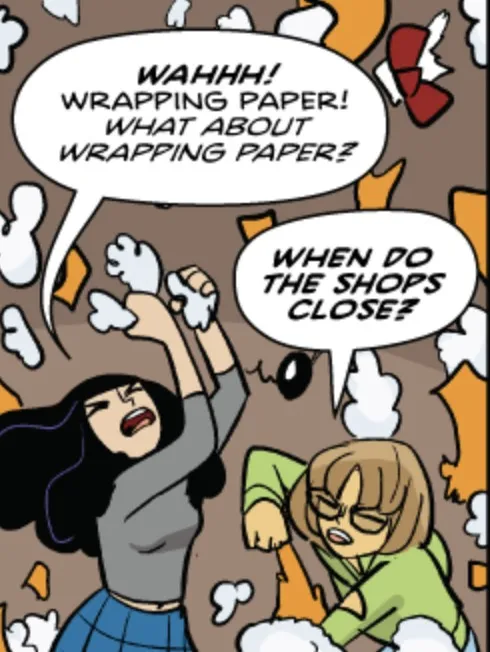
But very quickly, when I was working pages out by actually drawing them, I came to notice (and hate) that monotony. So now, I am always trying within my limited ability to vary things as much as I can. I will scan back through my issue as I write it, to make sure I'm not duplicating things. I can try to avoid similar angles and repetitions of composition. It helps in many ways. I also enjoy the many "funny faces" that emerge in the roughs, which can't possibly be reproduced in the final piece but give me a lot of pleasure. Each one accompanied, actually or implied, by the word "WAHHH!!"
WAHHH!!
Comments (1)
I like the fact that Lottie and Claire immediately waste the stuffed animal they spent who knows how many pounds trying to win it before they even leave the building