
Low Level C Data Types - Structs, Floats & Doubles
Let's talk about some more complicated data types: floats, doubles and structs.
🛠️ C Structs Group Multiple Types
💾 Alignment Boosts Memory Efficiency
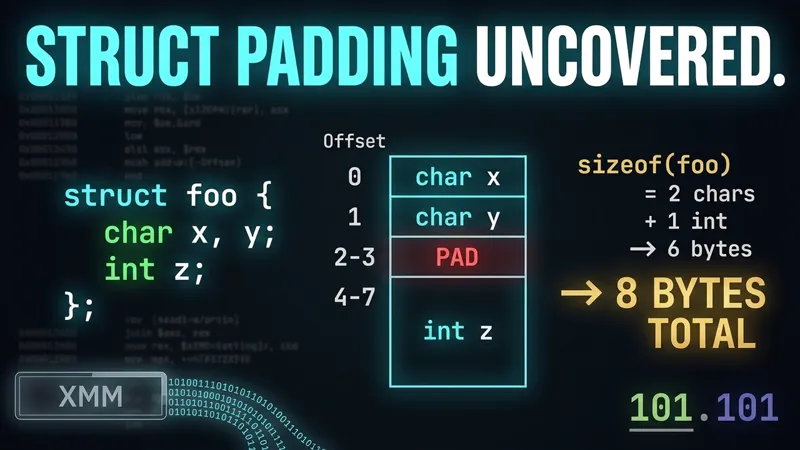
📏 Struct Size Includes Padding
🧮 Floats Handle Decimal Numbers
🔢 Doubles Provide More Precision
🚀 XMM YMM Registers Speed Up
🖥️ SIMD Instructions Enhance Speed
⚡ Improve Code Readability Fast
Understanding Structures in C
C structures, simply referred to as "structs", represent a collection of variables, that can be of various different types. In comparison, an array can only contain multiple variables of the same type. This lets you group multiple variables under 1 variable name. This capability is essential when dealing with complex collections of data, as it enhances code organization and readability. For instance, consider a scenario where we need to manage data for two chars, X and Y, along with an integer Z. A structure facilitates the bundling of these diverse data types seamlessly, and you interact with the struct using 1 variable name rather than each individual piece.
Please checkout the free Malware Analysis Sandbox from Malcore, they have generously sponsored this video!
What are the Basic Data Types in C Programming?
Maybe you are asking, what is the basic data types in C? Understanding data types like int, char, and float is very important for programming in C. For detailed informations, you can read this guide about low-level data types in C.
For example, the int type is use for integers and usually occupy 4 bytes of memory. The char type is for characters and take 1 byte. Knowing how much memory each data type use helps you write more efficient code. Try creating variables of different types and use the sizeof() operator to see how much memory they takes.
How to Start Learning C Programming Effectively?
So, how you begin to learn C programming in best way? It might be a bit chalenging at first, but there are steps you can take. You should look at this article on learning C programming for practical advise.
First, set up your development environment by installing a compiler like GCC or using a IDE like Code::Blocks. Then, start with learning the basic syntax and writing simple programs like "Hello, World!". Practice writing code every day, and try to solve small problems to improve your skill.
Why Should You Understand Floating Point Values and XMM Registers?
Ever wonder why floating point values and XMM registers are important? They is key for handling precise calculations, especially in performance-critical applications. To learn about them, you should read this informative piece on floating point values and XMM registers.
For instance, floating point numbers are stored in XMM registers when using SSE instructions. Understanding how to manipulate these registers allows you to perform high-speed mathematical operations. You can practice by writing code that perform floating point arithmetic and observing how it's handled at the assembly level.
What Tips Can Help Beginners Learn C Programming?
Are there any tips that help beginner in C programming? Yes, for sure! Some practical advice can make your learning journey more smoother. You might find these tips for beginners learning C quite useful.
One tip is to always check for errors when using functions like malloc() or file operations. Another is to comment your code to make it easier to understand later. Also, try to understand pointers thoroughly, as they are a crucial part of C programming. Practice by writing programs that use pointers to manipulate arrays and strings.
Low Level C Data Types - Structs, Floats & Doubles (YouTube)