
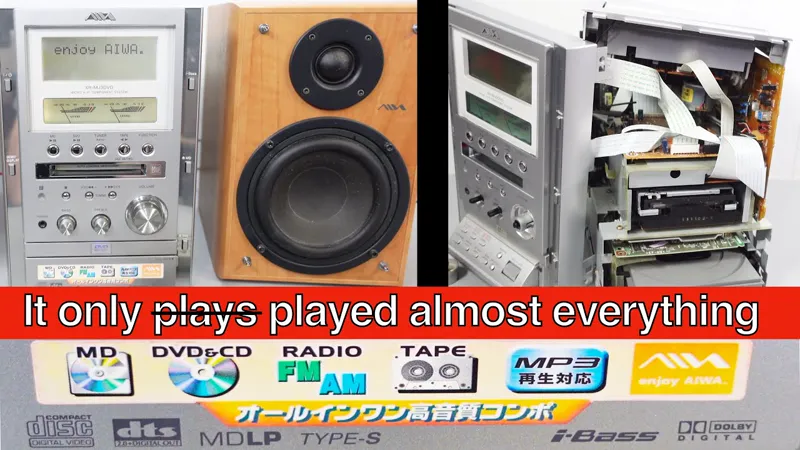
Micro Systems Part 2 - The naughties
Last week I demonstrated that a HiFi Micro System from the late 1970s might end up being more of a restoration project than a turn-key (press button) way to enjoy music.
In this video I’m looking at another Micro HiFi, but one that reflects almost a quarter of a century of additional technological development. Surely a fully loaded music system from 2003 will turn out to be a better option for the average person.
Well...
I was unwell for a good (bad) part of the week - so I’m happy that I finally managed to move this video along to a viewable state. I’m also pleased that I chose to showcase this second Micro HiFi as part of this series - it really wouldn’t have worked out on its own. After watching this you’ll understand why having a running narrative thread behind the video helped.
Due to time constraints I’ve had nothing else going on, so I’ll keep this post short…the video makes up for any brevity. Take care.
Comments (68)
Got you written all over these https://i.postimg.cc/V6VX0ZFq/FB-IMG-1684515523943.jpg
Oh, I love seeing those - miniatures are one of my favorite things.
Oh boy! A pity it went south. I liked the Sony a little better though (and was much cheaper) but the vu meters on this are sweet. I cannot agree more on your message user vs collector. I am myself somewhere in between as I do want to use them, fact is, nothing like that is being produced anymore. It is also an experience (as I collect them second hand) to talk to people usually a couple of years older than myself who say "nah mate, I got rid of all cds and stuff. Only digital" they are sad to see their memories go away but I do understand attractiveness of the one button peinciple. On my end, I just got my hi fi all set up a couple of months back and now the amp went kaboom and seems it took the subwoofer with it ( subwoofer is moden and was attached to the blue ray, but in the same power as the amp) So great Back to the series, I watched both consecutively and it's a treat, thanks
From frash to trash 😊
Hi! I managed to repair two things : my boombox Philips D8814. The headphones / speakers switch (cuts speakers when you plugin headphones) was the problem, sound was scratchy because of that. Just removed it and hard wired amp to speakers. And a used cassette tape: belts are OK, but the play/record switch mechanism was the culprit. A few pause-record-stop-play-record-stop-play and contact cleaner did the trick.
ha ha, I was about to suggest you look for a little blue piece of plastic jamming the DVD drive. I watched a video last week where you showed a tape player that played for a a few seconds then stopped. You then started it again and it stopped again. In that case it was the tape counter jamming an idler with a magnet on it, though I half expected you to pull out a mangled tape. To save wrecking the tape, we would always remove a tape which stopped on its own in case the take-up spool wasn't turning. This applied to video recorders too..
I was obsessed with hifi’s in my early teens, I was all about the black look with as many LED’s as possible lighting up the fronts. They were always received as my main Christmas present every 1 to 2 years from my parents and then I’d sell the old one and give my parents the money I had made to help with the costs. I had cheap units like Alba and Amstrad from Argos as couldn’t afford much more. But then, one Christmas, I got a little more… fantastic AIWA unit with sexy looking speakers. That unit turned my once casual approach to music… in to a real love for the stuff. At last I was listening to my KLF White Room tape on a decent stereo with graphic equaliser sliders, sound indicator LEDs and those speakers… god I love those speakers. I say ‘love’, because I still have those bad boys, they’ve been on the walls on brackets at my parents since I gave them to them 25 years ago. I do have a great appreciation for the AIWA brand, had another hifi in the late 90s and have had 2 personal stereos from them too. Thanks so much for the video, Matt. The stereo didn’t work out, but the content definitely did 😁 Lee
have you seen the last episode of To The Manor Born where in Richard Devers office he has a micro system which looks like it might have an 8 track as well as cassette player. keep up the good work
I repaired a Sony micro system from 2003 (not the same one I made a video about) and its cassette deck belt was also crumbling into pieces. I wonder if by then, they realized that belts were turning into goo as they aged, and changed the formula to make them dry-rot instead.
The interesting thing is that not all belts disintegrate over time. I have a Roadstar mini hi-fi, dating back to the early 1980s (or maybe late 1970s), which is running with its original belts, actually, with all its original components. The recorder belt is probably a bit loose, but not to the point of making it unusable.
2 videos in and Aiwa sadly disappointing, I've got a real soft spot for them... So can I just recommend an Aiwa line of 'mini-ish' hifi...!? The MX70 amp and associated tuner, tape and turntable. Came on a custom wooden stand and the turntable was a direct drive linear tracker. 1984 ish, and I repaired the turntable arm and cassette desk belts fairly easily. The amp is a little monster, 45w per channel and it kicks. For anyone looking for a fixer upper... It also fits **perfectly** in an IKEA kallax shelving unit.
In my case, I managed to repair an Aiwa mini Hi-Fi identical to the one you showed in the previous video. In contrast, a Sony very similar to the one in today's video was impossible to repair, it was definitely a piece of junk. Cheers to VWestlife who I saw in a comment above.
Representing present day I'd like to put forward the Teac Reference 300/500 series. Very nice bits of kit but sadly discontinued. (Teac still makes some products in the reference line but not as a micro stack)
I bought a house in 2020 that had an Aiwa microsystem left behind. The cassette didn't work (surprise), but the radio and CD were fine. It was listening to some CDs on that system, after years of mostly listening to streaming music on Amazon Echo devices, that got me interested in building a decent system. Then I saw your series on budget hifi and I built one myself. I think it's interesting that so many of us have gotten used to listening to music from really subpar sources like phones and crappy Bluetooth speakers.
Ugh, just puts me in mind of my attempt to repair my Xbox 360. It had been in storage after having been bought new and played with for only a few months before going back in the box. I naively assumed things would work perfectly fine, the device essentially being "new-used" and completely under damaged. The DVD player wouldn't eject, so I thought it was a mechanical problem. Bought some new mechanisms. Then realized the 360's laser unit wasn't built to last, so bought a new laser unit. Then one of the ribbon cables wouldn't seat properly. The little "hinge" was long gone. Tried to use some tape to adhere it to the station. But by that point nothing seemed to be working. I thought it was worthwhile to have a go at a repair since the console continues to be expensive to purchase new, and the hardware prevents the user from just swapping out the DVD drive. It leads me to the question: how long should we expect any consumer electronics unit to last nowadays? It seems like anything beyond 10 years is pressing luck. Hence the ever increasing size of those electronic waste piles we see in India.
The difference is the low initial cost these days. The first system Mat reviewed cost the equivalent of £1400 new. If that failed after a few years people would be happy to pay £100 for a repair And that repair cost was in 1990s money. I know someone who lives in what is now a £500K+ house paid for by fixing TVs, VCRs. etc in his garage. I recommended him to quite a few people at work who came back happy having got equipment repaired for a few days wages rather than having to spend a months wages on a replacement. Don't bother asking if he still does repairs as he retired when flat screens started to become popular.
Tracks with my experience of trying to fix things.
I think these videos are doing an important service to the community; showing people who might try getting into this hobby that “failure” is par for the course. All these devices were never designed or intended to last as long as they have so some failures are unavoidable. Like you have alluded in the past, you will always find someone in the comments who will say they could repair it for you, but they aren’t the average viewer and they likely wouldn’t offer to repair it for anyone else. So the reality is if any of your average viewers had the same device that was broken in the same way, it would be unrepairable. That is a tough but and honest lesson. That said, maybe it is worth mentioning on select certain rare devices that it would be worth putting up as-is on eBay for parts as it still could be worth it to someone.
There's a good chance that it even supports AM Stereo, as many Japanese tuners did from the early '90s to mid 2000s.
A sad outcome, but to see the insides is always interesting. I've had a few failed repair attempts as I'm sure we all have. You're just illustrating life! :-)
I am loving this mini-series! Seems like an idea for future videos as well
Was going to suggest you ran the demo all the way through for the video to see what was shown if you were looking at it in a shop, guess that’s not possible now :) Really enjoyed this video, classic Techmoan, you tell an interesting story about tech from a period in time and try repairs that may or may not be successful (no spoilers). Hope you’re well
That turned out to be an expensive mini-disc that you bought. This is the band that is on it: https://en.m.wikipedia.org/wiki/Yuzu_(band)
does anyone know where this guy gets the old advertisement reviews? i have some old gear I would like to see how it was thought-of when it came out ( i like it now, but what about then). likely a sales pitch though. i cant find anything by google
Sorry, I don't know him personally. I did try archive.org, but nothing. I'm specifically looking at yamaha yp-511
Really seems the quality just wasn't there on this unit, to be so easily breakable. A shame, but an interesting attempt at repair nonetheless!
I may be a rather odd man out- but I've never felt "deprived" when something you're working on ends up junked. I'm watching your channel for your presence, the tech is secondary. I mean- you somehow made dash cam videos as interesting to watch as anyone possibly could.
Well you've finally done it. You've posted a video where you attempted a repair and failed miserably. That's what all the comments have been asking for! Glad you did it on one like this to demonstrate a point!
Not the first time - here's a prior non-repair video with a fantasy ending: https://youtu.be/ZQYzyQ9yPhw
2 options down, 1 to go. I hope the next one doesn't end up as a pile of bits! Great video as always.
Car crash. Yes. :-)
I'd forgotten that AIVA... sorry... AIWA logo! Ghastly, isn't it?
It's not any worse than the new Kia logo. In fact, that may be part of where Kia got their inspiration from, in addition from Nine Inch Nails' logo.
Yet Another Excellent Video, sir.
I'm really glad you're happy - I think there's quite a bit of viewer dissatisfaction with this one.
The demo mode took me straight back to Curry's around 1999-2000 when I was a teen. I would walk around the HiFi section looking at all the light displays from the various models in demo mode. As a treat I would eject the CD trays and base my entirely theoretical purchase on the extravagance of the mechanism.
Yep those ribbon cables were always the worst part when attempting to repair laptops, they're basically designed to be put in once by someone who does it all day. Sharp intake of breath when you revealed them all.
I got given an LCD monitor in which the colours were wrong due to bad connections where one of those cables plugged into the panel. No matter what I tried (like adding sellotape to make the end thicker) the thing would fail again after about three months requiring me to take it apart and re-seat the cable. On the plus side last year I got a faulty Sony 7600G shortwave radio for £5 and the only problem was a cable like that half out of its socket.
Interesting video shame it didn't work but as u said even back in the 00s things weren't built to last I never saw mini disc hifi really in Europe was that only a Japan I know we got portable players but maybe I was just blind here can't remember anyone having a mini hifi with minidisc tho. I saw the Soundburger 2022 was going be up for sale end of this month non limited will have to get one of those.
Where did you see this (soundburger bit)?
MD - Microswitches that sense loading/unloading, common problem. Usually very tiny and they tarnish. Shame you killed it off, better luck next time ;-)
Great new series of videos, love watching reviews of old audio products through todays perspective!
I've been using a Denon D200 mini system for about a year (1993 vintage or so) and everything works surprisingly well.
OH! ME ELBOW!
Ribbon cables are new belts. I’ve seen that backing separation issue happen a couple of times. And cables that have to flex in normal operation can crack (eg for the overwrite head in some MD recorders). But, if you enjoy quality gear for legacy media, legacy equipment is the only game in town.
The worse ribbon cable routing was in the Sony SW100 radio. They actually supplied a new case part with the replacement cable so it wouldn't fail after 100 openings.
I blew up a guitar preamp by plugging a ribbon cable the wrong way round. Now I try to remember to put a mark on the connector and the cable so it's obvious how it goes back together
I'm looking forward to the next video in this series, but it's nice from time to time to see a video like this one in which everything seems to go wrong.
I may be a bit slow...but where is your merch store?
I suppose I should find somewhere to add it on Patreon - but here’s the link. https://etsy.me/3zzjweo It’s a chap in the U.K. so international postage costs are probably a bit silly.
I think one issue is getting the fanciest of the old systems, which also tend to be the most fragile since they have micro mechanisms that are high tech of the time. Not only are there perishing belts to worry about, but the lube is getting too thick and sticky over time as well. You'd have to wash it all off with a solvent and then re-lube them properly, and hope that the friction issue didn't cause other failures such as bending some delicate parts, overstressing some motors and frying their drive circuits and things like that. Lower spec units on the other hand tend to have a lot more fault tolerance to them, because the manufacturing quality isn't so great in the first place. Then again, they're really bare bones feature-wise and not so exciting, and could be more bulky and heavier due to use of more material to cope with less than perfect manufacturing. Most of all, they stick with tried and true solutions that have been tested by time over and over again. Another common issue, starting in late 1980s high tech stuff but by the early 2000s, practically everything will have surface-mounted aluminium electrolytic capacitors. These caps have a lifespan of about 20 years before they start leaking due to internal corrosion, and that that leakage will not initially cause malfunctioning of the purely electronic nature. Instead, they'll slowly corrode the components on the PCB, until some conducting traces have been corroded open, and if you didn't do preventive maintenance, at that point the entire thing is going to be a sticky corroded mess that needs an expert to fix, if it's fixable at all. That corrosion usually takes another 10 or 20 years to eat through the metal, longer if the device is low end and therefore has high fault tolerance. A newer thing that's eventually going to happen is the solder itself going bad in devices of the ROHS era of lead-free solder. Tin whiskers and tin pest primarily, which lead did a good job at preventing. Lead-free solder is additionally very brittle and therefore easily leads to cold solder joints and is a PITA to reflow. Tin whiskers are about the tin in the solder migrating along with the magnetic field of the conductors and eventually they collide with each another and cause short circuits. They're really atomic scale and it takes a long time for them to be visible with optical instruments nevertheless bare eyes. In a microscope, they look like tiny strands of hair growing out of the solder. Tin pest is a chain reaction of where the crystal structure of solder goes from something resembling a metallic structure into something resembling dry clay.
They actually don't allow lead free solder in most Avionics because of the risk of tin whiskers. I'm sure that some of the belts in newer units are actually much poorer quality than older ones/
You can buy those ribbon cables in custom lengths...don't remember who sells them...digikey?
Hope you're feeling better. Great video, I'm impressed the narration hadn't included some colorful metaphors. I'm wondering if part of the trouble with these micro systems is due to the fact that they had to squeeze all these components together in an incredibly tight system before they had shrunk the technology with low-power surface-mount electronics. Packing everything together has got to make it an oven for the components. I'm looking forward to the next video as I currently use a Denon micro system, "DVD Surround Receiver ADV-M71." It came out in 2004. The DVD stopped working around 10 yrs. ago, but most everything else works well.
Thoughts: • I enjoyed your 'rip-slice-crinkle' bubble unwrapping edits, nicely done. • Frash = flash+trash? • I agree; those VU meters are very appealing - at the time this was made I am surprised they included it • a pricey machine that KOs itself, and illness that KOs you, makes for a rough week 🫤 • it's a very nice precautionary video; even a meticulously constructed device of the time has a shelf life and it will eventually require maintenance. • For once, someone in Japan actually tried (too hard) to retrieve their MiniDisc from a machine 😅 I'm frustrated for your sake that the machine didn't turn out as you originally hoped. I'll be looking forward to next time to find out what's good, if anything, on a modern mini system. Take care 🤍
A dead unit, but I've thoroughly enjoyed this series so far and I can honestly say that watching you try-and-occasionally-fail to fix things has made me much more patient in my own attempts.
The mini system looked a bit like a PC case with those side panels and the drive bay-like arrangement. Unfortunately, that doesn't seem to make it any more maintainable. You would think that swapping a few belts would not be that much trouble. But as tightly packed as the interior of the unit is, it is quite an achievement to get to the belts at all without damaging anything. Replacing a failing laser diode is certainly no easier. Nevertheless, I enjoyed the video, even if the device was in a rather sad state at the end.
The Audience is Listening ™️
Another really interesting video. Thank you. Even when things go wrong you make the process interesting to watch right to the end.
Ugh, I feel ya on these repair projects gone wrong -- I've spent many hours on things that ended up worse than before I started on them. Yeah, I'll go with the "it was a learning project" too :) Before these "micro" systems, when I was growing up in the 70s/80s they had multi-component systems that tried to do everything fairly cheaply, and it always seemed like the more they tried to do, the less able they were to do any one thing well.
Forcing the output change onto component would have been a massive oversight in 2003. I could have seen my parents buying this for me as a nice bedroom set, but I only had the 13” Walmart special TV that was lucky to have GAME (that is, composite RCA) inputs… and my parents just had the old Sears TV with the coaxial RF input (we could use the VCR as an RF modulator for composite inputs like DVD). So had I been mucking around and decided to change the video setting to component, that’s it — I’d be stuffed until we either figured out a way to convert component to composite, or just bought a whole new damned TV.
Nice video as always. Tiny bit of feedback: you start mentioning the cost of importing the device, by starting with the ‘bare’ price. I was anticipating to hear how much the shipping costs were on top of that, but it’s omitted from your talk (or omitted from the final video?)
You know when there’s one thing that if you mention it - everything else thereafter will become all about that one thing - which didn’t really matter - this was that thing. Given all the shipping options combined with possible destinations and the weights and dimensions of packages, I suspect that there’s no way anyone watching could ever pay exactly the same as I did - so I decided it was an irrelevant fact and one best to skip.
Sounds like some sensors for the loading mechanism are broken... I had that once with a VHS VCR. Fixable, but you need to know how to find and check it...
Could just be the mechanism stuck. These things will need lubrication to function and the old lube gets too thick and sticky for the fragile little components to handle.
That logo... Maybe that's where Kia got their inspo when they decided to rebadge their cars as "KN".
Yes it’s like my signature - that starts off strong and fades to an ECG reading.
Always wanted the Kenwood black and gold system with an LD player, and never did so always looked at these with DVD players as it always seemed neat