
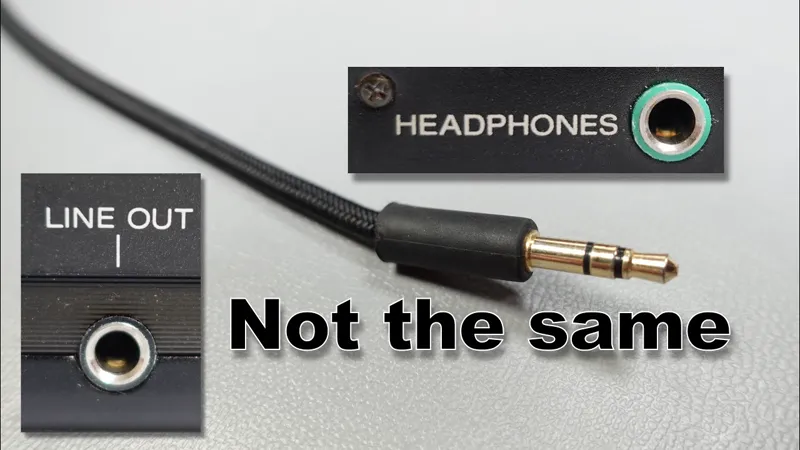
Line-out ≠ Headphone-out
I’m still slow in getting the next proper video closer to completion. It’ll likely take me another full week. So in the meantime here’s a simple rough-and-ready video intended to clear up some confusion that until last week I was unaware existed.
Here’s the link: https://youtu.be/4rLwqQE3DJA
I suppose things like this are a sight of getting old. Knowledge that was once commonplace gets lost as time moves on. I expect my predecessors would be surprised to learn that I didn’t know how to dig coal, prepare a pheasant, weave a blanket or load and fire a musket.
So just a little video today - I’ll get right back on making the next proper one after the weekend. The annoying thing is that if/when that is finally finished it’s not going to be noticeably different than anything else I've made, it’s just proved to be inordinately slow to assemble.
Anyway enjoy what’s left of your weekend, thanks for all your support and take care of yourself.
RE-EDIT
As there were a few comments on the first edit taking issue with the end, I’ve done a quick re-edit as I can see the way things would have gone otherwise.
Comments (47)
482k🧡 views so far... this topic must be quite controversial 🤔
It's weird - although a lot of it seems to be people arguing - people like arguing.
Great video, as always.. It's confusing since manufacturers, at a time, would often use a single socket for both phone & line out. As you said though, the Soundburger's lack of a volume control puts that decisively to rest. One thing I haven't ever seen before however - a device with combined on/off/volume control AND a USB port, even only for charging :-)
One of the YouTube commenters mentioned that PCs might be the cause of the confusion. I'll bet they're a big part of it. On most modern Windows desktops, the sound jacks are all labeled, but they'll magically reconfigure themselves if you hook them up wrong. I'm not sure if the labels even have any meaning.
One simple rule is that if a device doesn’t have a volume control then you’re not supposed to plug headphones into it.
I have a few, it's a cross between your snake oil formats and things like SACD, finding non PC hardware may be an issue tho
Would you ever have a look at HDCD? I know it's barely a "format" but would love to hear your take
I have got one somewhere - but I still need to try and get my head around the whole idea before I could hope to cover it.
The problem is that there is no standard for what counts as "line level" or "headphone level". You can have a phono pre-amp that puts out 150 millivolts (0.15 volts) and a CD player that puts out 2 volts, and yet both are called "line level". And headphone outputs have changed over the decades as the design of headphones has evolved. Early headphones were literally just a pair of tiny speakers strapped to your ears, so it was common for the headphone output on vintage equipment to tapped directly off of the amplifier's speaker outputs. Then the Walkman necessitated the development of higher-efficiency headphones to conserve battery life. So if you plug a pair of Walkman earphones into a vintage stereo receiver and forget to turn the volume down, it'll blow your ears off! But if you take a pair of vintage "cans" and plug them into a modern portable music player, they'll be disappointingly quiet even at maximum volume.
Thank you for this video. I honestly did not know the significance other than that they were different. As Grace said, "confuzzled". I also cheer the return of the cheese sandwich.
I didn’t hear you mention this in the video, but in the small section when you realize people often use them backwards (headphone jack as line out) when you say they can do so at a very low volume, we know you mean because a high output can conceivable damage whatever equipment you are plugging it into as even though a headphone jack is no where near as powerful as a full fledged speaker jack its still designed to drive speakers abet little tiny ones. Twenty years ago I learned the difference between line out and powered outs when I hooked two amps together without using the line out and ended up blowing one of them after awhile.
To be honest, I want to learn more about SCART and banana plugs. None of the equipment I have obtained is equipped with either. It's all RCA, or my speakers have to be attached by wire to poles or clippy thingies.
SCART would be a good subject as it seems to be as mysterious as MiniDisc to Americans. The 8 Bit Guy did complicated modifications to his Samsung TV to add RGB in. SCART, which gave you RGB in amongst other features was standard (by law) on every TV sold in France from around the same era.
A new challenge, should you choose to accept it. Explain the difference between Line Out and CD Out https://www.ebay.co.uk/itm/284827963343 I guess that this was from the days when CD was thought to be of such high quality the sound shouldn't be sullied by extra amplifiers etc. On that subject I have to add that the headphone out on my expensive Panasonic RX-E300 CD Radio Cassette was disappointingly noisy. That was why I bought a Discman.
They’re the same…unless anyone wants to correct me…which I’m more than open too.
A great instructional video, sir. You found more ways to say the same thing than I would have thought possible. Being as young as you and having this knowledge as well from my past, I too have had to correct others in the current day and age. The 3.5 MM plug and jack is extremely versatile, as you said - hence the confusion. Very well done.
Yay! The Cheese Sandwich is back!!
Great!!! Now do “phono” output.
PSA! Thanks.
Mat thanks for the clear explanation. Best wishes.
Oh, another topic to cover on this subject… the difference between -10db output on consumer audio devices and +4db on commercial stuff like mixers etc. can really trip people up (it did me)
I’ve yet to run into this issue - I guess it’s because I’ve never meddled with mixers etc.
Wow amazing how many people got it completely wrong. Headphones / line outputs are interchangeable with limitations, but you’re suffering quality , and volume control
and I only used a selection of the similar comments - I had many more that were too wordy to include.
There is another audiophile reason not to use the line out jacks for headphones. The line out usually presents a relatively high impedance which combined with headphones whose impedance varies with frequency (very common) will lead to unpredictable frequency response. IOW, if the headphones have resonance modes at certain frequencies, the line out will not be able to absorb the extra energy and sound quality will suffer.
Not just an “audiophile” thing. You may get very obviously tinny sound, not just quiet sound. (Depends on the design of both the output circuit and the headphones.) I think that would be worth mentioning in the video because people may think “if I try it and the volume is okay for me, then it works for me and I don't need anything else”. Of course, if people don't mind the tinny sound then that's fine, but they might not _know_ it's not supposed to sound like that.
It's synchronicity, I tell ya... albeit of a sort Sting and Co. are unlikely to reference. Just yesterday (Friday) the wife asked me to take a look at her portable DVD players because her headphones weren't working with it. I took said device into my office and plugged my cheap and cheerful Sony headphone and I instantly had sound. Asked the Mrs. for her headphones...sure enough it was a USB connection and not a traditional headphone jack. It is a variety of headphone that has a lot of volume and fidelity features that are necessary for conducting business over Zoom. I ended up giving her a pair of my spare Sony's and went looking for an adapter. But not finding one I realized that it was. a bit daft to think data made to go through a USB connection would be able to be delivered through a bog-standard jack that was never made for teh job.
Quite a few people suggested the USB-C on the Sound Burger could be used for headphones ‘well it works on my phone’… 😟
Well, thats been educational. Thank you Mat for going to the trouble to explain an issue that popped up that i personally didnt correctly understand. You explained everything in a easy to understand, none condescending,none patronising way and i very much appreciate this. Patreon payment well desered as always.
Thanks, I learned something new! For whatever reason I always thought the headphone jack just limited the volume, and that line out was the original (always louder) source . This makes more sense.
I'm old like you :-) But i'm sorry Matt .... although you can use the headphone out as line out, its not a good idea for a permanent solution. The impedance of the source and load is all wrong. Generally for good audio quality you are looking to always match impedance of devices connected in the chain. Also headphone amplifiers in many cheap battery products are not very good quality and its easy to overload the input of the device its connected too - so the sound is compromised. Its a last resort .......... I think i learnt this when i was 10 and had a horrible mono portable cassette recorder which i connected the headphone out to my fathers fancy Pioneer amplifier to dismal results !
The instructions of the Anabas GP-N3R https://youtu.be/UfplCMbD2Bo instruct the user how to make the headphone output into a line-out by lowering the volume output to about half way.
That's a good, clear, concise explanation of line-out vs. headphone out. FiiO makes good little amps. I have one I bought several years ago that is meant purely for use with a computer. The only "line-in" on it is a USB-C connection (it came with a USB to USB-C cable), and is powered from the computer. Works really well with a laptop for listening to music, since line/headphone out on laptops tend to be noisy. The audio sounds much better with it.
I disguised it well (at least I think I did) but while shooting this I discovered the headphone jack on my Fiio was knackered. I had to hold the plug down at an odd angle to get the audio to come through. Today I opened it up and re-soldered the socket, but I can see that this would be a point of failure as it’s very weak and not at all reinforced and I know it will fail again soon. I suspect this is one reason why this particular product disappeared - I wouldn’t be surprised if they all failed. Bit of a rookie error in my opinion.
Glad that you made this video. I've always been a little confused on this topic, but this clears it up. Now I'm wondering if something like those large, over-the-ear headphones that you've shown here would require greater amplification than ear buds do. I did just now test this by plugging an old set of Koss headphones into an IPod (using a 6.35mm to 3.5mm adapter) and they worked fine, but it sure seems that larger headphones would require more power.
It depends on the impedance and the efficiency of the drivers: having a matching input and output impedance yields the most power, so in theory the loudest sound. That does not necessarily correspond to the size of the headphones...
Teach us you did, ™Master https://ibb.co/zPXx3M1 I admit to being vaguely confuzzled about this issue, too - because all of the products I have used (until recently) did not include 'line outs.' This sandwich was delicious, thank you.
For what it's worth, I used to use the line out of a VCR in the 1990s to hear NICAM stereo on headphones. Doing so required a trip to Tandy for the 3.5mm to 3.5mm coupler, RCA/phono lead, and volume control box, but it worked just fine on my Panasonic headphone. Now looking back, I surmise that either that headphone had high sensitivity, or the VCR's line level was above spec, or both...
I don't understand some people. Why make a declarative statement that the line output is a headphone output when you have no idea? Asking the question is understandable and a good thing and helps learning - just making up an answer or just lying is pointless.
I suppose I mention lying because, otherwise, they're saying Matt's either ignorant or lying by making the comment. I see a lot of comments of this type and I don't understand how somebody can, effectively, call somebody ignorant without actually bothering to look into it so the assumption I make is that they know their comment is wrong but choose to post it anyhow.
I had my mind blown a little bit because one detail present didn't work the way I thought it did: I thought the line level was louder than headphones.. I can't tell how I formed that opinion when your test shows line level being quieter... I can't tell if that's just because not being able to control the volume was enough of a detriment that I wrote it off ages ago. Now I don't know how dynamic range works with amplifiers since you'd think phono out being quieter than line level and needing to be boosted means there's a limit to the granularity of audio levels when it goes through a phono preamp then an amplifier for speakers..
I thought line level was higher too. I have my portable Minidisc headphone socket connected to the MD input on my Sony TA-S2 amp, and I need the MD player volume at 80% to get the same volume that Line Out gives on another MD player. Maybe I'm just confused too. Edit. Watching the video when it went public confirmed that I was confused. I understand now.
Would be interesting to see a video comparing some headphone amplifiers as 5 minutes ago I had never even known that they existed! Thanks for the in depth look into this line vs headphone as it was, once again, very informative on something that I never knew of!
Here's some headphone tube amp videos Mat did a while back: https://youtu.be/22kx0q5j-JA https://youtu.be/2Zt5WPdyPTw
There's a coincidence. This notification came in as I was connecting my Optical, line in and line out (front & rear) on my PC.
I've seen this conflation get particularly bad with cheap "USB DACs". They're actually combo DAC+headphone amps, and the 3.5mm jack on the front is definitely amped. But they also have RCA jacks on the back, and you'd expect those to be line level, right? Unaffected by any physical volume knob the device might have? Well, sometimes, sometimes not! Gets even worse if the device has a physical volume knob but also accepts volume commands over USB. Will those RCA jacks have a constant output, or be affected by the USB-controlled level, or by the physical knob, or both? You'll just have to experiment and find out, because it definitely won't be documented anywhere.
"... why would this product exist?" *shows merch advert