
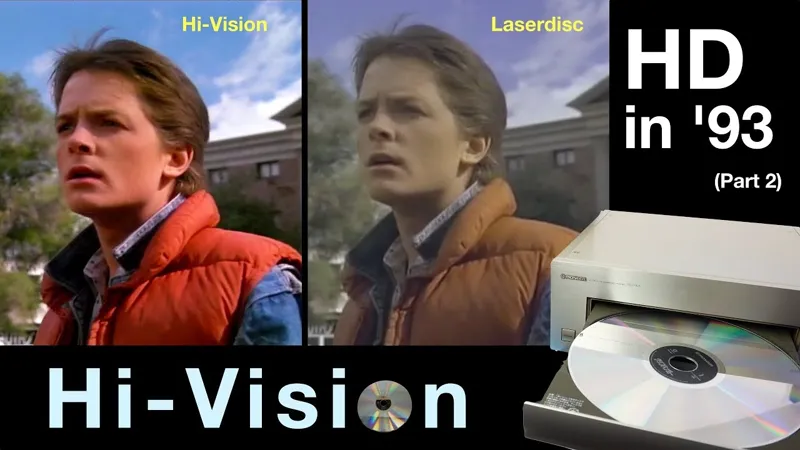
HD-LD Part 2
As promised, here is the conclusion of the MUSE LD video in which you finally get to see what those wealthy Japanese home cinema enthusiasts saw in the early to mid-90s. I hope you like it.
There was quite a bit more that I planned to include in this video, but unfortunately the player stopped working before I got the chance.
For example, I own one of the rare 'Squeeze' anamorphic LDs of Cliffhanger, so it would have been especially interesting to compare that disc against the Hi-Vision one as the Squeeze LDs were the best a 16:9 on LD could look.
However despite my plans being cut short, I'm relieved that the machine did function just long enough for me to capture the footage to do a proper side-by side demonstration of Hi-Vision vs standard LD.
My repair chap will be taking another look at my faulty machine in a couple of weeks. So fingers-crossed there might be a part three to this one at some point in which I get to complete those tests...but please don't hold your breath.
UPDATE: I see that most of the comments so far are about the broken machine. All I'd say is 'Please don't worry about it', because on the positive side we got to see a demonstration of HD Videodiscs from a quarter of a century ago.
That's what I'd rather take away from this experience. A couple of weeks ago this was something I'd never seen working, but now I have.
I only had to mention that the machine stopped working to explain why some demonstrations weren't in the video. If i'd managed to get those done just before it died, I'd never have mentioned its demise..that's all just behind the scenes stuff.
Comments (61)
Really enjoyed these two videos. The prices on those movies are outrageous though.
I'm glad you got this to work at all. I grew up around laserdiscs and read a lot about the fabled HD laserdiscs from japan over the years. So cool to finally see them in action - and they do look gorgeous, even accounting for all the issues with MUSE. Thank you for putting this together, this is some 17 years worth of curiosity sated.
This two parter was pretty amazing. Its sad it died but as Indy would say "It belongs in a museum!"
Nice video Matt. The part where you wanted to hook up the player to your CRT broadcast monitor triggered a question: I've looked at some of these monitors (maybe not broadcast but it could have been surveillance now I think of it) but I was a bit overwhelmed of all the connectors on the back (I know composite/svideo/component). Do you have any pointers, or maybe are you planning an epode about "the best CRT's" like you did with cassette players. I'm looking for a screen for an old home computer with component video, but my current CRT (a Sony KV-21X4D) doesn't support component. Looking for something else.
IWe all have ludicrous follies of ideas, but you're the only one who follows them up in such detail. FAscinating
I've been curious to see what Hi-Vision discs looked like since I first heard about them nearly 20 years ago. Thanks so much for this!
It's the ludicrous follies of ideas I come here for. Another great video. :)
I wonder if Mr. Carlson’s Lab would be interested in repairing it... maybe a crossover opportunity?
What an interesting format - thanks for making this video and I hope you get a few more Patreon subs out of it so you can get it fixed. The entire part of needing a separate decoder, in particular the part about converting the audio to digital coax, I've never heard of that before and I thought I was fairly well versed on this. Great job once again.
Thank goodness you managed to capture what you did! There's often a wonderful bit of storytelling shape to Techmoan videos through which the viewer hopes more and more that you'll get the thing to work ... and you do!
Putting this together reminded me a little bit of Bruce Lee’s Game of Death. They had the finale..but they had to work around the fact that the star died before they could film all the other stuff.
Coincidentally, I rarely if ever loan items to anyone as I've had bad experiences in the past. I'm a pretty good judge of character and you come over as scrupulous and careful. Perhaps we'll 'do' coffee sometime if I'm ever in your neck of the woods or vice versa..
I'm on the other side of the Irish Sea, I do have a few things you might want to borrow to Review - Stellavox SP8 R2R recorder, Nagra SNST, Nagra E, loads of other goodies including vintage hifi, plus who knows what that I've forgotten about.. Did you ever think of having a 'meet' like Big Clive does?
That’s an impressive list. The SNST is something I’d like to feature one day...but would never want to spend the money on. I also never like to borrow anything from anyone. It’s just one of those principles you pick up over the course of your life, somethings you don’t do, some you do. As far as meet-ups go, I’m not really good with meeting people any more - it just stresses me out. I’m much better off just working away on my own. I’m just not an interesting person in person.
Great video Matt, informative, entertaining and well presented as always.. Given the level of engineering in your your HD-LD player (just look at the thickness of those side cheeks!!) I would say it's definitely worth repairing. I spent years fault-finding domestic and industrial video equipment at the component level and wouldn't be surprised if the issue isn't a power-supply fault - it's always the first thing to check. And that could theoretically be the simplest to remedy since it's less likely to use exotic, unobtainable ASICs (custom chips). Contact me if you're stuck as I still have full workshop facilities.. Gordon
Thanks for the offer. Shipping this anywhere isn’t really feasible. I’ll see what my repair guy says though.
Thanks again for a great video.
You’re more than welcome.
Well Matt, you didn't disappoint! It was really interesting to see the comparisons to Blu-Ray and standard LD, I for one was impressed by the quality of the MUSE LD when compared to Blu-Ray and LD. Although not as crisp and smooth as we have become accustomed to today, impressive for the day. Its a pity the format itself priced itself outside the reach of almost all homes, I imagine the uptake would of been far higher had the price been closer to LD.
I was involved in the HD mastering process for Back to the Future on BluRay. We did go back and scan the film for that one (and touched up digitally). Before that, the latest HD master we had was from... I believe 2002 or so (and who knows if it's just a 2002 dupe of an even older master), on D5. And from what I can remember, it looked pretty darn close to the HiVision, because I think it was from the old-style video telecine instead of a film scanner. So I wonder if the limiting factor here is the MUSE compression, or the available mastering technology of the time!
That’s interesting to hear. A lot of the softness I think could be attributed to the telecine process. I suspect a perfectly mastered Hi-Vision disc could look a lot better. From what I read in the reviews Cliffhanger was considered a good example. I wish I’d done my capturing on that now.
I think I know why the standard Laserdiscs all look so washed out. Japanese NTSC format runs 10 IRE hotter than American NTSC, so everything that comes out of a Japanese analog NTSC signal is going to look about 10% brighter than it should, if you're using equipment expecting an American signal. (This caused some problems for Western publishers of Japanese media back in the day.) Luckily with the advent of digital this problem mostly went away, but only after the industry switched to Digital Betacam and SDI interconnects, which wasn't until the early 2000s. I must say, I'm quite fascinated by this format, based on what you've displayed here. It looks a little bit worse than the actual Hi-Vision masters I've seen (converted to modern formats). There were quite a few chroma artifacts, presumably from the MUSE compression, that I've never seen before: watch Laura Dern's face change color as it passes the car roof at 8:36 for an example of this. (That ain't a YouTube/h.264 thing!) The luminance echo (the ringing effect around the Japanese subtitles) is an analog thing too, and is also quite a bit worse here than I've seen before from Hi-Vision masters, but that could be from almost anything in the production pipeline, so I'm reluctant to blame that on the LD format. Very big thanks for this episode, learned a lot!
I run my 704 (which has an identical remote to your X9) through a iDVDO processor, and I don't get that washed out look in any LD...there are other artifacts but not washed out. (depending on if it is an extended play LD or not)
Well done :-)
The muse artefacts are always an issue bar a few discs. But the BD of BTTF is covered in DNR so I would rather watch the muse there
What is DNR?
1] I knew (and was one of the) people who bought the higher end of a given format or formats, after the format had peaked (Turntables, Cassette Decks, Laserdisc players). I have heard you recommend this as well. 2] When people were putting CD players in their car, I put in nice cassette decks. It basically made my stereo theft-proof. 3] For 3-4 years I even had 40” Mitsubishi CRT TV, while I waited for the dust to settle on flat screen TVs. It was awesome. 4] I also bought 40% of my records and CDs out of sync with the general public, and about 90% of my movies out of sync, so when people were dumping their record collections for CDs I increased wildly my buying of albums. When people were dumping their CD collection for vinyl or iTunes, I kept buying CDs, and even increased my pace of purchase. The last two years, as people have been dumping their blu-rays (and less quotidian DVDs), I have been scarfing them up. I was more of a music fan, always saw the transient nature of tape, only rented VHS, and never valued cassette beyond its utility. I also never wanted to spend a ton on home theatre, so I was lucky enough to be able to choose the much better experience of actually being at good theatres. 5] Now I get to buy all the movies I enjoyed seeing at the theatre, and for a fraction of the ticket price. Coming to a point, a comment in the HD-LD part 1 video led me to go soup to nuts (mostly review but some learning) into a review about resolution, aspect ratio, TV and film media (35mm goes through the photo camera horizontally and is a much bigger negative, equivalent to 4k-16k, but goes through the movie camera vertically, making a movie on film about the equivalent of 2k). How the original film 4:3 aspect ratio (standard at the time of television’s creation) was also the television aspect ratio, then there were TV resolutions and the VGA monitor connection, interlacing, fact that DVDs are SD and not HD. You covered some of this in the current part 2 video, and the upshot of what I learned outside of your excellent presentation is how much I should be appreciating blu-ray, which is good because I have been buying them by the dozen.
Same here with PC stuff, the second to last generation tend to be still great but vastly cheaper. And almost all the bugs have been ironed out. ;)
A most excellent ludicrously expensive folly of an idea, Mat. You do it so we don't have to! :-)
Great video, but can you upload the opening and ending from the laserdiscs for archival purposes?
I don't know what happens at the end - I expect they just stop. The only opening I got to record is the one you see in the video - two of the discs I have come with this same intro and the other disc doesn't have an intro.
I definitely feel that the analog mastering techniques used in the 80s and 90s for both laserdisc and VHS are vastly inferior to what we have today, which explains a lot of the difference in quality. For example, I wouldn't be surprised if even a modern DVD release of Back to the Future looks almost as good as the HiVision version simply from the better mastering technique, even if the resolution is somewhat less. This is especially true if the DVD player is used with S-Video or HDMI, because as you mentioned, regular laserdiscs (obviously not the hivision) are encoded as composite video and thus will always suffer from the image artifacts associated with that.
Seeing a comparison of Hi-Vision vs DVD would be interesting: maybe more comparable with one another. I remember the first DVDs could have variable picture quality from the scan/encoding (mastering) methods....there were also discs that weren't anamorphically encoded (and would then have less resolution when I upgraded to HDTV). Apart from mastering techniques, there were also interlacing artifacts with Hi-Vision (apparently up to 50% less resolution for camera pans). At least DVD was progressive and had full Dolby Digital/DTS. With the lower interlaced resolution, and limited surround format: Hi-Vision doesn't really compare with Blu-ray (which apart from 1080p, lossless audio is another great feature for home cinema). I suspect Blu-ray will also hold up better with the newest 4K standards being popularized.
I loved these two videos and being able to see this forgotten format, but I’d say don’t waste any more money fixing it for a video. Maybe cut your losses and sell it on eBay.
I see what my guy says, but I'm not throwing any more money at this. I don't even get the chance to watch that many movies...and Laserdisc just never looks good on my 65" TV.
Does the muse decoder convert the muse signal to 1080i in some way? That’s the only way I could see it being compatible with a modern HDTV.
I wish I knew. The output resolution was one thing that I intended to look at.
Absolutely fascinating as always, thank you for doing stuff like this. I've always been curious about this format and they best I could find on YouTube was the Panasonic preroll you showed. Just had a look at W-VHS and oddly enough it accepts component inputs, so I'm not sure what use the decoder would be with it. Japan were lightyears ahead of us; it's fascinating to see what could be achieved with analog technology. The BBC did trial HD video during the '92 Olympics using D2MAC encoding I believe, again another (mostly) analog format.
Yes I really didn't know whether to call this analog HD - because it seems like there's a lot of digital technology required to make it happen. I suppose it's an analog carrier of a partially digital signal (or something). In the end I just steered clear of trying to define it as I'm sure whatever I said would have ended up being wrong in some way. Even after spending a long time reading up on MUSE I just couldn't really get my head around it.
You can use a Playstation 3 to play a Blu-ray over component. That way you could do comparisons between formats with the same carrying signal, but I'm not sure if that would be a good comparison though...
Agreed: a tip of the hat to Zemeckis and Spielberg!
Your experience with -- as you put it -- overly complex 1990s technology is echoed in the world of photography, where features we take for granted today on digital cameras and smartphones -- such as autofocus and full auto exposure control -- were provided in 1990s cameras via jam-packed circuit boards, stuffed into several small compartments inside camera bodies. And these being film cameras, there are also tiny motors to advance and rewind the film. With very few exceptions -- Nikon's high end film SLRs, for example -- when one of these little gems fails, its next destination should be the recycle bin rather than the repair bench. The advances in IC design and manufacture over the past 20 years have been nothing short of spectacular -- your recent comparison of holiday photos made with your iPhone vs a Fuji standalone digital camera sure proved that point. Oh and by the way, Matt, this Saturday night's entertainment at our house will be watching Back To The Future ... !
Putting this together also made me want to watch it again too. Normally things like that can put me off something if I see it too many times. However notice in those side by side comparisons how the 'Ask Mr Foster" travel agent is there in 1955 and again in 1985. It's the attention to detail like that that really makes the film.
Fascinating, and I think you're dead right about the transfer quality of BTTF being less than perfect, I'm sure Hi-Vision could do a bit better than that if the disc was optimal.
That's often a problem with all these things, especially when it comes to audio. Whether a SACD is better than a CD more often than not comes down to the master recording used rather than the limitations of the format.
I am hugely impressed with your sync'ed side-by-side video comparison. I know little about video capture and editing, but I suspect this is quite difficult to pull off. Kudos!
It's easier than you think to get it almost perfect - getting it frame accurate takes a bit more fiddling.
Nice serie of videos. I’m sorry thqt ur player is broker, at least you were able to film The video I hope one day you can pick up another player
That was such a pleasure to watch! So sorry about the machine. A quiet LD player would have made a nice addition to your cabinet. But hey, at least you've got yet another BTTF on a weird format. That alone was probably worth all of it. Upping my donation right now.
There's no need to up your donation - I'm just glad you're here.
Get it repaired for sure, then sell it.
That's if it can be repaired. It is quite possibly the most complicated consumer electronics device ever made. Assembled by the best technicians in Japan. - and I'm relying on one bloke in Bolton with a soldering iron.
That's a lot of cash for something that is not reliable at all! Could it be a laser mechanism instead of some electronic failure? Maybe a quick clean is all that's required... Great information though. Love these obscure and mostly forgotten formats that few people knew existed...
Unfortunately that's often the way it goes with this 90s stuff - the electronics became so complicated at this point and then you have to consider that these things are 25 years old. They probably only expected them to last just past the warranty period. There are so many things that could be wrong with it, I'm not opening it up again. I'll take it to my chap next time I see him. But if he can't fix it - then that's it for this machine.
Impressive how Japan was able to a create commercial hd quality video format so early, too bad the player and discs came with such a high cost and demanded for that time a really expensive hd TV in order to be considered a successful product!
The cost probably would have come down eventually had the system gained more of a footing (much like digital HDTV, which was also initially extremely expensive, though perhaps not as much as muse). Digital just proved far superior and supplanted it before that could happen.
It is a shame there is not an engineering menu that would give you more idea of what the error is, then it would give you an idea of the complexity of the repair. So disappointing for you, very interesting however. Maybe get the air duster in and around the laser module to see if it is something silly like a spec of dust on the optical module and I assume it is direct drive and not a belt ... 🤔
P5 seems to be everything related to 'can't read a disc' since that's pretty much all you want the machine to do, it's a very broad error code.
That was quick.
Aw... such a bummer when things die out on you. And especially at that price! Great infotainment value though! :D
I have had an LD player since 96 and now have 3, and I still want to get into muse.