
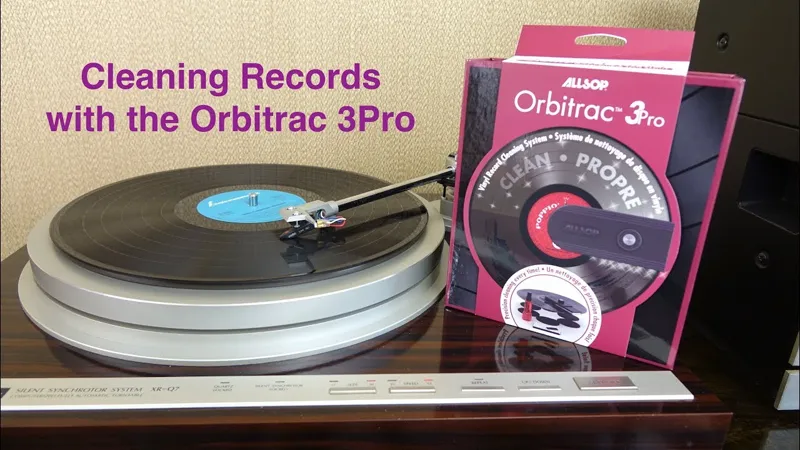
Quick Vid: Record Cleaning Tool
This is a short video about a record cleaning tool I was sent from Allsop. I turn down countless requests to try out all manner of odd gadgets from apps to hoverboards, but I needed a record cleaner and I"d been asked about this subject so I thought why the heck not.
Now as far as buying one…well the official website seems a little bit confusing for people outside the US, so if I were you I’d wait until they are on Amazon in a few weeks. The price at $60 seems a bit steep for what you get, but apparently this was a device that was raved about in its day so there should be people who are glad to see that it’s returned to the market.
There will be another ‘special’ video posted tomorrow that will only be available here on patreon and embedded on my website. It’s one of the talking to camera monologue ones to mark a special occasion.
Comments (25)
I've been using Orbitrac for about 3 months now (mid Nov 17 to mid Feb 18). Overall, I am quite impressed that it does reduce audible pops and crackles very well, especially from the lead-in areas before the music starts. I mainly use it on records I have owned since new, so as I am reasonably careful not to touch the playing surfaces, the only thing Orbitrac needs to remove is dust that settles during playing. I don't use it every time, just when there is still crackling audible after brushing with a carbon fibre brush. After a few uses, I noticed that the Orbitrac pad leaves a line of accumulated dirt on the record surface - clearly brushing the pad with the supplied brush doesn't completely remove the dust that collects on the pad. Although the complete Orbitrac kit can be obtained from Amazon in the UK, replacement pads and fluid are not available here, which is a shame. I have tried washing the pads in clean water and will see if that does the trick. I had assumed that a pair of pads would last as long as the bottle of cleaning fluid, but I have only used about a third of the bottle. The manufacturer's web site states that they will not supply replacement pads or fluid outside of the US, but even in the US, a pair of pads is $20. There are some on eBay at £20, which is a lot of money for what they are. Overall then, Orbitrac is good at what it does, but at quite a hefty price (£60 for a complete kit) and replacement consumables are not (yet) available in the UK. I know that there are other wet cleaning systems available that are similarly effective and at a lower price.
The only reason I reviewed this one rather than one of the others is because it was sent to me by the manufacturers. I don't have any great loyalty to it beyond that. It does seem expensive for what it is. Before I got this, I bought myself a big bottle of Clear Groove and a cloth - I suspect it will work just as well. <a href="http://amzn.to/2o0Zm8q" rel="nofollow noopener" target="_blank">http://amzn.to/2o0Zm8q</a> The Amazon reviews for this product are positive. So unless you prefer a more mechanical solution, this may be a more economical option.
Cool shirt! I recall all kinds of devices for cleaning disks from the vinyl heyday, and now I'm digging out my old vinyl again I may venture this way. You've reminded me of the Zerostat, a sort of gun that was meant to fire electron to remove static. Not sure if it worked, but it looked cool. And it still exists! <a href="https://www.amazon.co.uk/Milty-Zerostat-3-Anti-Static-Gun/dp/B0033SHDSS" rel="nofollow noopener" target="_blank">https://www.amazon.co.uk/Milty-Zerostat-3-Anti-Static-Gun/dp/B0033SHDSS</a>
I've got one too...and I'm not entirely convinced of the benefits.
I was quite surprised no one jumped in with wood glue - but then I went on youtube.......
I'm a person who really likes to be pleasantly surprised, especially when I'm watching a movie when there's a twist that I wasn't expecting. Unfortunately though I seem to have a knack of always predicting the way things are going to turn out - it took me about 15 mins into the Sixth Sense before I figured out what was going on and that pretty much ruined the film. Anyway the reason I mention this is because I can almost always predict what the most frequently posted comments will be under a video. In an attempt to avoid being right, I try to pre-empt the most likely comments, so in this one I posted the first comment about the wood glue method yesterday and pinned it to the top of the comments. It was approximately the 5th comment today where someone suggested using wood glue to clean a record...and then it's continued ever since, we're probably up to 20 comments on this now. This is kind of disappointing because it means that these people don't read the comments, they just post them and expect that other people will be reading their comments. If this sounds familiar, I did do an outro sketch about this issue some time ago.
Hi and greetings from Germany. I was born in 1980 and I grew up in my father's DIY loudspeaker shop in the 80s. I've been fascinated by audio technology for as long as I can remember. Which is why I'm enjoying these videos a lot! I am a bit alarmed by the cleaning method shown in this video. This thing seems to be causing a lot of friction on the record and dust can actually be quite abrasive. Imagine there's a harder and somewhat larger piece of dust or or other particle on the record surface. You are going to grind that into the groove *hard*, basically creating a nasty scratch that runs *along* the groove. A little spray probably can't prevent that. My normal "workflow" when playing LPs is this: Run a carbon brush over the spinning record to get rid of static charge and superficial dust. I then play the record with an Analogis Clean (like the old LencoClean) wet cleaning system. I do know that this is controversial as well. I am convinced it sounds cleaner, keeps the record clean and reduces stylus/vinyl wear, though (I can elaborate if desired). What I don't like about the Analogis Clean that much is the difficulty of adjusting proper liquid flow (a thin film on the part of the record where the stylus is, not a dry surface or a flood). I can second the recommendation of the "Knosti" / DiscoAntistat device. It is somewhat crude but costs only a fraction of what an "automatic" washing machine with a built in vacuum device costs. I've bought the older version for € 43,- two weeks ago and it seems to be doing a very good job with records that have dirt embedded deep in the groove where the wet playing arm can't reach it. Also, it is *quiet* - you can use it while listening to music! If anybody is *really* interested in it, I could try to make a before/after recording. Maybe these two devices might be an interesting thing to review: Analogis Clean: <a href="http://www.analogis.eu/6101_en.html" rel="nofollow noopener" target="_blank">http://www.analogis.eu/6101_en.html</a> Knosti: <a href="https://www.knosti.de/shop/en/vinyl/9/disco-antistat-generation-ii-record-cleaning-unit-new" rel="nofollow noopener" target="_blank">https://www.knosti.de/shop/en/vinyl/9/disco-antistat-generation-ii-record-cleaning-unit-new</a> (this is the new generation that is a little more expensive but has some improvements, like the crank for example) Speaking of new records: Yes, they are sometimes filthy! The vinyl debris thing is probably true and I also read that new records are sometimes stored in the open for quite a while before being packaged. There's another thing and that's a bit of a pet peeve for me: Plain paper inner sleeves! These are bad for at least two reasons. a) They are slightly abrasive and b) they usually contain paper debris from production *and* they cause static charge on the record which is usually so strong the record crackles when you take it out and the paper bits *really* stick to it. Considering the price of records these days, I'd like all records to come with foil-lined antistatic inner sleeves but most of them don't. I replace all paper sleeves with quality sleeves and just keep the original ones if they have print on them. Sorry for the fairly long post, but I like to provide a little detail :-) Kind regards, Stephan
I'm a serial hobbiest, so I have lots of different things that I'm moderately interested in, but I don't concentrate on any one thing intensely. So when it comes to records I'm just some chap who plays them, but I don't get too into the care and maintenance aspects, because I've got a dozen other things that can take up my time instead. Thanks for sharing this information and I hope it is useful to some people here, however I doubt I'll be trying lots of different cleaning techniques, for me this one video has been enough on the subject, unless it becomes a massive hit and then I might make a sequel.
Great demonstration and funny puppet skit! I may actually buy one of these. Now, here's something to add to your request list (it will probably go as far to the bottom as it possibly can): a similar cleaning demo for CEDs, including recoating the discs with new silicone lubricant, to try to stop some of that mad skipping. Those of us who are actually silly enough to collect and use the things will appreciate it, but it'll probably be one of those high-effort, low-return endeavors. Oh, and I don't expect someone to send you a free cleaning kit for that. And no need to humor me with, "Your request is important to me blah blah blah." I know what I'm asking and how inane it is. ;-)
I heard that cleaning CEDs just wasn't possible....but someone else will have to have a go at this one as I gave all my equipment and discs away to a viewer immediately after making the video.
Many thanks for this post. I remember Allsop from the 1970s. There are better cleaning / lubrication fluid systems on the market, but they are hideously expensive and also require the use of a vacuum to remove the liquids and collected dirt. .... I get pretty good results on LPs using Dawn dish detergent (known for its grease-cutting ability) under running hot water. I put a glob of Dawn on both bare hands, and rotate the disk while pressing lightly down. I'm careful to clean only parallel to the grooves. The disks get pat-dried on a cotton bath towel. Most of the time, the results are satisfactory. On certain vinyl formulas, however, the Dawn / water solution leaves a bit of audible residue. I play the disk at the highest rpm my Technics direct-drive turntable is capable of, and after one pass completely around each side, even that residue is gone, and the surfaces are quiet. The Poor Man's Allsop, I guess ... !
Thanks Mat. Top tip! I did that on my phone and then was able to get it on the YouTube Fire TV app by viewing my history. P.S. Tried to reply inline to your comment but it wouldn't let me.
Glad it worked... the inline replies on Patreon take a bit of getting used to. For some reason sometimes you have to click on the first comment in the thread (rather than the bottom one) to be able to respond to the thread.
I really enjoyed the before and after sound quality, its very exciting when things work out in good favor. keep it up! also great product!
New Patreon backer here. Is there a way I can watch the Patreon only videos on the YouTube app on my Amazon Fire TV?
Hmmm.... I suppose you could click through to YouTube on the video here on Patreon (click the video title at the top of the frame after pressing play) using a device like a phone/tablet/computer and then add it to your Watch Later playlist..then on the Fire TV you should be able to access the video through your playlists.
I'm surprised it worked as well as it did. I use a two-step process with a Spin Clean followed by a Nitty Gritty record doctor from 20 years ago. Both cleaning solutions are a bit of a home brew, but mostly alcohol. I have a bunch of CD-4 albums and they are notoriously difficult to clean. The wet-vac approach is the only thing that works (for me) but this did reasonably well. I'd be afraid that in certain instances, you might be pressing small particles further into the grooves. Still, good review as always!
Now you just need one of those expensive vacuum record cleaning machine companies to comp you one of their £1000 machines, so you can compare results between it and a bit of elbow grease. :)
They probably wouldn't like the findings.
Of course, old records will just tend to have some pops and scratches, which to me is part of the charm. If I wanted flawless fidelity, I'd get a digital remastered FLAC whatever. Vinyl is more than just the audio. There's the whole tactile experience to it.
I think I had something like this back in the 1980's... same manufacturer. As well as a fancy wooden handled, red velvety pad thing which IIRC stored the fluid and an extra wipe in a storage slot inside the handle.
I used to use a Lenco Clean system with either water or a water/isopropyl mix. The brush moves along the tracks like the stylus does. I know some people don't like wet systems but it never seemed to affect my vinyl records. I quite like the idea of using latex hooped on, spread out, allowed to dry and then peeled off. Silicone (2 part moulding type) will work well too.
Decent item, nice to see a "classic" product get a new chance!
I've always heard to use silly-puddy and roll it around. Never tried it myself, of course. I also wonder if just pressurized water would be best, if there were a way to protect the paper label first.
The silly putty thing might work if it doesn't leave residue on the record. Actually there are products that are a little like that. There are "sticky rollers" that have a sticky rubber surface that you can run over the record in order to pick up dust. Apparently you can just clean them with water after use. Then there's also a product called "Discofilm" that works something like a mixture of the wood glue and putty ideas. You apply a rubber mass to the record, let it dry and then pull it off again, probably removing a lot of dirt in the process. I haven't used any of these methods yet, so I can't comment on their effectiveness. P.S.: I'm enjoying your channel a lot as well :-)