
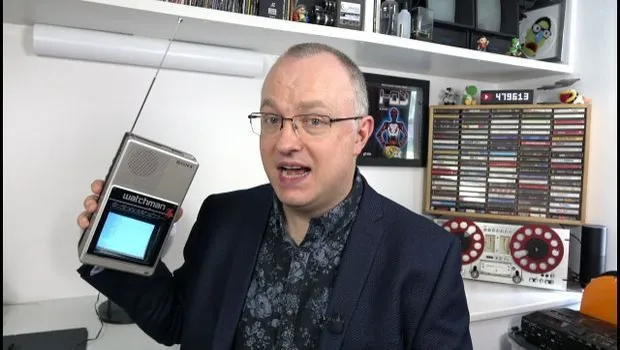
Whatever happened to pocket TVs?
Have you ever wondered why handheld TVs disappeared from the stores when the analog signals were switched off and why manufacturers like Sony and Casio didn't instead switch to making handheld digital televisions. If the answer is no, then I'm not surprised, most people are now happy using smartphones instead.
Hopefully though there are a few people out there who are intrigued enough to watch this video where I explain what happened as far as the UK is concerned. It's a tale of missed opportunities, and procrastination scuppering the chances to establish a new standard before an unprecedentedly disruptive technology emerged from the shadows and laid waste to everything in its path.
The second part of the video is a more conventional demonstration of one of the current crop of small and compromised digital TVs.
Comments (15)
My cousin had the TV tuner plug in for the SEGA GameGear. I was deeply jealous as my GameBoy couldn't let me sneakily watch 'The Word' under the bedclothes. However, I doubt the battery life made it to the first rude word!
Can't wait for the next puppet presentation, where we should be seeing Mrs Puppet receiving her new husband from Amazon Instant!
I was in the MPEG/DVB industry 15+ years ago, so I feel compelled to comment. DVB-H wasn't an enabler of mobile TV per se. It had aspirations of delivering a variety of media, and doing so in a time-sliced manner that was more friendly to mobile battery life. (Another gimmick was that data was formatted into IP packets, as this was perceived as being the future and somehow more easily integrated into handset software). It seems important to point out that DVB-T was already and still is viable for mobile use. Note: if the device was genuinely mobile (as in actively moving), it was essential that the transmitters employed the 8k FFT mode. (At least DVB-T *could* be used for mobile; the US standard ATSC has some fundamental limitations that largely thwart this.) Personally, I would argue that what killed mobile TV is simply a lack of interest by manufacturers, the YouTube-generation of consumers interested in watching what they want when they want, and cellular carriers that are happy to sell the data plans to make that personalized video watching happen; I wouldn't judge things by a poorly engineered Chinese receiver.
I'm glad you could share your expertise in this area...as with everything I'm just a tinkering amateur. Unfortunately I'd have loved to test out the latest Sony DVB-T handheld TV, but as they don't make them, I'm just left demonstrating what is available. I'd expect my issues with reception would be the same if I took my LG OLED into the garden and attached a handheld aerial to if. I agree that apathy and an alternative technology killed handheld TV, that was really what the first section video was about. I was showing that we missed out on a technology due to a slow start, followed by public indifference (it was only briefly tested in one of the UKs smaller cities) and then I went on to show that even in countries where it was adopted, it's pretty much been killed off by smartphones.
We now wait for a dedicated YouTube device with built in 4G.
Just noticed the video's upload date was June 19th. So there's currently an another episode sitting in your YouTube account, being converted and stuff? :)
Due to summer holidays I've been attempting to get myself two weeks ahead.
Like it. Bring on the puppets!
I'm curious what it was about DVB-H that made it more usable for handhelds.. Was it a higher wavelength that works better with small antennas? Or was it just a different encoding format for the video stream that made the error correction better?
According to Wikipedia the data stream was sliced by short time increments to make it less power intensive to process, along with some other portability-minded features.
Japan had a very popular standard called 1seg (so called because it used 1 of 16 segments of their digital broadcast standard) that was part of a huge number of cell phones as far back as the early 2000s. Unfortunately most people tried to use them on trains, and the signal didn't work well if you were in motion. Japan now uses mostly the same smartphones as the rest of the world, but the wacky Japan-only flip phones from that era were very advanced, albeit in a way that didn't really work for anyone outside of the country. Those unique cell phones (now known as "gara-kei", or "Galapagos Keitai") could be quite fun to explore in future videos.
1seg is still available on modern Japan-model smartphones. E.g. both the the Galaxy S8+ and Sony Xperia XZ Premium support it (albeit you need to plug the supplied antenna cable into the headphone port - no more built-in pull-out antennas)
Sadly IPTV over G3/G4 is highly impractical, traffic cost in Germany are an arm. a leg, your eternal soul and your firstborn on mobile. So for on the go i rather download stuff to my phone, like Youtube, and watch them "offline".
about 30seconds in, you say turned off the digital signal instead of analogue on another note, i have 3 pocket tv's with a converter from scart/composite to UHF :O) great fun wasting an afternoon making that work
I'll have to leave that faux pas in now....its too problematic to re-edit. I'll add a correction in the video description as soon as I get the opportunity.